June 16, 2026
The Four Industrial Revolutions and What They Mean for the Ground Beneath Our Feet
Every major leap in industrial capability has eventually reshaped how humanity extracts the raw materials that power civilisation. The first industrial revolution mechanised physical labour using steam. The second harnessed electricity and enabled mass production. The third introduced computing, automation, and programmable logic into manufacturing floors. Each transition arrived not as a gentle evolution but as a structural rupture, rendering previous competitive advantages obsolete while creating entirely new ones.
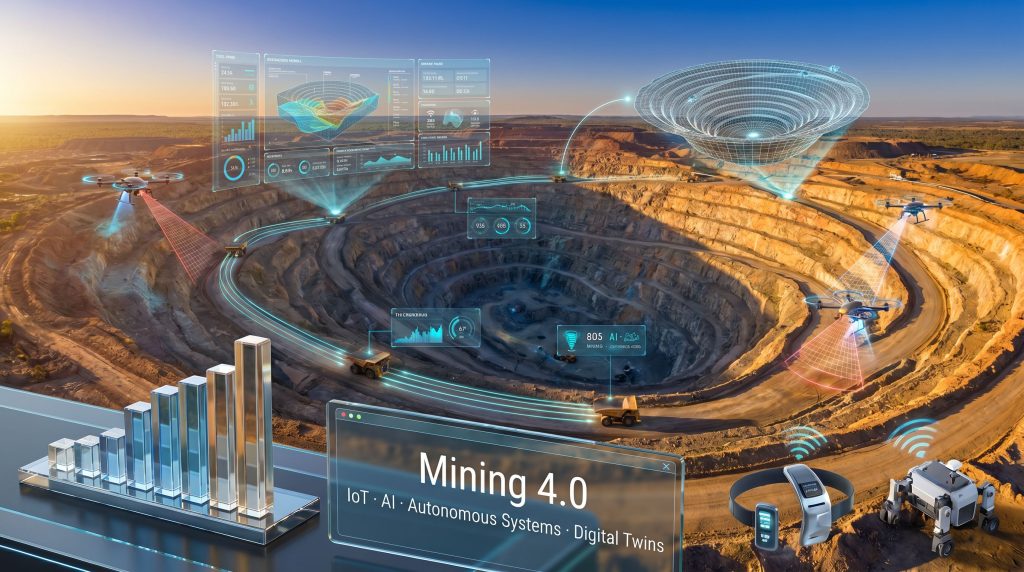
The fourth industrial revolution follows this same disruptive logic, but its reach into extractive industries is more consequential than any previous transition. Mining 4.0 in the mining industry is not simply a technology refresh. It is a convergence of the digital, physical, and biological domains into a single, interconnected operational system. Sensors embedded in rock faces, artificial intelligence modelling ore bodies from orbital data, and autonomous trucks navigating open-cut pits without a human hand on the wheel are no longer proof-of-concept experiments. They are live, revenue-generating realities at major operations globally.
Understanding why this transformation is irreversible, and what it means for operators, investors, and the broader resources sector, requires moving beyond individual technology stories and examining the structural architecture of Mining 4.0 as a whole.
When big ASX news breaks, our subscribers know first
From Picks to Processors: The Historical Arc That Made Mining 4.0 Inevitable
Mining 1.0 was defined by pure physical extraction, human labour applied directly to rock. Mining 2.0 introduced mechanisation, explosives, and early heavy equipment. Mining 3.0 layered digital control systems, GPS-guided equipment, and computerised mine planning into operations that remained fundamentally human-supervised.
Each iteration improved productivity but preserved the same underlying architecture: humans making decisions, machines executing them. Mining 4.0 breaks this dependency. The defining characteristic of the current era is that machines increasingly make operational decisions in real time, guided by continuous data flows that no human team could process at equivalent speed or scale.
"The convergence of IoT, artificial intelligence, autonomous systems, and digital twins does not improve the old model. It replaces it with something structurally different."
This distinction matters enormously for competitive positioning. Operators who treat Mining 4.0 as a toolkit of bolt-on upgrades will find themselves perpetually outpaced by those who have redesigned their operational architecture from the ground up. Furthermore, automation transformed mining by establishing the foundational systems upon which this next era is now being built.
The Business Pressures Accelerating Digital Transformation in Mining
No technology adoption cycle occurs without commercial pressure. Several converging forces are making Mining 4.0 adoption not just attractive but structurally necessary for operators across the size spectrum.
Why the Economics of Ore Grade Depletion Are Forcing Innovation
Average mined ore grades have declined significantly across most major commodities over the past half-century. Copper head grades at many of the world's largest mines have dropped from above 2% to below 0.5% over several decades. Processing more material to recover the same amount of metal demands either lower operating costs per tonne or higher recovery efficiencies. Digital technologies directly address both variables.
The combination of AI-driven grade control and sensor-based ore sorting allows operators to identify and route low-grade material away from energy-intensive processing circuits in real time. This reduces reagent and energy costs while improving recovery from high-grade parcels. For deposits where the difference between profitable and marginal operation is measured in fractions of a percentage point of recovered metal, this capability is economically decisive.
The Operational and Financial Case in Numbers
| Business Objective | Mining 4.0 Mechanism | Reported Impact |
|---|---|---|
| Productivity | Autonomous haulage and drilling systems | Continuous 24/7 operations without shift rotations |
| Cost Reduction | Predictive maintenance via IoT and AI | Material reduction in unplanned equipment downtime |
| Worker Safety | Remote operations centres and wearable monitoring | Significant reduction in personnel exposure to high-risk zones |
| Sustainability | Real-time energy and resource optimisation | Lower energy intensity per tonne processed |
| Decision Quality | Digital twins and advanced analytics | Faster, data-verified operational and strategic decisions |
Additional pressures accelerating adoption include:
- Escalating labour costs and persistent workforce availability constraints in remote mining jurisdictions
- Tightening ESG compliance requirements from institutional investors demanding measurable environmental performance
- Commodity price volatility that punishes operators with rigid, high-cost structures
- Competitive pressure from early technology adopters whose cost curves are diverging from industry averages
The Seven Core Technology Pillars of Mining 4.0
IoT: Building a Real-Time Nervous System Across the Entire Mine
The Internet of Things functions as the sensory infrastructure of a Mining 4.0 operation. Thousands of sensors distributed across mobile equipment, fixed plant, ventilation systems, ground support structures, and tailings storage facilities generate continuous data streams. The operational intelligence derived from these streams enables a form of situational awareness that periodic manual inspection simply cannot replicate.
One of the most commercially impactful IoT applications is ventilation-on-demand in underground mines. Traditional underground ventilation operates at fixed capacity regardless of actual occupancy or activity levels. IoT-enabled ventilation-on-demand systems adjust airflow dynamically based on real-time sensor data on personnel location, equipment position, and gas concentrations. Industry implementations have demonstrated energy savings of 30% to 50% in ventilation costs at underground operations, which is particularly significant given that ventilation frequently accounts for the largest single share of underground energy consumption.
Edge computing plays a critical enabling role here. By processing data at or near the point of capture rather than routing it to distant cloud servers, edge architecture reduces the latency between data generation and operational response, which is essential in environments where equipment decisions must occur within seconds.
Artificial Intelligence and Machine Learning: From Data to Operational Intelligence
Raw sensor data has no value without analytical capability. AI and machine learning transform the continuous data flows generated by IoT infrastructure into actionable operational intelligence across multiple domains. In addition, AI in drilling and blasting has emerged as one of the most precise and commercially validated applications of this technology:
- Geological modelling: Machine learning algorithms trained on historical drill core data, geophysical surveys, and production records can identify spatial patterns in ore body geometry and grade distribution that conventional geostatistical methods miss
- Equipment health surveillance: Anomaly detection algorithms establish baseline operational signatures for individual machines and alert maintenance teams when real-time behaviour deviates from predicted norms, often days or weeks before a failure that would otherwise occur unexpectedly
- Natural language processing: Applied to maintenance logs and incident reports, NLP tools extract structured insight from years of unstructured text data, identifying recurring failure modes and contributing factors that manual review would never surface at scale
- Decision support: AI models augment, rather than replace, experienced mine planners by rapidly evaluating scenario options and surfacing trade-offs between production rate, cost, recovery, and risk
Autonomous Systems: The Productivity Engine of Mining 4.0
Autonomous haulage systems represent one of the most mature and commercially validated Mining 4.0 technologies. Self-navigating haul trucks integrate GPS positioning, LiDAR obstacle detection, radar, and proprietary route management software to operate continuously without driver fatigue constraints or shift change delays. The productivity advantage is not simply the removal of human error. It is the elimination of the biological ceiling on operational hours.
Autonomous drilling systems take this further by adjusting drilling parameters in real time based on geological feedback from the drill string itself, achieving more consistent hole geometry and reducing both bit wear and blasting inefficiencies. Robotic inspection platforms extend human reach into environments that would otherwise require costly shutdowns or place personnel in unacceptable risk conditions.
Digital Twins: Virtual Replicas With Real Operational Power
A digital twin is a continuously updated virtual representation of a physical asset or process, fed by live sensor data and calibrated against actual operational performance. Consequently, data-driven mining operations are increasingly anchored to digital twin infrastructure as a core decision-making tool. In mining, digital twins are applied across:
- Mine design and geotechnical modelling, where slope stability scenarios can be tested virtually before physical commitment
- Blast optimisation, where fragmentation models predict downstream crushing and grinding efficiency from different explosive configurations
- Processing plant simulation, where bottlenecks can be identified and resolved in a virtual environment before implementing changes that would disrupt live production
The data infrastructure required to maintain an accurate digital twin is substantial, but the return comes from the ability to test decisions at no operational cost before committing to them physically.
Predictive Maintenance: Shifting From Failure Response to Failure Prevention
The maintenance philosophy distinction is worth understanding precisely:
Reactive Maintenance: Equipment is repaired after it fails. This approach carries the highest total cost and creates the greatest production disruption.
Preventive Maintenance: Servicing occurs on fixed schedules regardless of actual asset condition. This is more controlled but wastes resources on equipment that does not yet need attention.
Predictive Maintenance (Mining 4.0): AI and IoT data continuously monitor asset health and forecast failure probability windows, enabling targeted intervention before breakdown occurs. This approach delivers the lowest lifecycle cost and the highest equipment availability.
Predictive maintenance in mining is, however, one of the highest-ROI digital transitions available to operators, particularly for high-value, long-lead-time components such as SAG mill liners, dragline components, and large diesel powertrains.
Remote Operations Centres: Redefining Where Mining Work Happens
Centralised remote operations centres allow experienced supervisors and operators to control geographically dispersed mining assets from facilities located in regional cities or even different countries. Beyond the obvious safety benefit of removing people from active pit environments, remote operations centres carry a less-discussed strategic advantage: talent attraction.
For decades, the mining industry has struggled to attract technology professionals willing to relocate to remote sites. Remote operations infrastructure allows mines to offer careers in modern, urban-based facilities while maintaining operational control of assets anywhere in the world. This fundamentally expands the talent pool available to the industry.
Blockchain for Ethical Supply Chain Transparency
Blockchain's role in Mining 4.0 addresses one of the sector's most persistent reputational challenges: the difficulty of verifying ethical sourcing claims for battery metals and other critical minerals. Immutable distributed ledger systems create an unalterable record of mineral provenance from the point of extraction through refining, processing, and delivery to end-users.
This has direct commercial relevance as due diligence legislation in the European Union and North America increasingly requires manufacturers to demonstrate responsible sourcing across their supply chains. For cobalt, lithium, rare earth elements, and other battery-critical minerals, blockchain-enabled traceability is transitioning from a voluntary differentiator to a market access requirement.
Mining 4.0 Across the Full Value Chain
Exploration and Resource Assessment
Advanced hyperspectral imaging, LiDAR terrain mapping, and AI-assisted target generation are compressing the timeline and cost of greenfield exploration. Satellite data integration now enables geological assessment of terrains that would previously have required expensive and logistically complex ground campaigns, particularly in high-altitude, arctic, or politically sensitive jurisdictions.
Extraction and Ore Processing
Real-time grade control systems use sensors mounted on excavators and conveyor belts to continuously measure ore quality, allowing selective routing of material that maximises mill feed grade while minimising dilution. Sensor-based ore sorting, applied ahead of crushing circuits, physically rejects waste rock before it enters energy-intensive downstream processing, reducing both energy consumption and reagent demand. Furthermore, renewable energy in mining is increasingly integrated into these processing circuits to reduce the overall carbon intensity of extraction.
Logistics and Material Flow
Fleet management systems coordinate autonomous and semi-autonomous vehicle networks using dynamic route optimisation algorithms that respond to real-time grade, traffic density, and fuel efficiency variables. The integration of mine-to-port logistics into a single connected operational picture is enabling a level of supply chain coherence that was structurally impossible under previous technology generations.
Environmental Monitoring and Compliance
Distributed sensor arrays continuously monitor air quality, water quality, groundwater levels, and ground movement across mine footprints. Automated regulatory reporting reduces compliance burden and human transcription error. Early warning systems for tailings facility stability represent perhaps the most safety-critical application in this domain, given the catastrophic human and environmental consequences of tailings failures recorded at multiple global operations over the past decade.
Mining 4.0 vs Mining 3.0: A Structural Comparison
| Dimension | Mining 3.0 | Mining 4.0 |
|---|---|---|
| Automation Level | Partial, task-specific | End-to-end autonomous systems |
| Data Utilisation | Historical and periodic reporting | Real-time analytics and predictive intelligence |
| Decision-Making | Experience-driven, human-led | Data-augmented, AI-assisted |
| Equipment Monitoring | Manual inspections and scheduled servicing | Continuous IoT-based condition monitoring |
| Worker Role | On-site physical operation | Remote supervision and digital systems management |
| Environmental Management | Periodic compliance reporting | Continuous real-time environmental surveillance |
| Supply Chain Visibility | Limited traceability | End-to-end blockchain-enabled provenance tracking |
The next major ASX story will hit our subscribers first
The Barriers That Are Slowing Full Adoption
Cybersecurity: The Expanding Attack Surface
As operational technology and information technology networks converge in Mining 4.0 environments, the cybersecurity risk profile of mining operations changes dramatically. Industrial control systems and SCADA platforms that once operated in isolation from external networks are now connected, creating vulnerabilities that threat actors can exploit to disrupt production, steal geological and financial data, or compromise safety systems.
Recommended frameworks for mining operators addressing this risk include the NIST Cybersecurity Framework and IEC 62443 for industrial control system security. The consequences of inadequate cybersecurity in a Mining 4.0 environment extend beyond data loss to include production disruption of autonomous fleets, manipulation of sensor data, and potential compromise of safety-critical systems such as tailings monitoring and underground gas detection.
Workforce Transformation and the Skills Gap
The shift from manual operation to digital supervision creates a workforce transition challenge that is often underestimated in technology adoption discussions. The competency profile required in a Mining 4.0 operation is substantially different from that of a Mining 3.0 environment:
- Data literacy is now a core operational skill, not a specialist function
- Remote systems supervision requires both technical fluency and situational awareness across geographically dispersed assets
- The emerging hybrid role of a professional who understands both geological fundamentals and data analytics is genuinely scarce in current labour markets
- Cultural resistance to automation among experienced operational workforces requires deliberate change management investment, not simply technology deployment
Capital Expenditure and ROI Uncertainty
For mid-tier and junior operators, the upfront capital requirements for comprehensive Mining 4.0 implementation represent a genuine access barrier. The challenge is compounded by the difficulty of quantifying ROI for foundational digital infrastructure. The value of a centralised data architecture or a cybersecurity upgrade does not appear on a production report in the way that a new haul truck does.
A phased adoption strategy that prioritises high-impact, modular interventions offers a practical pathway. IoT-based equipment monitoring, drone surveying, and predictive maintenance platforms can be deployed incrementally, generating demonstrable returns that build internal confidence and financial capacity for deeper transformation. For a broader perspective on how digitalisation shapes the sector, industry research continues to highlight the strategic importance of staged implementation.
Frequently Asked Questions About Mining 4.0
What is the simplest definition of Mining 4.0?
Mining 4.0 in the mining industry refers to the application of Industry 4.0 technologies — including IoT, AI, automation, digital twins, and advanced analytics — to mining operations, creating smarter, safer, and more sustainable extraction processes across the entire value chain.
Which technologies are most central to Mining 4.0?
The most operationally significant technologies are autonomous haulage systems, IoT-based predictive maintenance, AI-driven geological modelling, digital twins, remote operations centres, and blockchain-enabled supply chain traceability.
How does Mining 4.0 improve worker safety?
Autonomous vehicles, robotic inspection platforms, and remote operations centres physically remove workers from the most hazardous environments. Wearable monitoring systems and AI-powered hazard detection provide additional protection for personnel who remain on site.
Is Mining 4.0 accessible to smaller operators?
Yes, though the adoption pathway differs from that of major producers. Smaller operators can implement targeted, modular technologies such as IoT equipment monitoring or drone-based surveying before progressing to more complex autonomous systems as ROI is established.
How does Mining 4.0 support ESG commitments?
Real-time energy monitoring, optimised resource utilisation, continuous environmental surveillance, and blockchain-based supply chain transparency directly support the environmental and governance dimensions of ESG frameworks that institutional investors increasingly apply to resource sector allocation decisions.
Is Mining 5.0 Already Taking Shape Beyond the Current Horizon?
Within industry strategy discussions, a Mining 5.0 framing is emerging — one that positions technology not simply as a productivity tool but as an instrument of ecological restoration, community co-design, and human-centred operational philosophy. Greater emphasis on circular economy principles, net-zero operational targets, and adaptive self-optimising mine ecosystems characterises this evolving conversation. The evolution towards Mining 5.0 is, however, widely understood to depend on operators first mastering the foundational systems of the current era.
The critical caveat is that Mining 5.0 ambitions are only credible for operators who have mastered the foundational architecture of Mining 4.0 in the mining industry. The data infrastructure, autonomous systems, and AI capabilities that define the current era are the prerequisite, not the alternative, for whatever comes next.
Key Takeaway: Safety, productivity, cost efficiency, and sustainability are not competing priorities within a Mining 4.0 framework. They are mutually reinforcing outcomes of the same connected digital infrastructure, and operators who understand this will define the competitive landscape of the global resources sector for the decades ahead.
This article is intended for informational purposes only and does not constitute financial or investment advice. Statements regarding technology performance, operational outcomes, and market trends reflect industry reporting and published research. Readers should conduct independent due diligence before making any investment or operational decisions based on this content.
Want to Know Which ASX Mining Companies Are Adopting the Technologies Driving the Next Wave of Discoveries?
Discovery Alert's proprietary Discovery IQ model scans ASX announcements in real time, instantly identifying significant mineral discoveries and turning complex data into actionable investment insights — exactly the kind of edge that matters as Mining 4.0 reshapes the competitive landscape. Explore historic examples of what major discoveries have delivered for investors and begin your 14-day free trial at Discovery Alert to position yourself ahead of the market.