June 16, 2026
Africa's Aluminium Awakening: Why Industrial Capacity Is the New Frontier
Sub-Saharan Africa sits atop some of the world's most significant mineral wealth, yet the continent has historically exported raw materials at the bottom of the value chain, watching downstream profits accumulate elsewhere. For aluminium specifically, this dynamic has been particularly stark. Despite Africa hosting vast bauxite reserves, particularly in Guinea which ranks among the world's largest producers, primary aluminium smelting on the continent remains concentrated in just a handful of facilities. South Africa's Hillside smelter and Mozambique's Mozal plant have long dominated sub-Saharan output, leaving an enormous structural gap between the continent's resource endowment and its industrial processing capacity.
That calculus is beginning to shift. A convergence of sovereign economic reform agendas, Chinese industrial co-investment, and the global push for diversified aluminium supply chains is creating conditions that were not present a decade ago. The SINOMACH Angola aluminium project sits squarely at the intersection of these forces, and its implications extend well beyond a single construction contract.
When big ASX news breaks, our subscribers know first
Angola's Economic Transformation Agenda and the Case for Aluminium
Angola's dependence on petroleum has been a structural vulnerability for decades. Crude oil has historically accounted for the overwhelming majority of the country's export revenue and a dominant share of government fiscal income, leaving the economy acutely exposed to commodity price cycles. Under President João Lourenço, Angola has pursued a deliberate diversification strategy, targeting manufacturing, free trade zone development, and industrial processing as pathways to a more resilient economic base.
The Barra do Dande Free Trade Zone in Bengo Province represents one of the flagship expressions of this strategy. Designed to attract foreign direct investment into value-added production rather than raw material extraction, the zone offers a regulatory and fiscal framework intended to lower barriers for large-scale industrial entrants. Aluminium smelting is particularly well suited to this model because it functions as an industrial anchor, generating employment, catalysing ancillary manufacturing, and producing a commodity with deep global demand across construction, automotive, packaging, and energy transition demand applications.
Why Electrolytic Aluminium Smelting Is a High-Stakes Industrial Bet
Primary aluminium production through electrolysis, the Hall-Heroult process, is one of the most energy-intensive industrial operations in existence. Industry benchmarks place energy consumption at roughly 13,000 to 15,000 kilowatt-hours per tonne of aluminium produced, meaning that the viability of any smelter is fundamentally determined by access to affordable, reliable power. This single variable explains why the world's most competitive smelters are clustered near abundant hydroelectric or gas resources.
For Angola, hydroelectric infrastructure is the strategic answer. The Laúca dam and the under-construction Caculo Cabaça hydroelectric project on the Kwanza River represent Angola's long-term energy solution for industrial-scale power demand. However, grid reliability and the timeline for these capacity additions remain binding constraints that will directly influence the pace at which the Huatong Aluminium Industrial Park scales through its planned phases.
The Huatong Aluminium Industrial Park: A Five-Phase, Decade-Long Industrial Programme
The scale and ambition of the Huatong Aluminium Industrial Park demand careful unpacking. This is not a single-phase investment but a structured, multi-decade industrial build-out designed to transform Angola into a meaningful primary aluminium producer.
| Project Parameter | Detail |
|---|---|
| Project Name | Huatong Aluminium Industrial Park |
| Location | Barra do Dande Free Trade Zone, Bengo Province, Angola |
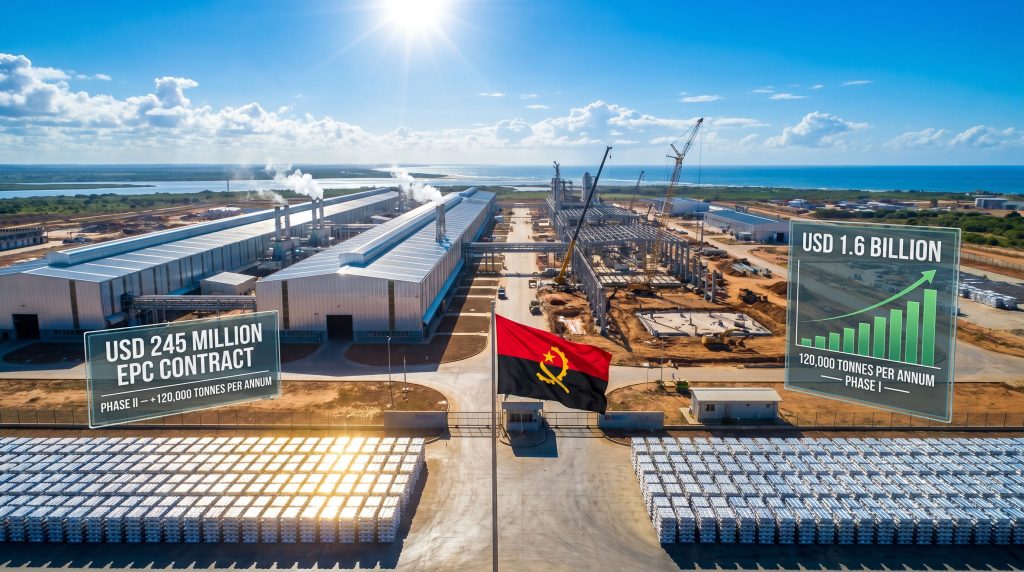
| Total Estimated Investment | USD 1.6 billion |
| Full Build-Out Timeline | 8 to 10 years across five phases |
| Phase I Capacity | 120,000 tonnes per annum |
| Phase I Investment | Approximately USD 250 million |
| Phase I Inauguration | January 19, 2026 |
| Phase II Capacity Addition | 120,000 tonnes per annum |
| Phase II EPC Contract Value | USD 245 million |
| Phase II Contract Signed | June 11, 2026 |
| Projected Jobs (Phase I) | Approximately 1,200 direct employees |
Phase I reached a significant milestone on January 19, 2026, when the first electrolytic production line of 120,000 tonnes per annum was formally inaugurated under the authority of President João Lourenço. The sovereign-level endorsement of the launch carries meaningful signal value: it indicates that the project enjoys political continuity at the highest level of the Angolan state, which matters considerably for a programme with a ten-year execution horizon.
The USD 245 Million Phase II EPC Contract: What It Covers
The Phase II contract, formalised on June 11, 2026 at the 17th International Infrastructure Investment and Construction Summit Forum and Exhibition, was signed by SINOMACH International Engineering (Jiangsu) Co., Ltd. and adds another 120,000 tonnes per annum of electrolytic aluminium capacity to the park. Furthermore, the USD 245 million EPC deal signals continued Chinese industrial commitment to the project's long-term execution horizon.
The EPC delivery model is worth understanding in detail, because it shapes how execution risk is distributed.
An Engineering, Procurement, and Construction contract consolidates full project delivery responsibility within a single contractor. The EPC entity manages design engineering, equipment and materials sourcing, physical construction, and final commissioning handover. For project owners in developing markets, this turnkey structure significantly reduces the coordination burden and transfers much of the execution risk to the contractor, making it the dominant model for large-scale industrial development in emerging economies.
Under this arrangement, SINOMACH International Jiangsu is responsible for the complete delivery chain, from design documentation through to operational readiness. This approach suits Angola's position: the sovereign capacity to manage a complex multi-contractor industrial build does not yet exist at scale, making an experienced EPC executor a practical necessity rather than merely a preference.
SINOMACH: Corporate Architecture and African Track Record
China National Machinery Industry Corporation, known as SINOMACH, is a central government state-owned enterprise and one of the largest industrial engineering conglomerates operating globally. Its competencies span EPC project delivery, industrial plant construction, infrastructure development, and overseas engineering contracts across Africa, Southeast Asia, and the Middle East.
SINOMACH International Engineering (Jiangsu) Co., Ltd. is the wholly owned subsidiary executing the Angola Phase II contract. The selection of a dedicated operating subsidiary rather than the parent entity directly is a common structural feature of large Chinese overseas engineering engagements, allowing for cleaner contractual liability and localised project management structures.
What distinguishes SINOMACH in competitive project tendering is its demonstrated capacity to execute mega-scale industrial projects in markets with developing infrastructure. The ability to manage alumina procurement logistics, equipment sourcing from Chinese industrial suppliers, and in-country construction management simultaneously is a capability set that few global EPC contractors can match at this price point.
The Huatong Wire and Cables Group: Vertical Integration as Strategic Logic
The Chinese industrial anchor investor behind the Huatong Aluminium Industrial Park is the Huatong Wire and Cables Group, and the vertical integration logic underpinning this investment is one of the project's most strategically interesting dimensions. In addition, the broader context of aluminium industry leaders pursuing integrated models globally lends further credibility to this approach.
The Huatong Wire and Cables Group is simultaneously developing both upstream electrolytic aluminium smelting capacity and downstream wire and cable manufacturing within the same free trade zone. This creates an integrated value chain in a single geographic footprint:
- Electrolytic aluminium produced at the smelter serves as the primary feedstock for wire and cable manufacturing
- Downstream conversion captures additional margin that would otherwise be lost to commodity aluminium sales
- Co-location within the Barra do Dande Free Trade Zone eliminates inter-facility logistics costs and customs friction
- The integrated model provides natural hedging against spot aluminium price volatility, since downstream margins can partially offset upstream commodity price pressure
This structure reflects a more sophisticated Chinese private-sector investment model than the resource-access arrangements that characterised earlier waves of Chinese engagement in Africa. Rather than extracting a commodity for processing back in China, Huatong is building productive industrial capacity in Angola with a commercially self-reinforcing logic.
Alumina Supply: The Feedstock Dependency Angola Cannot Ignore
One of the least-discussed structural vulnerabilities of the SINOMACH Angola aluminium project is Angola's complete absence of domestic alumina refining capacity. Electrolytic aluminium production requires refined alumina as its direct feedstock, typically consuming approximately two tonnes of alumina per tonne of aluminium produced. Angola has no bauxite processing or alumina refinery infrastructure, meaning the entire alumina requirement for the Huatong park must be imported.
This matters significantly from a cost structure perspective. Alumina typically represents 30 to 40 percent of total aluminium production costs, making supply chain reliability and price negotiation for this feedstock a first-order commercial concern. Understanding global bauxite production dynamics is consequently essential context for evaluating Angola's long-term supply chain options. The most likely sourcing pathways include:
- Guinea-derived bauxite processed through third-country refineries
- Australian alumina exporters, who supply a significant share of global seaborne alumina trade
- Chinese-controlled refinery networks, which would maintain supply chain continuity within the Huatong Group's broader industrial ecosystem
A strategically important question for the project's long-term economics is whether future phases of the Huatong park will incorporate upstream alumina refining capacity. If Angola were to attract a bauxite import and refining operation to complement the smelter, it would meaningfully reduce cost exposure and create additional industrial employment. This has not been announced, but it represents the logical extension of the vertical integration model already evident in the wire and cable manufacturing component.
The next major ASX story will hit our subscribers first
Risk Matrix: Assessing the Project's Structural Challenges
| Risk Category | Risk Level | Key Mitigation Factor |
|---|---|---|
| Political Stability | Moderate | Presidential-level endorsement and MPLA government continuity |
| Currency Risk (Kwanza volatility) | High | USD-denominated EPC contract and likely dollarised revenue structure |
| Power Supply Reliability | High | Proximity to Laúca and Caculo Cabaça hydroelectric infrastructure |
| Alumina Import Dependency | Moderate to High | Potential long-term supply agreements within Chinese alumina networks |
| Regulatory and Free Trade Zone Compliance | Low to Moderate | Bengo Province FTZ framework provides established investment protections |
The currency risk dimension deserves particular attention. Angola's kwanza has experienced significant volatility against major currencies, and a project with USD-denominated construction costs but potential local-currency revenue components faces real foreign exchange exposure. The EPC contract being denominated in US dollars provides insulation for the construction phase, but operational revenues will depend heavily on whether aluminium exports are priced and settled in hard currency, which is the more likely commercial structure for a project of this nature.
Angola's Position in the Sub-Saharan Aluminium Landscape
If the five-phase Huatong Aluminium Industrial Park reaches full build-out as planned, Angola's combined electrolytic aluminium production capacity would position it as one of the most significant primary aluminium producers in sub-Saharan Africa. Currently, South Africa's Hillside smelter operated by South32 and Mozambique's Mozal facility dominate the region's output.
Angola's entry into this space is timed against several macro tailwinds in global aluminium demand. Furthermore, the broader shift towards low-carbon metals pricing is reshaping how hydroelectric-powered output like Angola's is valued in international markets:
- Energy transition demand: Aluminium is a critical material in solar panel frames, electric vehicle components, and grid infrastructure, sectors experiencing structural demand growth
- European green procurement: The EU's Carbon Border Adjustment Mechanism is reshaping aluminium trade flows, creating demand for verifiably lower-carbon production
- Supply chain diversification: Buyers in Europe and Asia are actively seeking alternatives to Chinese-origin aluminium given trade policy uncertainty
Angola's hydroelectric-powered smelting model could, over time, position its aluminium output as a relatively low-carbon product compared to coal-powered alternatives. The adoption of renewable energy in mining and industrial processing more broadly is also accelerating this shift, creating a genuine commercial differentiator in markets where buyers are increasingly required to account for embodied carbon in purchased materials.
Frequently Asked Questions: SINOMACH Angola Aluminium Project
What is the value of the SINOMACH EPC contract for Phase II of the Angola aluminium project?
The Phase II EPC contract signed by SINOMACH International Engineering (Jiangsu) Co., Ltd. is valued at USD 245 million and covers full engineering, procurement, installation, and commissioning services for an additional 120,000 tonnes per annum of electrolytic aluminium capacity.
What is the total planned investment in the Huatong Aluminium Industrial Park?
The five-phase development carries a total projected investment of approximately USD 1.6 billion, with a completion horizon of eight to ten years from the Phase I inauguration in January 2026.
Where is the project located?
The project is situated within the Barra do Dande Free Trade Zone in Bengo Province, Angola, a designated industrial corridor established to attract foreign manufacturing and processing investment.
When did Phase I begin operations?
Phase I was officially inaugurated on January 19, 2026, under the authority of Angolan President João Lourenço, with initial production capacity of 120,000 tonnes per annum and approximately 1,200 direct jobs created.
Who are the primary entities involved?
The key parties are SINOMACH International Engineering (Jiangsu) Co., Ltd. as the EPC contractor and the Huatong Wire and Cables Group as the Chinese industrial anchor investor and project developer.
How does this project support Angola's economic diversification?
By establishing domestic aluminium smelting and downstream cable manufacturing capacity, Angola builds an industrial foundation that reduces structural reliance on crude oil revenues, generates skilled industrial employment, and creates the basis for a value-added metals export sector capable of competing in regional and international markets.
Key Milestones to Monitor as the Project Advances
For those tracking the SINOMACH Angola aluminium project over its multi-year execution horizon, the following indicators will be the most meaningful signals of project health and strategic trajectory:
- Phase II commissioning timeline: Whether SINOMACH delivers the expanded electrolytic line on schedule will establish the credibility of the project's subsequent phase planning
- Phase III announcement: The approval, financing structure, and contractor selection for Phase III will indicate whether the five-phase programme has genuine momentum or faces funding headwinds
- Power capacity additions: Progress on the Caculo Cabaça hydroelectric project is the binding energy constraint on full smelter utilisation across all phases
- Alumina supply agreements: Any public disclosure of long-term alumina procurement contracts will clarify the feedstock cost structure and supply chain resilience
- Phase I employment and local content reporting: Actual workforce numbers and Angolan content percentages from Phase I operations will serve as the benchmark against which Phase II obligations are measured
- Green aluminium positioning: Whether the project pursues international certification for low-carbon aluminium production will determine its ability to access premium-priced European and Japanese markets
The USD 245 million Phase II contract is a concrete and significant milestone, but it is best understood as one chapter in a decade-long industrial transformation programme. The structural logic of the Huatong Aluminium Industrial Park is sound: hydroelectric power potential, free trade zone incentives, vertical integration from smelting to cable manufacturing, and sovereign-level political commitment create a foundation that few comparable projects in sub-Saharan Africa can match. The execution risks around energy supply and alumina feedstock are real and material, but they are known quantities that competent project management can address with appropriate lead time and commercial structuring.
Angola's aluminium ambitions are no longer theoretical. Phase I is operational, Phase II is contracted, and the architecture for a sub-Saharan industrial heavyweight is taking shape in Bengo Province.
This article is intended for informational purposes only and does not constitute financial, investment, or legal advice. Projections regarding project timelines, production capacities, and economic outcomes are based on publicly available information and carry inherent uncertainty. Readers should conduct independent research before making any investment or business decisions related to the projects or entities discussed.
Want to Track the Next Major Mineral Discovery Before the Market Does?
Discovery Alert's proprietary Discovery IQ model delivers real-time alerts on significant ASX mineral discoveries, instantly turning complex mineral data into actionable investment insights for both short-term traders and long-term investors — explore historic examples of exceptional discovery returns to understand the opportunity, then begin your 14-day free trial at Discovery Alert to position yourself ahead of the broader market.