June 16, 2026
Steel's Hardest Decarbonisation Problem Just Got a Little Closer to Being Solved
Few industrial sectors carry as heavy a carbon burden as iron and steel. Unlike electricity grids, where the swap from fossil fuels to renewables is largely a question of infrastructure investment, steelmaking is entangled with chemistry itself. Blast furnaces do not merely burn coal for heat; they rely on carbon as a chemical reductant, stripping oxygen from iron ore through reactions that produce CO₂ as an unavoidable by-product. This is not an engineering inefficiency that can be optimised away. It is a fundamental feature of the dominant ironmaking process that has underpinned global industrial civilisation for over two centuries.
That structural reality explains why the LKAB fossil-free sponge iron plant permit, granted by Sweden's Land and Environmental Court, deserves attention well beyond the borders of Scandinavia. It represents one of the first regulatory green lights for hydrogen-based direct reduced iron (DRI) production at demonstration scale anywhere in Europe, and it advances a technology pathway that many consider the most credible route to genuinely fossil-free steel.
When big ASX news breaks, our subscribers know first
Why Steelmaking Is the Industrial Decarbonisation Problem Nobody Has Fully Solved
The scale of the challenge cannot be overstated. According to data from Global Efficiency Intelligence, the global iron and steel sector is responsible for approximately 11% of global CO₂ emissions and accounts for more than 8% of total greenhouse gas emissions, making it the single largest source of industrial carbon pollution on earth. To put that in perspective, the entire aviation industry, routinely targeted by climate campaigners, accounts for roughly 2-3% of global CO₂. Steel is a problem of a categorically different magnitude.
The difficulty is compounded by demand dynamics. Steel is not a niche product. It underpins construction, automotive manufacturing, shipbuilding, infrastructure, and energy systems. Global steel demand is projected to remain robust through mid-century, particularly as developing economies build out urban infrastructure. Decarbonising steel, furthermore, cannot mean producing less of it.
What has emerged as the most technically credible solution is the replacement of blast furnace technology with a two-step process:
-
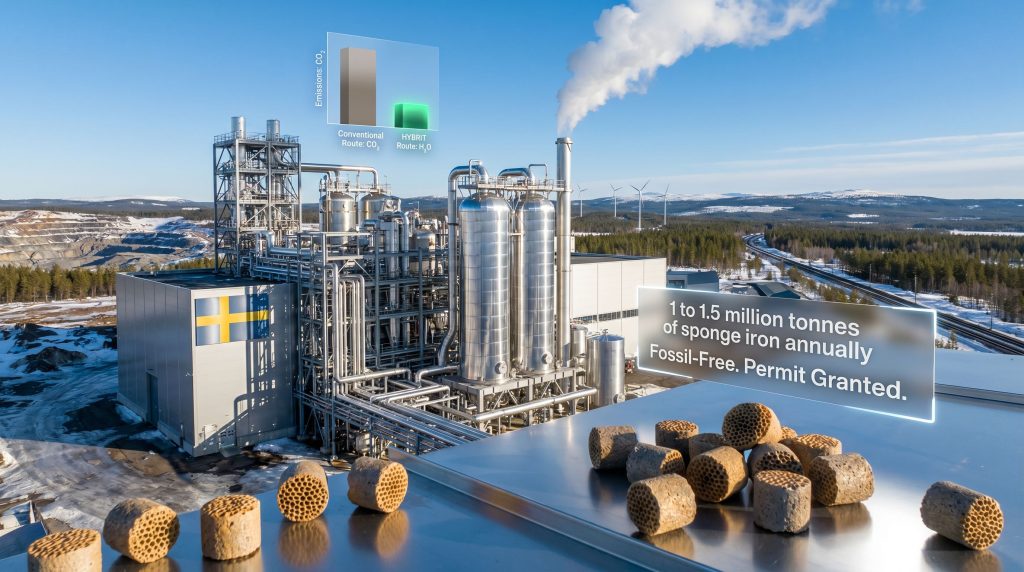
Direct reduction of iron ore using hydrogen gas rather than coke or natural gas, producing sponge iron (DRI) and water vapour instead of CO₂. Hydrogen iron ore reduction is increasingly recognised as the cornerstone of this approach.
-
Electric arc furnace (EAF) steelmaking, which melts the sponge iron using electricity, ideally sourced from renewables, to produce finished steel.
This is the pathway that the HYBRIT consortium, built around LKAB, SSAB, and Vattenfall, has been developing since its formation in 2016. The permit granted for the Gällivare demonstration facility marks the moment that pathway transitions from an engineered concept to an authorised industrial operation.
Understanding Sponge Iron: The Technical Intermediate at the Heart of Green Steel
The term sponge iron is descriptive. When iron ore pellets are exposed to a hot reducing gas at temperatures typically between 800°C and 1,100°C, the oxygen bound to the iron is chemically stripped away without melting the material. What remains is a porous, metallic iron product whose surface resembles a sponge at the microscopic level, hence the name.
In conventional DRI production, the reducing gas is typically a mixture of hydrogen and carbon monoxide derived from reformed natural gas. What HYBRIT introduces is the substitution of this gas with green hydrogen produced through electrolysis of water powered by renewable electricity. The implications for emissions are profound:
| Process Variable | Conventional DRI (Natural Gas) | HYBRIT H₂-DRI |
|---|---|---|
| Reducing Agent | H₂ + CO from reformed gas | Green hydrogen (H₂) |
| Primary By-Product | CO₂ | Water (H₂O) |
| Energy Source | Fossil-derived | Renewable electricity |
| Scope 1 Emissions | Moderate to high | Near-zero |
| Downstream Process | EAF or blast furnace | EAF only |
One aspect not widely appreciated outside specialist circles is that not all DRI is equivalent in terms of its suitability for electric arc furnace steelmaking. The iron content, degree of metallisation, and gangue mineral content all affect EAF performance and the quality of the final steel product. LKAB's high-grade iron ore pellets from northern Sweden, which have among the highest iron content of any commercially mined ore in the world, are particularly well-suited to DRI production.
This reduces the energy burden on the downstream EAF and improves the economics of the entire value chain. This is a material advantage that is often underweighted in discussions of green iron production competitiveness. The ore quality that LKAB brings to the HYBRIT joint venture is not merely a geological coincidence; it is a strategic asset that meaningfully reduces cost and energy intensity relative to projects relying on lower-grade feedstocks.
The HYBRIT Consortium: How Risk Is Distributed Across the Value Chain
One of the structural innovations of the HYBRIT model is its deliberate distribution of technical and financial risk across three established industrial operators, each with deep expertise in its segment of the value chain:
-
LKAB brings world-class iron ore mining capabilities, established pelletising technology, and the high-grade ore feedstock that underpins the DRI process.
-
SSAB contributes steelmaking expertise and, critically, existing customer relationships with automotive manufacturers and other downstream steel buyers who are under increasing pressure to reduce their Scope 3 emissions.
-
Vattenfall provides the renewable electricity backbone, without which green hydrogen production at scale is economically unviable.
This architecture contrasts sharply with many standalone green steel ventures that have struggled to secure both the energy supply and the downstream offtake agreements necessary to justify large capital commitments simultaneously. By vertically integrating from mine to mill across three partners, HYBRIT reduces the number of open variables any single entity must resolve before committing capital.
The project has also received financial backing from the EU's Innovation Fund, administered through the European Climate, Infrastructure and Environment Executive Agency (CINEA). This is not a trivial endorsement; Innovation Fund applications are assessed against rigorous criteria for greenhouse gas abatement potential, technical maturity, and commercial viability, and competition for funding is intense.
Financial support from the EU Innovation Fund via CINEA signals that independent technical assessors at the European level have evaluated the HYBRIT demonstration project and concluded that it represents a credible and commercially plausible pathway to industrial decarbonisation.
What the Environmental Permit Actually Authorises
The ruling from the Swedish Land and Environmental Court is broader in scope than coverage of the sponge iron facility alone. The permit encompasses several interconnected components across LKAB's northern Swedish operations:
-
Continued and expanded mining and processing activities at Malmberget, including measures designed to reduce air quality and water quality impacts on surrounding communities.
-
A new apatite processing facility designed to supply LKAB's planned industrial park in Luleå with apatite concentrate. Apatite is a phosphate-bearing mineral that serves as a primary source of phosphorus for fertilisers, and is increasingly relevant to European supply chain resilience discussions around critical minerals.
-
A demonstration plant for fossil-free sponge iron production in Gällivare, operating under LKAB's carbon-free processes framework within the HYBRIT structure, with a target output of approximately 1 to 1.5 million tonnes of sponge iron per year.
The inclusion of the apatite processing component is notable and often overlooked in coverage focused purely on the green steel narrative. LKAB's ore bodies contain mineralogical complexity beyond iron; apatite recovery represents a meaningful opportunity for by-product revenue and strategic relevance to Europe's critical minerals agenda, connecting LKAB's operations to fertiliser supply chains and potentially to battery material discussions as phosphate chemistry evolves.
LKAB's leadership has been direct about this diversification intent. The company's stated ambition involves gradually moving further up the value chain, shifting from raw pellet production toward processed intermediate products, whilst simultaneously expanding the range of critical minerals extracted from its ore bodies.
The Investment Decision That Still Needs to Be Made
The permit is a prerequisite, not a commitment. As Reuters has reported, a final investment decision for the HYBRIT demonstration plant remains pending as of mid-2026. The permit ruling will inform that decision, but it does not make it. This distinction matters for anyone tracking the timeline of green steelmaking technology commercialisation in Europe.
The current milestone status across key workstreams can be summarised as follows:
| Milestone | Status (June 2026) |
|---|---|
| Environmental Permit, Gällivare / Malmberget | Granted |
| EU Innovation Fund Support (CINEA) | Confirmed |
| Final Investment Decision, Demonstration Plant | Pending |
| Full-Scale Production, Kiruna Operations | Subject to grid capacity and additional permitting |
| Commercial Green Steel Supply to Market | Timeline under assessment |
The gap between permit and investment decision reflects the broader challenge facing capital-intensive green industrial projects: the cost of green hydrogen remains elevated relative to natural gas-based alternatives, and the premium that downstream steel buyers are willing to pay for verified low-carbon steel is still being established through commercial negotiation rather than settled market pricing.
The next major ASX story will hit our subscribers first
Infrastructure Bottlenecks: The Constraints That Permits Cannot Resolve
Regulatory approval clears one category of barrier. It does not, however, resolve the infrastructure challenges that will ultimately determine the pace at which LKAB can scale fossil-free sponge iron production.
Three constraints stand out as particularly significant:
Green hydrogen supply at scale. Producing 1 to 1.5 million tonnes of sponge iron annually through hydrogen-based direct reduction requires an enormous and continuous supply of green hydrogen. Generating that hydrogen through electrolysis demands substantial renewable electricity capacity. Northern Sweden benefits from a relatively clean grid anchored by hydropower, but transmission infrastructure to serve large new industrial loads in remote locations faces known bottlenecks that cannot be resolved on short timescales.
The Iron Ore Line (Malmbanan) capacity constraint. LKAB's Gällivare and Kiruna operations are connected to the Norwegian port of Narvik via the Malmbanan rail corridor, one of the heaviest-trafficked freight lines in Scandinavia. Increased production volumes, particularly of processed sponge iron rather than raw pellets, will alter the weight and volume characteristics of freight flows, requiring careful capacity planning and potentially national-level infrastructure investment in both Sweden and Norway.
The Kiruna expansion puzzle. The Gällivare permit does not extend to LKAB's Kiruna operations, which represent the larger of the two production centres. Expansion at Kiruna involves separate permitting processes, additional grid connection requirements, and a more complex interaction with local land use considerations. The Gällivare demonstration plant's performance will be a critical input to any future Kiruna expansion decision. Indeed, LKAB previously postponed fossil-free sponge iron production at its Arctic Kiruna site, underscoring how consequential this new permit is for the broader programme.
Green Steel Competition: Where HYBRIT Sits Among Global Initiatives
HYBRIT does not operate in isolation. A cohort of hydrogen-DRI and alternative ironmaking projects are advancing in parallel across Europe and North America, each with distinct technology choices, capital structures, and timelines. Consequently, the global steel and iron ore market is watching these developments closely.
| Initiative | Location | Technology Route | Current Status |
|---|---|---|---|
| HYBRIT (LKAB / SSAB / Vattenfall) | Sweden | H₂-DRI + EAF | Permit granted; investment decision pending |
| H2 Green Steel | Sweden | H₂-DRI + EAF | Commercial scale development underway |
| Salzgitter SALCOS | Germany | H₂-DRI stepwise transition | Pilot phase, scaling toward industrial |
| ArcelorMittal Sestao | Spain | H₂-DRI + EAF | Advancing toward commercial scale |
| Boston Metal | USA | Molten oxide electrolysis | Early-stage pilot |
What distinguishes HYBRIT within this competitive landscape is the combination of ore quality, renewable energy access, and the institutional depth of its three founding partners. H2 Green Steel, also based in Sweden, is arguably the most direct comparator in terms of geography and technology, but is structured as a standalone greenfield investment rather than a consortium leveraging existing industrial assets.
Policy Context: How EU Frameworks Shape Demand for Fossil-Free Sponge Iron
Several EU regulatory and policy mechanisms are creating structural demand signals for low-carbon steel, even if none of them directly designate the HYBRIT project as a recipient of government support:
-
The EU Emissions Trading System (EU ETS) continues to raise the carbon price faced by conventional steelmakers, gradually eroding the cost advantage of blast furnace production relative to hydrogen-DRI routes.
-
The proposed Industrial Accelerator Act includes provisions encouraging automakers and other downstream manufacturers to incorporate low-carbon steel into procurement frameworks, creating potential offtake demand for products like HYBRIT sponge iron.
-
Corporate Scope 3 emissions reporting requirements under the EU's Corporate Sustainability Reporting Directive (CSRD) are increasing the scrutiny that automakers, construction firms, and equipment manufacturers face regarding the embedded carbon in their supply chains. Verified low-carbon steel inputs represent a meaningful lever for these companies.
The commercial case for green steel is not purely altruistic. As Scope 3 accountability tightens across the EU, the ability to source verified fossil-free sponge iron will shift from a reputational asset to a procurement necessity for large industrial buyers.
What a Successful Demonstration Would Mean for Global Iron Production
If the Gällivare facility reaches its production targets following a confirmed investment decision, the implications extend well beyond Sweden. The LKAB fossil-free sponge iron plant permit, in this context, would be remembered as the moment a replicable industrial template was formally authorised. Furthermore, efforts in green iron production elsewhere in the world would benefit from the knowledge and commercial frameworks established here.
Several dynamics would likely follow a successful demonstration:
-
Technology licensing and knowledge transfer opportunities for SSAB and LKAB in markets where blast furnace operators are seeking transition pathways.
-
Green premium pricing for fossil-free sponge iron becoming more formally established through commercial contracts, providing a clearer financial signal for replication projects.
-
Accelerated investment decisions at other DRI sites globally, as the risk profile of the technology is de-risked by demonstrated large-scale operation.
-
Competitive pressure on conventional integrated steelmakers in Europe, particularly those facing rising ETS carbon costs without a credible transition plan.
The road from a 1 to 1.5 million tonne per year demonstration facility to the wholesale replacement of European blast furnace steelmaking capacity remains extraordinarily long and capital-intensive. However, demonstration-scale proof points are precisely how industrial transitions have historically progressed, from small-scale validation to commercial replication to sector-wide adoption over periods measured in decades rather than years.
The LKAB fossil-free sponge iron plant permit does not guarantee that outcome. What it does is remove one of the most significant barriers standing between ambition and industrial reality, and in a sector where concrete progress has been scarce, that deserves recognition as a substantive milestone.
This article contains forward-looking assessments based on publicly available information as of June 2026. Final investment decisions, production timelines, and commercial outcomes are subject to change. This content does not constitute investment advice.
Want to Track the Next Wave of Critical Mineral Discoveries Powering Green Industrial Transitions?
Discovery Alert's proprietary Discovery IQ model delivers real-time alerts on significant ASX mineral discoveries — including the iron ore, critical minerals, and energy metals central to green steel and industrial decarbonisation — ensuring subscribers can identify actionable opportunities ahead of the broader market. Explore Discovery Alert's discoveries page to understand how historic mineral discoveries have generated substantial returns, and begin a 14-day free trial to position yourself at the forefront of the next major find.