June 16, 2026
The Quiet Transformation Happening Beneath Australia's Mining Industry
Underground mining services rarely attract the same headlines as commodity price swings or major discovery announcements. Yet the contracts being won and alliances being renewed at depth tell a more nuanced story about where Australia's mining sector is heading. The steady accumulation of technically complex, multi-year underground engagements by specialist contractors signals a structural shift, and mining's transformation is playing out in real time.
As surface deposits become harder to find and easier projects get developed first, the industry is increasingly drilling deeper, requiring a different class of contractor altogether. This dynamic is evident across Victoria, Tasmania, and Queensland, where Thiess wins underground contracts alongside its specialist business PYBAR, confirming a cluster of new awards and a significant alliance extension that together paint a compelling picture of underground mining's growing strategic weight.
When big ASX news breaks, our subscribers know first
How Thiess Wins Underground Contracts Across a Deliberately Diverse Commodity Mix
Gold, Antimony, Polymetallics, and Coal: Building a Portfolio That Weathers Cycles
One of the least-discussed but most important risk management tools available to a mining services contractor is commodity diversification. When gold prices soften, thermal coal may strengthen. When coking coal faces headwinds, critical minerals can compensate. Thiess and PYBAR appear to have constructed their current contract portfolio with precisely this logic in mind.
The recent wave of activity spans five distinct commodity streams across three Australian states and territories, creating a natural hedge against single-market exposure.
| Commodity | Project | State/Region |
|---|---|---|
| Gold-Antimony | Sunday Creek | Victoria |
| Gold | Fosterville | Victoria |
| Polymetallics (Zinc, Lead, Silver) | Rosebery | Tasmania |
| Thermal Coal | Lake Vermont, Mount Pleasant | Queensland |
| Coking Coal | Olive Downs Complex | Queensland |
This breadth is not accidental. Thiess Group Chair and CEO Michael Wright has noted that the Rosebery, Sunday Creek, and Fosterville contracts are actively expanding the group's portfolio and commodity mix. Furthermore, PYBAR is increasingly being positioned as the contractor of choice for complex, high-value underground projects central to Australia's economic and energy future.
Why Underground Services Are Becoming a Core Growth Engine
The economics of underground mining are fundamentally different from open-cut operations. Underground projects require significantly higher capital intensity per tonne mined, far more specialised labour, and far greater technical precision in development planning. For contractors, this translates into longer contract tenures, deeper client relationships, and higher barriers to competitor entry.
As Australia's most accessible open-cut deposits are progressively exhausted or face greater community and environmental scrutiny, the pipeline of underground projects is expanding. This is being further amplified by the critical minerals demand curve, with many battery and defence-relevant minerals found in structurally complex underground ore bodies that require specialist development expertise. Consequently, Australia's critical minerals sector is fast becoming one of the most significant growth drivers for underground mining services firms.
Breaking Down the New Contract Wins: Project by Project
Sunday Creek: A$30 Million Exploration Decline at a Gold-Antimony Project
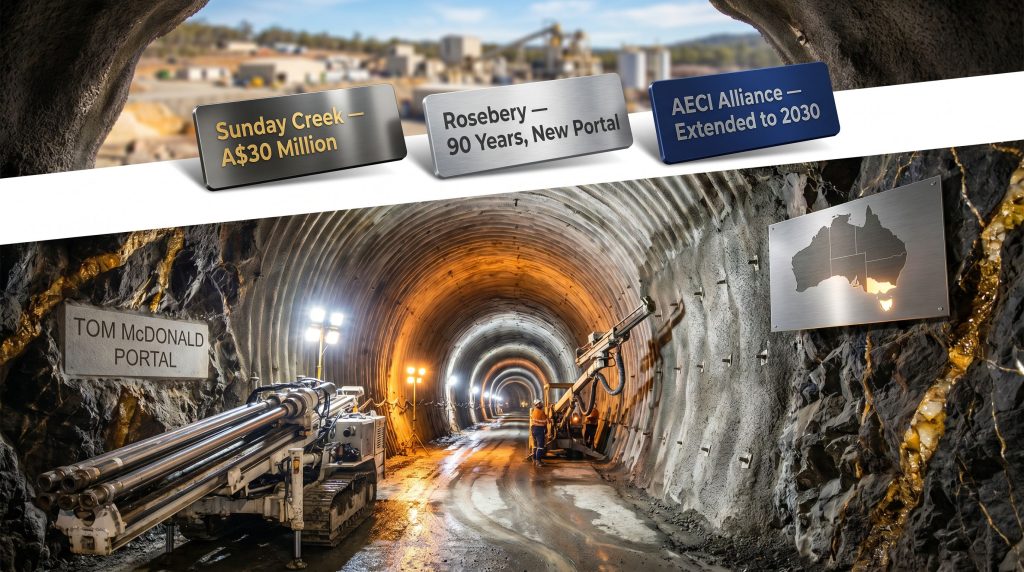
The engagement by Southern Cross Gold Consolidated of PYBAR to develop an approximately A$30 million exploration decline at the Sunday Creek project in Victoria is notable on multiple levels.
| Project Detail | Data Point |
|---|---|
| Client | Southern Cross Gold Consolidated |
| Scope | Exploration decline development |
| Estimated Value | A$30 million |
| Location | Victoria, Australia |
| Commodity Focus | Gold-Antimony |
The dual-commodity nature of Sunday Creek deserves particular attention. Antimony is a metalloid with significant and growing strategic importance — understanding antimony as a critical mineral helps explain why this project carries commodity profile characteristics that go well beyond what the headline gold price might suggest.
In addition, antimony shortage risks are intensifying globally, as China currently dominates production, controlling approximately 48% of global output according to the US Geological Survey. This has created pronounced supply chain anxiety among Western nations, making a domestic Australian gold-antimony project strategically significant for defence applications and energy storage technologies alike.
From a contractor's perspective, the fact that a junior explorer is committing A$30 million to an exploration decline before any production decision reflects the broader trend of early-stage projects seeking execution certainty by partnering with established, credentialed contractors rather than attempting to build bespoke in-house capability.
Fosterville: Raise Boring and Shaft Lining at One of Australia's Highest-Grade Mines
Agnico Eagle's Fosterville gold mine in central Victoria is not a peripheral project. It is one of the highest-grade operating underground gold mines globally, with historical grades in the Swan Zone routinely exceeding 30 grams per tonne gold — a figure that places it in genuinely elite company by world standards. The mine's geological signature, dominated by high-grade, structurally controlled quartz-carbonate veins, demands precision in every aspect of underground development.
PYBAR's engagement for raise boring and shaft-lining services at Fosterville speaks to the technical sophistication required. Raise boring is a specialist discipline involving the mechanical excavation of vertical or near-vertical openings underground without the use of explosives, used for ventilation shafts, ore passes, and infrastructure connections. The degree of precision required, combined with the capital value of the ore body being accessed, makes contractor selection at Fosterville a high-stakes decision for Agnico Eagle.
Rosebery: Three Decades of Evolution in Tasmania's West
MMG's Rosebery polymetallic mine in western Tasmania carries operational history stretching back approximately 90 years, making it one of Australia's most enduring underground mining operations. It produces zinc, lead, silver, and gold from a VMS ore deposit — a deposit type known for its complex mineralogical character and the technical demands it places on mining and processing operations.
The recently completed Tom McDonald portal and decline represents a genuinely significant milestone. Named after the prospector credited with discovering the Rosebery deposit in 1893, the approximately 1-kilometre-long development marks the first new portal cut at the site in 30 years. This is not a routine infrastructure upgrade. Opening a new portal into a previously untested resource area after three decades of single-access mining fundamentally changes the exploration and production optionality available to MMG at the operation.
Scope of PYBAR's Rosebery engagement:
- Shotcrete services supporting ground reinforcement in development headings
- Cemented rockfill operations to maintain stope stability and geotechnical integrity
- Collaborative delivery of the Tom McDonald portal and decline
- Two-year contract extension term providing operational continuity
Cemented rockfill, worth explaining for those outside the technical discipline, involves pumping a mixture of mine waste material, cement, and water into mined-out voids underground. This serves a dual purpose: it provides structural support to surrounding rock masses, reducing subsidence risk, and it offers an engineered solution for managing tailings material underground rather than at surface.
The AECI Alliance Renewal: Why Blasting Partnerships Are Strategically Different
A Decade of Operational Alignment Extended to 2030
The extension of Thiess' joint operating agreement with AECI Mining Explosives through to December 2030 — covering the Lake Vermont, Olive Downs Complex, and Mount Pleasant coal mines in Queensland — continues an Australian partnership that formally commenced in 2015. The longevity of this relationship is significant, and Thiess' alliance agreement with AECI itself builds on earlier cross-regional collaboration established in Indonesia.
Explosive supply in mining is often mistakenly categorised as a commodity-like input. In reality, blasting performance has profound consequences for downstream processing efficiency, equipment utilisation, and safety outcomes. The fragmentation profile of blasted rock directly determines crusher throughput, conveyor loading characteristics, and ultimately the energy consumption of the entire processing circuit.
Core capabilities reinforced by the AECI alliance extension:
- Site-specific blast design tailored to individual geological conditions at each operation
- Improved predictability in blasted ground response, reducing variability in downstream processing
- Enhanced fragmentation control to optimise particle size distribution for crushing and conveying
- Consistent safety outcomes across high-volume coal operations
- Supply chain continuity for explosives products through to December 2030
Transactional Supply vs. Strategic Alliance: Why the Model Matters
The distinction between how Thiess structures its AECI relationship versus a conventional procurement approach is not merely philosophical. It has measurable operational consequences.
| Factor | Transactional Supply | Strategic Alliance (AECI Model) |
|---|---|---|
| Blast Design | Standardised across sites | Geology-specific and production-optimised |
| Ground Response Predictability | Variable, reactive management | Systematically improved over time |
| Safety Outcomes | Baseline regulatory compliance | Proactively optimised |
| Operational Efficiency | Reactive problem-solving | Forward-planned and integrated |
| Contract Horizon | Short-term, bid-based | Multi-year (to December 2030) |
Thiess Group Executive for Australia East, Rae O'Brien, has articulated that the company's approach to supplier engagement prioritises developing tailored blasting solutions that align specifically to the geological conditions and production requirements of each individual site. This philosophy of site-specific technical customisation is what distinguishes a strategic alliance from a conventional supply arrangement.
Structural Advantages of Long-Term Underground Contracts for Mining Services Firms
Revenue Visibility, Workforce Planning, and the Compounding Effect of Site Knowledge
For a mining services business, multi-year underground contracts deliver value well beyond the revenue line. There are compounding operational benefits that accumulate over time and create genuine competitive moats. However, it is worth understanding precisely which advantages matter most.
- Predictable revenue streams enable workforce planning at scale and justify investment in purpose-specific equipment
- Deepened site knowledge allows crews to anticipate geological variability rather than react to it, improving productivity cycle by cycle
- Reduced mobilisation costs through continuity of personnel, equipment, and established site infrastructure
- Stronger safety records driven by crew familiarity with site-specific hazards, ventilation conditions, and geotechnical behaviour
- Preferential positioning for scope expansions as mine development accelerates or resource definitions are updated
This compounding dynamic is particularly pronounced in underground operations where geological conditions vary dramatically even within a single ore body. A contractor team that has spent two years developing a particular section of an underground mine carries institutional knowledge that simply cannot be replicated by a competing contractor mobilising fresh.
Victoria and Tasmania as Emerging Hubs for Complex Underground Activity
What the Geographic Concentration Reveals About Australia's Evolving Resource Map
The clustering of PYBAR's new Victorian and Tasmanian contract wins is not coincidental. Both states have distinct geological endowments that lend themselves to high-value underground mining. Victoria's gold fields, particularly the Bendigo and Castlemaine zones, host structurally controlled high-grade gold mineralisation that has been mined intermittently for over 170 years.
Tasmania's western mineral field, which hosts Rosebery, is among the most mineralogically complex and geotechnically demanding underground mining environments in the Southern Hemisphere. The region's VMS deposits contain not just zinc and lead but meaningful silver and gold credits that add significant economic resilience to projects when base metal prices soften.
Moreover, the ongoing evolution of underground mining's transformation through electrification and decarbonisation is reshaping how contractors like Thiess and PYBAR approach fleet selection and development planning. This adds another layer of strategic complexity to long-term underground contract commitments in these regions.
The engagement of specialist underground contractors by junior explorers — such as the A$30 million decline mandate at Sunday Creek — reflects a broader trend of early-stage projects seeking execution certainty through established contractors rather than attempting to build in-house capability from scratch.
Furthermore, Thiess' $700 million alliance agreement with Harmony for the Eva Copper mine project demonstrates that this contractor-led model is extending well beyond underground gold and polymetallic projects into copper and other critical mineral developments across Australia.
This trend carries important implications for junior and mid-tier project developers. The traditional model of owner-operated mine development is increasingly being replaced by contractor-led development models, particularly for complex underground projects. The capital efficiency argument is compelling: a junior explorer that engages an experienced contractor for its exploration decline avoids the capital commitment and management complexity of owning a specialised underground fleet, while gaining access to decades of accumulated expertise.
The next major ASX story will hit our subscribers first
FAQ: Thiess, PYBAR, and the AECI Alliance
What is PYBAR and how does it relate to Thiess?
PYBAR is Thiess' specialist underground mining division, operating across Australia with service capabilities that span development, production, raise boring, shaft lining, shotcrete application, and cemented rockfill operations.
Which mines are covered under the renewed AECI alliance?
The extended joint operating agreement covers three Queensland coal operations: Lake Vermont, Olive Downs Complex, and Mount Pleasant, with the partnership now confirmed through to the end of 2030.
When did Thiess and AECI begin working together?
The formal Australian partnership commenced in 2015, building on a prior collaborative relationship established in Indonesia.
What is the Sunday Creek project and why is it significant?
Sunday Creek is a gold-antimony exploration project in Victoria where Southern Cross Gold Consolidated has engaged PYBAR to develop an approximately A$30 million exploration decline. Its dual-commodity profile is strategically relevant given Western nations' focus on securing domestic antimony supply.
What services is PYBAR providing at the Rosebery mine?
PYBAR is delivering shotcrete and cemented rockfill services under a two-year contract extension, having also played a central role in constructing the new Tom McDonald portal and decline — the first new portal at the site in approximately 30 years.
What is the Tom McDonald portal and decline?
Named after the prospector credited with discovering the Rosebery deposit in 1893, the Tom McDonald portal and decline is an approximately 1-kilometre-long underground development that opens access to a previously unreached resource area for the first time in the mine's nine-decade operational history.
Key Takeaways: What Thiess' Contract Activity Signals for Australia's Mining Services Sector
- Specialist underground contractors are capturing increasing value as ore bodies become deeper and more geologically complex
- Multi-commodity exposure across gold, antimony, polymetallics, thermal coal, and coking coal provides meaningful protection against single-market cyclicality
- Long-term alliance structures with technical suppliers such as AECI deliver measurable and compounding operational and safety advantages over transactional procurement models
- Junior and mid-tier project developers are increasingly relying on established contractors for critical development milestones rather than building in-house capability
- Victoria and Tasmania are demonstrating renewed underground mining momentum, driven by both major mining companies and emerging explorers with critical mineral profiles
- The strategic value of antimony as a dual-use critical mineral adds a dimension to gold-antimony projects that pure-gold economics alone would not capture
Disclaimer: This article contains forward-looking statements and analysis based on publicly available information. It does not constitute financial advice. Readers should conduct their own due diligence before making any investment decisions. Contract values and project timelines are subject to change.
Want to Capitalise on the Next Major ASX Mineral Discovery Before the Market Moves?
Discovery Alert's proprietary Discovery IQ model delivers real-time alerts on significant ASX mineral discoveries — from high-grade gold projects to strategically critical minerals like antimony — instantly translating complex geological announcements into actionable investment insights for both short-term traders and long-term investors. Explore historic discoveries and their exceptional returns, then begin your 14-day free trial at Discovery Alert to position yourself ahead of the broader market.