June 16, 2026
The Structural Economics of Energy Dependency in Small Import-Reliant Nations
For countries without abundant hydrocarbon reserves, the cost of energy dependency is not merely financial. It shapes foreign policy, constrains industrial competitiveness, and exposes national budgets to the volatility of global commodity markets. Jordan sits at the sharper end of this reality. Lacking the vast reservoirs that define energy-wealthy neighbours, the Kingdom has historically channelled a disproportionate share of its foreign exchange toward importing natural gas and petroleum products. Energy imports have at various points represented a significant drag on Jordan's current account, with the country spending billions of dinars annually on external fuel procurement.
That vulnerability has been sharpened repeatedly by events outside Jordanian control. Disruptions to Egyptian gas pipeline flows in the early 2010s, caused by a sustained campaign of sabotage attacks on the Sinai pipeline, forced Jordan to switch to more expensive fuel oil for power generation, costing the national utility billions in additional expenditure. The episode crystallised a lesson that policymakers could not ignore: sovereign energy security requires domestic production capacity, not just favourable import agreements.
Against this backdrop, the Jordan Risha gas field concession extension, approved by Cabinet in June 2026, carries a weight that extends well beyond a routine administrative renewal. Furthermore, it speaks directly to the broader energy security dynamics shaping how smaller nations manage their long-term resource strategies.
When big ASX news breaks, our subscribers know first
Jordan's Only Commercially Producing Gas Field and Why It Cannot Be Sidelined
The Risha gas field occupies a geographically isolated position in Jordan's northeastern Badia desert, close to the Iraqi border. It is not a glamorous asset by regional standards. There are no offshore platforms, no liquefaction terminals, and no headline-grabbing reserve figures comparable to those that define the Gulf's energy identity. What Risha does offer is something more structurally valuable for a landlocked, import-dependent economy: reliable, domestically controlled gas production.
Risha holds the distinction of being Jordan's only commercial-scale natural gas producing field. Its contribution to national energy consumption, while modest relative to total demand, provides a baseline of supply that the Kingdom does not have to negotiate, import, or finance through foreign exchange reserves. In energy security terms, that distinction matters enormously.
The field's geology is characteristic of the broader Paleozoic sandstone formations that extend across the eastern Jordanian desert into Iraq's Anbar province. These are relatively shallow, onshore conventional reservoirs, which makes them less capital-intensive to develop than deepwater or tight gas plays. However, sustaining and growing production requires active well management, compression investment, and processing infrastructure upgrades as reservoir pressure naturally declines over time.
The Concession Architecture: From 1996 to 2061
The legal structure governing Risha's development has evolved through several layers of Jordanian resource law since the field's concession was first formalised in 1996.
| Concession Milestone | Year | Significance |
|---|---|---|
| Original concession granted to NPC | 1996 | 50-year term established |
| Amended under Temporary Law No. 15 | 2002 | Regulatory reinforcement |
| Reinforced under Law No. 1 | 2010 | Legislative permanence |
| Cabinet extension approved | 2026 | 15-year extension granted |
| Revised concession expiry | 2061 | Total 65-year operational mandate |
The 2026 extension pushes the concession's operational horizon to 2061, creating a total lifespan of 65 years from the original agreement. This is a significant policy signal. Long-dated concessions in upstream petroleum development serve a specific economic purpose: they reduce the cost of capital for the operating entity by extending the period over which infrastructure investment can be amortised.
For NPC, knowing that its mandate runs to 2061 removes a material planning uncertainty that would otherwise constrain its willingness to invest in long-lived assets such as pipelines and processing units. Consequently, the Jordan Risha gas field concession extension also aligns with the country's effort to address its energy transition challenges before import dependency becomes structurally irreversible.
The decision was structured as a cabinet-level approval rather than new parliamentary legislation, reflecting Jordan's existing petroleum concession framework, which grants the executive branch authority to approve amendments to existing agreements. This approach is consistent with concession extension practices observed in comparable jurisdictions across the Levant, where cabinet decisions serve as the primary instrument for upstream contract modifications.
The Role of the National Petroleum Company
NPC functions as Jordan's state-owned upstream operator and has held the Risha concession since its inception. The decision to extend the mandate of an existing state entity rather than open the concession to international competitive tender reflects a deliberate policy orientation. State-led upstream development allows Jordan to retain full fiscal control over production revenues, avoids the complexities of profit-sharing arrangements with international oil companies, and insulates the strategic asset from external commercial pressures.
This model is not without trade-offs. State operators in smaller economies often face capital constraints and technology gaps that international majors or independent producers might overcome more efficiently. The JD 87 million government funding package, while providing near-term capital certainty, raises legitimate questions about whether public financing alone can sustain the scale of infrastructure development required to hit NPC's ambitious production targets.
Breaking Down the Production Expansion: What 810 MMscfd Actually Means
NPC's production roadmap is structured in two distinct phases, each representing a step-change in output from current operational levels.
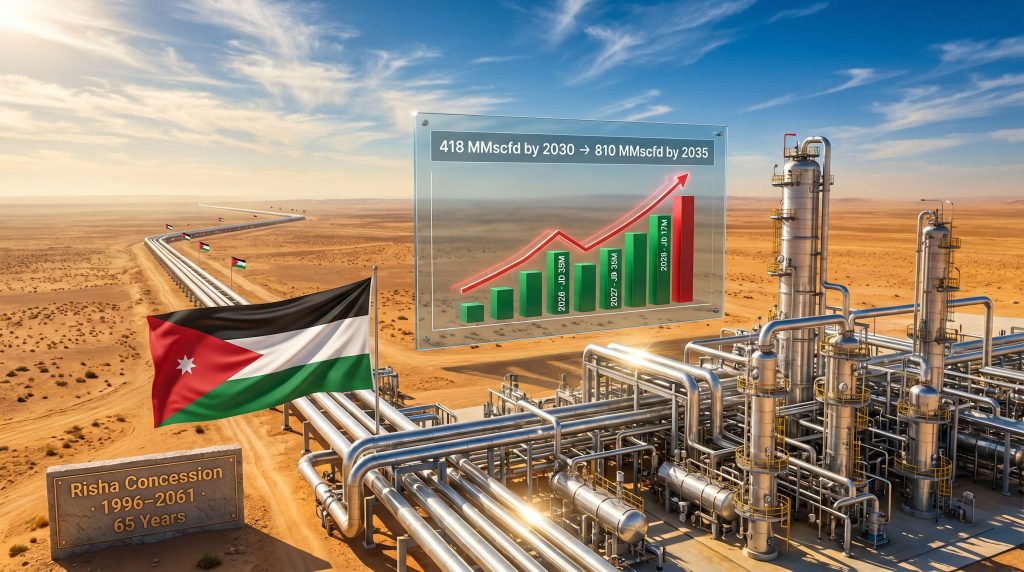
Production Targets at a Glance: NPC is targeting 418 million standard cubic feet per day (MMscfd) by 2030, then scaling to 810 MMscfd by 2035, nearly doubling Phase 1 output within five additional years.
- Phase 1 (by 2030): Expanding processing capacity and upgrading field infrastructure to reach 418 MMscfd
- Phase 2 (by 2035): Deploying additional compression, processing units, and well development programmes to reach 810 MMscfd
- Infrastructure keystone: Construction of a strategic pipeline linking Risha directly to the Arab Gas Pipeline, targeted for completion by 2029
To contextualise these targets, Jordan's total natural gas consumption in recent years has been estimated at several hundred MMscfd, supplied through a combination of domestic Risha output, liquefied natural gas imports through the Aqaba floating storage and regasification unit, and pipeline imports where available. Reaching 810 MMscfd from Risha alone would represent a transformative shift in Jordan's energy balance, potentially covering the majority of national consumption from a single domestic source.
However, achieving that output trajectory from an established, ageing onshore field is technically demanding. Production growth in conventional reservoirs requires active reservoir management, including infill drilling campaigns to access unswept zones, installation of compression infrastructure to maintain wellhead pressure as reservoir depletion progresses, and expansion of surface processing facilities to handle increased throughput volumes. The timeline implies NPC must execute these activities at a pace that will test both its operational capacity and its procurement logistics. In this respect, the prevailing natural gas price trends will also shape the commercial case for accelerating capital deployment.
The JD 87 Million Financing Package: What It Covers and What It Does Not
The Jordanian government has committed phased public financing totalling JD 87 million to support NPC's expansion programme.
| Fiscal Year | Government Allocation | Cumulative Capital Deployed |
|---|---|---|
| 2026 | JD 35 million | JD 35 million |
| 2027 | JD 35 million | JD 70 million |
| 2028 | JD 17 million | JD 87 million |
The front-loading of capital in 2026 and 2027 suggests the government is prioritising early-stage infrastructure procurement, likely covering initial processing unit fabrication and pipeline route engineering. The reduced 2028 allocation may reflect an expectation that NPC's own operating revenues will increasingly co-fund the expansion as new processing capacity comes online.
What remains less clear is the precise classification of this funding. Whether the JD 87 million represents an equity injection into NPC, a direct grant from public coffers, or a repayable capital facility has implications for how the expenditure flows through Jordan's national accounts and fiscal deficit calculations. For a country that has maintained an ongoing fiscal consolidation programme supported by the International Monetary Fund, the distinction is not trivial.
It is also worth noting that JD 87 million, while meaningful, is a relatively modest capital envelope relative to the scale of gas field expansion being contemplated. Regional benchmarks for onshore gas processing and pipeline construction suggest that projects of the complexity and ambition outlined by NPC could require multiples of this figure over the full development cycle to 2035. This points to the likelihood that NPC will need to supplement public funding with debt financing, concessional loans from development finance institutions such as the Arab Fund for Economic and Social Development, or retained operational earnings as the programme advances.
The Arab Gas Pipeline Connection: A Strategic Infrastructure Pivot
Perhaps the single most consequential element of NPC's development plan is the proposed pipeline linking Risha to the Arab Gas Pipeline network, targeted for completion by 2029.
The Arab Gas Pipeline is a regional transmission corridor that historically connected Egyptian gas production to Jordan, Lebanon, and Syria. While its utilisation has been intermittent due to regional geopolitical disruptions, the pipeline infrastructure represents an existing backbone for gas movement across the Levant. In addition, its strategic value is amplified when viewed alongside the broader LNG supply outlook for the region, which continues to evolve in ways that favour nations with domestic production assets.
Connecting Risha to this network achieves something that the field has never previously accomplished: it transforms Risha from an isolated production node into an integrated component of a broader regional energy system. That connectivity enables several strategic outcomes:
- Domestically produced gas can reach consumption centres across the Kingdom efficiently, replacing import volumes on a like-for-like basis
- If Risha output exceeds domestic consumption post-2035, surplus volumes could theoretically flow into the regional pipeline network, repositioning Jordan from net importer to potential net contributor
- Pipeline integration provides the infrastructure foundation for future gas trade agreements with neighbouring states, creating long-term energy diplomacy optionality
This regional dimension distinguishes the Risha expansion from a purely domestic supply story. Jordan's geographic position at the junction of the Levant corridor means that energy infrastructure investments at Risha carry implications that extend well beyond the Kingdom's borders.
The next major ASX story will hit our subscribers first
The Economic Modernisation Vision and Risha's Place Within It
The Jordan Risha gas field concession extension and expansion plan sits formally within Jordan's Economic Modernisation Vision, the governing policy framework for national development through 2033, with an executive programme running from 2026 to 2029. The Vision identifies domestic energy production as a pillar of economic resilience, investment attraction, and fiscal sustainability.
The strategic rationale is straightforward. Every cubic foot of gas produced domestically at Risha displaces an equivalent volume that would otherwise be procured through import channels, saving foreign exchange and reducing the current account deficit. Lower-cost domestic gas also translates into more competitive electricity generation costs, which has downstream implications for industrial energy bills, manufacturing competitiveness, and ultimately Jordan's attractiveness as a destination for energy-intensive foreign investment.
For the broader Levant region, Jordan's trajectory with Risha offers an instructive contrast to the offshore gas discoveries reshaping the eastern Mediterranean. While Israel's Leviathan and Cyprus's Aphrodite fields have attracted international attention for their export potential, Jordan's approach at Risha is fundamentally anchored in domestic supply security rather than export commercialisation. Furthermore, this approach shares certain structural similarities with the energy export challenges experienced by other mid-sized energy producers navigating between domestic priorities and external market pressures.
How Does Jordan's Approach Compare Regionally?
These are structurally different strategic objectives, executed through different investment models and policy frameworks. For instance, Jordan's broader energy landscape analysis from regional research institutions highlights that the Kingdom's policy choices at Risha reflect a conscious prioritisation of energy sovereignty over revenue maximisation — a trade-off that may prove prescient as global gas markets become increasingly contested.
Frequently Asked Questions: Jordan Risha Gas Field Concession Extension
What is the Jordan Risha gas field concession extension?
A 15-year extension of the operating concession held by the National Petroleum Company (NPC), approved by the Jordanian Cabinet in June 2026, extending the concession's validity from the original 2046 expiry date to 2061.
How long does the Risha concession now run?
The total concession spans 65 years from the original 1996 agreement, running through to 2061.
What are NPC's production targets for the Risha field?
NPC is targeting output of 418 MMscfd by 2030, scaling to 810 MMscfd by 2035, funded using NPC's own resources alongside government capital allocations.
How much is the Jordanian government investing in the Risha expansion?
The government has committed JD 87 million across three fiscal years: JD 35 million in 2026, JD 35 million in 2027, and JD 17 million in 2028.
When will the Risha-to-Arab Gas Pipeline link be completed?
The strategic pipeline connecting Risha to the Arab Gas Pipeline is targeted for operational status by 2029.
Why extend the concession through NPC rather than invite competitive tenders?
The extension reflects a policy preference for state-led continuity in upstream development, consistent with the goals of the Economic Modernisation Vision and Jordan's broader energy sovereignty objectives.
Key Takeaways
- The Jordan Risha gas field concession extension to 2061 represents a 65-year total operational commitment, not a routine administrative renewal
- NPC's two-phase production strategy targets 418 MMscfd by 2030 and 810 MMscfd by 2035, requiring sustained capital deployment and operational execution at a demanding pace
- The JD 87 million government funding package provides near-term certainty but is likely insufficient as a standalone financing source for the full expansion scope through 2035
- Connecting Risha to the Arab Gas Pipeline by 2029 is the infrastructure milestone with the greatest strategic multiplier, enabling regional integration and future energy diplomacy optionality
- Jordan's approach at Risha is anchored in domestic supply security rather than export commercialisation, making it structurally distinct from the offshore export-oriented gas models elsewhere in the eastern Mediterranean
This article is intended for informational purposes only and does not constitute financial or investment advice. Production targets, financing structures, and timelines referenced herein are based on publicly available official statements and are subject to change. Readers should conduct their own due diligence before drawing conclusions about economic or investment implications.
Want To Track the Next Major Mineral Discovery Before the Market Does?
Discovery Alert's proprietary Discovery IQ model delivers real-time alerts on significant ASX mineral discoveries, translating complex geological and commodity data into actionable investment insights for both short-term traders and long-term investors. Explore Discovery Alert's dedicated discoveries page to understand how historic finds have generated substantial returns, and begin your 14-day free trial today to position yourself ahead of the broader market.