June 16, 2026
The Economics of Incremental Offshore Development: Why Mature Fields Still Hold Enormous Value
Some of the most consequential decisions in offshore oil development never involve a new discovery at all. They involve the harder, slower, more technically demanding work of extracting additional value from fields already in production, using infrastructure already paid for, and reservoirs already partially understood. This is the discipline at the heart of Johan Sverdrup phase 4 development, and it represents a model increasingly favoured across the Norwegian Continental Shelf as operators seek capital-efficient ways to sustain output without committing to the enormous costs of greenfield projects.
The logic is straightforward but the execution is not. Every barrel produced through an existing processing facility at incremental cost is a barrel that generates superior returns compared to one requiring entirely new infrastructure. This fundamental economic principle is now driving Equinor's evaluation of the Tonjer and Geitungen resource areas, located in the northernmost section of the broader Johan Sverdrup area on the Utsira High. For a broader crude oil market overview, understanding this principle is essential context.
When big ASX news breaks, our subscribers know first
Johan Sverdrup: The Architecture of a World-Class Oil Field
Before understanding where Phase 4 fits, it is worth appreciating the scale and technical character of the host asset. Johan Sverdrup sits on the Utsira High in the central North Sea, roughly 65 kilometres northeast of the Sleipner field, in water depths of approximately 115 metres. That relatively shallow water depth is not incidental. It is one of the structural enablers of cost-effective subsea infrastructure deployment across multiple development phases.
The field's primary production comes from Upper Jurassic intra-Draupne sandstone at a reservoir depth of approximately 1,900 metres. What makes Johan Sverdrup genuinely exceptional among global offshore assets is not just its size but the quality of its reservoir. Permeability levels in the main reservoir interval rank among the highest recorded for a conventional offshore oil accumulation anywhere in the world. High permeability means fluid flows easily through the rock under pressure, which translates directly into high well productivity, strong water injection response, and exceptional recovery rates.
Beyond the primary reservoir interval, the field also holds oil in several secondary units:
- Sandstone within the Upper Triassic Statfjord Group
- Middle to Upper Jurassic Vestland Group sandstones
- Upper Jurassic Viking Group spiculites (silica-rich biological sedimentary rocks)
- Permian Zechstein carbonate intervals
This multi-horizon reservoir architecture is uncommon and, furthermore, adds material optionality to long-term field development planning.
The current partnership structure governing the Johan Sverdrup unit is as follows:
| Partner | Equity Interest | Role |
|---|---|---|
| Equinor Energy AS | 42.62% | Operator |
| Aker BP | 31.57% | Non-operating partner |
| Petoro | 17.36% | State participant |
| TotalEnergies | 8.44% | Non-operating partner |
Johan Sverdrup currently accounts for roughly one-third of total Norwegian oil production, making it the single most important asset in Norway's upstream portfolio and a key supply source for European crude markets. Indeed, understanding oil's role in the global economy helps contextualise why sustaining output from assets like this matters so profoundly.
The Tonjer and Geitungen Discoveries: From Uncertainty to Appraisal
Why the Northern Terrace Remained Ambiguous for So Long
The Geitungen terrace, which forms the northernmost structural extension of the Johan Sverdrup area, has long been a source of geological ambiguity. Oil presence in the Tonjer zone was identified in early assessments, but the combination of structural complexity, reservoir segmentation risk, and uncertain fluid contacts meant that volume estimates could not be reliably constrained. This is a common challenge in terrace-zone geology, where the reservoir architecture does not conform neatly to the simpler, more continuous geometries seen in the main field body.
The distinction between what an exploration well and an appraisal well can confirm is critical here. Exploration wells establish the presence of hydrocarbons. Appraisal wells go further, measuring pressure gradients across the structure, mapping fluid contacts, testing lateral reservoir continuity, and defining net pay thickness across the accumulation. A sidetrack from an appraisal well adds another spatial data point, resolving uncertainty in areas where a single wellbore cannot definitively answer structural questions.
Equinor's appraisal campaign in the Tonjer and Geitungen areas comprised two dedicated appraisal wells plus a sidetrack, collectively delivering a far more precise subsurface picture than any prior dataset. The integration of reprocessed seismic data with new well measurements has enabled the operator to construct refined volumetric models for both the Tonjer west, Tonjer east, and Geitungen segments.
What the Resource Estimates Actually Mean
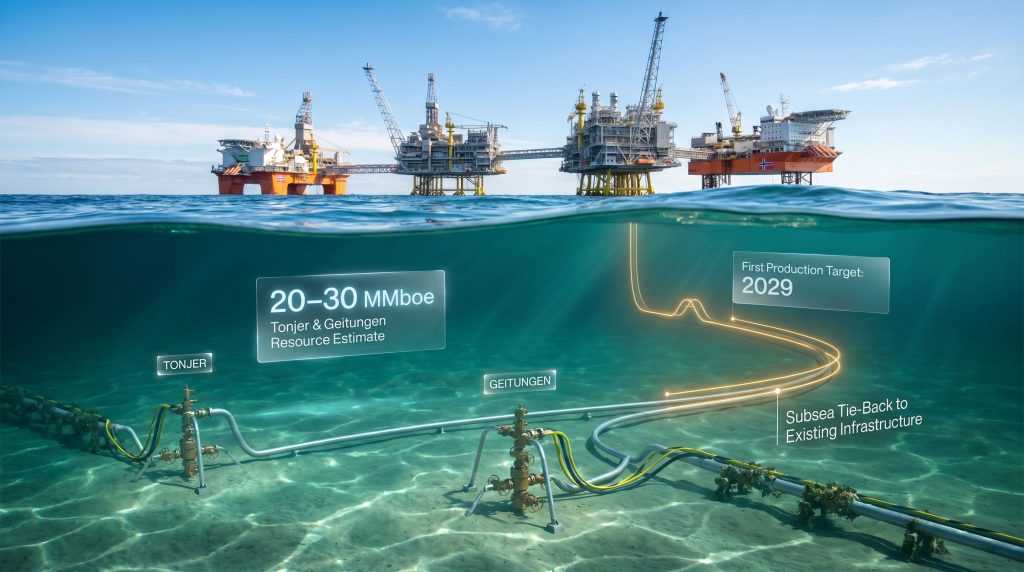
Preliminary combined resource estimates for Tonjer and Geitungen currently range between 20 and 30 million barrels of oil equivalent (MMboe), subject to ongoing subsurface data analysis.
That range is wide by design. When subsurface teams report a span of this kind at the pre-FID stage, they are communicating genuine geological uncertainty rather than imprecision. The key unknowns driving the range include:
- Reservoir connectivity between Tonjer west, Tonjer east, and Geitungen, which affects how many wells are needed and what pressure depletion looks like over time
- Fluid contact positions that define the oil-water interface and therefore the recoverable column height
- Recovery factor assumptions, which depend heavily on the production mechanism selected and the degree to which existing water injection infrastructure can support pressure maintenance in the new areas
For context, a volume of 20 to 30 MMboe sits comfortably above the typical commercial threshold for a subsea tie-back development in the North Sea. Industry experience suggests that around 10 to 50 MMboe represents the workable range for tie-back economics, with smaller volumes often unable to justify even the reduced capital costs of seabed tiebacks. Phase 4 sits in the middle of that range, making commercial viability plausible but not guaranteed until subsurface uncertainty narrows further.
The Subsea Tie-Back Development Concept: Technical and Commercial Logic
How a Subsea Tie-Back Actually Works
A subsea tie-back is one of the most capital-efficient development methods available in the offshore toolkit. Rather than constructing a new platform, topsides, or floating production unit, new subsea wellheads are installed on the seabed and connected via insulated flowlines to the processing and export systems of an existing host facility. Umbilical cables carry power, control signals, and chemical injection fluids from the host platform to the new subsea equipment, while produced fluids travel in the opposite direction through production flowlines.
For Johan Sverdrup phase 4 development, new wellheads positioned in the Tonjer and Geitungen areas would connect to the existing Johan Sverdrup platform infrastructure, utilising spare processing capacity that opens up as Phase 1 and Phase 2 wells progressively decline. This is sometimes described in the industry as "filling the pipe" — maintaining throughput across fixed-cost infrastructure at minimal incremental operating cost per barrel.
Tie-Back vs. Standalone: The Numbers That Matter
| Development Parameter | Subsea Tie-Back | Standalone Platform |
|---|---|---|
| Capital expenditure | Significantly lower | High |
| Emissions per barrel | Lower (leverages existing electrified systems) | Higher |
| Lead time to production | Shorter (typically 2-4 years post-FID) | Longer (5-8+ years) |
| Minimum viable volume | Approximately 10-50 MMboe | Generally 100+ MMboe |
| Infrastructure dependency | Requires host facility with spare capacity | Fully independent |
| Best suited for | Satellite and adjacent accumulations | Large standalone fields |
The emissions advantage of the tie-back concept deserves particular attention in the Norwegian context. Johan Sverdrup is already powered by shore-based electricity rather than gas turbines, giving it one of the lowest carbon intensities of any large-scale offshore oil field globally. New Phase 4 subsea equipment tied back to this infrastructure inherits that low-emissions profile automatically, aligning naturally with advances in low-emissions energy infrastructure without requiring any additional power generation capacity.
A Rarely Discussed Engineering Constraint: Flowline Thermal Management
One technical challenge that receives limited public attention in tie-back discussions involves thermal management of produced fluids over long seabed distances. As oil travels from a subsea wellhead to a host platform through cold deepwater flowlines, it loses heat rapidly. If the temperature drops below a critical threshold, waxy components in the crude can precipitate, and hydrates (ice-like structures formed from gas and water) can form, potentially blocking the flowline entirely.
This risk is managed through a combination of pipeline insulation design, chemical injection (typically methanol or glycol injected via the umbilical), and careful management of production rates and shutdown procedures. For the Tonjer and Geitungen areas, the flowline routing geometry and thermal management strategy will be key engineering workstreams during the Front-End Engineering and Design (FEED) phase. The northern terrace location adds complexity here, as seabed topography in terrace zones can create longer, more circuitous routing requirements compared to developments closer to the main platform.
Phase 4 Investment Timeline: Maturation to FID
Understanding the Norwegian PDO Process
A critical milestone in any Norwegian offshore development that receives limited attention outside specialist circles is the Plan for Development and Operation (PDO). Under Norwegian petroleum legislation, operators cannot proceed to construction and production without submitting a PDO to the Ministry of Energy and receiving parliamentary approval. The PDO process requires a comprehensive description of the development concept, cost estimates, production profiles, safety and environmental assessments, and decommissioning plans.
This is not simply a regulatory checkbox. The PDO submission triggers formal government and partner review processes that can take months, and conditions attached to PDO approval can materially affect project scope or execution. For Phase 4, PDO preparation will be one of the most resource-intensive workstreams between concept selection and FID.
Forward-Looking Timeline
| Milestone | Indicative Timing |
|---|---|
| Appraisal campaign completed | 2025-2026 |
| Subsurface data analysis and refined resource estimates | 2026 (ongoing) |
| Concept selection and FEED scoping | 2026-2027 (anticipated) |
| Final Investment Decision (FID) | 2027-2028 (anticipated) |
| First production | Target approximately 2029 |
Note: All timelines beyond the current appraisal phase are indicative and subject to subsurface outcomes, partner alignment, regulatory processes, and commodity market conditions. This article does not constitute investment advice. Readers should conduct independent due diligence before making any investment decisions.
The 2029 production target reflects one of the key commercial advantages of the tie-back model. A standalone development at equivalent scale would typically require two to three additional years beyond this window simply to complete engineering, fabricate topsides, and install new infrastructure.
Reservoir Quality and Recovery Factor: The Hidden Value Driver
Why Permeability Is the Single Most Important Reservoir Parameter
Across the broader industry, reservoir permeability is often underappreciated by those outside subsurface engineering disciplines. Permeability measures how easily fluid can move through rock pore spaces under pressure, typically expressed in millidarcies (mD). Conventional offshore reservoirs routinely produce at permeabilities of 10 to 200 mD. Johan Sverdrup's main Draupne sandstone interval is documented at permeability levels orders of magnitude above typical North Sea averages, which is why individual wells at this field produce at exceptional rates.
For Phase 4, the question is whether the Tonjer and Geitungen reservoir intervals carry comparable permeability to the main field body, or whether the terrace zone geology introduces lower-quality, more heterogeneous rock. Appraisal well core and log data collected during the recent campaign will be central to resolving this question, and the answer will directly determine the number of wells needed, the production plateau achievable, and the ultimate recovery factor.
Norway's CO2 Tax Regime and Its Influence on Development Economics
Norway applies one of the world's highest carbon prices to offshore oil and gas production, currently exceeding USD 200 per tonne of CO2 when combining the domestic CO2 tax with exposure to the EU Emissions Trading System. This creates a powerful financial incentive for operators to minimise combustion-based emissions at every stage of field development.
For Phase 4, the tie-back concept's reliance on Johan Sverdrup's shore-powered infrastructure means that production from Tonjer and Geitungen would avoid the carbon cost burden associated with gas turbine power generation. This is not merely an environmental benefit but a direct influence on project economics, particularly given Norway's intention to maintain or increase carbon pricing over the coming decade.
The next major ASX story will hit our subscribers first
Key Risks That Will Determine Phase 4's Commercial Outcome
Subsurface Risks
- Downside volume scenario: If subsurface analysis converges toward the lower end of the 20-30 MMboe preliminary estimate range, tie-back economics become marginal and the project may require commodity price assumptions above current forward curves to justify a positive FID
- Reservoir compartmentalization: If the Tonjer west, east, and Geitungen segments prove hydrodynamically isolated from one another, each may require separate well clusters, increasing well count and capital cost relative to an integrated development scenario
- Recovery factor uncertainty: Without established production history in the terrace zone, recovery factor assumptions will carry wider confidence intervals than those applied to the main field body
Commercial and Operational Risks
- Partner capital allocation decisions in a volatile Brent crude price environment could affect the timing and scope of FID. Monitoring crude oil price trends remains therefore essential for assessing project viability
- Norwegian CO2 tax trajectory and potential changes to the petroleum tax regime introduce fiscal uncertainty over the project's production life
- Seabed intervention complexity in the northern terrace area may result in higher-than-anticipated flowline installation costs
- Integration of new subsea control systems with Phase 1 and Phase 2 legacy infrastructure requires careful engineering coordination to avoid production disruptions to existing wells
- In addition, broader oil market trade risks arising from geopolitical tensions could influence partner appetite for long-cycle investment commitments
How Phase 4 Sustains Johan Sverdrup's Long-Term Production Contribution
The systemic importance of Johan Sverdrup to Norwegian and European energy supply creates a strategic dimension to Johan Sverdrup phase 4 development that extends beyond project economics alone. A field responsible for roughly one-third of Norwegian oil output and representing a significant source of low-carbon-intensity crude for European refineries has inherent value in sustaining production beyond the natural decline curves of its initial development phases.
Phase 1 achieved first oil in 2019. Phase 2 reached production in 2022, adding water injection capacity and additional wells that extended the field's plateau. Phase 4 follows this pattern of progressive infrastructure leverage, each phase building on the capital base of its predecessor while targeting incrementally more challenging resource areas. This stepped development model is arguably the most commercially rational approach to large, complex offshore fields because it defers risk and allocates capital progressively as subsurface understanding improves.
From a European energy security perspective, every additional barrel of NCS production represents supply diversity from a stable, transparent regulatory environment with a long track record of reliable delivery. That context, while not a driver of project economics, forms part of the broader commercial environment within which partner investment decisions are made.
Frequently Asked Questions: Johan Sverdrup Phase 4
What is Johan Sverdrup Phase 4?
It is a proposed additional development stage targeting newly appraised oil resources in the Tonjer west, Tonjer east, and Geitungen areas via a subsea tie-back to existing field infrastructure. Preliminary combined resource estimates range from 20 to 30 MMboe.
Who operates Johan Sverdrup Phase 4?
Equinor Energy AS is the field operator with a 42.62% equity interest. Partners are Aker BP (31.57%), Petoro (17.36%), and TotalEnergies (8.44%).
When might Phase 4 first production occur?
Subject to a positive Final Investment Decision, the project targets first production in approximately 2029.
Why is a subsea tie-back the preferred development method?
It eliminates the need for new platform infrastructure, significantly reducing capital expenditure, shortening lead time to production, and maintaining the low emissions intensity profile of the existing shore-powered Johan Sverdrup facilities.
Where is Johan Sverdrup located?
On the Utsira High in the central North Sea, approximately 65 kilometres northeast of the Sleipner field, in approximately 115 metres of water.
What are the main risks for Phase 4?
Key risks include subsurface volume uncertainty at the lower end of the estimate range, reservoir compartmentalization between the three accumulation segments, partner capital allocation decisions, and the Norwegian PDO regulatory approval timeline.
Want to Know Which ASX Discoveries Could Deliver the Next Major Return?
Discovery Alert's proprietary Discovery IQ model delivers real-time alerts the moment significant mineral discoveries are announced on the ASX, transforming complex geological data into clear, actionable investment insights — explore historic discovery returns to understand the scale of opportunity, then begin your 14-day free trial to position yourself ahead of the broader market.