June 15, 2026
The Regulatory Frontier: Why Geological Hydrogen Is Forcing Governments to Write Entirely New Rules
Most energy transitions happen incrementally, with existing regulatory frameworks slowly adapting to accommodate new technologies. Natural hydrogen is different. Unlike solar panels or wind turbines, which slot reasonably well into established electricity licensing regimes, geological hydrogen sits in a category that existing law simply was not built to handle. It is not a mineral. It is not a conventional hydrocarbon. In most jurisdictions, it exists in a legal grey zone that makes even basic exploration legally ambiguous.
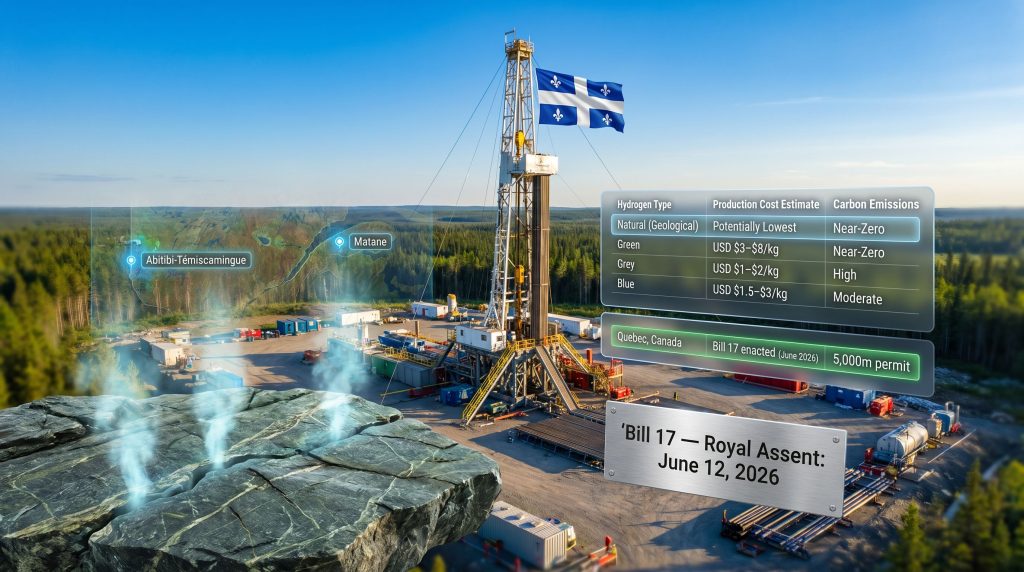
Quebec has moved to close that gap. With the passage of Bill 17, which received royal assent on June 12, 2026, the province has enacted what is among the first purpose-built legislative frameworks for Quebec natural hydrogen drilling in North America. Understanding why this matters requires looking not just at the legislation itself, but at the geology underneath it, the economics surrounding it, and the global race to define who governs this emerging resource class.
When big ASX news breaks, our subscribers know first
What Bill 17 Actually Establishes, and What It Does Not
It would be a mistake to interpret Bill 17 as a broad green light for commercial hydrogen production. The legislation is more precisely scoped than that. What it creates is a formal authorisation pathway for government-backed natural hydrogen pilot projects, granting legal authority for underground reservoir exploration under provincial oversight.
This distinction is significant. Before Bill 17, companies holding exploration permits in Quebec faced a fundamental problem: the law did not clearly define who owned subsurface hydrogen, how it should be regulated, or under what conditions drilling could be authorised. A 5,000-metre drilling permit means very little if the legal basis for what you might extract from that depth remains undefined.
Bill 17 resolves this by creating a standalone institutional framework specifically architected for natural hydrogen, distinct from Quebec's broader mining legislation. It establishes the co-governance model through which the provincial government can oversee pilot project activity, rather than simply leaving companies to interpret existing resource law. Furthermore, this kind of regulatory clarity around emerging resource categories is increasingly critical as jurisdictions compete to attract early-stage exploration capital.
What Bill 17 creates is not just a drilling permission, but an institutional architecture for state-industry co-governance of a resource category that did not previously have a legal identity in Quebec.
Critically, the legislation does not yet establish a full commercial licensing regime. The transition from pilot project to commercial-scale production will require additional legislative and regulatory steps beyond the current framework. Investors and analysts should interpret Bill 17 as the beginning of a regulatory journey, not its conclusion.
The Geochemistry That Makes Quebec Relevant: Understanding Serpentinisation
Why Precambrian Shield Geology Generates Hydrogen
To understand why Quebec natural hydrogen drilling is attracting serious attention, it helps to understand the subsurface chemistry involved. Natural hydrogen is produced primarily through a process called serpentinisation, a geochemical reaction that occurs when water percolates through iron- and magnesium-rich rocks known as ultramafic formations. The heat and chemical energy released during this reaction splits water molecules, liberating hydrogen gas.
The key geological requirement is the presence of ancient, iron-rich basement rocks, precisely the kind that characterise Quebec's Abitibi-Témiscamingue region. This area sits atop Precambrian shield geology, some of the oldest exposed rock on Earth, and the iron-rich composition of these formations makes them theoretically well-suited to ongoing serpentinisation reactions at depth.
What has strengthened confidence in the Quebec thesis is that gas composition analysis from the province's subsurface reportedly mirrors findings from Nova Scotia, where similar geological conditions have yielded detectable natural hydrogen signatures. Cross-provincial geological validation of this kind reduces exploration risk, though it does not eliminate it entirely. In addition, the broader white hydrogen discovery activity occurring globally in comparable geological settings continues to reinforce the scientific plausibility of the Quebec model.
The Purity Advantage: What Separates Geological Hydrogen from Industrial Variants
One of the most commercially compelling characteristics of natural hydrogen is its purity profile. Unlike grey hydrogen produced through steam methane reforming, or even green hydrogen generated via electrolysis, geological hydrogen is reported to be essentially free of methane (CH₄) and carbon dioxide (CO₂). This has meaningful downstream implications for processing costs.
The comparative economics across hydrogen production pathways are instructive:
| Hydrogen Type | Production Method | Carbon Emissions | Estimated Production Cost | Purity Profile |
|---|---|---|---|---|
| Natural (Geological) | Subsurface extraction | Near-zero | Potentially sub-USD $1/kg (unconfirmed at scale) | High purity, minimal CO₂/CH₄ |
| Green | Electrolysis (renewable energy) | Near-zero | USD $3–$8/kg | High purity |
| Blue | SMR + carbon capture | Moderate | USD $1.5–$3/kg | Requires CCS infrastructure |
| Grey | Steam methane reforming | High | USD $1–$2/kg | Requires downstream purification |
Disclaimer: Production cost estimates for natural hydrogen are speculative and based on early-stage geological assessments globally. No commercial-scale extraction exists in North America to validate these figures at this time.
The absence of methane and CO₂ in geological hydrogen is not simply an environmental benefit. It directly reduces the capital and operating expenditure associated with gas purification infrastructure, which represents a significant cost component in conventional hydrogen production chains.
Quebec Innovative Materials Corp. and the 5,000-Metre Drilling Permit
From National Assembly to Drill Site
Quebec Innovative Materials Corp. (QIMC) currently holds a 5,000-metre drilling permit in the Abitibi-Témiscamingue region, making it the most operationally advanced natural hydrogen explorer in the province. The company was formally invited to present before the Quebec National Assembly during the Bill 17 deliberation process, a relatively uncommon form of industry participation in Canadian provincial resource policy.
QIMC's testimony before the Assembly emphasised Quebec's geological suitability and the necessity of a purpose-built regulatory structure for the sector. According to the Canadian Mining Journal, the company's CEO, John Karagiannidis, indicated that QIMC's operational readiness would allow it to begin translating legislative progress into real-world results almost immediately, noting that Quebec possesses the geology, clean energy infrastructure, and now the legislative framework required to move forward. (Source: Canadian Mining Journal, June 15, 2026)
A 5,000-metre permit depth is technically significant. At these depths, pressure and temperature conditions are consistent with active serpentinisation zones, and subsurface hydrogen accumulations are more likely to have been compressed and concentrated over geological timescales. Drilling to this depth requires specialised equipment, rigorous wellbore integrity management, and environmental monitoring protocols that differ substantially from shallower exploration activities.
The Matane Project: Evidence of Province-Wide Prospectivity
Beyond Abitibi-Témiscamingue, QIMC is also advancing the Matane Natural Hydrogen Project, located in a geologically distinct part of Quebec. The existence of a second active exploration front is meaningful because it suggests the province's hydrogen prospectivity is not confined to a single geological province.
Multiple active projects also create a kind of competitive exploration dynamic. With Bill 17 now enacted, other companies may accelerate permit applications across Quebec's geological zones, potentially triggering a broader staking wave similar to patterns seen in early-stage lithium and rare earth exploration cycles.
Indigenous Partnership as Project Architecture, Not Afterthought
The Témiscamingue First Nation MOU: A Structural Departure
The proposed drilling sites in Abitibi-Témiscamingue fall within the traditional hunting and cultural territory of the Témiscamingue First Nation. What distinguishes QIMC's approach is the sequencing of its Indigenous engagement: the company signed a Memorandum of Understanding with the Témiscamingue First Nation in October 2025, more than seven months before Bill 17 received royal assent.
This pre-legislative MOU establishes two core pillars:
- Business contract arrangements governing economic participation and benefit-sharing frameworks
- Environmental oversight mechanisms granting the First Nation a formal monitoring role throughout exploration activities
The distinction between consultation rights and oversight rights is not trivial. Many historical resource development disputes in Canada have centred on the difference between being informed of decisions and having the institutional capacity to influence them. The Témiscamingue MOU appears to embed the latter.
Signing an Indigenous partnership agreement months before the enabling legislation existed signals that community consent was treated as a foundational project requirement rather than a regulatory checkbox.
QIMC has confirmed that any upcoming exploration activities will be subject to local community agreements under this framework, meaning the MOU functions as a living governance document rather than a one-time sign-off.
How Quebec Compares Globally: The Natural Hydrogen Regulatory Landscape
First-Mover Advantage in an Unregulated Global Sector
Quebec's passage of Bill 17 positions it as one of the most legislatively advanced jurisdictions for natural hydrogen in North America. The global regulatory landscape for geological hydrogen remains strikingly nascent, which amplifies the significance of purpose-built legislation:
| Jurisdiction | Regulatory Status | Active Permits | Geological Validation | Indigenous Framework |
|---|---|---|---|---|
| Quebec, Canada | Bill 17 enacted (June 2026) | Yes (5,000m permit held by QIMC) | Confirmed geological indicators | MOU in place (Oct. 2025) |
| Saskatchewan, Canada | Exploratory permits issued | Yes | Early-stage | Developing |
| Mali, West Africa | Active production (Bourakebougou field) | Yes | Confirmed, producing since ~2012 | Varies |
| Nebraska, USA | Exploratory | Yes | Partial confirmation | Developing |
| South Australia | Regulatory review underway | Limited | Geological surveys ongoing | Developing |
The Mali example is particularly instructive for geologists and investors. The Bourakebougou field in Mali has been producing natural hydrogen for over a decade and represents the only known commercial-scale geological hydrogen operation globally. Its existence proves that subsurface hydrogen can be extracted and utilised, though the geological and logistical conditions there differ substantially from Quebec's Precambrian shield environment.
Quebec's Hydroelectric Grid as a Structural Advantage
Quebec generates approximately 94 to 96 percent of its electricity from hydropower, giving the province one of the cleanest electrical grids in North America. This is relevant to natural hydrogen development for a reason that is not immediately obvious: the processing, compression, and transport of extracted hydrogen gas requires energy inputs.
In jurisdictions powered by fossil fuel grids, these energy inputs can partially erode the emissions advantage of natural hydrogen. In Quebec, they do not. This creates a compounding clean energy argument: low-emission extraction powered by low-emission electricity, potentially feeding into energy transition mining pathways where direct electrification remains technically impractical, such as high-temperature industrial processes and long-haul freight.
The next major ASX story will hit our subscribers first
Key Risks That Cannot Be Ignored
Technical Uncertainties at the Frontier of a New Resource Class
Natural hydrogen exploration carries a distinct risk profile compared to conventional resource development, and investors and policymakers should understand these risks clearly:
- Reservoir characterisation challenges: Natural hydrogen accumulations do not behave like conventional oil and gas reservoirs. Standard seismic interpretation tools were not designed to identify geological hydrogen, meaning subsurface targeting remains technically imprecise at this stage of the industry's development.
- Flow rate and commercial viability unknowns: Even where geological hydrogen is confirmed to exist, the flow rates and reservoir continuity required for commercial extraction have not been demonstrated at scale in North American geology.
- Depth-related engineering complexity: Drilling to 5,000 metres introduces significant wellbore integrity challenges, particularly in managing pressure differentials and preventing hydrogen embrittlement in steel well casings, a well-documented challenge in hydrogen containment engineering.
- Infrastructure gaps: Hydrogen transport and storage infrastructure in Quebec is currently underdeveloped. The province's electricity grid is world-class; its hydrogen pipeline and compression network is not.
- Pilot-to-commercial regulatory gap: Bill 17 authorises pilots. The pathway to full commercial licensing is not yet legislated, introducing a meaningful transition risk for projects that successfully demonstrate geological viability.
This article contains forward-looking analysis and speculative assessments. Nothing in this article constitutes financial or investment advice. Investors should conduct independent due diligence before making investment decisions related to natural hydrogen exploration companies or projects.
What Comes Next: The Near-Term Roadmap Post-Bill 17
Operational Priorities and Medium-Term Milestones
With royal assent secured, the near-term priorities for Quebec natural hydrogen drilling activity centre on several sequential steps:
- Formal engagement with Quebec's Ministry of Economy, Innovation and Energy to define pilot project parameters and authorisation timelines
- Mobilisation of drilling equipment and specialist personnel to Abitibi-Témiscamingue target sites
- Activation of community engagement protocols under the existing Témiscamingue First Nation MOU
- Establishment of baseline environmental monitoring systems prior to drilling commencement
Medium-term milestones that will define whether this legislative moment translates into a genuine industry inflection point include:
- Publication of pilot project data covering flow rates, gas purity measurements, and reservoir continuity assessments
- Regulatory review of pilot outcomes to inform whether a full commercial licensing framework is warranted
- Potential expansion of exploration permits across additional Quebec geological zones, including the Matane project area
- Federal-provincial dialogue on integrating geological hydrogen into Canada's national hydrogen strategy framework
Furthermore, the broader question of how green transition materials and clean energy resources are governed will likely be shaped by what Quebec demonstrates through this process. Renewable mining solutions are also converging with hydrogen exploration, as the sector increasingly relies on clean-powered equipment and low-emission operational practices to strengthen the environmental credentials of what it extracts.
As reported by NewsFile Corp, QIMC's appearance before the National Assembly was a landmark moment in defining how industry and government will co-shape the emerging natural hydrogen sector in Canada.
If Quebec's pilot projects yield commercially meaningful flow rates within the next two to three years, the province could be drafting full commercial licensing legislation within a single electoral cycle, compressing a regulatory timeline that historically took decades in conventional resource sectors.
The passage of Bill 17 is best understood not as the arrival of a new industry, but as the formal opening of the door through which one might eventually walk. The geology is ancient. The chemistry is well-understood in principle. The economics remain unproven at scale. What Quebec has now provided, for the first time in its history, is a legal address for natural hydrogen, and that alone is a significant structural development in the global clean energy transition.
Ready to Track the Next Major Clean Energy Discovery Before the Market Does?
Discovery Alert's proprietary Discovery IQ model scans ASX announcements in real time, instantly identifying significant mineral and energy discoveries — including emerging sectors like natural hydrogen — and delivering actionable alerts to subscribers ahead of the broader market. Explore how major discoveries have historically generated extraordinary returns on Discovery Alert's dedicated discoveries page, and begin your 14-day free trial today to position yourself at the forefront of the next significant find.