June 16, 2026
The Hidden Cost of Standing Still: Why Mining's Old Operating Model Is Failing
For most of the twentieth century, mining operated on a simple premise: dig deeper, move more material, and fix things when they break. That model worked when ore grades were high, labour was cheap, and the consequences of inefficiency could be absorbed by commodity price margins. None of those conditions reliably exist today.
The structural economics of modern mining have shifted dramatically. Ore bodies that were once rich and accessible near the surface now require extraction at depths where heat, pressure, and geological complexity multiply operational risk. Average copper ore grades mined globally have declined by roughly 30% over the past two decades, forcing operators to process significantly larger volumes of material to produce the same metal output. Against this backdrop, the question facing the industry is not whether to adopt AI in mining efficiency and safety programmes, but how quickly that transition can be executed before the cost gap between early and late adopters becomes permanent.
When big ASX news breaks, our subscribers know first
Why the Traditional Monitoring Model Cannot Scale
The conventional approach to mine site management relied on scheduled inspection cycles, periodic maintenance windows, and post-incident analysis. Trained personnel would walk equipment lines, review sensor logs at fixed intervals, and respond to failures after they had already disrupted production. This model had a fundamental architectural flaw: it was inherently backward-looking.
As mining automation trends have accelerated, the volume of data generated by a single mine site now far exceeds what any human-led inspection regime can meaningfully process. A modern large-scale open cut mine can operate hundreds of pieces of heavy equipment simultaneously, each generating continuous streams of telemetry from engine temperature sensors, tyre pressure monitors, hydraulic system gauges, and fuel consumption trackers. The cognitive load required to interpret this data in real time, without AI assistance, is simply beyond the capacity of conventional operational structures.
The most consequential shift AI enables is not faster detection of problems that have already formed. It is the systematic identification of conditions that, if left unaddressed, would allow problems to form at all.
The Investment Signals Are Unambiguous
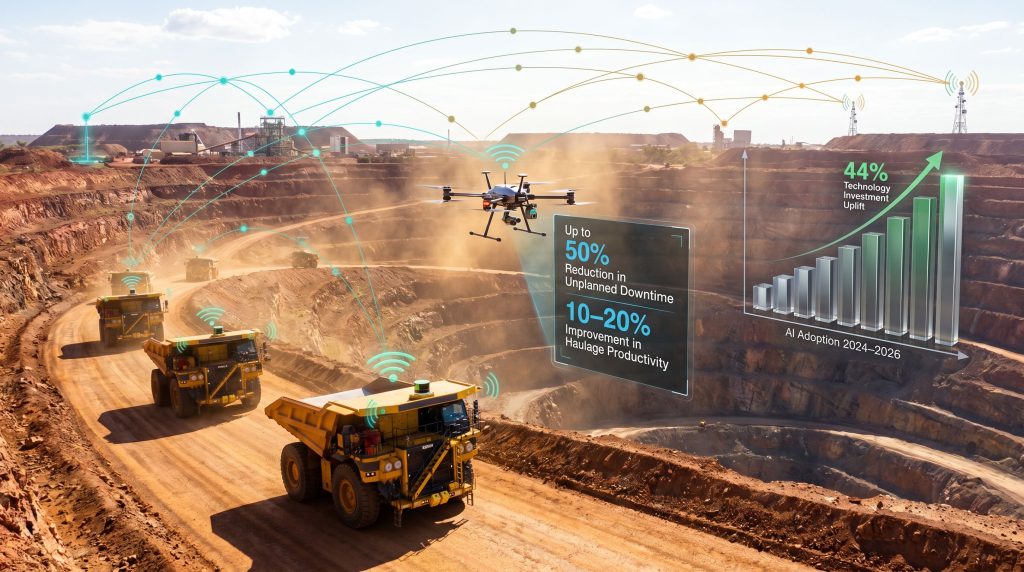
Industry survey data confirms that mining operators have recognised this structural reality. The Equinix Mining Technology Report documented a 93% increase in overall technology spending among surveyed mining operators, with 44% of respondents reporting a significant uplift in investment directed specifically toward automation and AI systems. These are not marginal adjustments to capital allocation; they represent a fundamental reorientation of where the industry believes future productivity gains will originate.
Importantly, this investment trend is not displacing human capital as rapidly as automation narratives might suggest. The same survey data indicated that approximately eight in ten mining companies planned to increase headcount in the near term, even as AI adoption accelerated. The picture that emerges is one of augmentation rather than replacement, with AI systems handling data-intensive monitoring and pattern recognition tasks while human workers shift toward system oversight, data interpretation, and technology maintenance roles.
What the AI Technology Stack Actually Does in a Mine
Understanding the practical application of AI-powered mining efficiency requires moving beyond generic descriptions of machine learning and examining how specific technology layers function within the mining value chain.
| Technology Layer | Primary Mining Application | Operational Benefit |
|---|---|---|
| Machine Learning | Ore grade prediction, equipment fault classification | Fewer unproductive drill targets, earlier fault detection |
| Computer Vision | PPE compliance, proximity detection, hazard identification | Real-time safety enforcement at the workface |
| Predictive Analytics | Equipment failure forecasting, condition monitoring | Reduced unplanned downtime, proactive risk management |
| Autonomous Systems | Haul trucks, drilling rigs, inspection drones | Human removal from highest-fatality environments |
| Natural Language Processing | Maintenance log analysis, incident report processing | Faster anomaly identification from unstructured records |
| IoT Sensor Integration | Atmospheric, structural, and equipment monitoring | Early warning for gas accumulation, vibration anomalies |
A critical distinction worth understanding is the difference between conventional data analysis and machine learning in operational contexts. Traditional analytical tools require engineers to define the rules that determine whether a reading is normal or abnormal. ML models, by contrast, learn the boundary conditions themselves by processing historical datasets that include thousands of examples of both normal operation and pre-failure states. In practice, this means ML systems can detect equipment degradation signatures that no human analyst would think to look for, because those signatures were not known to be meaningful until the model identified them.
How AI Is Transforming Safety Across the Mining Cycle
Real-Time Hazard Detection Using Computer Vision
AI-powered vision systems installed across mine sites continuously analyse video feeds from fixed cameras, vehicle-mounted units, and drone platforms. These systems are trained to recognise unsafe conditions as they emerge in real time, with alert latency measured in seconds rather than the minutes or hours associated with manual monitoring workflows.
Detectable conditions include:
- Worker proximity to operating heavy equipment
- Restricted zone breaches by personnel or vehicles
- PPE non-compliance, including absent helmets, harnesses, or high-visibility vests
- Visibility degradation from dust, fog, or smoke obscuring operational zones
Furthermore, Deloitte's research on AI and mining safety highlights that computer vision-driven compliance monitoring is increasingly regarded as a foundational safety layer rather than a supplementary tool at leading operations globally.
Atmospheric and Structural Monitoring at Scale
Underground mining environments present atmospheric hazards that are invisible to the human senses until exposure thresholds have already been exceeded. AI monitoring platforms connected to distributed sensor networks can detect early-stage methane or carbon monoxide accumulation, abnormal vibration signatures indicating structural instability in tunnel walls or pillars, and temperature anomalies that may precede spontaneous combustion events in coal seams or sulphide ore bodies.
A less commonly appreciated capability of these systems is their ability to distinguish genuine hazard signals from routine operational noise. Underground environments generate constant background vibration from blasting, drilling, and haulage activity. AI models trained on site-specific baseline data can filter this noise and identify the distinctive signatures of structural movement or seismic precursor activity that warrant evacuation or ground support intervention.
Predictive Maintenance as Accident Prevention
Equipment failure is simultaneously a productivity and safety problem in mining. A conveyor belt failure that halts production also creates emergency repair conditions where maintenance personnel work under time pressure in potentially compromised environments. Predictive maintenance systems trained on sensor telemetry, maintenance records, and operational parameters can forecast component degradation trajectories with sufficient lead time to schedule planned interventions.
Predictive maintenance systems deployed across the industry have demonstrated the capacity to reduce unplanned equipment downtime by 30 to 50% in high-utilisation mining environments. Key equipment classes monitored include:
- Conveyor systems and drive components
- Ventilation fans and ducting infrastructure
- Hoisting and winding equipment
- Haul truck powertrains, suspension, and tyre systems
- Processing plant grinding mills and flotation circuits
Autonomous Systems Removing Workers From High-Risk Zones
Autonomous haul trucks now operate at multiple Tier 1 mine sites globally, with some fleet deployments numbering in the hundreds of vehicles. These systems navigate mine roads using GPS positioning, LiDAR obstacle detection, and AI-driven route optimisation, operating continuously without the fatigue-related performance degradation that affects human operators on extended shifts.
Inspection drones equipped with thermal imaging, gas detection payloads, and structural assessment sensors conduct surveys of areas that are inaccessible or unsafe for human entry, including active blast zones, unstable highwall faces, and confined underground workings following seismic events.
Efficiency Gains Across the Mining Value Chain
Exploration and Resource Definition
ML algorithms processing multi-layered geological datasets, including satellite imagery, airborne geophysical surveys, historical drill core records, and geochemical sampling results, can generate probabilistic deposit models that compress exploration timelines by reducing the volume of unproductive drilling required.
One technically significant but underappreciated capability of AI-assisted exploration is its ability to identify mineralisation patterns that correlate with known deposit types but manifest in subtle geophysical or geochemical signatures that conventional geological interpretation routinely misses. In porphyry copper systems, for example, the spatial relationship between certain alteration mineralogy assemblages and economic ore zones can be captured by ML models processing multi-variable datasets across hundreds of historical drill holes.
Drill and Blast Optimisation
Blast design represents one of the highest-leverage intervention points in the mining value chain, yet it remains one of the least optimised at most operations. Poorly fragmented ore increases downstream crushing and grinding energy consumption significantly, because grinding mills must work harder to reduce oversized rock to the particle sizes required for mineral liberation.
AI in drilling and blasting applications analyse real-time drilling performance data, including penetration rates, bit wear indicators, and rock hardness variability measured through mechanical specific energy calculations, to dynamically adjust drilling parameters and calculate optimised charge placement and timing. The downstream energy savings from improved fragmentation are measurable and material, particularly at operations where processing accounts for the majority of operating costs.
Operational Efficiency Summary
| Operational Area | AI Application | Reported Efficiency Range |
|---|---|---|
| Exploration targeting | ML geological modelling | 20-40% reduction in unproductive drilling |
| Predictive maintenance | Sensor-based fault detection | 30-50% reduction in unplanned downtime |
| Autonomous haulage | AI fleet management and routing | 10-20% improvement in haulage productivity |
| Processing optimisation | Real-time parameter adjustment | 2-5% improvement in metal recovery rates |
| Safety compliance | Computer vision monitoring | Significant reduction in recordable incidents |
Note: Figures represent ranges reported across industry implementations. Individual outcomes vary by operation scale, ore type, and system maturity. Many reported figures originate from vendor case studies rather than independently audited sources.
The next major ASX story will hit our subscribers first
AI and Sustainable Mining: Beyond the ESG Checkbox
The environmental dimension of AI in mining extends well beyond compliance monitoring. Ventilation-on-demand systems, guided by AI analysis of real-time personnel location data and atmospheric sensor readings, deliver airflow precisely where and when it is needed underground rather than maintaining constant ventilation across entire mine workings. This approach can reduce underground ventilation energy consumption substantially, given that ventilation typically accounts for 30 to 50% of total underground mine energy demand.
AI-assisted tailings storage facility monitoring represents perhaps the most consequential safety and environmental application in the sector. Real-time geotechnical monitoring of dam stability, supported by AI pattern recognition across settlement, pore pressure, and seepage data, provides early warning capability for conditions that might otherwise precede catastrophic failure events. The consequences of tailings dam failures, both in human and environmental terms, make this one of the highest-value AI applications in the industry regardless of the economic return calculation.
The Practical Barriers That Slow AI Adoption
Despite compelling evidence of the operational and safety benefits of AI in mining efficiency and safety programmes, adoption rates across the industry remain highly uneven. Several structural barriers account for this:
- Legacy data infrastructure: Many established mine sites operate sensor networks and data management systems installed in previous decades that are architecturally incompatible with modern AI platforms. Upgrading these systems requires capital expenditure before any AI benefit can be realised.
- Connectivity constraints at remote sites: Cloud-based AI systems require reliable high-bandwidth connectivity that remote mine sites frequently cannot guarantee. Edge computing solutions, which process data locally rather than transmitting it to cloud infrastructure, are emerging as a partial mitigation but introduce their own integration complexity.
- Workforce capability gaps: The transition from conventional operations to AI-augmented workflows requires substantial investment in retraining and cultural change. Workers who have spent careers developing expertise in manual inspection and conventional equipment management must develop comfort with data-driven decision frameworks.
- Integration complexity across interdependent systems: Mining operations involve dozens of operational technology systems that must continue functioning during any AI integration programme. The risk of production disruption during integration phases is a significant deterrent to rapid adoption.
Survey data indicates that approximately 80% of mining companies planned to increase headcount even as AI adoption accelerated, suggesting that fears of wholesale workforce displacement in the near term are likely overstated. The transition appears to be shifting roles rather than eliminating them.
Frequently Asked Questions: AI in Mining Efficiency and Safety
Which mine types have advanced furthest in AI adoption?
Large-scale surface operations in iron ore, copper, and gold mining have led adoption due to their scale, standardised equipment fleets, and greater capital availability. Underground hard rock operations are following as sensor miniaturisation and edge computing technologies mature.
How long does full AI integration typically take?
Targeted deployments such as predictive maintenance for a specific equipment class can be implemented within months. Comprehensive AI integration across exploration, operations, and processing typically requires multi-year programmes with phased rollout strategies.
What are the documented ROI profiles for AI investment in mining?
The strongest documented returns come from predictive maintenance, autonomous haulage, and processing optimisation. Payback periods of two to five years are commonly cited, though many of these figures originate from vendor-reported case studies rather than independently audited third-party assessments. Investors and operators should apply appropriate scrutiny to vendor-sourced performance claims.
Can AI eliminate mining accidents entirely?
AI significantly reduces accident probability by detecting hazards earlier and removing workers from high-risk environments. It does not eliminate risk. System reliability, data quality, connectivity, and human oversight quality all remain critical variables in overall safety performance. Indeed, BHP's own analysis of AI in mining reinforces that human oversight remains indispensable even as autonomous systems mature.
The Trajectory of AI in Mining Through 2035
The near-term development pipeline for AI in mining is focused on expanding capabilities proven at trial scale into standard operational deployment. Fully autonomous drilling systems, digital twin technology enabling scenario modelling without physical intervention, and generative AI tools integrated into geological interpretation workflows are all progressing from proof-of-concept phases toward broader commercial availability.
The medium-term structural shift involves a progressive transition toward remotely operated mine control centres, where on-site human presence is concentrated in maintenance, inspection, and emergency response roles while the operational management of production systems occurs from facilities located away from the mine environment entirely. Data-driven mining operations are consequently expected to become the dominant operational model for Tier 1 producers well before 2035.
The broader strategic imperative driving all of this is the intersection of declining ore grade trends with accelerating critical mineral demand. As the global energy transition intensifies requirements for lithium, copper, cobalt, and rare earth elements, the industry faces a fundamental challenge: extracting more metal from lower-grade, more complex ore bodies, at greater depths, with tighter environmental constraints, and under more demanding safety standards than any previous era has required.
AI in mining efficiency and safety programmes is not a technology trend competing with other technology trends. It is the foundational capability layer on which the industry's capacity to meet these compound demands will increasingly depend. Mining companies that approach AI adoption strategically, investing in data infrastructure, workforce capability, and phased system integration, are building structural advantages that will widen over time relative to operators who treat adoption as optional or deferred.
This article contains forward-looking statements and references to projected efficiency ranges sourced from industry reports and operator case studies. Actual outcomes vary significantly by operation, ore type, system maturity, and implementation quality. Nothing in this article constitutes financial or investment advice. Readers should conduct independent research before making any investment or operational decisions.
For additional industry context on operational technology trends across the global mining sector, further analysis is available at Metals Mining Review.
Want to Identify ASX Mining Companies Capitalising on the AI Revolution Before the Market Does?
Discovery Alert's proprietary Discovery IQ model scans ASX announcements in real time, instantly converting complex mineral discovery data into clear, actionable insights across more than 30 commodities — giving subscribers a decisive edge in identifying high-potential opportunities as soon as they emerge. Start your 14-day free trial with Discovery Alert today, or explore the historic returns major mineral discoveries have generated to understand the scale of opportunity that early identification can deliver.