June 16, 2026
When Scale Becomes a Survival Strategy: Inside Japan's Aluminium Extrusion Consolidation
Across mature industrial economies, there is a well-documented inflection point where incremental efficiency gains can no longer outpace structural cost disadvantages. For Japan's aluminium extrusion sector, that point has arrived. Years of margin erosion, driven by energy cost pressures, regional competition from lower-cost producers, and softening domestic demand, have created conditions where operating in isolation is increasingly difficult to justify. The decision to have Nippon Light Metal and Kobe Steel merge aluminium units is not a reactive move born of crisis management. It is a calculated response to a structural reality that has been building for years, and it offers a revealing window into how Japanese industrial companies are navigating a competitive environment they cannot easily change from the outside.
When big ASX news breaks, our subscribers know first
The Structural Pressures Reshaping Japan's Aluminium Extrusion Sector
Japan occupies a complicated position in the global aluminium value chain. As a nation with no meaningful domestic bauxite resources, it depends entirely on imported primary aluminium, sourcing much of its feedstock from Australia, Russia, and the Middle East. This upstream dependency has always meant that Japanese producers cannot compete on raw material cost. Their competitive advantage has resided entirely downstream, in the quality of their processing technology, the sophistication of their alloy development, and the precision of their extrusion engineering.
That model has served Japan well in higher-value end markets, including automotive components, railway vehicles, and aerospace-adjacent applications. However, it requires sustained investment in technology and capital equipment, and those investment cycles become punishing when order volumes decline and margins compress. Furthermore, the aluminium tariffs impact on global trade flows has added further complexity to an already pressured operating environment for Japanese producers.
Over the past several years, Japan's domestic extrusion producers have faced exactly that scenario, with Chinese and Southeast Asian producers steadily advancing their technical capabilities while retaining a significant cost advantage on both energy and labour. The result has been a structural squeeze that no single producer can fully escape through internal optimisation alone. This is the environment in which the decision to combine Nippon Light Metal and Kobe Steel's extrusion divisions was made.
What the Nippon Light Metal and Kobe Steel Merge of Aluminium Units Actually Involves
It is important to be precise about the scope of this transaction. The move to have Nippon Light Metal and Kobe Steel merge aluminium units does not constitute a full corporate merger between the two parent groups. Both Nippon Light Metal Holdings and Kobe Steel will remain separately listed, independently operated entities. What is being integrated is a defined set of operational divisions, and that distinction matters significantly for how the deal is assessed.
The relevant units and their respective contributions are as follows:
| Business Unit | Parent Company | Annual Sales Volume | Key End Markets |
|---|---|---|---|
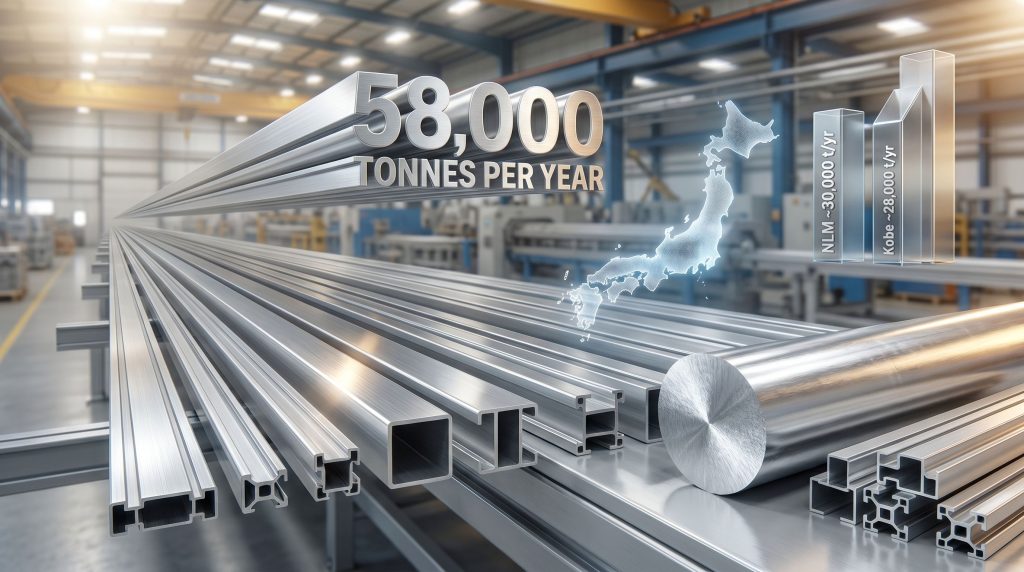
| Aluminium Extrusion Division (incl. Nikkeikin Aluminium Core Technology) | Nippon Light Metal | ~30,000 t/yr | Transport equipment, industrial machinery, containers |
| Chofu Works Aluminium Extrusion Unit | Kobe Steel | ~28,000 t/yr | Automotive components, railway vehicles, general distribution |
| Combined Entity | Joint Holding Company | ~58,000 t/yr | Broad industrial and transport portfolio |
The combined annual volume of approximately 58,000 tonnes makes the new entity a considerably more substantial domestic presence in Japan's extrusion landscape. Nippon Light Metal Holdings will hold a majority stake in the joint holding company, giving it strategic and operational control, while Kobe Steel retains a minority interest that preserves its financial exposure to the sector without the full burden of standalone operation.
The Kobe Steel assets being transferred include not just its extrusion operations at Chofu Works, but also its billet casting division, processed product operations, and domestic sales divisions, making this a substantive operational consolidation rather than a superficial holding arrangement.
Why Kobe Steel's Position Made Collaboration Necessary
Understanding the strategic logic of this deal requires examining Kobe Steel's position honestly. In a management briefing covering the fiscal period from April 2024 to March 2026, Kobe Steel disclosed that its aluminium extrusion business had recorded weakening earnings, with falling order volumes identified as the primary cause. The company had publicly flagged that it was evaluating collaboration options to restore long-term competitiveness.
This integration represents the outcome of that strategic review, offering Kobe Steel a path to preserve its presence in aluminium extrusion without bearing the full financial weight of a standalone recovery effort.
For Kobe Steel, the decision reflects a broader strategic reality that many Japanese industrial companies have confronted: it is possible to have genuinely differentiated technical capabilities in areas like alloy development and still face structural disadvantage at the business unit level when order volumes are insufficient to absorb fixed costs. Kobe Steel's Chofu Works, with approximately 28,000 tonnes per year in sales, is capable but not at the scale required for efficient standalone capital investment and R&D deployment in today's competitive environment.
The Complementarity Logic: Why These Two Companies Fit Together
Not all consolidation creates strategic value. The question that matters is whether the combination produces capabilities that neither party could develop alone at comparable cost and speed. In this case, the fit is genuinely complementary rather than duplicative.
- Nippon Light Metal brings advanced processing technology, a broad and diversified order base across transport and industrial end markets, and the infrastructure of the Nikkeikin Aluminium Core Technology unit
- Kobe Steel's Chofu Works contributes deep alloy development expertise, specialisation in automotive components, and established relationships in the railway and high-specification distribution markets
- Together, the combined entity gains a vertically integrated technical capability spanning from billet casting through to finished extrusion and processed products
- The breadth of Nippon Light Metal's order base reduces revenue concentration risk for the new entity, while Kobe Steel's higher-specification automotive and railway exposure adds margin quality to the portfolio
The integration also targets three concrete operational improvements: standardisation of capital investment across facilities, shared deployment of technical expertise to reduce duplicated R&D costs, and improved aluminium scrap collection and recycling infrastructure. In addition, similar moves such as the aluminium joint venture between other major players demonstrate that this kind of structural collaboration is becoming an industry-wide response to shared pressures.
Aluminium Scrap and the Circular Economy Dimension
The scrap recovery objective embedded in this deal deserves particular attention, because it reflects pressures that extend beyond cost management into regulatory and commercial sustainability. Japan already operates one of the world's most efficient aluminium recycling systems for consumer products. Its used beverage can recycling rate exceeds 90%, placing it among the global leaders in this metric.
However, industrial scrap recovery within extrusion manufacturing remains a more complex challenge. Extrusion processes generate various forms of scrap, including press scrap, machine scrap, and process rejects, each with different alloy compositions that must be carefully managed to maintain the quality of recycled billet. At the scale of approximately 58,000 tonnes per year, the combined entity will have a far stronger economic and logistical foundation for investing in closed-loop scrap recovery systems than either company could justify independently.
This matters commercially because secondary aluminium production requires roughly 95% less energy than primary smelting, a critical advantage for Japanese producers who bear the full cost of imported energy and primary metal. A more efficient scrap circuit directly improves the cost competitiveness of the combined entity relative to both regional peers and domestic competitors still operating fragmented scrap handling. Consequently, efforts such as Nippon Light Metal's initiative to import recycled aluminium from India further illustrate how seriously the company takes its circular economy commitments.
The next major ASX story will hit our subscribers first
The EV Transition as a Long-Term Demand Driver
Aluminium extrusion plays a role in electric vehicle manufacturing that is frequently underappreciated outside the industry. The EV manufacturing shift is rapidly reshaping demand patterns for high-specification aluminium profiles, placing new technical demands on producers. The specific applications include:
- Battery enclosures and housings — requiring precise extrusion profiles with tight dimensional tolerances and specific alloy properties for thermal and structural performance
- Structural frame components — where extruded aluminium provides high strength-to-weight ratios critical for extending EV range
- Thermal management systems — including coolant channels and heat exchanger components where aluminium extrusion geometry directly affects thermal efficiency
- Crash management systems — where the energy absorption characteristics of specific aluminium alloys and extrusion profiles are engineered for safety performance
Japan's automotive sector, a primary customer for both companies, is undergoing its own structural transformation toward electrification. The combined entity's strengthened alloy development capability, drawn from Kobe Steel's expertise, combined with Nippon Light Metal's processing technology, positions it to engage with the increasingly demanding technical specifications that EV manufacturers are requiring from their extrusion suppliers. Furthermore, the growing battery materials demand across the electric vehicle supply chain is adding further momentum to aluminium's role in next-generation vehicle architectures.
The EV transition does not simply increase aluminium demand in aggregate. It shifts demand toward higher-specification, more technically complex extrusion profiles, exactly where a capability-pooled entity has an advantage over smaller, less technically resourced producers.
Timeline and Path to Operational Integration
The companies have established a clear milestone sequence for bringing the new entity into operation:
| Milestone | Target Date |
|---|---|
| Public announcement of integration intent | 15 June 2026 |
| Signing of definitive binding agreement | By end of November 2026 |
| Commencement of integrated entity operations | April 2027 or later |
During the transition period, both companies' extrusion divisions are expected to continue operating independently. Japanese antitrust review processes for business unit integrations in concentrated industrial sectors will need to be completed, and Japan's established practice of substantive labour consultation means that union engagement is likely to be a meaningful component of the timeline rather than a formality.
The joint holding company structure was almost certainly chosen in part because it is less likely to trigger complex regulatory review than a full corporate merger, while still achieving the operational integration objectives. This reflects a sophisticated understanding of how to structure consolidation in Japan's regulatory environment. For instance, efforts such as the aluminium operations repower undertaken by major global producers demonstrate that capital-intensive restructuring at scale is increasingly a prerequisite for long-term competitiveness across the sector.
What This Signals for Japan's Remaining Extrusion Producers
The creation of a combined entity at approximately 58,000 tonnes per year is not merely an event between two companies. It recalibrates the competitive benchmark for the entire domestic extrusion sector.
Smaller independent Japanese extrusion producers now face a more formidable domestic competitor with superior capital investment capacity, broader technical capabilities, and improved scrap economics. The realistic responses available to them are limited:
- Pursue their own consolidation partnerships with peers before the competitive pressure intensifies further
- Identify and commit to defensible niche specialisations where technical depth can sustain margins without scale advantages
- Seek integration arrangements with downstream customers, particularly in automotive, to secure volume through supply chain alignment rather than open market competition
The broader implication is that the decision to have Nippon Light Metal and Kobe Steel merge aluminium units may well function as a catalyst for a second wave of consolidation among Japan's mid-tier extrusion producers within the next three to five years.
Frequently Asked Questions
Is this a full corporate merger between Nippon Light Metal and Kobe Steel?
No. This is a targeted business unit integration covering only the aluminium extrusion divisions of each company. The parent organisations remain separately listed and independently operated. The integrated business will function under a joint holding company structure, with Nippon Light Metal Holdings holding the majority stake.
What is the combined annual production volume of the merged entity?
The two contributing units bring approximately 30,000 t/yr from Nippon Light Metal and approximately 28,000 t/yr from Kobe Steel's Chofu Works, for a combined total of roughly 58,000 tonnes per year.
Why did Kobe Steel pursue this integration rather than continue independently?
Kobe Steel's aluminium extrusion division disclosed weakening earnings attributed to declining order volumes in its management briefing covering the April 2024 to March 2026 fiscal period. The company had identified collaboration with a complementary partner as its preferred route to restoring long-term competitiveness, and this integration is the result of that process.
When will the combined entity begin operations?
The companies are targeting finalisation of a definitive agreement by the end of November 2026, with the integrated entity commencing operations in April 2027 or later, subject to regulatory and structural requirements.
How does aluminium scrap recovery factor into the deal rationale?
Improved scrap collection and recycling is one of the three core operational objectives of the integration. At combined scale, the entity will be better positioned to invest in closed-loop scrap systems, which reduce energy costs significantly compared to primary aluminium processing and improve overall cost competitiveness.
Readers seeking broader context on aluminium market dynamics and global metals industry trends can access ongoing reporting through Argus Media's metals market coverage, which provides pricing, analysis, and market intelligence across base metals and industrial manufacturing sectors. This article contains forward-looking assessments and structural analysis that involve assumptions about market dynamics. These perspectives should not be construed as financial advice.
Want to Track the Next Major Mineral Discovery Before the Market Does?
Discovery Alert's proprietary Discovery IQ model delivers real-time alerts on significant ASX mineral discoveries, transforming complex mineral data into clear, actionable insights for both short-term traders and long-term investors — explore historic discoveries and their returns to understand the opportunity, then begin your 14-day free trial at Discovery Alert to position yourself ahead of the broader market.