June 17, 2026
Offshore West Africa and the Challenge of Mature Field Management
In mature offshore oil basins, the most persistent challenge facing independent operators is not exploration risk, but the gradual erosion of production rates from ageing wells. Reservoir pressure declines, water cut increases, and the economics of individual wells shift from highly productive to marginal over multi-year cycles. For independent producers operating in West Africa, managing this natural decline through disciplined well placement and reservoir targeting is the difference between a portfolio that grows and one that quietly shrinks. Vaalco Gabon well production in 2026 offers a compelling case study in how targeted development drilling in proven reservoirs can sharply reverse this trend.
When big ASX news breaks, our subscribers know first
Vaalco Gabon Well Production: What the Ebouri-5H Numbers Actually Mean
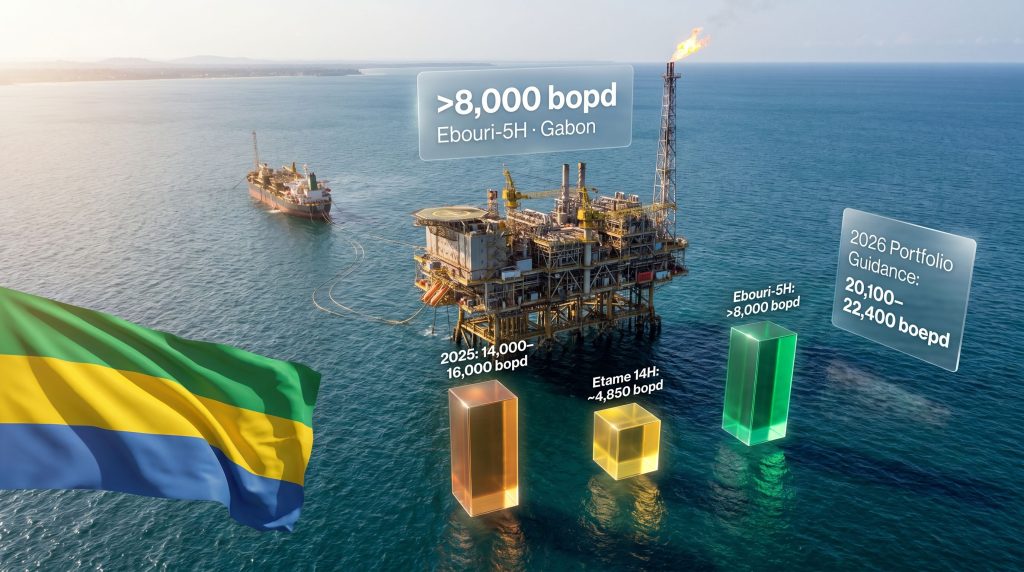
The Ebouri-5H development well, drilled in the offshore Ebouri field within Gabon's Etame Marin block, began producing at a rate exceeding 8,000 gross barrels of oil per day (bopd) following completion. With Vaalco holding a 58.8% working interest as the designated operator of the block, approximately 4,700 bopd accrues net to the company from this single well.
Those figures deserve context. A single development well delivering nearly 4,700 bopd net to operator is a meaningful result in any offshore environment, but particularly notable in a mature Gabonese block where natural decline had been eroding baseline output for several years. For reference, Vaalco's total Gabon production across all assets sat at roughly 14,000 to 16,000 bopd through 2025 — meaning Ebouri-5H alone adds net production equivalent to roughly 30% of the prior-year Gabon total.
| Metric | Ebouri-5H | Etame 14H (April 2026) |
|---|---|---|
| Gross Initial Production Rate | >8,000 bopd | ~4,850 bopd |
| Net to Vaalco (bopd) | ~4,700 | ~2,850 |
| Reservoir Interval | Gamba Sands | Gamba Sands |
| Net Pay Thickness | ~300 metres | ~325 metres |
| Water Cut | Very Low | Not disclosed |
| Field Location | Offshore Ebouri Field | Main Fault Block, Etame Field |
| Vaalco Working Interest | 58.8% | 58.8% |
The very low water cut recorded at Ebouri-5H carries particular operational significance. Water cut is a ratio that measures how much of a well's produced fluid is water rather than oil. In older offshore wells, rising water cut is often the first indicator that a reservoir's most productive zones are being depleted. A very low water cut at initial production suggests Ebouri-5H is perforating a structurally elevated portion of the Gamba reservoir, where buoyancy keeps oil concentrated and water influx remains limited. This translates directly into lower fluid handling costs and a longer high-rate production phase before decline sets in.
The Gamba Sands Reservoir: Why This Formation Repeatedly Delivers
Both wells drilled across Vaalco's 2026 Gabon campaign penetrated the Gamba sandstone formation, a sedimentary reservoir unit that has been the primary production target across the Etame Marin block since Vaalco commenced operations in 2002. Understanding why this formation continues to support strong initial flow rates requires a brief look at its geological characteristics.
Porosity, Permeability, and Net Pay Thickness
Sandstone reservoirs are valued in oil exploration importance for two key properties: porosity (the volume of pore space available to store hydrocarbons) and permeability (the ability of fluids to flow through connected pore spaces toward the wellbore). The Gamba sands in the Etame Marin block are well-characterised in both respects, having been extensively studied across Vaalco's multi-decade operational history. The thick net pay intervals recorded in 2026 — 300 metres in Ebouri-5H and 325 metres in Etame 14H — indicate that productive reservoir rock extends continuously across substantial vertical intervals rather than being confined to isolated thin beds.
This matters for production longevity. Thicker pay zones provide larger hydrocarbon volumes in place per wellbore, reducing the rate at which reservoir pressure depletes and supporting sustained production rates over longer periods before artificial lift or enhanced recovery techniques become necessary.
Structural Position and Its Impact on Well Performance
Despite having slightly thinner net pay than Etame 14H, Ebouri-5H delivered a significantly higher initial production rate, exceeding the April 2026 Etame well's output by approximately 65% on a gross basis. This divergence almost certainly reflects differences in structural position within the Gamba reservoir. Wells placed higher on a structural trap, closer to the crest of an anticline or fault block, encounter reservoir conditions where natural pressure drives oil toward the wellbore more efficiently, and where the oil-water contact is furthest below the perforations. The very low water cut at Ebouri-5H strongly supports this interpretation.
Reservoir pressure and completion design, including perforation intervals, completion fluids, and stimulation methods, also contribute to initial production differences between wells in the same formation. Given Vaalco's two decades of operational data from the Etame Marin block, the company's engineering teams have accumulated substantial subsurface intelligence that informs how and where each successive well is positioned.
Side-by-Side: 2026 Gabon Well Comparisons
| Comparison Factor | Ebouri-5H | Etame 14H |
|---|---|---|
| Announced | June 2026 | April 2026 |
| Gross Production Rate | >8,000 bopd | ~4,850 bopd |
| Net Production Rate | ~4,700 bopd | ~2,850 bopd |
| Net Pay (metres) | ~300 | ~325 |
| Reservoir | Gamba Sands | Gamba Sands |
| Field | Ebouri | Etame (Main Fault Block) |
| Campaign Sequence | Second Gabon well, 2026 | First Gabon well, 2026 |
Together, Ebouri-5H and Etame 14H contribute approximately 7,550 bopd net to Vaalco's 2026 portfolio from Gabon alone, representing a material portion of the company's full-year guidance range of 20,100 to 22,400 barrels of oil equivalent per day across all assets.
The ETBNM-3 Well: Gas-to-Power as a Cost Reduction Strategy
After completing Ebouri-5H, Vaalco's drilling rig was relocated to the SEENT platform to drill the ETBNM-3 well, which targets natural gas accumulations in proximity to the existing production infrastructure. While this well will not contribute crude oil volumes, its strategic logic is compelling and often underappreciated in coverage of the broader campaign.
Offshore oil operations in remote locations typically rely on diesel-powered generators or diesel fuel transported by supply vessel to run platform equipment, including pumps, compressors, and accommodation systems. Diesel marine logistics add meaningful cost per barrel to offshore production, particularly in West African locations where vessel transit distances and port infrastructure variability can inflate supply chain expenses.
If ETBNM-3 encounters commercially viable gas volumes, Vaalco would be positioned to:
- Redirect produced gas through existing pipelines to power FPSO or platform facilities directly
- Eliminate or substantially reduce the frequency and volume of diesel fuel shipments by vessel
- Lower the operating cost per barrel across the entire Etame Marin block, not just at the SEENT platform
- Reduce the carbon intensity of offshore operations, which is increasingly scrutinised by institutional investors and lenders assessing ESG performance of oil and gas operators
This gas-to-power logic is a well-established cost optimisation strategy in mature offshore basins. In the North Sea, for instance, operators have converted produced gas to electricity for decades, substantially lowering operating expenditures on mature fields that would otherwise be marginal. The same principle applies in Gabon, where a successful ETBNM-3 result could extend the economic life and improve the per-barrel margin of the broader Etame Marin production system.
Reversing Gabon's Production Decline: The Recovery Math
Vaalco's Gabon operations had experienced measurable output erosion leading into 2026, consistent with the natural depletion dynamics of a field that has been producing continuously since the early 2000s. The company's 2025 annual results disclosed a Gabon production range of approximately 14,000 to 16,000 bopd, a baseline that management publicly identified as requiring active intervention. Furthermore, the commodity prices impact on revenue projections made addressing this decline all the more commercially urgent.
The 2026 drilling campaign was constructed specifically to arrest this decline and rebuild the production base toward a target range of 20,000 to 23,000 bopd from Gabonese assets alone.
| Period | Gabon Production Range (bopd) | Status |
|---|---|---|
| 2025 (Annual Reported) | 14,000 to 16,000 | Declining baseline |
| 2026 Gabon Target | 20,000 to 23,000 | Recovery target |
| 2026 Full Portfolio Guidance | 20,100 to 22,400 boepd | Confirmed guidance |
Hitting the top of the 2026 Gabon range would represent production growth of approximately 44% from the midpoint of 2025 actuals. With Ebouri-5H and Etame 14H both online and delivering strong initial rates, the probability of reaching the upper end of the target band improves materially. The 2026 Gabon target also requires sustaining these rates over the full year, which underscores the significance of reservoir quality indicators like net pay thickness and low water cut — both of which favour extended high-rate production at Ebouri-5H.
The next major ASX story will hit our subscribers first
Vaalco's Three-Front African Expansion: Egypt, Côte d'Ivoire, and Gabon Simultaneously
What distinguishes Vaalco's 2026 activity from prior years is the simultaneous execution of growth programmes across three distinct African operating environments, each at a different stage of development maturity. However, the geopolitical landscape across these regions adds an additional layer of complexity that operators must navigate carefully alongside their subsurface planning.
1. Gabon (Etame Marin Block)
- Two wells online as of mid-2026: Etame 14H (April) and Ebouri-5H (June)
- Third well (ETBNM-3) underway at the SEENT platform, targeting gas reserves
- 2026 Gabon production target: 20,000 to 23,000 bopd
2. Egypt
- First well of the 2026 Egypt drilling programme brought into production following 2025 campaign success
- Continued drilling planned throughout the remainder of the 2026 calendar year
- Egypt operations provide geographic and fiscal diversification against Gabon-specific risks
3. Côte d'Ivoire (Baobab Field)
- The Baobab field resumed production after a 17-month planned shutdown for floating production vessel refurbishment
- Four wells restarted at field resumption; three additional wells expected online in the near term
- A five-well drilling programme at Baobab is planned for the second half of 2026
The Baobab field restart deserves particular attention. A 17-month shutdown for FPSO refurbishment is a significant operational undertaking, and the decision to pair the restart with a five-well H2 drilling programme signals strong confidence in the field's subsurface potential following the vessel upgrade. Refurbished FPSO capacity effectively resets the production ceiling for an offshore field, enabling the operator to accommodate higher fluid throughput from new wells without infrastructure constraints.
Vaalco's CEO George Maxwell noted that the company had achieved numerous significant operational milestones across its African portfolio since the beginning of 2026, with the Baobab restart, Gabon well results, and Egypt programme advancing concurrently.
The 2030 Target: What 225% Organic Growth Actually Requires
Vaalco's stated objective of 225% organic production growth by 2030 is an ambitious multi-year commitment that depends on sustained execution across its four-country African footprint. Achieving it requires sound risk management across all operating jurisdictions, in addition to strong drilling results. Consequently, the company's planning must account for:
- Sustained drilling success in Gabon, including potential additional wells beyond the 2026 campaign
- Continued well additions in Egypt across 2026 and subsequent years
- Full production ramp-up at Baobab following the five-well 2026 programme
- Ongoing production maintenance from Equatorial Guinea operations
| Country | 2026 Activity | Role in 2030 Growth Architecture |
|---|---|---|
| Gabon | 2 wells online + gas well drilling | Core production base recovery and optimisation |
| Egypt | 2026 programme commenced | Incremental volume additions year-on-year |
| Côte d'Ivoire | Baobab restart + 5-well H2 programme | New production layer added to portfolio |
| Equatorial Guinea | Ongoing operations | Baseline volume maintenance |
The 2026 operational year is particularly important in this trajectory because it resets the production baseline from which future growth is measured. A stronger 2026 base, driven by results like Ebouri-5H, effectively lowers the compound annual growth rate required to hit 225% by 2030.
Vaalco's Operational Tenure in Gabon: Two Decades of Subsurface Knowledge
Vaalco has maintained continuous offshore operations in Gabon since 2002, giving the company over two decades of subsurface data, production history, and reservoir characterisation across the Etame and Ebouri fields. This operational longevity is a competitive advantage that is often overlooked when assessing independent operators in frontier or emerging oil provinces.
Long-tenure operators in mature offshore blocks accumulate seismic reprocessing datasets, well log libraries, production decline curves, and fluid composition analyses that enable progressively more precise well placement with each successive drilling campaign. The strong Vaalco Gabon well production performance from both 2026 wells, particularly Ebouri-5H's structurally advantaged position within the Gamba reservoir, reflects the depth of geological intelligence Vaalco has built over 24 years of continuous operations on the block.
| Country | Key Asset | Role | Operational Since |
|---|---|---|---|
| Gabon | Etame Marin Block (Etame and Ebouri Fields) | Operator | 2002 |
| Egypt | Active block(s) | Operator | Active |
| Côte d'Ivoire | Baobab Field | Operator | Active |
| Equatorial Guinea | Active block(s) | Participant | Active |
Key Takeaways for Investors and Industry Observers
- Ebouri-5H is Vaalco's strongest single-well result in Gabon in several years, with gross output exceeding 8,000 bopd and net production of approximately 4,700 bopd
- Reservoir fundamentals at the Gamba sands formation — characterised by thick net pay intervals exceeding 300 metres and a very low water cut at Ebouri-5H — support a sustained production profile rather than a rapid initial-rate decline
- The ETBNM-3 gas well represents a structural cost reduction opportunity that extends beyond volume growth, with potential to materially lower per-barrel operating costs across the entire block
- Multi-country execution across Gabon, Egypt, and Côte d'Ivoire simultaneously reduces the company's dependence on any single asset and accelerates the cumulative production base needed for the 2030 target
- The 2026 Gabon production recovery, from a 2025 baseline of 14,000 to 16,000 bopd toward a target of 20,000 to 23,000 bopd, represents a structural inflection point driven primarily by targeted development drilling in proven, high-quality reservoir rock. A definitive feasibility study framework, applied to analogous development programmes, further illustrates why rigorous pre-drill analysis underpins these kinds of results
This article is intended for informational purposes only and does not constitute financial advice. All production figures, forward-looking targets, and guidance ranges are sourced from publicly available company disclosures. Investors should conduct independent due diligence before making any investment decisions. Production rates mentioned represent initial rates and are not necessarily indicative of sustained long-term performance.
Want to Spot the Next Major Mineral Discovery Before the Market Does?
While Vaalco's disciplined development drilling demonstrates how proven reservoirs can deliver transformative production growth, Discovery Alert's proprietary Discovery IQ model scans ASX announcements in real time to identify significant mineral discoveries the moment they are made public — explore historic discovery returns on Discovery Alert's dedicated discoveries page and begin your 14-day free trial to position yourself ahead of the broader market.