June 17, 2026
The Hidden Knowledge Crisis Reshaping How Mining Trains Its Next Generation
Few industries carry a more acute awareness of the gap between what universities teach and what mine sites actually demand. Across the globe, operational technology is advancing faster than academic curricula can adapt, and the consequences are beginning to compound. Automation systems now manage tasks that once required entire crews of engineers. Furthermore, AI in mineral exploration is rewriting the methodology of geological exploration. The pressure to decarbonise extractive operations is forcing a generation of professionals to master competencies that simply did not exist when their degree programs were designed.
This is the structural backdrop against which the World Mining Congress 2026 arrives in Lima, Peru, carrying with it a genuinely novel institutional experiment: the World Mining Congress Alameda de la Academia, a dedicated academic corridor embedded within one of the world's most significant mining industry gatherings.
When big ASX news breaks, our subscribers know first
What Is the Alameda de la Academia and Why Does It Matter?
The Alameda de la Academia is not a university pavilion in the conventional trade-show sense. It is a purpose-built knowledge-exchange environment integrated directly into the congress floor, designed to function as a structural bridge between educational institutions and the operational realities of modern mining.
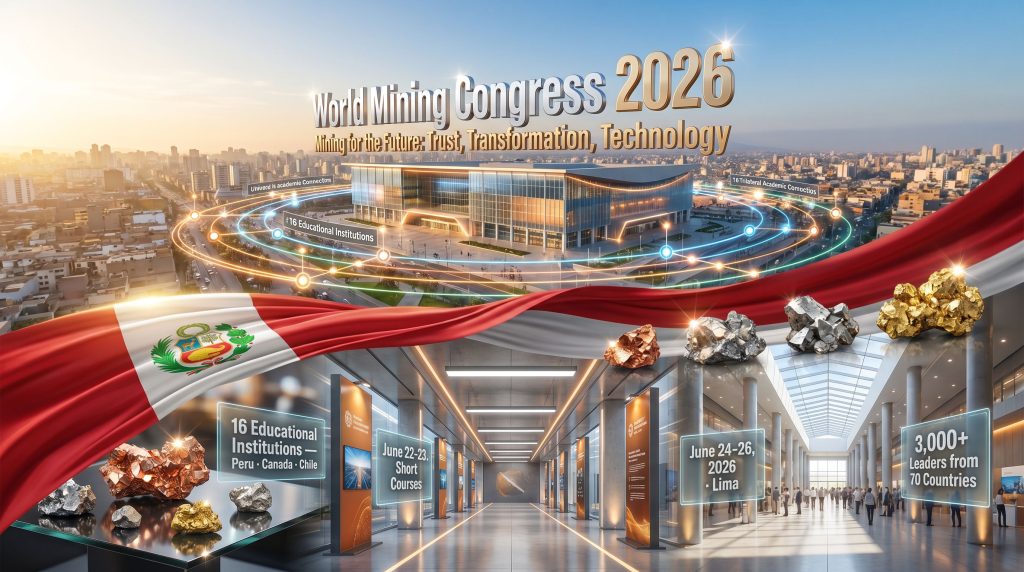
Sixteen institutions from Peru, Canada, and Chile are confirmed participants, making this one of the most geographically and institutionally diverse academic inclusions ever embedded into a global mining congress. The initiative is organised by the Institute of Mining Engineers of Peru (IIMP), the body responsible for the WMC2026 overall.
The Alameda de la Academia functions as a structured knowledge-transfer environment connecting undergraduate and postgraduate students, academic researchers, industry professionals, and institutional partners exploring collaborative research frameworks, all within a single congress setting.
What distinguishes this model from a standard academic side-event is its integration into the core congress architecture. Students and researchers are not attending a peripheral symposium. They are participating in the same physical and intellectual space as the executives, engineers, and policymakers shaping the global industry.
World Mining Congress 2026: Event Context and Core Parameters
WMC2026 returns the congress to Peru for the first time in more than five decades, a detail that carries considerable symbolic and strategic weight. Peru ranks among the world's leading producers of copper, zinc, gold, and silver, and its mining sector is undergoing an active period of regulatory, technological, and social transformation. Lima's selection as host reflects the country's enduring centrality to global resource supply chains.
Core Event Details at a Glance
| Parameter | Detail |
|---|---|
| Event Name | World Mining Congress 2026 (WMC2026) |
| Dates | June 24–26, 2026 |
| Venue | Lima Convention Center, Calle del Comercio 192, San Borja, Lima, Peru |
| Organizer | Institute of Mining Engineers of Peru (IIMP) |
| Expected Attendance | 3,000+ leaders from 70 countries |
| Congress Theme | Mining for the Future: Trust, Transformation, Technology |
| Alameda Institutions | 16 educational institutions from Peru, Canada, and Chile |
The congress theme, Mining for the Future: Trust, Transformation, Technology, is not marketing language. Each of the three pillars maps directly onto a structural challenge that the global extractive industry is actively navigating:
- Trust relates to social licence dynamics, environmental transparency, and the growing sophistication of community opposition to poorly managed mining operations
- Transformation reflects the energy transition imperative and the role of critical minerals such as copper, lithium, cobalt, and nickel in decarbonising global infrastructure
- Technology addresses the operational revolution underway in AI-driven exploration, digital twin mine planning, fleet electrification, and remote operational management
The Full Academic Roster: 16 Institutions Across Three Nations
One of the more analytically significant features of the World Mining Congress Alameda de la Academia is its geographic distribution within Peru. Rather than concentrating on Lima-based prestige institutions, the programme incorporates universities anchored in Peru's most active mining regions.
Peruvian Institutions
Lima-based universities and technical institutes:
- Universidad de Ingeniería y Tecnología (UTEC)
- Pontificia Universidad Católica del Perú (PUCP)
- Universidad Nacional Mayor de San Marcos (UNMSM)
- Universidad Nacional de Ingeniería (UNI)
- TECSUP
- CETEMIN
- Universidad Nacional Agraria La Molina (UNALM)
Regional institutions in active mining zones:
- Universidad Nacional de Cajamarca
- Universidad Nacional de Moquegua (UNAM)
- Universidad Nacional de San Agustín de Arequipa (UNSA)
- Universidad Continental (Arequipa)
- Universidad Nacional de Juliaca
- Universidad Nacional de Trujillo
The inclusion of institutions from Cajamarca, Arequipa, Moquegua, Juliaca, and Trujillo is worth pausing on. These are not administrative centres. They are regions where Peru's actual mining extraction occurs, where environmental tensions most frequently surface, and where local workforce development has the most direct operational relevance. Placing their universities in the same corridor as Lima's leading technical faculties creates a genuinely representative national knowledge network.
International Institutions
| Country | Institution | Core Focus Area |
|---|---|---|
| Canada | University of Alberta | Mining engineering, resource economics, environmental science |
| Canada | Fleming College | Applied environmental and mining technology programmes |
| Chile | Sustainable Minerals Institute (SMI) | Applied research, sustainability, and responsible mining practice |
The Canadian and Chilean presence introduces a trilateral Americas dimension. Canada and Chile both maintain world-class mining research ecosystems, and their inclusion signals that the Alameda de la Academia is not a domestically focused initiative but a genuinely international knowledge corridor spanning the hemisphere's three most consequential mining geographies.
The Pre-Congress Short-Course Programme: June 22–23, 2026
Running two days before the official congress opening, a structured short-course programme delivers intensive professional training in subject areas that are increasingly central to competitive mining operations.
Programme Formats
| Format | Duration | Designed For |
|---|---|---|
| Intensive Short Course | 4 hours | Professionals seeking targeted competency updates |
| Extended Short Course | 8 hours | Executives and researchers requiring deeper technical grounding |
Key Subject Domains
The curriculum is oriented around four areas of critical industry relevance:
- Artificial intelligence in mining exploration — covering machine learning applications for geological modelling, resource estimation, and drill target generation
- AI-driven safety systems — predictive risk management, sensor-based hazard detection, and incident prevention technologies applicable to both surface and underground operations
- Sustainability and ESG frameworks — operational decarbonisation pathways, water stewardship in arid mining environments, and community engagement methodologies
- Risk management in extractive operations — encompassing geopolitical exposure, environmental liability assessment, and financial risk modelling across project lifecycles
All participants completing these courses receive certification validated by the IIMP, providing formal professional recognition across Latin American mining jurisdictions. Course attendees also gain priority access to networking sessions with international specialists and are positioned for introductions to strategic collaboration and technology transfer opportunities.
Why the Talent Gap in Mining Is More Complex Than It Appears
The mining industry's workforce challenge is frequently framed as a simple numbers problem: not enough engineers. The reality is considerably more nuanced. The sector faces three converging pressures that interact and amplify each other:
- Demographic pressure — A significant proportion of senior geologists, metallurgists, and mining engineers are approaching retirement age across major jurisdictions, including Australia, Canada, and the United States, compressing the knowledge transfer window
- Technology acceleration — Automation, remote operations, and AI in mining operations require competencies that are rarely covered in traditional mining engineering programmes, creating a growing skills mismatch even among recent graduates
- ESG complexity — The demands placed on mining professionals now extend well beyond technical disciplines to include environmental impact assessment, indigenous land rights, greenhouse gas accounting, and investor-facing sustainability reporting
The challenge is not simply hiring more engineers. It is fundamentally about whether academic programmes can produce professionals who combine hard technical skills with digital fluency and cross-disciplinary sustainability literacy within a compressed training timeframe.
The World Mining Congress Alameda de la Academia model, by embedding research institutions alongside technical and applied training within an active industry congress, attempts to compress this competency development cycle. Students and researchers gain direct exposure to the industry's operational challenges and emerging priorities, while industry participants gain visibility into the next generation of technical talent and the applied research being developed in universities.
The next major ASX story will hit our subscribers first
How WMC2026's Academic Model Compares to Conventional Mining Conferences
| Feature | Standard Mining Conference | WMC2026 Alameda de la Academia |
|---|---|---|
| Academic presence | Occasional panel sessions | Dedicated corridor with 16 institutions |
| Student engagement | Limited or entirely absent | Structured access and participation pathways |
| Certification | Rarely offered | IIMP-validated credentials |
| Research transfer | Ad hoc and informal | Structured applied research showcase |
| Geographic representation | Typically capital-city concentrated | National and international multi-region coverage |
| Pre-congress training | Uncommon | Two-day intensive programme with global specialists |
This comparison illustrates that WMC2026 is not incrementally improving an existing format. It is introducing a structurally different model for how an industry congress integrates knowledge development. In fact, PDAC conference insights from earlier in 2025 similarly highlighted the growing demand for structured knowledge-transfer environments within major mining gatherings.
The Applied Research Dimension: What Labs Are Bringing to the Mining Floor
One aspect of the Alameda de la Academia that deserves closer attention is its function as a conduit for applied research transfer. In most mining conference formats, laboratory-stage research reaches operational professionals through journal publications or academic presentations that occur in separate forums. The integration of research institutions into the congress floor compresses this timeline considerably.
Areas where applied research is most urgently needed in modern mining operations include:
- Geometallurgical modelling — the integration of geological, mineralogical, and metallurgical data to predict processing behaviour from resource-stage data, reducing costly surprises during production ramp-up
- Tailings management innovation — particularly dry-stack tailings technologies and real-time geotechnical monitoring systems responding to the global regulatory tightening following high-profile failures
- Predictive equipment maintenance — machine learning systems trained on vibration, thermal, and operational data to prevent unplanned downtime, which in large-scale copper operations can represent tens of millions of dollars per incident
- Water circuit optimisation — critical in Peru's high-altitude arid mining regions, where water availability is simultaneously an operational constraint and a community relations flashpoint
However, the broader picture extends beyond operations alone. Mining electrification and decarbonisation are increasingly shaping what research institutions prioritise, and renewable energy in mining is fast becoming a standalone field of applied study in its own right.
Audience Value Map: Who Should Be at the Alameda de la Academia
| Attendee Profile | Primary Value Gained |
|---|---|
| Mining engineering students | Direct exposure to global industry standards and active employer networks |
| Academic researchers | Platform to present applied findings to operational decision-makers |
| Mid-career professionals | Certified upskilling in AI applications, sustainability, and risk management |
| University administrators | Partnership development with peer institutions and industry sponsors |
| Industry executives | Visibility into emerging talent pipelines and collaborative research opportunities |
Frequently Asked Questions: WMC2026 and the Alameda de la Academia
What is the Alameda de la Academia at WMC2026?
The Alameda de la Academia is a dedicated academic zone within the World Mining Congress 2026, hosted at the Lima Convention Center from June 24–26, 2026. It brings together 16 universities, technical institutes, and research centres from Peru, Canada, and Chile to create a structured knowledge-exchange environment operating within the congress itself.
How many institutions are confirmed for the Alameda de la Academia?
Sixteen institutions are confirmed, comprising 13 Peruvian universities and technical institutes spanning Lima and major mining regions, alongside two Canadian universities — the University of Alberta and Fleming College — and the Sustainable Minerals Institute from Chile.
When does the pre-congress short-course programme take place?
The specialised short-course programme runs on June 22 and 23, 2026, immediately before the official congress opening. Courses are structured in 4-hour and 8-hour intensive formats covering artificial intelligence in mining, safety systems, sustainability frameworks, and risk management.
Who certifies the short courses?
Certification is issued by the Institute of Mining Engineers of Peru (IIMP), the congress organiser and a recognised professional body across Latin American mining jurisdictions.
What makes Peru a significant host for WMC2026?
Peru is among the world's top producers of copper, zinc, gold, and silver. The return of the 27th World Mining Congress to Peru after more than 50 years reflects the country's continued centrality to global resource supply chains and its ongoing role in shaping Latin American mining practice and policy.
Key Takeaways: The Strategic Significance of WMC2026's Academic Corridor
- The Alameda de la Academia represents a structural evolution in how a global mining congress integrates academic knowledge with operational industry practice
- With 16 institutions spanning three countries and Peru's most active mining regions, the initiative creates a genuinely cross-sector knowledge network with national and international reach
- The pre-congress short-course programme running June 22–23 provides IIMP-certified professional development in subject areas directly relevant to the industry's most pressing technology and sustainability challenges
- The trilateral Americas knowledge corridor created by Peruvian, Canadian, and Chilean institutions reflects the geographic concentration of the world's most significant mining operations
- WMC2026's congress theme of Trust, Transformation, and Technology maps precisely onto the three structural challenges defining the current decade in global extractive industries
- Embedding regional Peruvian universities alongside Lima's leading technical faculties creates a nationally representative academic network that mirrors where mining actually happens on the ground
This article is informational in nature. Details regarding the WMC2026 programme, participant institutions, and event logistics are sourced from publicly available announcements. Readers seeking the most current event information are encouraged to consult the IIMP and official WMC2026 channels directly.
Want to Stay Ahead of the Next Major ASX Mineral Discovery?
Discovery Alert's proprietary Discovery IQ model delivers real-time alerts the moment significant mineral discoveries are announced on the ASX, turning complex geological data into clear, actionable insights for investors at every level — explore historic discovery returns on Discovery Alert's discoveries page to understand the scale of opportunity, then begin your 14-day free trial at Discovery Alert to position yourself ahead of the broader market.