June 17, 2026
The Industrial Economics of Steel Self-Sufficiency: Why Developing Nations Build Blast Furnaces
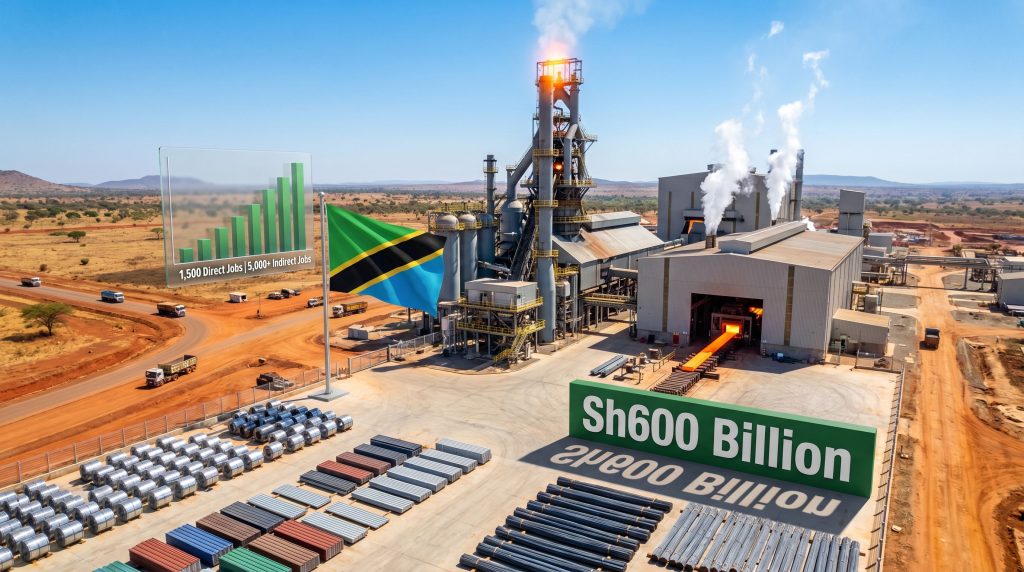
Across the arc of modern economic history, the transition from raw material exporter to finished goods manufacturer has consistently defined which nations escape the commodity trap and which remain locked inside it. Steel sits at the centre of this equation. It is not merely a construction input — it is the skeletal infrastructure of industrialisation itself, underpinning housing, transport corridors, agricultural equipment, and manufacturing capacity simultaneously. For East Africa, the absence of domestic integrated steel production has long represented a structural vulnerability, forcing countries to pay import premiums for a material their own geology can theoretically supply. Tanzania's move to change that calculus with a TZS 600 billion Tanzania integrated steel plant in Dodoma is a story that reaches well beyond a single facility.
When big ASX news breaks, our subscribers know first
Why Tanzania's Steel Import Dependency Creates an Urgent Industrial Problem
Tanzania, like most Sub-Saharan African economies, has historically sourced the bulk of its steel requirements from imports, primarily from China, India, and the Middle East. This dependency operates as a persistent economic drain on multiple levels simultaneously.
First, imported steel exposes domestic consumers and infrastructure developers to global price volatility. When international hot-rolled coil prices spike — as they did dramatically in 2021 and again during 2022 supply chain disruptions — Tanzanian construction costs rise in direct proportion, with no domestic buffer to absorb the shock. Second, the foreign exchange burden of steel imports competes with other import priorities, placing quiet pressure on Tanzania's current account.
Third, and perhaps most structurally significant, reliance on imported steel means that the value-addition layer of converting iron ore into usable product occurs entirely outside Tanzania's borders, despite the country possessing iron ore deposits of its own.
Structural Context: According to World Steel Association data, Sub-Saharan Africa accounts for a fraction of global crude steel outlook despite holding significant iron ore reserves across the continent. The gap between resource endowment and productive capacity represents one of the region's most consequential missed industrial opportunities.
This is the economic backdrop against which the Tanzania integrated steel plant in Dodoma must be understood — not as an isolated infrastructure project, but as a deliberate intervention in a long-running structural imbalance.
Project Snapshot: The Nala Facility at a Glance
The project, to be developed by A1 Iron & Steel Tanzania Ltd at the Nala area within Dodoma City, represents what its proponents describe as Tanzania's first fully integrated steelmaking operation. The essential parameters are outlined below.
| Parameter | Detail |
|---|---|
| Developer | A1 Iron & Steel Tanzania Ltd |
| Location | Nala Area, Dodoma City, Tanzania |
| Estimated Investment | TZS 600 billion (~Sh600 billion) |
| Primary Raw Material | Locally mined iron ore |
| Core Technology | Blast Furnace + Basic Oxygen Furnace (BOF) |
| Construction Commencement | July 2026 |
| Target Completion | Within 15 months of construction start |
| Direct Employment | Approximately 1,500 jobs |
| Indirect Employment | 5,000+ jobs across supply chains |
The Nala site's selection within Dodoma City is strategically coherent. Dodoma has evolved substantially from its origins as a designated administrative capital into a genuine logistics and infrastructure hub. Its central geographic positioning within Tanzania's national road and rail network makes it a viable anchor for heavy industry in a way that coastal alternatives, while port-adjacent, would not capture the interior market as efficiently.
Understanding What "Integrated" Actually Means in Steelmaking
The term integrated steel plant carries specific technical meaning that matters enormously for assessing this project's ambition and its economic implications.
The Difference Between Integrated and Mini-Mill Operations
Most steel production currently operating across East Africa relies on electric arc furnace (EAF) or semi-integrated models. These facilities melt scrap steel to produce finished products — a less capital-intensive approach that suits markets with abundant scrap supply. However, scrap-based production has inherent quality limitations for certain flat steel products, and it creates dependency on scrap availability rather than raw ore.
An integrated plant, by contrast, begins the production chain from iron ore itself, requiring no scrap feedstock. This matters for Tanzania because:
- It eliminates reliance on scrap markets, which are themselves subject to global price cycles
- It enables production of hot-rolled coil (HR coil), a base flat steel product that scrap-based EAF operations typically cannot produce cost-competitively
- It positions Tanzania to extract value from its own iron ore deposits rather than exporting them
- It creates the full domestic steel value chain from ore handling through to finished product manufacturing
The Blast Furnace to BOF Production Route: Step by Step
The technology pathway chosen for the Nala facility — blast furnace followed by Basic Oxygen Furnace steelmaking — is the dominant global route, accounting for approximately 70% of world crude steel output according to World Steel Association figures. Furthermore, the steel and iron ore outlook globally suggests this integrated route will remain dominant for decades to come. Here is how the process operates:
Stage 1: Ironmaking via Blast Furnace
Iron ore, coke (derived from coking coal), and limestone are charged into the blast furnace. Hot air blasted through the bottom of the furnace combusts the coke, generating intense heat and carbon monoxide. The carbon monoxide reduces iron oxides in the ore to produce molten iron, known as pig iron or hot metal, which pools at the furnace base. Limestone acts as a flux, combining with impurities to form slag, which floats above the iron and is tapped separately. Blast furnace operation is continuous, with temperatures exceeding 1,500 degrees Celsius maintained around the clock.
Stage 2: Steelmaking via Basic Oxygen Furnace
Molten iron from the blast furnace is transferred to the BOF converter, where a lance blows high-purity oxygen through the melt at supersonic velocity. This oxidises carbon and other impurities in the hot metal, raising the temperature further and converting pig iron into steel. The BOF heat cycle typically completes in roughly 30 to 40 minutes per charge, making it one of the most throughput-efficient steelmaking processes available at industrial scale. Steel composition is controlled by managing oxygen blow duration and adding alloy elements post-blow.
Stage 3: Casting, Rolling, and Downstream Finishing
Liquid steel from the BOF is continuously cast into billets or slabs, which are then processed through hot rolling mills to produce HR coil and flat products. Downstream finishing lines convert these intermediates into roofing sheets, wire rod, reinforcing mesh, binding wire, and nails — the specific product range the Nala facility is designed to manufacture.
The Product Mix and Why It Is Calibrated to Tanzania's Demand Profile
The selection of products planned for the Dodoma facility reflects a deliberate targeting of Tanzania's most acute domestic consumption gaps rather than a generic steel portfolio:
- Hot-rolled coil: The foundational intermediate for downstream manufacturing, used in everything from fabricated steel sections to pipe production
- Roofing sheets: Among Tanzania's highest-volume steel consumption categories given the country's ongoing urban housing construction wave
- Steel mesh and reinforcing bar: Essential inputs for the reinforced concrete construction method used across virtually all infrastructure and building development in the region
- Binding wire and nails: Finished consumer goods that currently represent significant import volumes for the construction sector
This product orientation means the facility is not positioned as an export-first operation but as one designed to displace import volumes that are already confirmed demand within Tanzania's domestic economy.
Tanzania's Mineral Beneficiation Strategy: The Policy Architecture Behind the Investment
Minister for Minerals Anthony Mavunde confirmed the project following a meeting with A1 Iron & Steel Tanzania Ltd investors in Dodoma, framing the investment within President Samia Suluhu Hassan's broader push to ensure that minerals extracted within Tanzania generate maximum in-country value rather than departing as raw commodities. You can read the full announcement details of the project directly from Tanzania's Daily News.
This is not isolated policy language. Tanzania has been systematically tightening the connection between extraction licences and domestic processing commitments across multiple mineral categories. The pattern is visible across the following areas simultaneously:
- Iron ore: The Dodoma integrated steel plant operationalises the principle of converting ore into manufactured products before any export consideration
- Graphite: Tanzania and Lindi Jumbo have recently advanced cooperation to expand graphite mining alongside processing capacity
- Rare earths: Recent rare earth discoveries in Tanzania have been framed explicitly within a processing-first framework
- Diamonds: Tanzania's diamond sector has been subject to reform conversations centred on retaining more value domestically
The consistency of this approach across commodities signals that the Dodoma steel project is not an exception but an expression of a durable and evolving policy architecture.
How Tanzania's Approach Compares to Regional Peers
| Country | Core Beneficiation Strategy | Representative Projects |
|---|---|---|
| Tanzania | Iron ore to steel; graphite processing; rare earth development | Dodoma steel plant; Lindi Jumbo graphite |
| Zimbabwe | Lithium and platinum processing mandates | Arcadia lithium; Zimplats downstream |
| Zambia | Copper smelting and refining retention | Konkola, Mopani copper infrastructure |
| DRC | Cobalt and copper processing incentives | Tenke Fungurume; Kamoa-Kakula |
| Ethiopia | Steel industrialisation through state-led entities | Metals and Engineering Corporation initiatives |
The next major ASX story will hit our subscribers first
The Employment and Economic Multiplier Effect
The job creation projections attached to this investment deserve careful analysis rather than simple citation. The approximately 1,500 direct operational roles represent a meaningful contribution to Dodoma's skilled industrial workforce, but the 5,000+ indirect jobs across logistics, transport, raw material sourcing, construction services, and downstream manufacturing carry arguably greater long-term economic weight.
Integrated steel plants generate employment multipliers across multiple upstream and downstream layers simultaneously:
- Iron ore mining and beneficiation operations feeding the blast furnace
- Coking coal procurement and logistics networks
- Limestone quarrying and supply
- Transport and freight corridors between raw material sources and the plant
- Engineering and maintenance services for continuous industrial equipment
- Downstream fabricators who will process HR coil and finished steel into end-use products
- Construction contractors supporting ongoing plant infrastructure maintenance and expansion
Beyond direct employment, the economic case for domestic steel production rests on foreign exchange savings. Every tonne of steel produced locally substitutes an import, conserving the foreign exchange that would otherwise leave the economy. At scale, this creates a measurable improvement in Tanzania's current account position and reduces vulnerability to external price shocks.
Critical Risk Factors the Project Must Navigate
No objective analysis of an integrated steel plant development in Sub-Saharan Africa is complete without a candid assessment of the challenges that have historically derailed comparable initiatives across the continent.
Energy Supply: The Most Consequential Constraint
Blast furnace operations require uninterrupted, high-volume power supply. Tanzania's national grid has made substantial progress in recent years, but industrial-scale baseload demand of the type that integrated steelmaking requires places significant pressure on any developing economy's power infrastructure. The Nala facility will need to either secure dedicated generation capacity or obtain firm long-term power supply agreements before commissioning — a requirement that will likely shape the project's actual capital structure considerably.
Coking Coal: Tanzania's Imported Input Dependency
Here lies one of the less-discussed complexities of the blast furnace route in an African context. Tanzania does not possess commercially developed coking coal deposits of the quality required for blast furnace operation. This means the facility will likely depend on imported metallurgical coal, primarily from Mozambique, South Africa, or seaborne suppliers. This creates an ironic partial dependency on imports even within a project whose core purpose is to reduce import reliance — and it introduces a cost variable that will require careful long-term supply contracting to manage.
Technical Note: The distinction between thermal coal (used for power generation) and metallurgical or coking coal (used in blast furnace steelmaking) is frequently misunderstood. Coking coal commands a significant price premium over thermal coal and is a genuinely constrained global commodity with concentrated supply in Australia, Russia, and parts of southern Africa.
Construction Timeline: Benchmarking 15 Months Against Global Precedent
The stated construction target of 15 months from July 2026 is ambitious when measured against the typical timeline for greenfield integrated steel plants globally. Comparable facilities have historically required 24 to 48 months for civil works, equipment installation, and commissioning phases. The 15-month target may reflect a modular or phased approach to initial production capacity rather than full integrated-plant commissioning, and investors and observers should apply appropriate scenario planning to timeline assumptions.
Iron Ore Supply Chain Integrity
The project's entire economic rationale depends on reliable, cost-effective access to iron ore feedstock of sufficient grade and volume to sustain blast furnace operations. Tanzania holds documented iron ore deposits, most notably in the southern highlands region. However, the distance between those deposits and Dodoma introduces logistics costs that must be factored into the plant's competitiveness against imported steel benchmarks. Beneficiation — the process of upgrading ore grade before blast furnace feed — will add further capital and operating cost requirements.
The Dodoma Project Versus the Liganga Initiative: Two Distinct Pathways
Observers of Tanzania's industrial landscape should not conflate this project with the long-running Liganga integrated iron and steel initiative located in Njombe Region in southern Tanzania. The two are structurally and operationally separate:
| Factor | Liganga Project (Njombe Region) | Dodoma/Nala Project |
|---|---|---|
| Developer | Government-linked consortium | A1 Iron & Steel Tanzania Ltd (private) |
| Location | Njombe Region, southern Tanzania | Nala area, Dodoma City |
| Development Stage | Long-running, extended timeline | Construction scheduled July 2026 |
| Primary Driver | State-led industrialisation | Private FDI with mineral policy alignment |
| Ore Source | Liganga iron ore and vanadium deposit | Domestically mined iron ore, logistics TBC |
The Liganga deposit is particularly notable for containing vanadium alongside iron, which adds a potentially valuable secondary product stream that the Dodoma project does not appear to share. The two projects can and should coexist, serving different market orientations and drawing on different resource bases.
What This Investment Signals to the Broader Market
A privately funded commitment of TZS 600 billion to a greenfield integrated steel plant communicates several things to the investment community simultaneously. It validates the attractiveness of Tanzania's regulatory environment for large-scale manufacturing FDI. It signals investor confidence that domestic steel demand is sufficient to sustain a facility of this scale. And it establishes a reference transaction that other mineral-linked manufacturing investors can use when evaluating Tanzania's risk-return profile.
The broader pattern is one that mirrors industrialisation trajectories that South Korea, India, and China each navigated in earlier development phases — using domestic mineral endowments as the raw material input for manufacturing capacity that then generates higher-value exports. In addition, the China steel and iron ore market provides a sobering reminder of how overcapacity risks can emerge when steel ambitions outpace domestic demand, a lesson Tanzania's planners would do well to study carefully.
Tanzania's ambition to become a net exporter of manufactured steel products to East African Community markets — including Kenya, Uganda, Rwanda, and Ethiopia — represents a plausible long-term scenario if the foundational infrastructure challenges outlined above are resolved effectively. Consequently, the trajectory of green iron production globally also warrants attention, as future-proofing Tanzania's steel sector against decarbonisation pressures will become increasingly relevant as export market requirements evolve. The green iron production shift already under way in other resource economies illustrates how rapidly these standards are changing.
Disclaimer: This article contains forward-looking statements and projections regarding the Tanzania integrated steel plant in Dodoma, including employment, construction timelines, and economic outcomes. These represent stated intentions and analytical assessments at the time of publication and are subject to change based on financing, infrastructure, regulatory, and operational variables. This article does not constitute financial or investment advice.
Want to Track the Next Major Mineral Discovery Before the Market Does?
Discovery Alert's proprietary Discovery IQ model delivers real-time alerts on significant ASX mineral discoveries — instantly translating complex mineral data into actionable investment insights for both traders and long-term investors. Explore why historic mineral discoveries have generated extraordinary returns and begin your 14-day free trial at Discovery Alert to position yourself ahead of the broader market.