June 17, 2026
Syria's Post-War Energy Sector: Why the World's Largest Oil Companies Are Paying Attention
When a country's energy infrastructure collapses, the downstream effects ripple through every corner of its economy. Power stations go dark, factories stall, hospitals run on generators, and the informal economy fills the void with expensive, imported alternatives. Syria has lived this reality for over a decade. What makes 2026 different is not simply that foreign companies are interested in Syrian gas again — it is that the institutional architecture required to translate that interest into binding contracts now appears to be taking shape. The Syria ConocoPhillips gas exploration deal represents the most concrete expression of that shift yet.
Understanding what this deal means, and what it does not yet guarantee, requires examining the structural conditions that created Syria's energy deficit in the first place, the geopolitical realignment that has made Western energy capital willing to engage, and the considerable risks that remain between a signed memorandum and functional gas production.
When big ASX news breaks, our subscribers know first
The Arithmetic of Syria's Energy Crisis
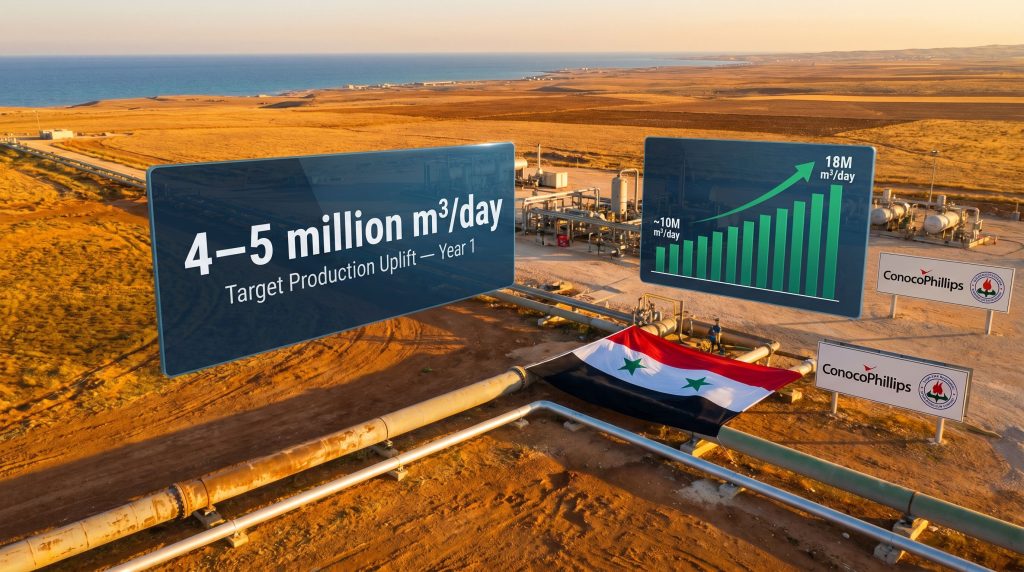
Syria's gas production trajectory over the past fifteen years tells a stark story. Before the onset of conflict in 2011, the country produced approximately 30 million cubic metres of natural gas per day. Today, that figure sits at roughly 10 million cubic metres per day, a contraction of around 67% driven by infrastructure destruction, workforce displacement, lack of maintenance investment, and the collapse of the operational ecosystem that kept legacy fields running.
The consequences extend far beyond the energy sector itself. Syria's national power generation network requires a minimum of 18 million cubic metres of gas per day to operate at functional capacity. With only 10 million cubic metres available domestically, the country faces a structural daily deficit of at least 8 million cubic metres. That gap must currently be covered through energy imports, which exposes Syria to global commodity price volatility and supply chain disruptions.
The situation has been made considerably more acute by ongoing disruptions to navigation in the Strait of Hormuz, through which a significant share of the region's energy trade flows. Syria's Energy Minister Mohammed Al-Bashir acknowledged directly that rising global energy prices driven by the Iran conflict have compounded Syria's import costs at precisely the moment when foreign exchange reserves are most stretched, according to reporting by Asharq Bloomberg published June 11, 2026.
Syria is not merely attempting to rebuild its energy sector. It is working to close a structural production gap that is actively preventing every other dimension of post-war reconstruction from proceeding at meaningful scale.
This deficit framing is important because it changes how the ConocoPhillips partnership should be evaluated. This is not an optional enhancement to Syria's energy mix. Closing the gap between current production and power station requirements is a precondition for functional economic activity across the country. Furthermore, crude oil market dynamics in the broader region continue to complicate the cost of bridging that deficit through imports alone.
What the Syria ConocoPhillips Gas Exploration Deal Actually Involves
The agreement being finalised between ConocoPhillips, Novaterra Energy, and Syria's state-owned Syrian Petroleum Company (SPC) converts a Memorandum of Understanding signed in November 2025 into operational contracts. According to reporting on the deal, the MOU was structured around three core objectives:
- Increasing output from existing underperforming gas fields that have suffered from war damage and years without proper maintenance investment
- Upgrading and modernising Syria's legacy gas infrastructure to improve operational efficiency and reduce transmission losses across the field network
- Conducting new gas exploration targeting undeveloped reserves that were identified prior to the conflict but never developed
The scale of the near-term production target is significant. SPC CEO Youssef Qablawi indicated at the time of the November MOU signing that successful implementation could lift production by 4 to 5 million cubic metres per day within one year, with newly explored fields requiring approximately three years to reach development stage, according to Syria's state news agency as reported by Asharq Bloomberg.
The Production Gap Mathematics
| Metric | Current Position | Target Outcome |
|---|---|---|
| Domestic gas production | ~10 million m³/day | +4 to 5 million m³/day within 12 months |
| Power station daily requirement | 18 million m³/day | Partially addressed |
| Structural daily deficit | ~8 million m³/day | Reduced to ~3 to 4 million m³/day |
| New field exploration timeline | Not commenced | ~3 years to development |
Even at the upper end of the stated production target, the ConocoPhillips deal alone would not close Syria's energy deficit entirely. It would, however, meaningfully narrow the gap, reducing import dependency and creating the conditions for further investment cycles that could progressively address the remaining shortfall. Consequently, this positions the deal as a critical first step rather than a complete solution.
Understanding Novaterra Energy's Role
One aspect of the deal that deserves closer examination is the co-signatory role of Novaterra Energy alongside ConocoPhillips. The structure of the original MOU and the subsequent contract negotiations suggests a partnership model rather than a single-operator arrangement.
In post-conflict energy environments, this kind of structure typically reflects a deliberate division of responsibilities — with a major international company providing capital, technical expertise, and institutional credibility, while a more regionally oriented partner manages operational logistics, local relationships, and on-the-ground execution.
This matters practically because Syria's gas field infrastructure has not simply been idle. It has been actively damaged, and restoring it to operational condition requires localised expertise and supply chain management capabilities that differ from greenfield development. Novaterra's involvement likely addresses precisely that operational dimension.
The Broader U.S. Energy Company Positioning in Syria
The Syria ConocoPhillips gas exploration deal does not exist in isolation. Syrian Energy Minister Al-Bashir confirmed to Asharq Bloomberg that during the Global Energy Forum in Washington, his ministry held discussions with Chevron and ExxonMobil in addition to ConocoPhillips, with all three expressing strong interest in operating within Syria.
While ConocoPhillips has progressed furthest toward binding contractual commitments, the presence of Chevron and ExxonMobil at ministerial-level discussions signals that the broader pipeline of U.S. energy interest in Syria is substantive rather than merely diplomatic. In addition, industry sources tracking the deal have noted the speed at which these engagements have escalated toward formal agreements.
Syria's Full Investment Partner Matrix
| Company | Origin | Engagement Type | Status |
|---|---|---|---|
| ConocoPhillips + Novaterra | United States | Onshore gas development and exploration | MOU converting to contract |
| Chevron | United States | Sector discussions | Ministerial-level engagement |
| ExxonMobil | United States | Sector discussions | Ministerial-level engagement |
| TotalEnergies | France | Offshore Block 3 technical review | In progress |
| QatarEnergy | Qatar | Offshore Block 3 technical review | In progress |
| Qatar International Power Holding | Qatar | Gas and energy development | MOU signed |
| Dana Gas | UAE | Oil and gas exploration | Agreement signed |
The Offshore Dimension: Block 3 Near Latakia
A separate but strategically significant thread involves offshore Block 3 near Latakia, where a technical review is reportedly underway involving TotalEnergies, QatarEnergy, and ConocoPhillips. This adds an important dimension to ConocoPhillips' overall Syria exposure, suggesting the company is not limiting its positioning to onshore gas restoration but is also evaluating the longer-term offshore exploration opportunity in Syrian Mediterranean waters.
Offshore exploration in the Eastern Mediterranean has delivered substantial discoveries in recent years, with the Levant Basin having proven productive across Israeli, Cypriot, and Lebanese maritime zones. Syria's offshore geology shares characteristics with these adjacent productive regions, though the technical and commercial risks of offshore development in a post-conflict environment are considerably higher than comparable deepwater projects in more stable jurisdictions. Furthermore, LNG supply considerations for the broader region lend additional strategic weight to any new Mediterranean gas developments.
Syria as a Regional Energy Transit Corridor
One of the more strategically interesting dimensions of Syria's energy diplomacy is the framing of the country not merely as a gas producer but as a potential energy transit corridor between producing nations and Mediterranean export terminals. This argument has gained traction precisely because the Strait of Hormuz disruptions have focused attention on the vulnerability of routes through which significant volumes of Gulf energy exports must currently pass.
Minister Al-Bashir highlighted Syria's geographic positioning as a transit pathway capable of connecting producing countries to Mediterranean ports and onward to global markets. The most concrete expression of this vision involves the Kirkuk-Baniyas pipeline, a legacy infrastructure asset connecting Iraqi oil fields to Syria's Mediterranean coast at Baniyas.
Current rehabilitation discussions between Syria and Iraq target an expansion of this pipeline's capacity to up to 1.5 million barrels per day, a figure that would represent a transformative contribution to regional energy logistics if achieved. The transit relationship is already operational at a modest level, with Iraq currently routing approximately 250,000 barrels per day of fuel oil through Syrian territory.
If the Kirkuk-Baniyas pipeline reaches its rehabilitation target capacity, Syria would emerge as one of the most strategically significant energy transit nations in the Eastern Mediterranean, with implications for regional pricing, European supply security, and the geopolitical weight Syria carries in future multilateral negotiations.
This transit corridor logic also helps explain why Syria's government has pursued such a deliberately diversified partner strategy. By inviting U.S., French, and Gulf Arab companies simultaneously into different segments of its energy sector, Syria is building a web of stakeholder interests that gives multiple parties a vested interest in Syria's stability and commercial success.
The Geopolitical Realignment Enabling Western Energy Entry
For over a decade, Western energy companies were effectively excluded from Syria by a combination of sanctions, political isolation, and the practical impossibility of operating in an active conflict zone. The fall of the Assad government and the emergence of a new Syrian administration has opened a narrow but consequential window. Diplomatic signals from Washington, the easing of certain sanctions restrictions, and Syria's new government's active outreach to international investors have collectively shifted the risk calculus for American energy majors.
The impact of sanctions on regional energy markets elsewhere offers a useful reference point for understanding how compliance frameworks shape deal timelines in practice. The Global Energy Forum in Washington served as the formal diplomatic venue where these discussions reached ministerial level, an institutional setting that signals both parties are treating the engagement seriously.
For U.S. energy companies, operating in Syria still requires navigating a complex and evolving sanctions compliance framework, and any binding contract will require robust legal structuring and likely specific licensing arrangements. This regulatory complexity is a material risk that should not be underestimated.
Key Risks That Remain Material
- Sanctions compliance: U.S. companies engaging in Syria must navigate layered sanctions frameworks. Legal structuring costs and licensing timelines add friction and uncertainty to deal execution.
- Infrastructure rehabilitation costs: The capital expenditure required to restore Syria's war-damaged gas field infrastructure to operational condition is substantial and has not been publicly quantified. Investors should treat production uplift timelines as aspirational until field-level assessments are completed.
- Security conditions: While Syria's new government has made significant progress in stabilising the country, parts of the gas-producing regions remain subject to security risks that could affect field access and workforce safety.
- Contract finalisation timing: As of the June 11, 2026 reporting by Asharq Bloomberg and Arab News, the contract was described as days away from signature rather than fully executed. Operational commencement remains subject to regulatory, logistical, and potentially geopolitical milestones beyond the signing ceremony itself.
- Exploration discovery risk: New field exploration carries inherent geological uncertainty. The three-year development timeline cited for new reserves assumes successful discovery, which cannot be guaranteed.
The next major ASX story will hit our subscribers first
What This Means for Syria's Electricity Crisis and Economic Recovery
The connection between gas production and everyday life in Syria is direct and immediate. Without sufficient domestic gas supply, power stations cannot generate the electricity that households, hospitals, schools, and businesses require. Syria's electricity supply crisis has been one of the most visible and economically damaging consequences of the energy infrastructure collapse.
A production increase of 4 to 5 million cubic metres per day would not restore Syria's electricity supply to pre-war norms, but it would meaningfully improve availability in ways that ripple through the broader economy:
- Reduced reliance on expensive imported energy, preserving foreign exchange reserves
- Improved electricity availability enabling manufacturing and commercial activity to expand
- Lower per-unit energy costs as domestic supply covers a larger share of demand
- A signalling effect to foreign investors in non-energy sectors that Syria's reconstruction is gaining operational momentum
Reliable domestic energy supply is widely understood among post-conflict reconstruction economists as a prerequisite for attracting manufacturing, industrial, and commercial investment. The Syria ConocoPhillips gas exploration deal, if executed on the stated timeline, represents the most significant single step toward addressing that prerequisite taken since the conflict ended. Moreover, the geopolitical landscape for resource development across the broader region continues to shape how quickly international capital can be mobilised for projects of this nature.
Three Scenarios for Syria's Energy Trajectory
Scenario 1: Accelerated Recovery
Multiple binding contracts with U.S. and Gulf energy majors are completed within 12 to 18 months, gas production recovers toward 20 million cubic metres per day or beyond, and the Kirkuk-Baniyas pipeline rehabilitation proceeds toward its stated capacity target. Syria emerges as a meaningful regional energy hub by the late 2020s.
Scenario 2: Gradual Progress
The ConocoPhillips deal proceeds but encounters delays from infrastructure rehabilitation complexity and sanctions compliance requirements. Production increases modestly over two to three years, partially addressing the electricity deficit. Broader investment attraction remains conditional on sustained political stability.
Scenario 3: Stalled Reconstruction
Renewed security instability, sanctions complications, or geopolitical deterioration disrupts deal execution. Foreign energy companies adopt a wait-and-see posture, and Syria's energy deficit persists, prolonging the electricity crisis and constraining economic recovery across all sectors. However, the effects of tariff-driven oil price shifts may further influence whether global energy majors accelerate or pull back from frontier market commitments.
Disclaimer: The scenario projections above represent analytical frameworks for understanding possible outcomes and do not constitute investment advice or forecasts. Conditions in post-conflict energy markets are subject to rapid change, and actual outcomes may differ materially from any projection.
Frequently Asked Questions
What is the Syria ConocoPhillips gas exploration deal?
Syria's state-owned Syrian Petroleum Company is finalising a binding contract with ConocoPhillips and Novaterra Energy for onshore natural gas development and exploration. The deal converts a November 2025 MOU into operational commitments covering production increases from existing fields and exploration of new gas reserves.
How much could gas production increase under this deal?
Syrian officials have indicated a target production uplift of 4 to 5 million cubic metres per day within one year of implementation, with new field exploration expected to require approximately three years to reach development stage from discovery.
Why is the Strait of Hormuz relevant to Syria's energy situation?
Disruptions to Hormuz navigation have raised global energy prices and increased Syria's import costs, since the country currently relies on imported energy to bridge its domestic production gap. The crisis has also elevated the strategic appeal of alternative Mediterranean transit routes that pass through Syrian territory.
Is ConocoPhillips the only major Western energy company engaging with Syria?
No. Chevron and ExxonMobil have both held ministerial-level discussions with Syrian energy officials. TotalEnergies and QatarEnergy are involved in a separate offshore technical review. Dana Gas and Qatar International Power Holding have also signed agreements with Syria's energy sector, according to Asharq Bloomberg reporting.
What is the Kirkuk-Baniyas pipeline?
The Kirkuk-Baniyas pipeline is a legacy infrastructure asset connecting Iraqi oil fields to Syria's Mediterranean coast. Rehabilitation discussions between Syria and Iraq aim to restore and expand its capacity to up to 1.5 million barrels per day, potentially making Syria a significant energy transit corridor for the region.
Want to Track the Next Major Resource Discovery Before the Market Does?
Discovery Alert's proprietary Discovery IQ model scans ASX announcements in real time, instantly identifying high-potential mineral discoveries across more than 30 commodities — converting complex geological data into clear, actionable insights for investors at every level. Explore historic discoveries and their returns to understand what early positioning in a major find can mean, then begin your 14-day free trial at Discovery Alert to secure your market-leading edge.