June 17, 2026
The Upstream Economics of Accelerating a Mature Basin: What Egypt's Western Desert Tells Us About the Cost of Growth
Across North Africa, the economics of mature basin management present a fundamental paradox: the fields that generate the most revenue today are the same ones losing productive capacity fastest. Natural decline rates in onshore sedimentary basins across the region average between 5% and 10% annually for conventional reservoirs, meaning operators must continuously drill new wells simply to hold output flat. Against this backdrop, any net production increase represents a compounding achievement, requiring capital deployment that outpaces geological attrition while maintaining cost discipline in a volatile oil price environment.
Egypt Western Desert oil production increase of approximately 12,000 barrels per day, recorded in the two weeks ending June 8, 2026, is best understood through this lens. It is not simply a drilling success story. It is evidence of an accelerating operational tempo designed to close the gap between Egypt's current production reality and its declared ambition to reach 1.2 million barrels per day by 2030, a target announced by Petroleum Minister Karim Badawi in February 2026.
When big ASX news breaks, our subscribers know first
The Western Desert as Egypt's Onshore Production Backbone
Egypt's petroleum geography spans several distinct producing environments, from the deep offshore of the Mediterranean and the Red Sea to the onshore Sinai Peninsula and the vast sedimentary expanse of the Western Desert. Of these, the Western Desert has historically supplied the largest share of domestic crude, anchored by a network of joint ventures operating under production-sharing and concession frameworks coordinated by the Egyptian General Petroleum Corporation (EGPC).
What distinguishes the Western Desert geologically is its layered Cretaceous and Jurassic sedimentary sequences, which contain both conventional oil reservoirs and condensate-bearing formations. Condensate, a light hydrocarbon liquid recovered alongside natural gas, carries commercial value distinct from crude and contributes meaningfully to gross liquids output. The basin's reservoir quality varies considerably across concession areas, but productive zones in the northern and central portions have proven capable of sustaining multi-decade output when properly managed.
Critically, the Western Desert's existing pipeline and processing infrastructure creates a structural advantage for new well development. Unlike frontier offshore discoveries, which require extensive subsea tie-back engineering and floating production units, new onshore wells in established concession areas can often be tied into existing gathering systems within weeks of completion. This infrastructure maturity compresses the timeline between exploration success and first production, which is precisely why Khalda Petroleum's five-well commissioning programme generated measurable output gains within a single two-week window.
Breaking Down the 12,000 Barrel Per Day Gain
The production increase was not uniform in origin or mechanism. Furthermore, two operators contributed in materially different ways, reflecting the Western Desert's operational diversity.
| Operator | Production Contribution | Mechanism | Field Area |
|---|---|---|---|
| Khalda Petroleum (Apache / EGPC JV) | Over 10,000 bpd | Five new wells commissioned | Western Desert concession |
| General Petroleum Company (GPC) | ~1,500 bpd crude + ~1 MMcf/d gas | GPF-1X exploration well brought online | Abu Sennan concession |
| Combined Western Desert Gain | ~12,000 bpd | Development drilling + exploration conversion | Multiple areas |
Khalda Petroleum: Scale, Speed, and Capital Efficiency
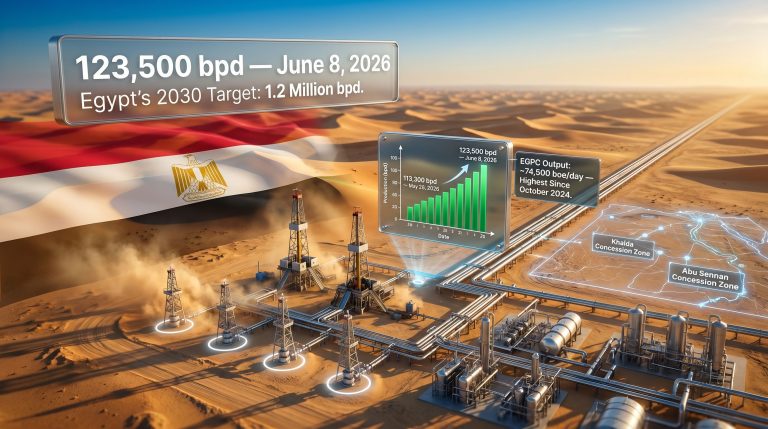
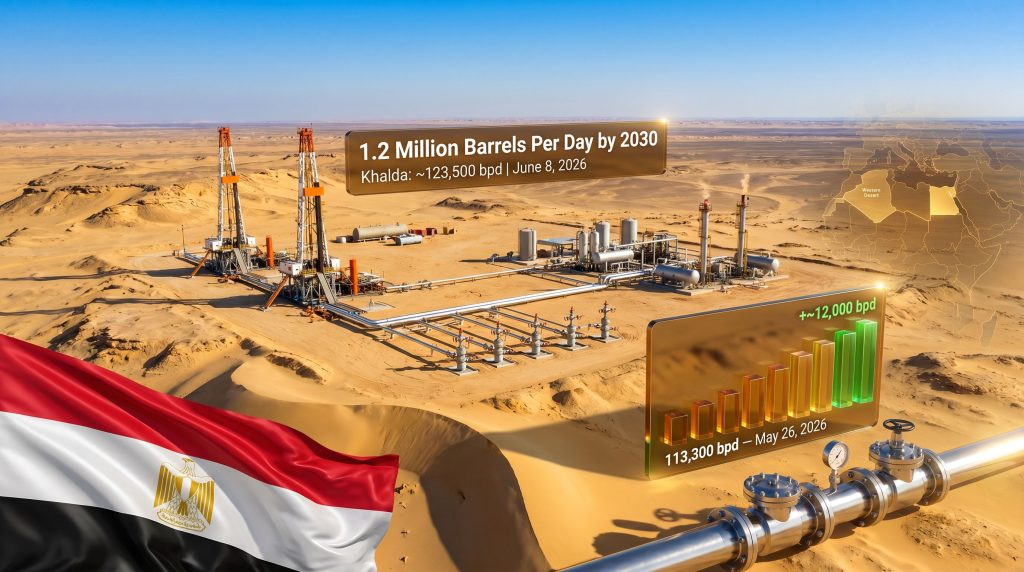
Khalda Petroleum's output moved from approximately 113,300 bpd on May 26, 2026 to roughly 123,500 bpd by June 8, 2026, representing a gain of close to 9% within a fortnight. The mechanism was the near-simultaneous commissioning of five production wells, a concentration of activity that carries specific operational advantages.
When multiple wells in a concession are brought online within a tight timeframe, rig utilisation rates improve and completion crews can be deployed with minimal mobilisation gaps between assignments. The fixed costs of supporting infrastructure are spread across a larger production base immediately, improving the per-barrel project economics of the campaign. For Apache Corporation, which has maintained an operational presence in Egypt since the 1990s and built deep technical familiarity with Western Desert reservoir behaviour, Khalda represents one of its most productive global assets on a barrels-per-well basis.
The speed of this production gain also reflects a less-discussed technical reality of Western Desert operations: many of the formation targets are relatively shallow by global standards, allowing faster drill times compared to deepwater or ultra-deep onshore plays. Shallower wells typically cost less to complete and can be brought online more quickly, which is why a five-well programme can deliver results visible within two weeks rather than months.
Abu Sennan's GPF-1X Well: Exploration Risk Converted to Production Value
The Abu Sennan contribution, while smaller in volume, carries strategic significance that extends beyond its roughly 1,500 bpd crude addition. The GPF-1X designation indicates this was an exploratory well, meaning it was testing an unproven or partially delineated reservoir target rather than developing a known accumulation. When exploration wells successfully convert to production, they demonstrate active basin prospectivity and provide geological data that informs future drilling programmes across the concession.
The well's associated gas output of approximately 1 million cubic feet per day adds a dimension that pure crude production figures obscure. Egypt has faced persistent domestic energy supply pressures, including periods of LNG import dependency that impose significant foreign exchange costs. Consequently, every incremental volume of associated gas brought online from new oil wells reduces this import burden at the margin, contributing to both energy security and macroeconomic stability.
Egypt's upstream challenge is not simply one of geological potential. The Western Desert holds substantial remaining recoverable resources, but converting that potential into production at scale requires sustained capital allocation, drilling velocity, and technical partnership ecosystems that take years to build and are easily disrupted by commodity price cycles or fiscal uncertainty.
EGPC's Consolidated Output: A Performance Benchmark Since October 2024
EGPC's total consolidated output for the period reached approximately 74,500 barrels of oil equivalent per day (boepd), with the crude oil component alone accounting for close to 61,000 bpd. The corporation's own reporting identified this as its strongest production reading since October 2024, a benchmark that signals the effectiveness of the accelerated drilling campaign pursued through the first half of 2026.
Understanding how EGPC consolidates these figures requires some context. EGPC operates as both a direct producer through its own concessions and as a joint venture partner across numerous third-party operated assets including Khalda. Its consolidated output figures aggregate these contributions but do not always capture the full gross production of each joint venture, since EGPC's equity share varies by concession agreement. This means the 74,500 boepd figure represents EGPC's equity-attributable production, while gross field production across all concessions in which it participates is considerably higher.
A Multi-Basin Strategy: Western Desert and Sinai Offshore Moving Together
The Western Desert gains did not occur in isolation. Just days before the June 8 Western Desert milestone, Egyptian authorities reported that offshore fields in the Sinai region had reached approximately 27,000 bpd, their highest output level since 2017. That recovery followed an optimisation programme led by Italy's Eni in partnership with EGPC, demonstrating that enhanced recovery techniques applied to mature offshore assets can deliver meaningful production uplift without requiring new greenfield development.
| Production Region | Recent Output | Key Operator(s) | Notable Achievement |
|---|---|---|---|
| Western Desert (Khalda / Abu Sennan) | +~12,000 bpd gain (June 2026) | Apache Corp / GPC | Highest EGPC reading since Oct 2024 |
| Sinai Offshore | ~27,000 bpd peak (June 2026) | Eni / EGPC | Highest since 2017 |
| EGPC Consolidated Total | ~74,500 boepd | Multiple JV partners | Equity-attributable output |
The concurrent gains across geographically distinct producing regions point to coordinated operational prioritisation rather than isolated field-level events. For Egypt to reach 1.2 million bpd by 2030 from a base estimated below 700,000 bpd in recent years, simultaneous progress across every major basin is not optional; it is a mathematical necessity.
The Upstream Development Cycle: How These Gains Are Actually Generated
For readers unfamiliar with oil field development mechanics, the journey from geological concept to flowing barrel involves a precise sequence of capital-intensive steps. Understanding this cycle clarifies why the recent Egypt Western Desert oil production increase represents meaningful execution rather than routine operation.
-
Seismic Acquisition and Interpretation — Geophysical surveys map subsurface structures and identify reservoir candidates before a single well is drilled.
-
Exploratory Drilling — A wildcat or step-out well tests whether hydrocarbons are present in commercial quantities. The GPF-1X at Abu Sennan represents this phase successfully completed.
-
Appraisal and Reservoir Delineation — Additional wells confirm the lateral extent, thickness, and quality of the reservoir to support development investment decisions.
-
Development Well Drilling — Multiple production wells are drilled into the confirmed reservoir. Khalda's five-well programme represents this phase executed at pace.
-
Completion and Tie-In — Wells are hydraulically completed, perforated, and connected to surface gathering infrastructure and processing facilities.
-
Production Optimisation — Flow rates, wellhead pressures, and artificial lift systems are tuned to maximise sustainable output without damaging reservoir integrity.
-
Enhanced Recovery Programmes — Water injection, gas reinjection, or chemical flooding techniques maintain reservoir pressure and slow the natural production decline curve.
Each stage carries distinct cost profiles and timeline uncertainties, which is why compressing the cycle, as Khalda appears to have done through simultaneous well commissioning, represents genuine operational value creation.
The next major ASX story will hit our subscribers first
Challenges on the Road to 1.2 Million Barrels Per Day
Achieving Egypt's 2030 target requires sustained annual production growth of roughly 3% to 4% across a diversified mix of onshore and offshore assets. However, several structural challenges make this more difficult than the recent Western Desert gains might suggest.
Natural Decline as the Baseline Hurdle
Mature onshore fields in North Africa typically decline at rates of 6% to 10% per year without active intervention. At those rates, Egypt must add between 40,000 and 70,000 new barrels of daily production annually just to hold output flat. Every barrel above that threshold represents genuine net growth. The 12,000 bpd Western Desert gain is meaningful, but it must be replicated and exceeded consistently over four years.
Capital Requirements and Foreign Investment Dependence
Egypt cannot fund this expansion from domestic resources alone. International oil companies including Apache Corporation and Eni provide not only capital but irreplaceable technical expertise in reservoir management, completion engineering, and enhanced recovery design. The attractiveness of Egypt as an upstream destination depends on cost recovery mechanisms under joint venture agreements, the stability of the Egyptian pound, and the competitive positioning of Egyptian upstream licensing terms relative to rival North African opportunities in Libya and Algeria.
The Gas-Oil Balancing Act
Egypt's energy policy must simultaneously serve two objectives that create occasional tension: maximising crude oil energy export revenues to generate foreign exchange, while meeting domestic natural gas demand to limit expensive LNG imports. Associated gas from new oil wells like GPF-1X helps on the supply side. In addition, the nation's parallel pursuit of renewable energy expansion alongside oil production growth reflects the dual-track energy strategy increasingly common among major emerging market producers navigating the global energy transition.
What the Numbers Say: Key Metrics at a Glance
| Metric | Value | Period |
|---|---|---|
| Western Desert production increase | ~12,000 bpd | Two weeks to June 8, 2026 |
| Khalda output at period start | ~113,300 bpd | May 26, 2026 |
| Khalda output at period end | ~123,500 bpd | June 8, 2026 |
| New wells commissioned (Khalda) | 5 wells | Same period |
| Abu Sennan GPF-1X oil contribution | ~1,500 bpd | June 2026 |
| Abu Sennan associated gas contribution | ~1 MMcf/d | June 2026 |
| EGPC consolidated output | ~74,500 boepd | June 2026 |
| EGPC crude oil component | ~61,000 bpd | June 2026 |
| Sinai offshore peak output | ~27,000 bpd | June 2026 (highest since 2017) |
| Egypt's 2030 production target | 1.2 million bpd | Announced February 2026 |
Regional Positioning and the International Investment Signal
Egypt's demonstrated capacity to add production at pace across multiple basins simultaneously carries implications for how international oil companies evaluate North African upstream opportunities. Compared to Libya, where political instability introduces severe operational risk, and Algeria, where the upstream fiscal framework has historically been less favourable to foreign equity participation, Egypt offers a combination of established infrastructure, geological diversity, and a track record of joint venture delivery.
The Western Desert's recent output gains reinforce that track record. For IOCs evaluating capital allocation across a global portfolio, evidence that Egyptian concessions can deliver measurable production growth within short operational windows reduces the perceived execution risk of committing additional capital to Egyptian upstream licensing rounds.
Maximising hydrocarbon output while building clean energy infrastructure is not necessarily contradictory; for economies dependent on energy export revenues to fund development, it is arguably the only viable path through the transition decade. The Egypt Western Desert oil production increase of June 2026 is, in this respect, far more than a fortnightly operational statistic — it is a signal of strategic intent.
Disclaimer: This article contains forward-looking statements, production targets, and financial analysis based on publicly available information as of June 2026. Oil production targets, timelines, and investment projections are subject to geological, operational, commodity price, and geopolitical risks. Nothing in this article constitutes investment advice. Readers should conduct independent due diligence before making any investment decisions related to companies or markets discussed herein.
Want to Stay Ahead of Significant ASX Mineral Discoveries Before the Broader Market?
Discovery Alert's proprietary Discovery IQ model delivers real-time alerts on significant ASX mineral discoveries, instantly converting complex geological data into actionable investment insights for traders and investors at every experience level — explore historic discovery returns on Discovery Alert's dedicated discoveries page and begin your 14-day free trial to secure a market-leading edge.