June 18, 2026
The Hidden Fragility Beneath America's Battery Ambitions
Battery supply chain conversations in the United States have centred heavily on lithium, cobalt, and nickel. Yet there is a quieter, less-publicised vulnerability sitting at the foundation of every lithium-ion cell manufactured today: graphite. Specifically, natural flake graphite, the material that forms the anode in virtually every EV battery on the market. Without a reliable domestic source, the entire downstream ambition of American battery manufacturing rests on a foreign-controlled input.
That structural reality is precisely why the Westwater Coosa graphite permit application, filed with the U.S. Army Corps of Engineers in June 2026, carries significance well beyond a routine regulatory submission. It represents a tangible attempt to close a supply chain gap that has been openly acknowledged in federal policy circles for years but has yet to produce a single operating natural flake graphite mine in the contiguous United States.
When big ASX news breaks, our subscribers know first
Why Graphite Is the Anode Material Nobody Talks About Enough
Most lithium-ion battery anodes are made from graphite, either natural or synthetic. Natural flake graphite, sourced directly from crystalline graphite ore, is mined, purified, and micronised into spherical graphite particles before being coated and incorporated into anode materials. This is a chemically intensive, multi-stage process that demands consistent feedstock quality.
The challenge for the U.S. is stark: China currently accounts for roughly 70% to 80% of global natural graphite production and an even higher share of the downstream anode material processing capacity, according to the U.S. Geological Survey. This concentration creates a single-point-of-failure risk for American battery manufacturers. Furthermore, the global graphite shortage that analysts have flagged means that no amount of domestic lithium production can resolve this vulnerability on its own.
A critical but underappreciated technical detail is that natural and synthetic graphite are not always interchangeable in battery anode design. Certain high-energy-density battery formulations are optimised for natural graphite's crystalline structure, which delivers higher initial capacity compared to synthetic alternatives. Switching feedstock types is not a simple substitution; it requires reformulation, re-testing, and requalification across the entire battery cell manufacturing process.
Industry Insight: Battery manufacturers operating under strict anode specification tolerances cannot simply pivot between natural and synthetic graphite suppliers without significant time and cost implications, making supply chain continuity a deeply technical issue, not just a logistics one.
What Makes the Coosa Deposit Geologically Distinct
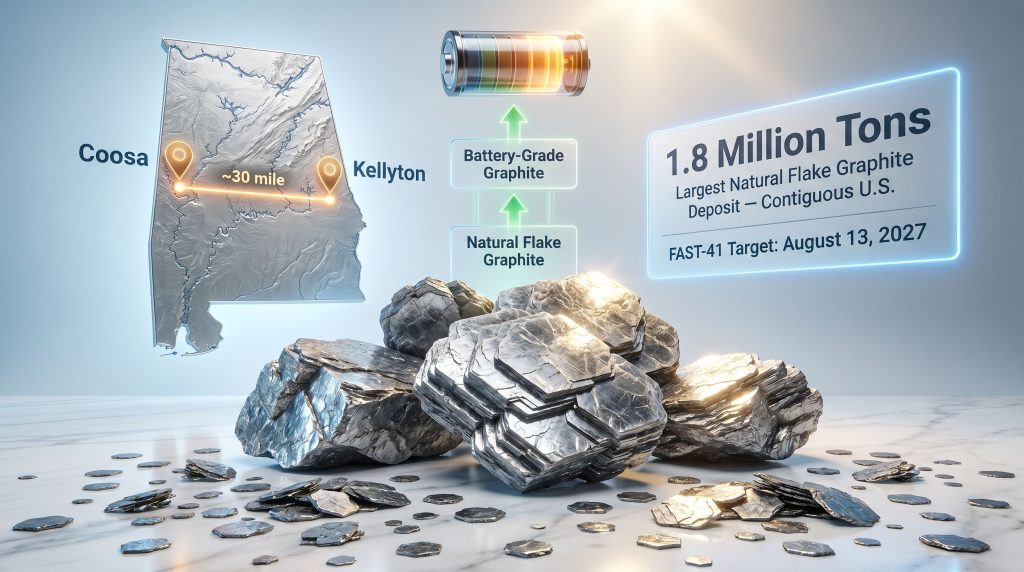
Located in Coosa County, Alabama, the Coosa graphite deposit is classified as the largest and most advanced natural flake graphite deposit in the contiguous United States, with an indicated resource base exceeding 1.8 million tons. That scale alone places it in a different category from the many early-stage graphite exploration projects scattered across North America.
What makes Coosa particularly notable from a geological standpoint is the character of its graphite mineralogy. The deposit contains naturally occurring crystalline flake graphite, which is chemically distinct from amorphous graphite found in lower-grade deposits. Crystalline flake graphite commands a significant premium in battery anode markets because it can be purified to the high-carbon specifications required for lithium-ion applications, typically above 99.95% carbon purity after processing.
Alabama's geological setting is relatively underexplored as a graphite province compared to more publicised mining states, which has kept Coosa below the radar of many investors despite its scale. The deposit's metamorphic rock host sequence, common to graphite deposits formed under high-temperature and high-pressure geological conditions, is associated with consistent flake size distribution. Larger flake fractions attract higher market prices and are more readily processed into spherical graphite for anode applications.
Understanding the Westwater Coosa Graphite Permit Application: Regulatory Anatomy
The Westwater Coosa graphite permit application submitted to the USACE under Section 404 of the Clean Water Act is one component of a layered, multi-agency regulatory process. It is worth understanding precisely what this filing does and does not represent. As detailed on the permitting update published via Medianet, the application follows a structured dual-track approach designed to satisfy both state and federal environmental obligations.
Section 404 explained in plain terms:
- Section 404 prohibits the discharge of dredged or fill material into jurisdictional waters of the United States, including wetlands, streams, and navigable waterways, without prior USACE authorisation
- The permit process requires the applicant to demonstrate that all practicable alternatives to impacting water resources have been evaluated
- A public interest review weighs the benefits of the proposed activity against the potential environmental costs
- Compensatory mitigation is typically required for unavoidable wetland impacts, either through on-site restoration, mitigation banking credits, or payment into an in-lieu fee programme
The Section 404 application followed an earlier state-level permit submission to the Alabama Department of Environmental Management (ADEM), establishing a dual-track regulatory progression that addresses both state and federal environmental obligations simultaneously rather than sequentially.
Regulatory Sequencing: The Full Permitting Stack
| Permit Type | Regulatory Body | Jurisdiction | Status (as of June 2026) |
|---|---|---|---|
| State Environmental Permit | Alabama Dept. of Environmental Management | State water and land impacts | Filed earlier in 2026 |
| Section 404 Permit | U.S. Army Corps of Engineers | Federal wetlands and waterways | Filed June 2026 |
| FAST-41 Environmental Review | Federal Permitting Improvement Steering Council | Cross-agency coordination | In progress |
| Final Investment Decision | Westwater Resources (internal) | Capital allocation | Post-permitting |
Projected FAST-41 Completion: The federal permitting dashboard currently reflects an estimated environmental review completion date of August 13, 2027, establishing a concrete regulatory horizon for stakeholders tracking the project's advancement.
FAST-41: What the Federal Dashboard Actually Does
FAST-41, established under the Fixing America's Surface Transportation Act, is frequently misunderstood. It does not fast-track approvals by reducing environmental standards or bypassing public comment periods. What it does is impose structured timelines and mandatory interagency coordination on the review process, creating accountability mechanisms that would not otherwise exist under traditional agency-by-agency review.
For a project like Coosa, FAST-41 enrolment means:
- A lead federal agency is formally designated to coordinate the review
- Participating agencies are required to adhere to coordinated schedules
- Progress milestones are publicly visible on the federal permitting dashboard
- Escalation pathways exist if agencies fail to meet scheduled milestones
This transparency framework is valuable to investors because it converts an otherwise opaque permitting process into a trackable public timeline. The August 2027 target date is not a guarantee, but it is a formal accountability marker that creates pressure for agencies to maintain review momentum. Indeed, the broader critical minerals executive order framework has further reinforced federal intent to accelerate domestic resource development reviews.
The Kellyton Integration: Why Proximity Matters More Than It Appears
The Kellyton Graphite Plant, located approximately 30 miles from the Coosa deposit in Alabama, is the downstream processing anchor for Westwater's vertically integrated strategy. This geographic proximity is commercially meaningful in ways that are not always immediately obvious.
Transporting raw natural flake graphite concentrate is not the same as shipping refined anode material. Concentrate contains gangue minerals and moisture and is bulkier per unit of contained graphite than the final spherical graphite product. Short haul distances between mine and processing facility reduce transportation cost per tonne of contained graphite, compress logistical complexity, and minimise the quality degradation risks associated with long-distance concentrate handling.
The integration model also enables tighter feedback loops between mining operations and processing specifications. If the processing plant requires a specific flake size distribution to optimise its spheroidisation yields, the mining operation can adjust its beneficiation circuit accordingly, something that is structurally impossible to do with an overseas feedstock supplier. Furthermore, this proximity model aligns well with the broader battery raw materials market shift towards localised, vertically integrated supply chains.
Natural vs. Synthetic Graphite: Competing Domestic Strategies
| Attribute | Natural Flake Graphite (Coosa) | Synthetic Graphite |
|---|---|---|
| Raw Material Source | Mined crystalline graphite ore | Petroleum coke or coal tar pitch |
| Energy Intensity | Lower processing energy requirement | High-temperature Acheson furnace process |
| Domestic Supply Potential | Enabled by Coosa mine development | Dependent on petroleum feedstock availability |
| Anode Performance | High initial capacity, crystalline structure | Consistent quality, widely deployed |
| Cost Profile | Potentially lower at scale with domestic source | Exposed to energy cost volatility |
| Policy Alignment | Qualifies as domestic critical mineral extraction | Indirect domestic content pathway |
The next major ASX story will hit our subscribers first
Risk Variables That Could Alter the Permitting Timeline
No major mining permitting process advances without encountering uncertainty. The Coosa permitting pathway carries several material risk variables that industry observers and investors should understand clearly.
Wetlands delineation disputes represent perhaps the most technically complex risk. The USACE independently verifies the boundaries of jurisdictional water bodies. If its field determination identifies wetland areas larger than those initially mapped in the permit application, the project's impact footprint grows, potentially triggering additional mitigation requirements or permit conditions.
Public comment periods open formal channels for opposition. Environmental advocacy groups, downstream water users, and tribal interests with treaty-protected rights to water resources all have standing to submit substantive objections that the Corps must formally address before issuing a permit decision.
Compensatory mitigation costs can be significant. Wetland mitigation bank credits in the southeastern United States have historically traded at prices ranging from tens of thousands of dollars per credit upward depending on watershed and credit type, adding a variable cost layer to mine development economics that is difficult to forecast precisely before the permit scope is finalised.
Regulatory posture shifts at the federal level can affect the pace of Section 404 reviews. Changes in how the Corps interprets the jurisdictional scope of waters of the United States — a legal question that has seen repeated litigation and regulatory revision over the past two decades — can expand or contract the permit's complexity mid-process.
What a Successful Coosa Permitting Outcome Would Mean for U.S. Critical Minerals Policy
The broader significance of the Westwater Coosa graphite permit application extends beyond the project itself. The U.S. has never operated a commercial-scale natural flake graphite mine in the contiguous states during the modern battery era. However, if Coosa advances through permitting to construction and production, it would establish a regulatory and operational template for domestic graphite development that currently does not exist.
Scenario Analysis: If the FAST-41 environmental review concludes on schedule by August 2027 and Westwater proceeds to a positive Final Investment Decision, the Coosa-Kellyton integrated operation could represent the first fully domestic, mine-to-battery-grade-graphite supply chain in U.S. history — a landmark outcome for domestic industrial policy in the critical minerals era.
The permitting approach itself — pursuing state and federal authorisations on parallel tracks under FAST-41 coordination — could serve as a replicable model for other domestic critical mineral projects navigating similar multi-agency frameworks. This matters considerably given the surging critical minerals demand driven by the global energy transition. Conversely, material delays or permit denials would reinforce long-standing arguments that U.S. regulatory timelines are structurally incompatible with the pace of battery supply chain buildout that domestic clean energy targets require.
Additionally, developments at Coosa could inform how direct lithium extraction and other emerging domestic resource technologies are assessed within the same federal permitting frameworks, potentially creating cross-sector policy learnings.
Frequently Asked Questions: Westwater Coosa Graphite Permit Application
What is the Westwater Coosa graphite permit application?
Westwater Resources filed a Section 404 permit application under the Clean Water Act with the U.S. Army Corps of Engineers in June 2026 for its Coosa graphite deposit in Coosa County, Alabama. The application covers potential impacts to wetlands and water bodies associated with future mine development activities at the site. Full details of the filing are available via the official announcement published on Investing.com.
What is Section 404 of the Clean Water Act?
Section 404 is a federal provision requiring developers to obtain USACE authorisation before discharging dredged or fill material into jurisdictional waters of the United States, including wetlands and streams. It is one of the primary environmental permitting requirements for mining projects that intersect with water resources.
How large is the Coosa graphite deposit?
The Coosa deposit holds an indicated graphite resource of over 1.8 million tons, making it the largest and most advanced natural flake graphite deposit in the contiguous United States.
What is the FAST-41 Permitting Dashboard?
FAST-41 is a federal transparency and coordination framework that tracks environmental review progress for major infrastructure and resource projects. Coosa is listed on the dashboard, with environmental review currently in progress and an estimated completion date of August 13, 2027.
What is the relationship between Coosa and the Kellyton Graphite Plant?
Coosa is designed to supply raw natural flake graphite feedstock to Westwater's Kellyton processing facility, located approximately 30 miles away in Alabama. Kellyton is being developed to upgrade that feedstock into battery-grade graphite for lithium-ion anode applications, forming a vertically integrated domestic supply chain.
When will Westwater make a Final Investment Decision on Coosa?
Westwater has indicated it expects to evaluate a Final Investment Decision for Coosa following the completion of the broader permitting process, which is currently projected to conclude by August 2027 under the FAST-41 timeline.
Key Takeaways for Industry Observers and Investors
- The Section 404 filing marks a substantive regulatory advancement for the largest undeveloped natural flake graphite deposit in the contiguous United States
- The dual-track state and federal permitting strategy, combined with FAST-41 enrolment, reflects a structured approach designed to compress overall review timelines without bypassing environmental obligations
- Coosa's crystalline flake graphite mineralogy and 1.8-million-ton indicated resource base position it as a foundational domestic supply asset in a market currently dominated by foreign-controlled production
- The projected August 2027 FAST-41 completion date defines the near-term regulatory horizon that will determine whether Westwater proceeds toward capital commitment and construction
- Material risks including wetlands delineation disputes, public comment opposition, and mitigation cost uncertainty remain active variables that could affect the permitting timeline and development economics
This article is intended for informational purposes only and does not constitute financial or investment advice. Forward-looking statements regarding permitting timelines, resource estimates, and project development outcomes involve uncertainty and should not be relied upon as guarantees of future performance. Readers should conduct independent due diligence before making any investment decisions related to companies or projects discussed in this article.
Want to Stay Ahead of the Next Major Mineral Discovery?
Discovery Alert's proprietary Discovery IQ model delivers real-time alerts on significant ASX mineral discoveries, transforming complex mineral data into actionable insights for investors at every level — explore Discovery Alert's dedicated discoveries page to understand how historic finds have generated substantial returns, and begin your 14-day free trial today to position yourself ahead of the broader market.