August 5, 2026
The Strategic Logic Behind Staged Capital in Critical Mineral Exploration
Junior mining companies operating in the critical minerals space face a persistent tension: the need to deploy capital quickly enough to prove up resources, while avoiding the kind of aggressive equity dilution that erodes shareholder value before a project ever reaches production. Earn-in agreements have emerged as one of the most structurally elegant solutions to this problem. The Andrada Brandberg West earn-in agreement in Namibia is a textbook example of this model in action, and its recent regulatory clearance marks a pivotal moment for a polymetallic project targeting some of the most strategically significant minerals on the planet.
When big ASX news breaks, our subscribers know first
Understanding the Earn-In Model and Why It Matters in Junior Mining
Before examining the specifics of the Brandberg West transaction, it is worth understanding what an earn-in agreement actually achieves from a structural standpoint. Unlike a direct acquisition or a traditional joint venture formed at inception, an earn-in arrangement allows an investing party to incrementally acquire equity in a project by deploying capital against agreed milestones. This protects the original project holder from over-selling at an early, undervalued stage, while giving the investor a structured pathway to build meaningful exposure as technical risk is progressively reduced.
This milestone-dependent architecture has become increasingly favoured across Sub-Saharan Africa's junior mining sector, particularly for projects where resource definition is still incomplete. The investing party assumes exploration risk, but that risk is calibrated and staged rather than front-loaded. Furthermore, the critical minerals demand surge globally has made structured earn-in arrangements even more attractive to institutional investors seeking calibrated exposure.
Earn-in structures are particularly well-suited to polymetallic exploration projects where multiple commodity streams create complex valuation dynamics that are difficult to price accurately at early-stage.
The Corporate Layers Involved in the Brandberg West Deal
The transaction involves a carefully constructed subsidiary architecture. Andrada Mining, listed on AIM, sits at the top as the operator and parent entity. Beneath it sits Andrada Investments (Mauritius) Limited, the wholly owned subsidiary that serves as the project-level holding company. The actual prospecting licence is held by Grace Timon Investments, a fully owned subsidiary of Andrada Investments. The investing entity, BWCAM, is affiliated with the natural resource partnership ACAM LP, which provides the capital under the earn-in terms.
This layered structure is not bureaucratic complexity for its own sake. Channelling investment into the subsidiary rather than directly into Andrada Mining's listed share register minimises dilution at the corporate level, which is a material consideration for existing shareholders in any junior mining vehicle.
How the Two-Tranche Funding Structure Works
The deal is built around two discrete capital deployment phases, each tied to technical and regulatory conditions.
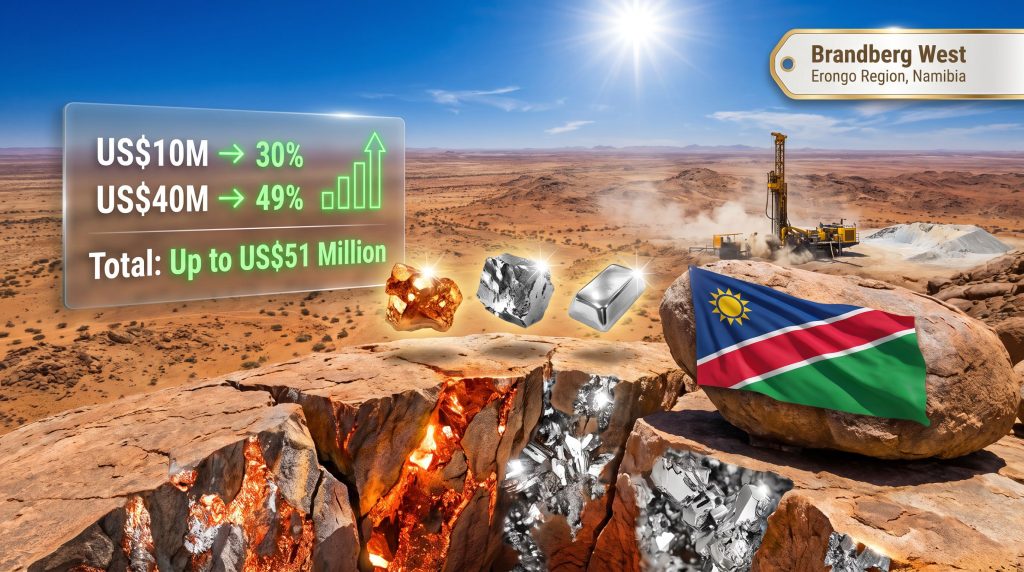
Tranche One: US$10 Million for a 30% Position
The first phase involves BWCAM committing US$10 million into Andrada Investments in exchange for a 30% equity stake in that entity. This capital is directed toward early-stage exploration activities, including geophysical survey work, reverse circulation (RC) drilling across the historical tailings storage facility, and baseline metallurgical sampling programmes. Andrada Mining retains operational control throughout this phase, with its geological and technical teams driving on-the-ground decision-making.
Tranche Two: Up to US$40 Million to Reach 49% Ownership
Once agreed technical and regulatory milestones are satisfied, BWCAM holds the option to deploy a second tranche of up to US$40 million. Successful deployment of this tranche would bring BWCAM's total interest in Andrada Investments to 49%, with Andrada Mining retaining a controlling 51% majority. Capital at this stage is intended to fund resource definition drilling, prefeasibility-level metallurgical test work, and preliminary plant design work. Definitive feasibility studies at this scale typically represent the most capital-intensive phase of a project's development cycle.
The Listed-Company Equity Subscription
Running parallel to the earn-in tranches, BWCAM also executed a US$1 million direct equity subscription at the Andrada Mining listed-company level on AIM. This gives BWCAM dual exposure: project-level equity through the earn-in structure and corporate-level exposure through publicly traded shares. Aligning incentives across both tiers is a structurally sound approach to long-term partnership durability.
| Funding Component | Amount | Equity Acquired | Entity Level |
|---|---|---|---|
| Tranche 1 | US$10 million | 30% stake | Andrada Investments |
| Tranche 2 (conditional) | Up to US$40 million | Up to 49% stake | Andrada Investments |
| Direct equity subscription | US$1 million | Listed-company shares | Andrada Mining (AIM) |
| Total potential capital | Up to US$51 million | 49% of project holding co. | Combined |
The Role of the Namibian Competition Commission and What Unconditional Approval Signals
The Namibian Competition Commission (NaCC) is the statutory regulatory body responsible for reviewing transactions that may materially affect competitive conditions within Namibia's economy. For earn-in agreements involving significant equity transfers in resource licence-holding entities, mandatory NaCC notification thresholds are typically triggered under Namibian competition law, particularly where foreign capital is acquiring a substantial interest in a domestically held licence structure.
The NaCC granted unconditional approval for the Brandberg West earn-in agreement. In the language of competition law, unconditional clearance is the most favourable possible outcome. It means no behavioural undertakings, no structural remedies, and no ongoing monitoring conditions were attached to the decision. The regulator found no material competitive concerns arising from the transaction in its current form.
Unconditional NaCC clearance removes the final gating condition from the earn-in agreement, enabling capital deployment to commence without further regulatory uncertainty hanging over the project timeline.
From an investor's perspective, this distinction matters. Conditional approvals in competition law often impose obligations that can complicate project governance, restrict commercial flexibility, or create reputational friction with future counterparties. Unconditional clearance, however, carries none of these complications.
Brandberg West's Location and Brownfield Advantages
The Brandberg West project sits within Namibia's Erongo Region, a mining corridor of genuine substance. The region hosts some of Africa's most significant uranium operations, including the Rössing and Husab mines, alongside a growing base metals and industrial minerals sector. Namibia consistently ranks among Africa's most transparent and operationally stable mining jurisdictions, with a well-developed legal framework for mineral licensing, a convertible currency environment, and established logistics infrastructure connecting to the deep-water port of Walvis Bay.
Critically, Brandberg West is a brownfield project. It has a documented production history, which means the exploration team is not working from a blank geological canvas. Pre-existing geological datasets, historical production records, and legacy infrastructure remnants reduce some of the uncertainty that defines greenfield exploration work.
The presence of historical tailings storage facilities (TSFs) at the site is particularly significant. TSF reprocessing has emerged as a low-capital-intensity pathway for early-stage revenue generation in brownfield projects, as surface-level mineralisation data already exists and the capital required to access it is substantially lower than sinking new underground development or establishing fresh open-cut operations.
Sampling to assess mineral extraction potential from these waste streams is already underway at Brandberg West, with metallurgical test work results expected to inform decisions on TSF reprocessing viability. If this work confirms economic grade and recoverable volumes, it could represent a near-term cash flow pathway that partially de-risks the longer exploration programme.
The Polymetallic Profile: Copper, Tungsten, and Tin Explained
Brandberg West targets three distinct commodity streams simultaneously, which creates both complexity and opportunity.
Copper: The Electrification Backbone
Copper needs little introduction as a critical industrial metal. Its role in electrical wiring, EV motor windings, renewable energy infrastructure, and grid transmission makes it one of the most demand-exposed metals to the global energy transition. Furthermore, the relationship between critical minerals and energy security is becoming increasingly central to national policy frameworks across Western economies. Long-term supply deficits are widely forecast as existing mine grades decline and new project development struggles to keep pace with demand growth.
Tungsten: The Hidden Critical Mineral
Tungsten is considerably less widely understood by lay investors, yet tungsten's strategic importance carries substantial weight in defence and industrial supply chains. It is one of the densest naturally occurring elements, with the highest melting point of any metal at approximately 3,422 degrees Celsius. These properties make it irreplaceable in cutting tools, drill bits, armour-piercing ammunition, and high-temperature industrial applications. Critically, China controls an estimated 80% or more of global tungsten production, making non-Chinese supply development a priority for Western governments and industrial consumers alike. Both the EU Critical Raw Materials Act and the US Critical Minerals list include tungsten as a strategic material requiring supply diversification.
Tin: More Than a Solder Metal
Tin's profile has been transformed by the electronics and semiconductor industries. Beyond traditional uses in food packaging and traditional soldering, tin is now a critical component in semiconductor packaging, advanced circuit board assembly, and emerging tin-based anode technologies in next-generation battery chemistries. Supply is geographically concentrated in Indonesia, China, and Myanmar, with politically stable alternative sources in high demand from global electronics manufacturers.
The polymetallic combination of copper, tungsten, and tin at Brandberg West is not a coincidence of geology. It is a strategic alignment with three separate critical mineral supply chains that Western economies are actively working to diversify away from Chinese-dominated sources.
The next major ASX story will hit our subscribers first
Exploration Progress: What Has Already Been Achieved
Understanding the current state of exploration work at Brandberg West is essential for contextualising where the project sits in its development arc.
| Work Programme | Status | Purpose |
|---|---|---|
| Geophysical surveys | Completed | Subsurface structural mapping and drill targeting |
| RC drilling across historical TSF | Completed | Grade and volume estimation of recoverable tailings material |
| Waste stream sampling | In progress | Metallurgical extraction potential assessment |
| Diamond drilling | Active | Primary mineralisation definition below historical workings |
| Resource definition drilling | Planned (Tranche 2) | JORC-compliant resource estimation |
| Feasibility and metallurgical studies | Planned (Tranche 2) | Economic viability and plant design assessment |
Diamond drilling currently underway is targeting primary mineralisation beneath the historical workings, which is where the project's longer-term resource potential lies. Interpreting drill results accurately at this stage is critical to determining whether the project advances toward a full prefeasibility study. The distinction between RC drilling and diamond drilling is worth noting: RC drilling is faster and cheaper, making it well-suited to initial reconnaissance and tailings characterisation, while diamond core drilling produces intact cylindrical rock samples that allow far more detailed geological, structural, and metallurgical analysis.
Partnership Architecture: Complementary Capabilities as a Development Accelerant
One of the less-discussed but structurally important aspects of the Brandberg West earn-in is the deliberate pairing of complementary capabilities between the two parties. Andrada Mining brings deep Namibian operational and geological expertise, built through its work at the Uis lithium project and its broader understanding of the Erongo Region's mineralogy and regulatory environment. ACAM brings structured investment infrastructure and capital deployment capabilities.
This division of competency is strategically logical. Junior mining companies frequently possess geological knowledge but lack access to the institutional capital structures needed to systematically develop projects through the expensive resource definition and feasibility phases. Structured partnerships that pair technical expertise with investment capability have consequently become increasingly common as traditional equity markets for junior miners have grown more selective.
The retention of 51% operational control by Andrada Mining is a critical value preservation mechanism. It ensures that geological and technical decision-making remains with the party that has the deepest on-the-ground knowledge of the asset, while still attracting up to US$51 million in staged development capital. For further detail on the transaction structure, Andrada Mining's official project page provides comprehensive background on the Brandberg West asset.
Key Risks Investors and Analysts Should Monitor
No critical minerals project is without risk, and intellectual honesty demands that these be clearly articulated.
- Resource definition is incomplete. No JORC-compliant mineral resource estimate has been publicly disclosed for the primary mineralisation at Brandberg West. Diamond drilling results will be a critical determinant of whether the project advances toward prefeasibility.
- Tranche 2 is conditional, not guaranteed. The US$40 million second tranche depends on agreed milestones being met. If drilling outcomes or metallurgical results fall short of thresholds, capital deployment at this scale is not assured.
- Commodity price exposure across three markets. The project's economics are influenced by copper, tungsten, and tin prices simultaneously, each with distinct and sometimes countercyclical supply-demand dynamics.
- Tungsten and tin price opacity. Unlike copper, which trades on the London Metal Exchange with transparent daily pricing, tungsten and tin markets are considerably thinner and less liquid. Price discovery can be slower, and valuation of the project's potential economics is correspondingly more complex.
- Tailings reprocessing outcomes remain unconfirmed. While the TSF reprocessing pathway represents a compelling early-stage opportunity, metallurgical test work is still in progress. Results must confirm both economic grade and recoverable volumes before this stream can be considered a viable near-term revenue contributor.
This article contains forward-looking information relating to exploration outcomes, capital deployment, and project development timelines. Such information is inherently uncertain and should not be relied upon as a guarantee of future results. Readers should conduct their own independent research and consider seeking professional financial advice before making any investment decisions.
Namibia's Broader Investment Climate and the Critical Minerals Race
The NaCC's efficient and unconditional clearance of the Brandberg West earn-in is consistent with Namibia's broader track record as one of Africa's most reliable mining jurisdictions. The country's transparent licensing framework, well-functioning judiciary, and established relationship with international mining capital make it a preferred destination for foreign investment in the region.
Namibia is not simply a passive beneficiary of the global critical minerals push. The country is actively positioning its geological endowment, spanning uranium, lithium, copper, tin, tungsten, and rare earth elements, as a cornerstone of Western supply chain diversification strategies. Projects like Brandberg West, combining multiple critical mineral targets with a brownfield development advantage and a stable regulatory environment, sit exactly at the intersection of geological opportunity and geopolitical demand.
The Andrada Brandberg West earn-in agreement in Namibia represents more than a single corporate transaction. It is a microcosm of the structural forces reshaping how critical mineral projects are financed, developed, and positioned within global supply chains. A detailed breakdown of the original transaction announcement can be found via Crux Investor's coverage of the deal. For investors and industry observers tracking the evolution of the critical minerals sector, it is consequently a deal structure worth studying closely.
This article contains forward-looking information relating to exploration outcomes, capital deployment, and project development timelines. Such information is inherently uncertain and should not be relied upon as a guarantee of future results. Readers should conduct their own independent research and consider seeking professional financial advice before making any investment decisions.
Want to Stay Ahead of the Next Major Critical Mineral Discovery?
Discovery Alert's proprietary Discovery IQ model delivers real-time alerts on significant ASX mineral discoveries, instantly transforming complex polymetallic and critical mineral announcements into actionable investment insights — explore historic discoveries and their returns to understand just how transformative early positioning can be, then begin your 14-day free trial at Discovery Alert to secure your market-leading edge.