July 20, 2026
The Metal That Built Civilisation Is Now a Geopolitical Flashpoint
For most of the twentieth century, tungsten existed quietly at the edge of industrial consciousness. It hardened drill bits, kept lightbulb filaments glowing, and strengthened the cutting edges of machinery that carved through rock and steel. Few investors paid attention. Fewer still understood just how narrow the global supply chain for this metal had become. As tungsten's critical strategic importance has grown, however, that quiet has now broken.
When one of Australia's most celebrated mining entrepreneurs commits nearly $190 million to a single tungsten producer, it signals something far larger than a portfolio tweak. It reflects a structural realignment in how sophisticated capital views the critical minerals landscape — and the Andrew Forrest EQ Resources stake, in particular, has captured the market's full attention.
When big ASX news breaks, our subscribers know first
Understanding Tungsten's Unique Physical and Industrial Position
Why No Other Element Can Replace It
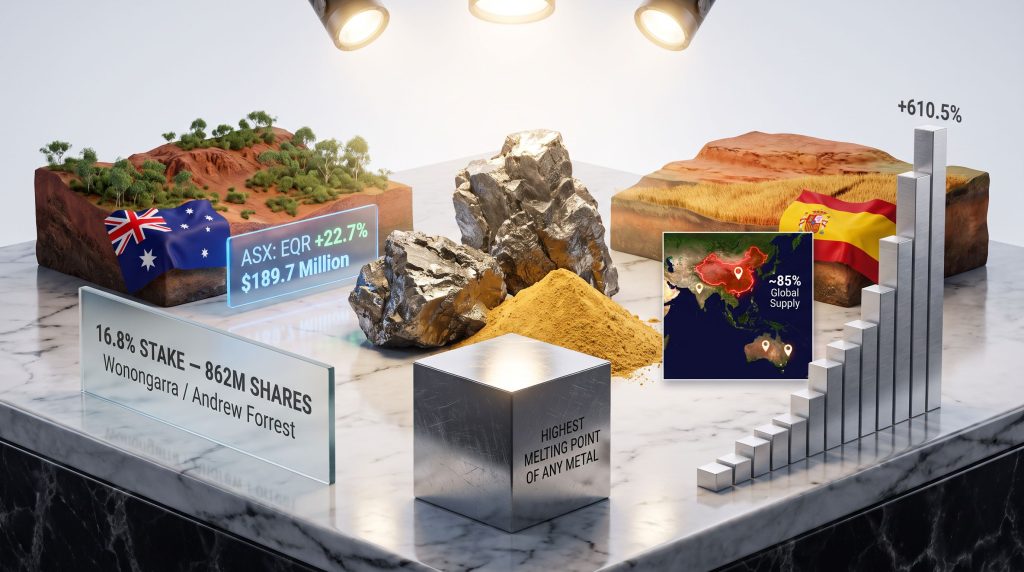
Tungsten carries a distinction shared by no other metal: it has the highest melting point of any element, reaching approximately 3,422 degrees Celsius. That single property makes it irreplaceable across a surprisingly wide spectrum of industries.
Consider where tungsten actually goes:
- Cutting and drilling tools: Tungsten carbide composites form the tips of drill bits and cutting inserts used across construction, mining, and precision manufacturing
- Semiconductor fabrication: Tungsten is used as an interconnect metal in chip manufacturing, where its ability to withstand extreme temperatures during deposition processes makes it uniquely suited for modern integrated circuits
- Defence applications: Tungsten's density, roughly 1.7 times that of lead, makes it the material of choice for kinetic energy penetrators and armour-piercing projectiles
- Energy infrastructure: High-temperature components in turbines and advanced reactors rely on tungsten's thermal stability
- Medical equipment: X-ray shielding and radiation therapy components often use tungsten for its combination of density and thermal resistance
Unlike lithium, where sodium-ion chemistry presents a credible alternative, or cobalt, which battery manufacturers are actively engineering out of cathode chemistries, tungsten has no commercially viable substitute for most of these high-performance functions. That irreplaceability is, arguably, its most important investment characteristic.
China's 85% Grip: The Supply Chain Vulnerability Driving Capital West
A Concentration Problem Without Modern Precedent
China currently controls approximately 85% of global tungsten supply, making it one of the most geographically concentrated critical mineral markets on Earth.
This level of single-nation dominance is extraordinary even by the standards of critical minerals, where geographic concentration is a known risk. For context, the Democratic Republic of Congo controls roughly 70% of global cobalt production, a figure that has drawn enormous investor and policy attention. Tungsten's concentration exceeds even that.
China's dominance is not accidental. It reflects decades of deliberate industrial policy, low-cost processing infrastructure, and the presence of significant tungsten deposits in provinces including Jiangxi, Hunan, and Guangdong. Chinese tungsten is predominantly extracted from scheelite and wolframite ores, often in regions where environmental and labour cost structures allow for highly competitive pricing.
The remaining 15% of global tungsten supply is distributed across a very small number of Western-operated mines. Furthermore, this concentration creates acute structural fragility for industries that cannot afford supply disruption: defence contractors in the United States and Europe, semiconductor fabricators, and advanced manufacturing operations that depend on tungsten carbide tooling. Consequently, the critical minerals demand surge now underway is placing intense pressure on Western producers to scale rapidly.
Wolframite vs. Scheelite: Why Ore Type Matters for Investors
Most investors in the tungsten space overlook a technically significant distinction that materially affects processing costs and concentrate quality.
Tungsten occurs primarily in two mineral forms:
| Mineral | Chemical Formula | Processing Route | Typical Grade |
|---|---|---|---|
| Scheelite | CaWO₄ | Gravity concentration, flotation | Variable, often 0.2%–0.5% WO₃ |
| Wolframite | (Fe,Mn)WO₄ | Gravity concentration, magnetic separation | Typically higher recoveries |
Scheelite deposits, which dominate in Australia and Spain, require more complex processing but are increasingly the focus of Western mining investment because the deposits tend to be larger and more amenable to open-cut or bulk underground methods. The Mt Carbine mine in Queensland processes scheelite ore, and the Barruecopardo mine in Spain mines wolframite-bearing veins, giving EQ Resources a technically diversified production base across both ore types.
Andrew Forrest EQ Resources Stake: Deconstructing the $190 Million Transaction
The Structure of the Wonongarra Acquisition
The Andrew Forrest EQ Resources stake was executed through his private investment vehicle Wonongarra, which acquired 862 million ordinary shares and 35.5 million options in EQ Resources (ASX: EQR) from Oaktree Capital Management. According to reporting by The West, the transaction represents one of the most significant strategic moves in the Australian tungsten sector to date.
Key transaction parameters:
| Parameter | Detail |
|---|---|
| Acquirer | Wonongarra (Andrew Forrest vehicle) |
| Target | EQ Resources Ltd (ASX: EQR) |
| Stake | 16.8% |
| Shares acquired | 862 million ordinary shares |
| Options acquired | 35.5 million |
| Price per share | ~22 cents |
| Total consideration | ~$189.7 million |
| Seller | Oaktree Capital Management |
The transaction took place entirely at the shareholder level. EQ Resources confirmed that the change in ownership has no bearing on the company's management structure, operational strategy, or day-to-day activities at either of its mining operations.
The Oaktree Exit: Reading the Financial Sponsor Lifecycle
Oaktree Capital Management first entered EQ Resources in 2023 as a cornerstone investor at a pivotal moment in the company's growth trajectory. Their capital supported two critical corporate events: the acquisition of the Barruecopardo tungsten mine in western Spain, and the continued expansion of the Mt Carbine operation in North Queensland.
This pattern is textbook private equity and strategic credit investing. Oaktree identified a capital-intensive inflection point, provided the funding required to execute transformational corporate actions, supported the business through its early operational development phase, and then exited once the asset base had matured into an operating company with demonstrated production credentials.
The significance for remaining and prospective shareholders lies in what replaced Oaktree. The departure of a financial sponsor and the arrival of an industry operator with Forrest's track record represents a qualitatively different kind of ownership. Financial capital and operational capital carry different risk tolerances, different time horizons, and different signalling value to the market.
EQ Resources: Inside the Western World's Largest Tungsten Producer
Dual-Asset Architecture: Mt Carbine and Barruecopardo
EQ Resources operates across two distinct geographies, which is itself an underappreciated structural advantage in a sector where single-asset concentration risk is common.
Mt Carbine, North Queensland:
Mt Carbine is one of Australia's most historically significant tungsten deposits. The mine has a long operational history dating back to the early twentieth century, though modern processing infrastructure has substantially updated its capabilities. The operation processes scheelite ore and has been expanded in recent years to increase throughput capacity and tungsten recovery rates.
Barruecopardo, Salamanca Province, Spain:
The Barruecopardo mine sits in western Spain, a region with established mining infrastructure and a skilled workforce. Its location within the European Union creates natural proximity to European manufacturers seeking certified, non-Chinese tungsten supply. In addition, the EQ Resources tungsten offtake agreements secured for this operation give the company reliable revenue visibility. European semiconductor fabricators, tooling manufacturers, and defence contractors represent a logical offtake customer base.
FY26 Combined Production Output:
EQ Resources produced 1,189 tonnes of tungsten trioxide (WO₃) across both operations in FY26. The company has indicated that both assets carry identified pathways to increased production volumes, though investors should note that scaling up mining operations involves execution risks that any forecast must account for.
Market Reaction and the Psychology of High-Profile Endorsement
What the 22.7% Intraday Move Actually Tells Us
EQR shares surged 22.7% intraday to 27 cents following the announcement. That reaction is instructive, but it rewards careful analysis rather than face-value interpretation.
The move reflects two distinct forces operating simultaneously:
- Information signal: Forrest's entry communicates to the market that a sophisticated, well-resourced industry participant has conducted due diligence and assigned significant value to EQR's asset base and growth trajectory
- Liquidity signal: The transaction eliminates a large, motivated seller overhang. Oaktree, as a financial sponsor with finite fund life and return targets, represented potential selling pressure. Forrest, as a long-term strategic investor, is far less likely to be a near-term seller
The 12-month cumulative return of 610.5% tells a more nuanced story. EQR was already deep into a re-rating cycle before Forrest arrived. This trajectory reflects the company's operational progress, the broader market recognition of tungsten's critical mineral status, and growing institutional interest in Western producers offering supply chain security.
For investors evaluating this situation, the critical question is not whether the Forrest endorsement is meaningful, but whether the current market capitalisation of approximately $1.14 billion already prices in the growth potential that attracted him in the first place.
The next major ASX story will hit our subscribers first
Forrest's Investment Logic: Pattern Recognition from Fortescue
The Structural Parallels That Define His Approach
Andrew Forrest's career is built on a recognisable template: identify a commodity with structural demand tailwinds and constrained supply, acquire a significant ownership position at a moment of operational inflection, and hold for a long development cycle.
Fortescue Ltd (ASX: FMG) is the defining example. When Forrest was building Fortescue's iron ore operations in the mid-2000s, the consensus view was that the major iron ore producers had an unassailable competitive position. He disagreed, backed his conviction with capital, and generated one of the most extraordinary wealth-creation outcomes in Australian corporate history. Forrest's investment track record across resources underscores why his entry into EQR has been interpreted as such a powerful signal.
The EQ Resources investment mirrors that structural logic:
- Supply concentration creates pricing power: With China controlling 85% of supply, Western producers face structurally elevated demand from buyers seeking supply chain security, often at a price premium
- Operational inflection timing: Forrest noted publicly that EQR is beginning to generate meaningful operating cash flow, suggesting the capital-intensive development phase is giving way to cash generation
- Expansion optionality: Both Mt Carbine and Barruecopardo have identified growth pathways, offering leverage to any future increase in tungsten prices or demand volumes
- Geopolitical tailwinds: Growing tension between Western economies and China over technology and defence supply chains has materially elevated the strategic value of Western-controlled tungsten assets. For instance, the Almonty tungsten partnership announced in 2025 further illustrates how defence and aerospace sectors are actively seeking supply chain diversification
Risk Framework: What Investors Must Weigh Carefully
The Case For and Against at Current Valuations
Sophisticated investors entering the EQR story at current levels face a materially different risk-return profile than those who participated in the early re-rating. Intellectual honesty requires mapping the key risk categories:
Commodity Price Risk
Tungsten pricing is influenced by Chinese export policy, global manufacturing volumes, and defence procurement cycles. China has previously used export controls on critical materials as a geopolitical instrument, and any easing of trade tensions could soften the Western supply premium that underpins EQR's investment thesis. However, the growing antimony shortage risks affecting defence and industry in 2025 serve as a reminder of just how rapidly critical mineral supply disruptions can escalate.
Operational Execution Risk
Scaling production across two mines in two jurisdictions involves regulatory complexity, workforce management across different labour markets, and the inherent variability of underground and surface mining operations. Production guidance should be viewed as directional rather than guaranteed.
Valuation Compression Risk
At a market capitalisation of approximately $1.14 billion against FY26 production of 1,189 tonnes of WO₃, the market is embedding significant growth assumptions into the current price. A production shortfall or tungsten price correction could rapidly compress valuation multiples.
Concentration Risk
Despite its dual-mine structure, EQR remains a single-commodity company. Any sustained disruption to tungsten demand or pricing flows directly to earnings without diversification buffers.
Disclaimer: This article contains general information only and does not constitute financial advice. Past share price performance, including multi-year returns of the magnitude discussed here, is not indicative of future results. Investors should seek independent financial advice and conduct thorough due diligence before making investment decisions in small-to-mid capitalisation critical mineral producers.
The Broader Signal: What This Transaction Reveals About Capital Flows
Critical Minerals Investment Is Entering a New Phase
The Andrew Forrest EQ Resources stake is not an isolated event. It sits within a broader pattern of sophisticated capital migrating from traditional bulk commodity exposure into critical minerals with defence, technology, and energy transition demand drivers.
Several structural forces are accelerating this rotation:
- Western governments and large corporations have publicly committed to reducing single-source dependencies on Chinese critical mineral supply, creating durable demand for certified Western production
- The semiconductor industry's ongoing capacity expansion in the United States, Europe, and Japan requires reliable non-Chinese tungsten supply for chip interconnects
- Defence procurement budgets across NATO nations have increased materially since 2022, expanding demand for tungsten in munitions and armour applications
- Australian producers benefit from the country's status as a geopolitically stable, well-regulated mining jurisdiction with proximity to Asian manufacturing customers and alignment with Western security frameworks
The replacement of Oaktree with Forrest as EQR's anchor shareholder reflects the maturation of the Western critical minerals investment cycle. The early phase, characterised by exploration-stage speculation and junior miner capital raises, is giving way to an operational phase in which producing companies attract strategic capital from industry participants with genuine operational expertise.
For ASX critical minerals investors, the EQR transaction offers a valuable case study in how re-rating cycles unfold: from obscure developer, through production ramp, to strategic anchor investor entry, and ultimately toward potential index inclusion and institutional portfolio participation. Each phase carries different risk and return characteristics, and understanding where a given company sits in that cycle is fundamental to sound investment analysis.
Key Transaction Summary
| Data Point | Detail |
|---|---|
| Acquirer | Andrew Forrest via Wonongarra |
| Target | EQ Resources Ltd (ASX: EQR) |
| Stake acquired | 16.8% |
| Shares purchased | 862 million ordinary shares + 35.5 million options |
| Transaction value | ~$189.7 million |
| Seller | Oaktree Capital Management |
| Price per share | ~22 cents |
| Market cap at announcement | ~$1.14 billion |
| Intraday price reaction | +22.7% |
| 12-month cumulative return | +610.5% |
| FY26 tungsten production | 1,189 tonnes WO₃ |
| China's share of global tungsten supply | ~85% |
| Operating mines | Mt Carbine (QLD) + Barruecopardo (Spain) |
Readers seeking broader context on tungsten's industrial significance and the evolving dynamics of non-Chinese mineral supply are encouraged to explore publicly available research from Geoscience Australia and the Critical Minerals Council, both of which publish detailed analysis on Western supply chain development.
Want to Stay Ahead of the Next Major ASX Critical Minerals Discovery?
Discovery Alert's proprietary Discovery IQ model scans ASX announcements in real time, instantly identifying significant mineral discoveries across tungsten, rare earths, and over 30 other commodities — translating complex data into clear, actionable insights for both traders and long-term investors. Explore historic discovery returns on Discovery Alert's dedicated discoveries page and begin your 14-day free trial to position yourself ahead of the broader market.