June 18, 2026
Iron Ore and the Decarbonisation Imperative: Why Ore Chemistry Now Drives Mining Strategy
The global steel industry is undergoing a structural shift that most commodity observers underestimate. The transition away from coal-fired blast furnaces toward electric arc furnace and direct reduction technologies is not simply an environmental preference — it is a fundamental rewiring of raw material requirements. As steelmakers in Europe and Asia accelerate low-carbon production pathways, the chemical specification of iron ore feedstock has become as commercially critical as the volume of tonnes shipped. In this context, the distinction between commodity-grade iron ore and high-grade pellet feed is no longer a technical footnote. It is a strategic fault line that separates mining assets with long-term pricing power from those exposed to displacement risk.
It is within this macro framework that Anglo American's Anglo American produção de minério de ferro e níquel no Brasil takes on significance well beyond the quarterly production figures themselves. The company's Brazilian operations in early 2026 reflect two divergent trajectories playing out simultaneously: a premium iron ore system being positioned for long-term growth, and a ferronickel business in the final stages of a strategic exit.
When big ASX news breaks, our subscribers know first
The Minas-Rio System: What Makes It a Premium Asset?
Integrated Infrastructure as a Competitive Moat
The Minas-Rio operation is structurally distinct from most large-scale iron ore producers because it functions as a closed-loop export system. The ore body sits in Minas Gerais state, where open-pit extraction feeds directly into an on-site beneficiation plant. From there, iron ore concentrate is transported via a dedicated slurry pipeline — known in Brazilian mining terminology as a mineroduto — stretching hundreds of kilometres to the coast of Rio de Janeiro, where a dedicated export terminal at Porto do Açu handles vessel loading.
This architecture eliminates a series of logistical vulnerabilities that affect producers relying on shared rail and port infrastructure. There is no competing cargo for pipeline capacity, no third-party scheduling constraints at the terminal, and no quality dilution from blending with other ore streams during transit. The result is a product that arrives at the export point with consistent chemical specifications — a commercially important attribute for steelmakers who require predictable feedstock inputs for direct reduction plants.
What High-Grade Pellet Feed Actually Means for Steelmakers
The term pellet feed de alto teor describes a concentrate with iron content typically ranging from 67% to 69% Fe, significantly above the 55–62% Fe range of conventional lump and fines products. This distinction matters because direct reduction technologies — both the gas-based shaft furnace method and emerging hydrogen-based variants — achieve dramatically better energy efficiency and lower CO₂ output when processing high-grade material. Furthermore, the China steel and iron ore market continues to shape global pricing dynamics for these premium products.
The chemical logic is straightforward: gangue minerals such as silica and alumina require energy to heat but contribute nothing to the iron yield. A tonne of 67% Fe pellet feed produces more metallic iron per unit of energy input than a tonne of 58% Fe fines. For steelmakers paying carbon prices in European emissions trading markets, this difference translates directly into operating cost advantages. Minas-Rio's product therefore carries an embedded decarbonisation premium that becomes more valuable as carbon pricing spreads globally.
In addition, green iron production pathways increasingly depend on high-grade feedstocks of precisely this nature, reinforcing the long-term commercial logic of Minas-Rio's product specification. Similarly, advances in hydrogen iron ore reduction technology are amplifying demand for the kind of premium concentrate that Minas-Rio consistently delivers.
Production Performance: Q1 2026 in Context
| Period | Production Volume | Change |
|---|---|---|
| Q1 2025 | 6.5 Mt | Baseline |
| Q1 2026 | 6.4 Mt | -1% |
| Full Year 2025 | 24.75 Mt | Above prior guidance |
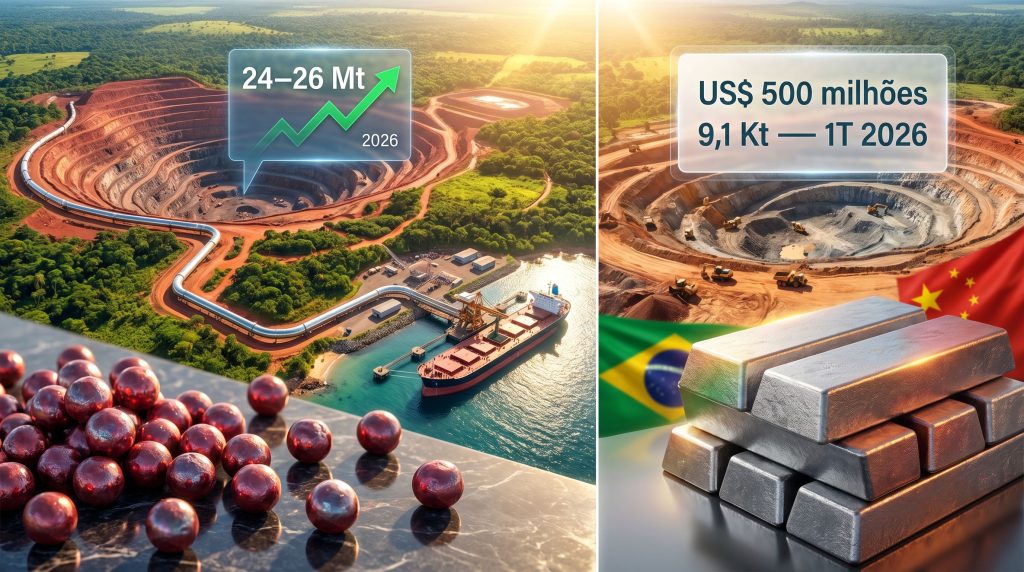
| 2026 Guidance | 24–26 Mt | Raised from 23–25 Mt |
The Q1 2026 output of 6.4 million tonnes represents a marginal year-on-year reduction of approximately 1%, but the headline decline obscures an operationally positive underlying story. According to reporting from April 2026, the modest volume reduction reflected lower iron ore grades during the rainy season — a geological and climatic pattern typical for this time of year in southeastern Brazil — rather than any systemic operational failure.
What is more significant is that the operation maintained plant utilisation levels through improved ore feed consistency during the wet season. This is technically non-trivial: tropical precipitation affects the moisture content and processing behaviour of ore at the beneficiation plant, and sustaining throughput under these conditions requires both infrastructure resilience and operational discipline.
The upward revision of full-year 2026 guidance — from 23–25 Mt to 24–26 million tonnes — reflects management confidence that the operational improvements embedded in the 2025 results are durable. The 2025 full-year output of 24.75 Mt already exceeded previous guidance, and the new target range signals expectation of continued efficiency gains rather than volume expansion dependent on unproven capital projects.
Analytical note: Guidance upgrades of this kind in iron ore operations typically signal improved plant recovery rates, better ore selectivity, or reduced unplanned downtime. Investors should treat an upward guidance revision mid-cycle as a credibility indicator rather than simply a volume story.
Nickel Operations in Goiás: A Business in Managed Transition
Barro Alto and Codemin: Understanding the Asset Base
The two nickel operations in Goiás state represent materially different histories but share the same ore type and process route. Both extract saprolitic nickel ore through open-pit methods, and both produce ferronickel as the final saleable product.
| Asset | Location | Production Start | Ore Type | Product |
|---|---|---|---|---|
| Barro Alto | Goiás (GO) | 2011 | Saprolitic laterite | Ferronickel |
| Codemin | Niquelândia (GO) | 1982 | Saprolitic laterite | Ferronickel |
A detail worth understanding is the geological distinction of saprolitic ore relative to other laterite nickel types. Laterite deposits form through prolonged tropical weathering of nickel-bearing ultramafic rocks. The saprolite zone — the lower, less-weathered portion of the laterite profile — is enriched in nickel silicate minerals and is amenable to pyrometallurgical processing in rotary kiln-electric furnace (RKEF) circuits. This contrasts with the limonite zone (upper laterite), which contains predominantly nickel-bearing iron oxyhydroxides and requires hydrometallurgical processing such as high-pressure acid leaching (HPAL).
Barro Alto and Codemin both employ the RKEF route, which has a long track record in ferronickel production but carries higher energy intensity than HPAL. This is a commercially important point: in a low-nickel price environment, energy costs represent a larger proportion of operating costs for RKEF operations, compressing margins relative to lower-cost HPAL producers in Indonesia.
Production Numbers: The Maintenance Effect in Q1 2026
| Period | Nickel Production | Change |
|---|---|---|
| Q1 2025 | 9.8 Kt | Baseline |
| Q1 2026 | 9.1 Kt | -7% |
| Q4 2025 | 10.3 Kt | +3% vs. Q4 2024 |
| Full Year 2025 | 39.7 Kt | +1% vs. 2024 |
| Full Year 2024 | 39.4 Kt | Historical base |
The 7% decline in Q1 2026 nickel output — from 9.8 Kt to 9.1 Kt — is directly attributable to scheduled maintenance shutdowns across both Barro Alto and Codemin. In RKEF operations, planned maintenance typically involves furnace relining, kiln refractory repair, and overhaul of ore preparation circuits. These activities are unavoidable and are typically scheduled during periods of anticipated lower demand or lower price environments to minimise revenue opportunity cost.
The full-year 2025 result of 39.7 thousand tonnes — representing a 1% improvement on 2024 — was driven by improved ore grades and better metallurgical recoveries. This combination of factors is the most efficient path to production improvement in ferronickel operations because it requires no incremental capital expenditure. Gradual production recovery from the second quarter of 2026 is anticipated, with both assets returning to normalised operating rates following the completion of maintenance programmes.
The Barro Alto Reserve Paradox
One underappreciated dimension of the Barro Alto asset is its reported reserve life exceeding 100 years at current production rates. This is an exceptionally long reserve base by global mining standards, where most operating mines carry 20–40 year reserve lives. The paradox is that this long-life, well-characterised asset is being divested at a time when its geological endowment would ordinarily make it highly attractive for long-term investors.
The divestment decision reflects commodity cycle dynamics rather than geological limitations. Anglo American's decision to exit nickel is driven by the economics of ferronickel production in a market now structurally oversupplied by Indonesian nickel pig iron (NPI) production — not by any depletion of the Brazilian ore body. Furthermore, the Indonesian nickel supply growth story has been central to the sustained margin compression facing higher-cost RKEF producers globally.
The MMG Transaction: Strategic Rationale and What Comes Next
Why Anglo American Is Exiting Nickel in Brazil
Anglo American's portfolio rationalisation — prioritising copper, premium iron ore, and agricultural nutrients — reflects a deliberate alignment with three macro investment themes: electrification infrastructure demand (copper), low-carbon steelmaking (high-grade iron ore), and global food security (crop nutrients). Ferronickel for stainless steel sits outside all three of these thematic pillars.
The structural case for divestment is reinforced by the global nickel market context. Nickel price momentum has remained broadly unfavourable since 2023, as Indonesia's rapid expansion of NPI production using rotary kiln-electric furnace technology created a sustained supply overhang. Operating a Brazilian ferronickel business with higher logistics and energy costs in competition with Indonesian NPI producers creates an unfavourable margin profile that is unlikely to improve materially without a significant supply-side correction.
Transaction Details: The MMG Deal
- Buyer: MMG Limited, a Chinese-controlled mining company
- Assets included: Barro Alto, Codemin, and development projects Morro Sem Boné (Mato Grosso) and Jacaré (Pará)
- Transaction value: Up to US$500 million
- Agreement date: February 2025
- Status as of Q1 2026: Regulatory approval process ongoing
The inclusion of the Morro Sem Boné and Jacaré development projects in the transaction is strategically significant. These are early-stage assets that Anglo American had not advanced to production but that represent future nickel resource optionality in Brazil. Under MMG's ownership — with access to Chinese industrial networks and potentially lower financing costs through Chinese capital markets — the development economics of these projects could be evaluated under a very different strategic lens than Anglo American's returns-focused portfolio framework.
Important note for readers: The completion of this transaction remains subject to Brazilian regulatory approvals. Until formal control transfer occurs, Anglo American retains full operational responsibility over the nickel assets. This explains why production figures for Barro Alto and Codemin continue to appear in Anglo American's operational reports throughout 2026.
Implications for Brazil's Ferronickel Supply Chain
The transition of Brazilian ferronickel assets to Chinese ownership via MMG introduces an interesting geopolitical dimension to the country's nickel supply chain. Brazil has historically supplied ferronickel primarily to European and East Asian stainless steel producers. Under MMG's management, commercial relationships may evolve toward closer integration with Chinese stainless steel networks, which dominate global stainless production. Whether this shift ultimately benefits or disadvantages Brazilian mining communities and downstream customers will depend significantly on the operational strategies MMG pursues post-acquisition.
Competitive Positioning: Iron Ore vs. Nickel in 2026
The contrasting strategic treatment of Anglo American's two Brazilian commodity businesses reflects broader market dynamics that apply across the global mining sector. Anglo American produção de minério de ferro e níquel no Brasil thus encapsulates one of the clearest portfolio divergence stories in mining today.
| Dimension | Minas-Rio (Iron Ore) | Barro Alto / Codemin (Nickel) |
|---|---|---|
| Cost position | Competitive via integrated logistics | Pressured by Indonesian NPI competition |
| Demand trajectory | Growing via decarbonisation transition | Volatile and oversupplied |
| Anglo American strategy | Retain and grow | Divest to MMG |
| Reserve life | Long-term | Over 100 years (Barro Alto) |
| Product specification advantage | High-grade pellet feed premium | Ferronickel (commodity product) |
| Market pricing environment | Structurally supported | Structurally suppressed |
This divergence illustrates a broader truth in mining sector analysis: asset quality and commodity market dynamics can move in opposite directions. Barro Alto has a world-class reserve base but operates in a commodity segment experiencing structural margin compression. Minas-Rio, however, has integrated infrastructure advantages and produces a product benefiting from a demand tailwind that is still gaining momentum.
The next major ASX story will hit our subscribers first
Key Variables to Watch Through the Rest of 2026
For investors and industry observers tracking Anglo American's Brazilian operations, several data points will be material in the coming quarters:
- Regulatory approval for the MMG nickel transaction — the timeline and conditions of approval will determine when Anglo American formally exits the nickel business in Brazil.
- Minas-Rio production performance in Q2 and Q3 — the elevated guidance of 24–26 Mt requires consistent above-average quarterly performance; Q2 results will be the first test of whether the guidance upgrade is achievable.
- International iron ore pricing dynamics — while premium pellet feed typically commands a price differential above benchmark iron ore, broader price movements in the iron ore complex affect revenue outcomes regardless of product quality premiums.
- Nickel production recovery trajectory — Q2 2026 output from Barro Alto and Codemin will confirm whether the maintenance-driven Q1 decline was fully temporary and whether the operations can sustain normalised rates under new ownership preparation.
- MMG's stated plans for development assets — any public disclosure regarding the Morro Sem Boné or Jacaré projects would signal the acquiring company's strategic intentions and the potential longer-term contribution of these deposits to Brazil's nickel production profile.
Consequently, the Anglo American produção de minério de ferro e níquel no Brasil narrative heading into the second half of 2026 is one of consolidation and transition — with iron ore firmly on an upward trajectory and nickel operations moving toward a carefully managed ownership change that will reshape the country's ferronickel supply chain for years to come.
This article is intended for informational purposes only and does not constitute financial or investment advice. Production guidance, transaction timelines, and commodity market conditions are subject to change. Readers should conduct independent research and consult qualified advisors before making investment decisions based on the information presented here.
Want to Capitalise on the Next Major ASX Mineral Discovery Before the Market Does?
Discovery Alert's proprietary Discovery IQ model delivers real-time alerts on significant ASX mineral discoveries — transforming complex geological and commodity data into actionable investment insights for both short-term traders and long-term investors. Explore how historic discoveries have generated substantial returns on Discovery Alert's dedicated discoveries page, and begin your 14-day free trial today to position yourself ahead of the market.