June 18, 2026
The Hidden Mechanics Behind a Trade Protection That Isn't Protecting Prices
Commodity trade policy rarely behaves the way its architects intend. Tariff-rate quota systems, safeguard investigations, minimum import prices — these instruments are designed in controlled regulatory environments, then released into markets shaped by inventory cycles, seasonal rhythms, substitution dynamics, and the calculated patience of traders who know how to read the clock. The EU ferro-silicon safeguard quotas, active since November 2025, are a textbook illustration of this gap between policy intent and market reality.
Despite a framework specifically engineered to shelter European producers from import surges, spot prices for ferro-silicon in Northwest Europe have continued to slide. Understanding why requires looking past the headline policy and into the structural mechanics that govern how traders, producers, and steel buyers actually respond to quota-based trade measures.
When big ASX news breaks, our subscribers know first
How EU Ferro-Silicon Safeguard Quotas Actually Function
The Architecture of the Tariff-Rate Quota System
The EU's ferro-silicon safeguard regime entered force on 18 November 2025 and is scheduled to remain operational through 17 November 2028, establishing a three-year window of managed import protection. The mechanism at its core is a tariff-rate quota (TRQ) — a two-tier system that applies different duty treatments depending on whether imports fall within or outside country-specific volume thresholds.
Quota volumes were calibrated to approximately 75% of the EU's average annual ferro-silicon imports recorded between 2022 and 2024. This calibration was deliberate: it was designed to preserve adequate downstream supply for European steelmakers and aluminium alloy producers while creating enough supply constraint to sustain a 30 to 40% market share for domestic ferro-silicon manufacturers. The safeguard was triggered after the European Commission concluded that a measurable surge in imports had caused material injury to European producers.
The duty mechanics work as follows:
| Import Scenario | Duty Treatment |
|---|---|
| Within allocated quota | Duty-free entry |
| Above quota, price at or above MIP | Duty-free entry |
| Above quota, price below MIP | Variable duty equal to the price gap |
This structure creates a powerful disincentive to import beyond quota at current market prices — a dynamic that becomes especially significant when the minimum import price (MIP) sits at a substantial premium to prevailing spot levels. Broader ferroalloys market dynamics across global supply chains reinforce why these threshold mechanisms matter so much to downstream buyers.
Country Coverage and Notable Exclusions
- Norway and Iceland are included within the safeguard regime despite their European Economic Area status — an unusual treatment that reflects the Commission's concern about import volume concentrations from Nordic ferro-silicon producers.
- Brazil holds a quota allocation but at volumes significantly smaller than the Nordic suppliers.
- Silicon metal was investigated as part of the original safeguard inquiry but was ultimately excluded from the final measures after the Commission determined that import volumes had not risen materially during the reference period. This exclusion carries significant market consequences, as discussed in detail below.
Why the €2,408/t Minimum Import Price Is the Market's Critical Variable
A Price Floor Set Nearly Double Current Spot Levels
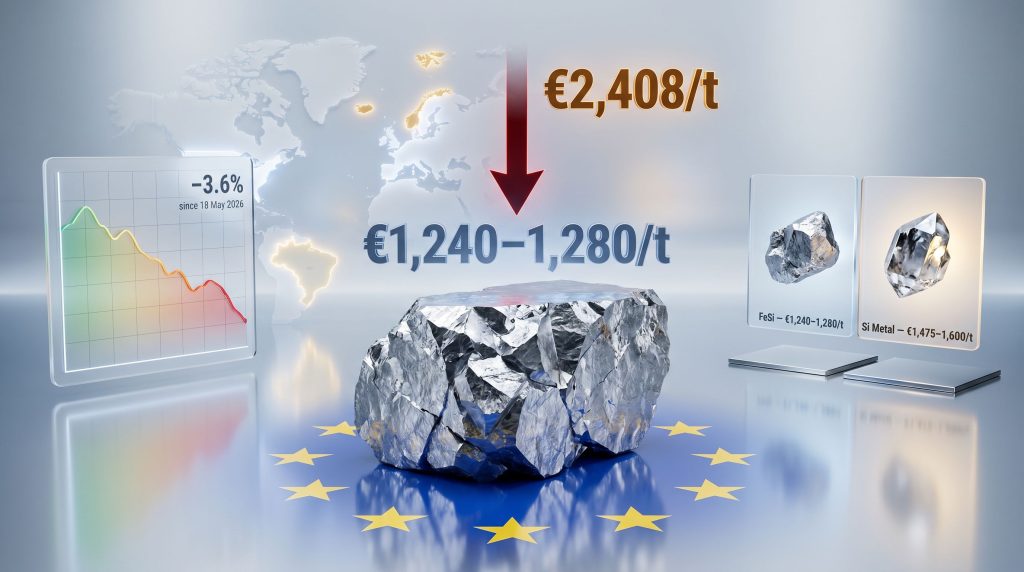
The MIP for ferro-silicon is fixed at €2,408 per tonne. As of mid-June 2026, European spot prices were assessed at €1,240 to €1,280 per tonne delivered duty paid Northwest Europe — placing the MIP at roughly twice the prevailing market price. This is not a minor administrative threshold. It is a structural ceiling on out-of-quota import economics.
Any importer who exhausts their country-specific quota allocation and attempts to source additional material at spot prices faces an immediate loss equivalent to the entire gap between the MIP and the import price. At current levels, that exposure amounts to approximately €1,128 to €1,168 per tonne — a loss so large that rational commercial actors will simply stop importing rather than absorb it.
Comparing the ferro-silicon MIP against other safeguarded ferro-alloys highlights just how extreme this gap is. Furthermore, commodity tariff impacts across related sectors suggest that wide MIP-to-spot gaps of this kind are relatively rare in modern safeguard frameworks.
| Ferro-Alloy | Minimum Import Price | Current Spot Price (June 2026) |
|---|---|---|
| Ferro-silicon | €2,408/t | €1,240–1,280/t ddp NWE |
| Silico-manganese | €1,392/t | Above MIP post-quota fill |
Analytical Insight: The distance between ferro-silicon's MIP and its spot price is the widest of any material within the safeguard framework. This creates an unusually sharp binary outcome: while quotas remain unfilled, imports can continue freely. Once they are exhausted, the market effectively closes to new import supply. The price consequences of that transition could be substantial.
Why Ferro-Silicon Prices Are Falling Despite Active Protections
The Pre-Safeguard Stockpiling Effect
The most significant force suppressing ferro-silicon prices in mid-2026 is not inadequate trade protection — it is the inventory overhang created by the trade protection itself. Ahead of the safeguard's November 2025 implementation date, market participants rushed to import large volumes of ferro-silicon into European warehouses at prevailing duty-free prices, effectively front-running the quota restrictions.
This pre-positioning strategy was rational at the time. Traders and consumers who correctly anticipated that safeguard quotas would constrain future supply secured a buffer of competitively priced units before the framework took effect. The consequence, now playing out in mid-2026, is that European warehouses remain well-stocked with low-cost material, significantly reducing the urgency to fill current-period quota allocations.
European ferro-silicon prices have declined by approximately 3.6% since the third safeguard period opened on 18 May 2026, with the market moving sideways for several consecutive weeks amid subdued transactional activity, according to Argus Media price assessments.
Seller Psychology: The Rational Case for Withholding Offers
Holders of existing inventory face an interesting strategic calculation. Selling at current prices of €1,240 to €1,280 per tonne generates immediate revenue but sacrifices the potential upside that quota exhaustion will create. Market participants across the supply chain have widely concluded that patience is commercially superior to early liquidation.
This creates a self-reinforcing dynamic:
- Sellers withdraw offers at current price levels, reducing visible spot supply.
- Buyers, facing low urgency due to ample warehouse inventory, decline to bid up.
- Trading volumes collapse into a narrow, rangebound pattern.
- The absence of clearing transactions delays the inventory drawdown needed to justify higher bids.
- The cycle continues until an external catalyst — most likely advancing quota fill rates — shifts the equilibrium.
Market participants have widely noted that near-term activity is expected to remain constrained by weak underlying steel sector demand. The broader steel market challenges facing producers across major economies in 2025 and 2026 have further compounded this subdued demand environment, reinforcing the predictable seasonal slowdown that characterises European industrial markets during July and August.
Differential Quota Fill Rates Across Supplier Countries
Not all country allocations are behaving the same way. Smaller quota allocations — including those assigned to Brazil and minor supplier nations — have already reached full utilisation. The significantly larger allocations held by Norway and Iceland remain partially unfilled, maintaining a continued pathway for duty-free imports that reduces price support.
This differential fill dynamic is a critical leading indicator. The market cannot tighten in any sustained way until the major Nordic allocations approach exhaustion. Until that point, importers retain access to quota-eligible material, suppressing any premium that would otherwise emerge from supply scarcity.
Silico-Manganese as a Market Precedent
What Happened When SiMn Quotas Filled
The silico-manganese market in May 2026 provided a live demonstration of how safeguard quota exhaustion translates into rapid price escalation. Once quota allocations for India and other supplier countries filled during that month, the combination of the MIP mechanism and reduced duty-free supply availability drove silico-manganese prices sharply higher in a short window of time.
This sequence has not gone unnoticed by ferro-silicon market participants. Buyers who experienced the cost shock from SiMn's post-quota-fill price movement are now weighing whether to secure ferro-silicon units proactively — before an equivalent transition occurs in that market. The silico-manganese precedent illustrates a distinctive feature of tariff-rate quota systems: markets can shift from apparent oversupply to acute tightness within a single quota period, with limited lead time for procurement teams to adapt.
Strategic Consideration for Procurement Teams: The SiMn experience demonstrates that the safeguard mechanism's binary structure compresses the warning window between stable pricing and a step-change higher. Buyers who wait for visible signs of quota exhaustion before acting may find themselves competing for the same limited duty-free units at the same time, accelerating the price move they sought to avoid.
Silicon Metal: The Unregulated Substitute Reshaping Competitive Dynamics
How Silicon Metal's Safeguard Exclusion Creates a Structural Advantage
The European Commission's decision to exclude silicon metal from the safeguard framework, based on its finding that import volumes had not materially increased during the reference period, has created an unintended competitive asymmetry. Silicon metal — which functions as a source of elemental silicon and can substitute for ferro-silicon across a range of steelmaking and aluminium alloy applications — now faces no quota restrictions or variable duties whatsoever.
This exclusion means that lower-cost silicon metal imports from Angola and China continue to enter the European market without restriction, providing downstream buyers with an alternative that sidesteps the safeguard entirely. For European ferro-silicon producers, who lobbied for protection against exactly this type of competitive pressure, the silicon metal carve-out represents a meaningful gap in the framework's coverage. In addition, the broader effects of tariffs and supply chains globally mean that unprotected materials like silicon metal can be re-routed with relative ease.
The Narrowing Price Spread and Its Substitution Implications
Historically, silicon metal commanded a premium over ferro-silicon because of its higher elemental purity and broader application range across industries including chemicals, semiconductors, and solar panels. However, the spread between the two materials has compressed materially since 2022, driven by the influx of competitively priced silicon metal from lower-cost producing regions.
As of mid-June 2026, European 5-5-3 grade silicon metal was assessed at €1,475 to €1,600 per tonne delivered duty paid Europe works, according to Fastmarkets. This compares to ferro-silicon at €1,240 to €1,280 per tonne. While silicon metal remains the higher-priced material in absolute terms, the spread has narrowed enough that the functional economics of substitution — particularly given silicon metal's freedom from quota risk — are increasingly compelling for downstream buyers.
| Comparison Factor | Ferro-Silicon | Silicon Metal |
|---|---|---|
| Safeguard coverage | Yes — quota-restricted | No — excluded |
| Current EU spot price (June 2026) | €1,240–1,280/t | €1,475–1,600/t |
| Out-of-quota duty risk | High (MIP: €2,408/t) | None |
| Market share trajectory | Under pressure | Gaining |
| Primary import origins | Norway, Iceland, Brazil | Angola, China |
European ferro-silicon producers now face a dual competitive challenge: near-term price suppression from the warehouse overhang, and the longer-term structural risk of permanently losing end-user market share to a substitute material that operates entirely outside the regulatory framework designed to protect them.
It is worth noting that silicon metal and ferro-silicon are not identical substitutes. Ferro-silicon typically contains 70 to 75% silicon by weight, with the remainder predominantly iron, making it particularly suited to iron and steel deoxidation and alloying applications. Silicon metal, at 98%+ purity, is used where elemental silicon content rather than iron carrier efficiency is the priority. The substitution opportunity exists where downstream specifications are flexible enough to accommodate either material.
The next major ASX story will hit our subscribers first
Market Outlook: Three Scenarios for the Rest of 2026
Scenario Analysis for Ferro-Silicon Price Recovery
Scenario 1 — Quota Fill Drives Gradual Normalisation (Base Case)
Norway and Iceland's larger quota allocations progressively fill through the third quarter of 2026. As inventory overhang clears and sellers exhaust their patience, offers return to the market. Prices recover toward the €1,400 to €1,500 per tonne range as the risk premium associated with approaching quota exhaustion re-enters market pricing. Seasonal restocking activity in Q4 provides additional support.
Scenario 2 — Prolonged Inventory Surplus Extends Price Weakness (Bear Case)
Pre-safeguard stocks persist longer than anticipated due to continued weakness in European steel output and capacity utilisation. The July-August seasonal slowdown delays quota fill beyond Q3, deferring meaningful price recovery to Q4 at the earliest. Spot prices remain rangebound between €1,240 and €1,300 per tonne through the summer period. European steel demand trends suggest this bear case scenario is a plausible near-term risk given current output trajectories.
Scenario 3 — Silicon Metal Substitution Structurally Caps Recovery (Downside Risk)
Accelerating substitution toward silicon metal permanently reduces the addressable demand pool for ferro-silicon. Even as quota allocations approach exhaustion, the reduced underlying demand base limits the price recovery ceiling. European producers face sustained margin compression unless the Commission reviews silicon metal's exclusion from the EU ferro-silicon safeguard quotas in a future investigation period.
Key Variables to Track Through the Remainder of 2026
- Norway and Iceland quota fill rates — the most reliable leading indicator for price inflection timing
- European steel sector capacity utilisation — the fundamental demand driver underpinning ferro-silicon consumption volumes
- Silicon metal import flows from Angola and China — the primary gauge of substitution pressure intensity
- Seasonal demand cadence — the anticipated July-August deceleration followed by potential Q4 procurement activity
- Any Commission review of silicon metal's exclusion — a regulatory wildcard that could materially shift competitive dynamics for domestic producers
Disclaimer: This article contains forward-looking scenario analysis and market commentary. All price references, quota fill rate assessments, and market projections are based on publicly available data current as of mid-June 2026. Commodity markets are subject to rapid change. Nothing in this article constitutes financial or investment advice. Readers should conduct their own independent research before making commercial or investment decisions.
Frequently Asked Questions: EU Ferro-Silicon Safeguard Quotas
What is the EU ferro-silicon safeguard quota?
The EU ferro-silicon safeguard quota is a tariff-rate quota system permitting defined volumes of ferro-silicon from specific exporting countries to enter the EU duty-free within each quota period. Material exceeding the country-specific allocation is subject to a variable duty unless its declared import price reaches or exceeds the fixed minimum import price of €2,408 per tonne. The overall framework operates from 18 November 2025 to 17 November 2028.
Why did the European Commission introduce these safeguard measures?
The Commission determined, following a formal investigation, that a surge in ferro-silicon imports had caused material injury to EU-based producers. Quota volumes were set at approximately 75% of average annual EU imports between 2022 and 2024, targeting preservation of a 30 to 40% domestic market share while maintaining downstream supply adequacy for steelmakers and aluminium producers.
Why are prices falling when the safeguard is active?
The price decline reflects a large inventory overhang accumulated before the safeguard took effect in November 2025. Traders and consumers who pre-purchased material ahead of quota restrictions created a stock surplus that continues to suppress import demand. Sellers are deliberately limiting offer activity in anticipation of stronger pricing once quota allocations advance toward exhaustion.
What happens once all quota allocations are exhausted?
When quota allocations are fully consumed, new imports can only enter the EU duty-free if their price matches or exceeds the €2,408 per tonne minimum import price. Given current spot prices are approximately half that level, quota exhaustion would effectively halt new commercial import activity, compelling buyers to source entirely from existing European inventory and creating the conditions for a significant upward price adjustment.
Can silicon metal replace ferro-silicon?
Silicon metal can partially substitute for ferro-silicon in applications where the downstream specification is flexible on elemental silicon delivery method. It was excluded from the EU ferro-silicon safeguard quotas and faces no quota restrictions. The price premium silicon metal previously commanded over ferro-silicon has narrowed considerably since 2022 due to competitive import flows from Angola and China, making substitution increasingly attractive for cost-sensitive buyers. However, full substitution is not always technically feasible given the different silicon content profiles and iron-carrier characteristics of the two materials.
Want to Know When the Next Major Mineral Discovery Hits the ASX?
Discovery Alert's proprietary Discovery IQ model delivers real-time alerts on significant ASX mineral discoveries, transforming complex commodity and market data into actionable investment insights — ideal for both traders and long-term investors navigating volatile resource sectors. Explore historic discoveries and their extraordinary returns, then begin your 14-day free trial at Discovery Alert to position yourself ahead of the market.