June 17, 2026
The Invisible Metal Holding Western Industry Together
Few industrial materials carry the strategic weight of tungsten without receiving the public attention that weight deserves. It sits beneath radar, moving through supply chains that most manufacturers take for granted until they cannot access it. Tungsten's physical properties are almost absurdly extreme: it holds the highest melting point of any metal at approximately 3,422°C, exhibits a density comparable to gold, and delivers hardness characteristics that make it irreplaceable in cutting tools, armor-piercing ammunition, turbine components, and high-performance electronics. When a material like this becomes concentrated in the hands of a single national producer, the industrial and national security implications are severe.
That concentration has been the defining reality of the global tungsten market for decades. China currently controls an estimated 80 to 85% of global tungsten mining output, and commands an even larger share of the downstream refining and processing capacity that converts raw concentrate into usable industrial products. This dominance is not accidental. It reflects sustained state investment, resource nationalism, and a deliberate long-term strategy to anchor critical mineral value chains within Chinese borders. For Western manufacturers and defence contractors, the result has been a structurally fragile supply situation dressed up as normalcy.
Understanding tungsten's strategic importance helps explain why the Trinity Metals US tungsten concentrate story is genuinely significant — not merely because a new supplier has emerged, but because the commercial architecture surrounding Nyakabingo mine represents a purpose-built response to a vulnerability that Western policymakers have been cataloguing for years without a credible industrial solution.
When big ASX news breaks, our subscribers know first
Understanding Tungsten Concentrate: The Critical Intermediate Product
From Ore to Industry: What Concentrate Actually Is
Before examining the Nyakabingo supply chain, it helps to understand where tungsten concentrate sits within the broader processing sequence. Tungsten is extracted from two primary ore types: scheelite (calcium tungstate) and wolframite (an iron-manganese tungstate). Both are mined, crushed, and processed through flotation or gravity concentration techniques to produce tungsten concentrate, typically expressed as a percentage of tungsten trioxide (WO₃).
This concentrate is an intermediate product. It cannot be used directly in manufacturing. The downstream processing sequence typically follows this path:
- Concentrate production at mine site, achieving commercially viable WO₃ grades
- Chemical dissolution to produce ammonium paratungstate (APT), the primary global benchmark product
- Reduction processing to convert APT into tungsten metal powder or oxide
- Consolidation and fabrication into tungsten carbide, ferrotungsten, or specialty alloys
- End-use manufacturing across defence, aerospace, cutting tools, and electronics sectors
A critical and underappreciated structural problem in the US tungsten market is that domestic refining capacity to process concentrate into APT and beyond remains limited. This means that securing reliable, high-grade concentrate from a non-Chinese source is necessary but not by itself sufficient. The presence of Global Tungsten & Powders (GTP) in Towanda, Pennsylvania as the processing partner in this supply chain is therefore as strategically important as the mine itself. GTP functions as the bottleneck through which raw African concentrate becomes usable American industrial feedstock.
Why APT Pricing Matters for Western Manufacturers
Global tungsten pricing is benchmarked primarily through Chinese APT prices, which creates a persistent challenge for Western buyers. When Beijing tightens export controls or adjusts tungsten quota allocations, the price signal transmitted through APT markets can be severe and rapid. Furthermore, Western manufacturers with long production contracts find themselves exposed to cost volatility that originates entirely outside their supply chain visibility. The transition toward multiyear concentrate agreements with non-Chinese producers represents a partial hedge against this structural pricing risk.
Nyakabingo Mine: Operational and Geological Profile
Rwanda's Position in the African Tungsten Landscape
The Nyakabingo mine is situated in Rwanda, a jurisdiction that has invested deliberately in becoming a credible, governance-premium mineral supplier to Western markets. Rwanda holds significant wolframite deposits within the broader Central African metallogenic belt, a geological zone that also hosts substantial tantalum, tin, and niobium mineralisation. The country's geological endowment is real, but its competitive advantage over regional peers in the Democratic Republic of Congo and Uganda derives primarily from its regulatory environment and mineral traceability infrastructure rather than geology alone.
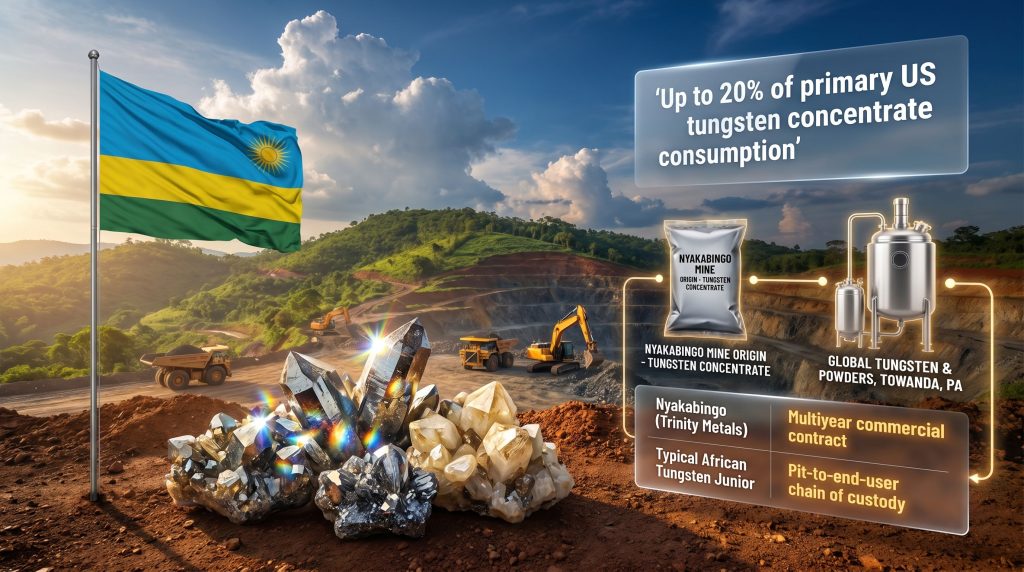
Trinity Metals acquired Nyakabingo in 2022 and has since scaled production to a position of material significance in Western tungsten supply. The speed of that ramp from acquisition to up to 20% of primary US tungsten concentrate consumption within approximately three years is operationally notable and reflects both the asset's underlying quality and the urgency of Western buyer demand.
Nyakabingo vs. Comparable African Operations
| Metric | Nyakabingo (Trinity Metals) | Typical African Tungsten Junior |
|---|---|---|
| US Market Share (Concentrate) | Up to 20% of primary US consumption | Negligible to trace volumes |
| Supply Agreement Type | Multiyear commercial contract | Spot or short-term |
| Traceability Standard | Pit-to-end-user chain of custody | Variable |
| Processing Partner | Global Tungsten & Powders (GTP) | Typically undisclosed or Asian refiner |
| Logistics Partner | Traxys | Varies |
The comparison above highlights a structural distinction that is easy to overlook. It is not just that Nyakabingo produces tungsten concentrate at scale. It is that the mine operates within a commercial ecosystem specifically designed to meet Western industrial sourcing standards. Most African junior mining operations supplying tungsten have historically directed material toward Asian processors, where traceability requirements are less stringent and pricing may be marginally more favourable in spot market conditions.
The Commercial Architecture: Three Interlocking Partners
Global Tungsten & Powders: America's Refining Hub
GTP, headquartered in Towanda, Pennsylvania, is the largest tungsten processor and refiner in the United States. The company produces tungsten carbide powder, tungsten metal, and specialty alloys that feed directly into defence contractors, aerospace manufacturers, and industrial tool producers. Its selection as the processing partner for Trinity's Nyakabingo concentrate carries specific implications beyond commercial convenience.
GTP's intake standards are understood to be demanding. Concentrate accepted for processing must meet purity thresholds consistent with defence and advanced industrial applications. The fact that Nyakabingo material has cleared these specifications indicates that the mine's metallurgical output is genuinely competitive with global quality benchmarks, not merely an acceptable substitute for buyers with no other options.
Traxys: Compliance Infrastructure in Motion
Traxys is a globally recognised specialty metals and minerals trading and logistics firm with particular expertise in navigating conflict-sensitive mineral supply chains. Its involvement in the Trinity Metals supply chain serves multiple functions simultaneously:
- Providing commercial risk management across the logistics chain from Rwanda to Pennsylvania
- Ensuring compliance with OECD due diligence guidelines for responsible mineral sourcing
- Delivering the institutional credibility that US defence-sector buyers require from their upstream supply chains
- Managing the documentation and custody handoffs that support chain-of-custody certification
The partnership between Traxys and Trinity Metals also signals something about how the global responsible sourcing ecosystem is maturing. Large logistics and trading intermediaries are no longer passive freight managers. They are active participants in supply chain compliance architecture, and their willingness to partner with a given mining operation is itself a form of quality certification.
Why This Three-Party Structure Is Historically Significant
The Trinity Metals, GTP, and Traxys arrangement is recognised as the first direct commercial tungsten concentrate supply from Rwanda to the United States. That distinction matters beyond symbolism. It establishes a precedent, a blueprint, and a documented proof of concept for Africa-to-US critical mineral supply chains built around Western governance standards. Consequently, the broader critical minerals demand surge across Western markets lends further urgency to ensuring arrangements like this succeed and are replicated.
"The long-term sustainability of Western tungsten diversification depends not only on securing new supply sources but on building the domestic refining and processing infrastructure that converts raw concentrate into end-use materials. GTP's role as the processing anchor in this supply chain is therefore as strategically significant as the mining operation itself."
Quantifying the 20% Market Share: What It Actually Means
US Tungsten Consumption by End-Use Sector
To understand the significance of a 20% primary concentrate supply share, it helps to understand where US tungsten actually goes:
| End-Use Sector | Estimated Share of US Consumption |
|---|---|
| Cemented Carbide (cutting tools, drill bits) | ~60% |
| Defence & Armor Applications | ~15% |
| Electrical & Electronic Components | ~10% |
| Aerospace & High-Temperature Alloys | ~10% |
| Other Industrial Uses | ~5% |
Sources: USGS Mineral Commodity Summaries; industry estimates
Cemented carbide, which accounts for the largest single share of US tungsten demand, is the material form most commonly associated with industrial cutting tools and drill bits. It is produced by combining tungsten carbide powder with a cobalt binder under high pressure and temperature. The quality consistency of concentrate feedstock directly affects carbide product performance, which is why GTP's role as quality gatekeeper between Nyakabingo output and US manufacturing is so functionally important.
The defence sector's 15% share is strategically disproportionate to its volume. Armor-piercing kinetic energy penetrators, for instance, depend on tungsten's combination of extreme density and hardness to function. These applications have essentially no viable substitute material at equivalent performance levels, creating a category of demand where supply disruption translates almost immediately into defence supply chain risks.
China's Export Restrictions as a Demand Accelerant
China's imposition of tungsten export restrictions — part of a broader pattern of critical mineral leverage that has included germanium, gallium, and rare earth elements — has directly accelerated demand for non-Chinese concentrate among US buyers. The mechanism is straightforward: when export controls raise the uncertainty and cost of Chinese-origin material, buyers with the option to source from traceable, allied-nation suppliers have strong commercial and compliance incentives to do so.
Trinity's Nyakabingo operation has benefited from this demand pull. However, the mine did not simply find buyers through conventional mineral marketing. It filled a gap that Chinese policy actions had made increasingly uncomfortable for US industrial purchasers to ignore.
Rwanda's Governance Premium: Why Jurisdiction Matters
Traceability as a Market Access Requirement
Rwanda operates one of the most advanced mineral traceability systems in Africa. The country's national mineral tracking infrastructure certifies the origin and chain of custody of exported minerals, reducing the compliance burden for downstream buyers who must demonstrate responsible sourcing to regulated customers. For a US defence contractor or a manufacturer supplying government procurement channels, the ability to document mineral origin from pit to product is no longer optional.
Trinity Metals has implemented a full chain-of-custody model across the Nyakabingo operation. The traceability process involves multiple documented steps:
- Mine-site tagging and batch identification at the point of extraction
- Third-party auditing of concentrate composition, grade, and origin
- Logistics documentation maintained by Traxys across the export and import journey
- Refinery intake verification confirming material identity when GTP receives concentrate
- End-use certification for defence or regulated industrial applications
This architecture directly addresses the compliance frameworks that increasingly govern mineral procurement in Western markets, including Section 1502 of the Dodd-Frank Act and the emerging requirements of the EU Critical Raw Materials Act. Rwanda's national traceability infrastructure and Traxys' logistics expertise together create a dual-layer compliance system that is genuinely difficult for producers in less-governed jurisdictions to replicate.
Rwanda vs. Regional Peers: The Governance Differential
Other Central African nations including the DRC and Uganda possess substantial tungsten-bearing geology. The DRC in particular hosts enormous mineral wealth across multiple critical minerals. Yet Western buyers consistently face compliance challenges when sourcing from the DRC, given its historical association with conflict mineral financing and the additional due diligence burden this creates.
Rwanda's political stability, anti-corruption governance track record, and deliberate investment in mineral certification infrastructure have translated into a concrete commercial advantage. Its tungsten exports carry a governance premium that is not merely reputational but functionally embedded in the procurement processes of Western industrial buyers. In addition, considerations around energy security and critical minerals further reinforce why securing supply from stable, allied-adjacent jurisdictions such as Rwanda has become a Western policy priority.
The next major ASX story will hit our subscribers first
Risks and Constraints in Scaling African Tungsten Supply
Operational Vulnerabilities
No mining operation is without risk, and African critical mineral supply chains carry a specific set of considerations that investors and procurement managers should understand clearly:
- Geological variability: Central African tungsten deposits can exhibit grade inconsistency that affects concentrate output and quality across different ore zones. Maintaining the specification standards required by GTP demands rigorous grade control at the mine site
- Infrastructure limitations: Road quality, port capacity, and inland logistics networks in Central Africa remain constraints that can introduce cost escalation and delivery timing uncertainty
- Currency and political risk: Rwanda's risk profile is lower than most regional peers, but long-term supply contracts spanning multiple years must account for political and macroeconomic scenario ranges
Market-Level Risks
Beyond operational factors, the broader tungsten market presents structural risks that are worth understanding:
- Chinese producers retain the capacity to increase concentrate export volumes and compress global pricing, potentially undermining the economics of higher-cost African production in spot market conditions
- The multiyear contract structure between Trinity, GTP, and Traxys mitigates but does not eliminate exposure to volume and pricing shifts over the contract duration
- US manufacturers sourcing Rwandan tungsten may face a modest price premium relative to Chinese-origin material, creating competitive pressure in sectors where input cost discipline is tight
"A nuanced perspective often absent from mainstream coverage of critical mineral diversification is that building resilient Western supply chains requires accepting a structural cost premium over Chinese-origin material. The question for industrial policy is whether that premium is worth paying in exchange for supply security. For defence applications, the answer is almost certainly yes. For commodity industrial applications, the calculus is more complex."
The Broader Template: What Nyakabingo Signals for Critical Mineral Diversification
Africa as a Strategic Sourcing Continent
The Trinity Metals US tungsten concentrate story is not an isolated event. It sits within a broader reorientation of Western critical mineral strategy toward African supply. The continent holds substantial reserves across multiple minerals on the US and EU critical minerals lists, including cobalt, tantalum, niobium, graphite, and rare earth elements in addition to tungsten.
What the Nyakabingo model demonstrates is that Africa-to-US critical mineral supply chains can be built to meet Western industrial standards when the right combination of mine quality, governance environment, logistics expertise, and downstream processing capacity is assembled. However, replicating this combination across other minerals and jurisdictions requires sustained commercial commitment, not just policy aspiration. Australia's own defence critical materials strategy reflects similar thinking, reinforcing that allied nations are actively working to build robust, non-Chinese supply chains in parallel.
The Processing Bottleneck Problem
A point that deserves more attention than it typically receives is the downstream refining constraint. Securing non-Chinese concentrate supply solves only part of the Western tungsten supply chain problem. Without sufficient US-based processing capacity to convert that concentrate into value-added materials, the supply chain remains partially dependent on either Chinese refiners or a small number of non-Chinese processors like GTP.
Scaling GTP's capacity, or developing additional Western refining infrastructure, is therefore a prerequisite for fully realising the strategic value of new concentrate sources like Nyakabingo. This upstream-downstream interdependence means that mining investment and processing investment must advance together for the diversification goal to be genuinely achieved. Recent coverage from The Northern Miner confirms the landmark nature of Rwanda's first tungsten shipment to the US, further validating the model's commercial and strategic significance.
Key Takeaways: What the Trinity Metals Model Means for Tungsten Markets
- A structural shift, not a temporary adjustment: One African mine now supplies up to one-fifth of US tungsten concentrate consumption, representing a durable change in sourcing geography
- Traceability is the market access threshold: Buyers in defence and regulated manufacturing are requiring documented chain-of-custody from pit to product, and producers without this capability are increasingly excluded from premium Western markets
- Multiyear contracts create the investment certainty that diversification requires: Without long-term demand commitments, mining operators cannot justify the capital expenditure needed to develop and scale non-Chinese supply
- The governance premium is commercially real: Rwanda's regulatory environment and traceability infrastructure are not soft attributes — they translate directly into market access and contract eligibility for Western industrial buyers
- Processing capacity is the critical bottleneck: GTP's role as the US's primary tungsten refiner makes it a strategic asset in the broader diversification equation, and its feedstock security is inseparable from the Nyakabingo supply relationship
Disclaimer: This article is intended for informational purposes only and does not constitute financial or investment advice. Statements regarding market share figures, supply volumes, and end-use consumption data are based on publicly available information and industry estimates including USGS Mineral Commodity Summaries. Forecasts, projections, and strategic assessments involve inherent uncertainty and should not be relied upon as guarantees of future outcomes. Readers should conduct independent research and seek qualified professional advice before making investment or procurement decisions.
Want to Track the Next Major Critical Mineral Discovery Before the Market Does?
Discovery Alert's proprietary Discovery IQ model delivers real-time alerts on significant ASX mineral discoveries — including critical minerals like tungsten and its peers — instantly translating complex geological announcements into actionable insights for both traders and long-term investors. Explore how major mineral discoveries have historically generated substantial returns on Discovery Alert's dedicated discoveries page, and begin your 14-day free trial today to position yourself ahead of the broader market.