June 17, 2026
The World's Most Critical Oil Bottleneck and Why Iraq Bears the Greatest Risk
Every barrel of crude oil that travels from the Persian Gulf to refineries across Asia, Europe, and beyond must pass through a narrow strip of water separating the Arabian Peninsula from Iran. The Strait of Hormuz, at its narrowest point just 33 kilometres wide, functions as the circulatory valve of the global petroleum system. When that valve is open, the world's energy markets operate with a degree of predictability. When it is threatened or closed, the consequences radiate across every sector of the global economy with alarming speed.
Understanding why Iraq oil exports through the Strait of Hormuz occupy such a uniquely vulnerable position requires looking beyond the geography itself and examining the structural asymmetries that define each Gulf producer's exposure to a Hormuz disruption. Furthermore, monitoring oil price trends during such disruptions reveals just how interconnected these dynamics truly are.
When big ASX news breaks, our subscribers know first
Iraq's Disproportionate Exposure Compared to Other Gulf Producers
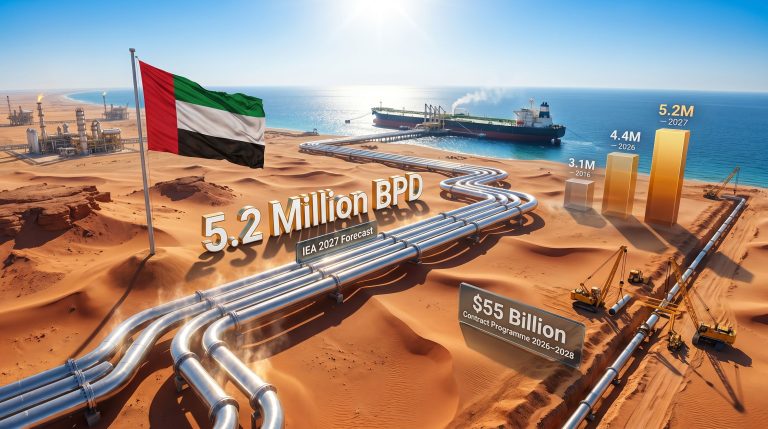
Not all Persian Gulf producers carry the same level of risk when Hormuz comes under threat. Saudi Arabia, for instance, invested heavily in the East-West Pipeline decades ago, providing a Red Sea outlet capable of handling a meaningful portion of its crude output. The UAE has developed the Abu Dhabi Crude Oil Pipeline, which bypasses Hormuz entirely and terminates at the port of Fujairah on the Gulf of Oman.
Iraq has no equivalent bypass infrastructure at significant scale. Its entire southern export architecture, anchored by the Basra Oil Terminal and a network of offshore Single Point Mooring buoys engineered for Very Large Crude Carrier and Ultra Large Crude Carrier loading operations, feeds directly into waters that require Hormuz passage for onward delivery. This concentration of export dependency is not simply an inconvenience during a disruption. It is a structural amplifier of risk.
Iraq does maintain a northern export route: the Kirkuk-Ceyhan pipeline, which carries crude through Kurdish-administered territory to Turkey's Mediterranean coast. During the peak disruption period, this corridor was transporting approximately 200,000 barrels per day (bpd). Iraqi authorities have outlined expansion targets of up to 500,000 bpd for this route, yet even that aspirational ceiling represents less than 15% of Iraq's normal pre-war export capacity. Compounding this limitation, the pipeline has a history of operational interruptions tied to long-running revenue-sharing disputes between the Iraqi federal government and the Kurdistan Regional Government, introducing political fragility into what is already a constrained alternative.
How Severe Was the Collapse? A Data-Driven Assessment
The scale of Iraq's export contraction during the Hormuz disruption is difficult to contextualise without direct comparison. The figures that emerged from tanker tracking data and official Iraqi sources are stark.
| Metric | Pre-Conflict Baseline (Jan-Feb) | Wartime Low (May) | Early Recovery (June, First Half) |
|---|---|---|---|
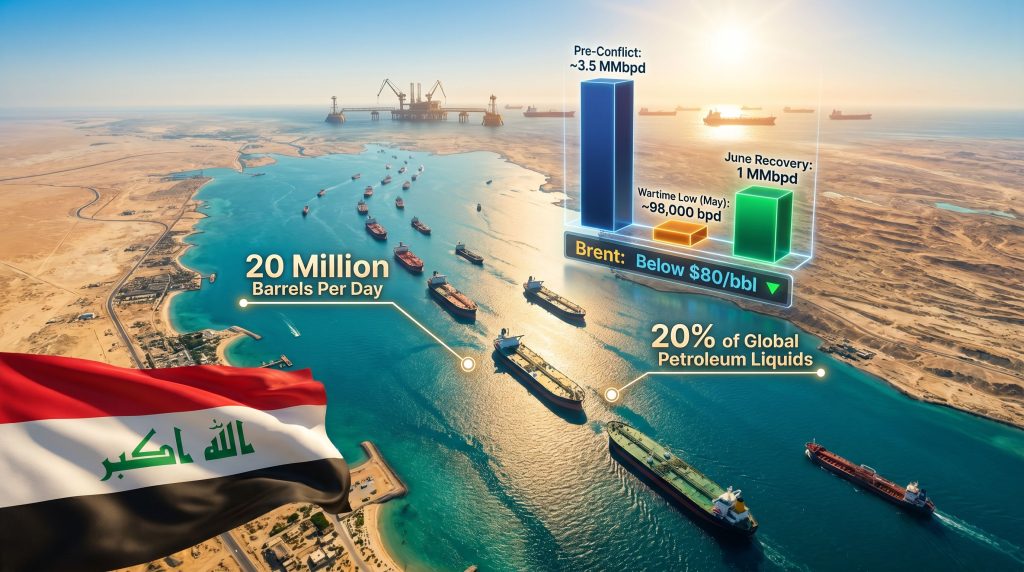
| Daily southern port exports | ~3.5 MMbpd | ~98,000 bpd | ~1 MMbpd |
| Monthly southern port volume | ~93 million barrels | ~10 million barrels | Actively ramping |
| Northern route (Ceyhan) | Limited throughput | ~200,000 bpd | Target: 500,000 bpd |
The contraction in southern port exports from a monthly average of roughly 93 million barrels to approximately 10 million barrels in April represents a collapse of close to 89% from baseline. By the first half of June, SOMO Director General Ali Nizar confirmed that southern port shipments had recovered to approximately 1 million barrels per day, signalling that some restoration was already underway even before a formal agreement was signed.
Critical context: The disruption was not caused by physical damage to Iraq's export infrastructure. Iraq's oil ministry spokesperson Salim Al-Rikabi explicitly confirmed that southern terminal infrastructure remained intact throughout the conflict period. The bottleneck was entirely logistical and geopolitical in nature.
The Hidden Mechanisms Behind the Export Collapse
It would be a simplification to attribute Iraq's export collapse solely to blocked shipping lanes. Several less visible forces compounded the physical disruption into something far more severe.
War Risk Insurance Withdrawal
War risk insurance withdrawal played a pivotal role. The Lloyd's of London market and other major marine underwriters suspended or repriced coverage for tankers transiting the Persian Gulf to levels that rendered most commercial voyages economically unviable. For operators working on thin freight margins, insurance cost spikes can be just as prohibitive as a physical barrier.
AIS Transponder Blackouts
AIS transponder blackouts created a secondary layer of uncertainty. An increasing number of tankers across the region disabled their Automatic Identification System tracking to avoid detection, which complicated cargo verification for buyers, insurers, and regulators alike. This behaviour, while offering vessels some protection from targeting, paradoxically discouraged mainstream commercial operators from accepting Gulf assignments, since the inability to verify vessel positions in real time introduced contractual and compliance risks.
Buyer-Side Hesitancy
Buyer-side hesitancy created a feedback loop that further suppressed loading nominations. Crude purchasers, uncertain about whether their nominated vessels could obtain insurance coverage or safely exit the Gulf after loading, delayed or withheld tanker nominations to SOMO. This backlog then queued against SOMO's processing capacity, adding administrative delay on top of logistical constraint.
The result was a disruption that, according to contemporary market analysis, exceeded the 1973 Arab Oil Embargo in terms of total volume removed from global supply. The 1973 embargo removed an estimated 4 to 5 million barrels per day from markets. A full Hormuz constraint affecting the roughly 20 million barrels per day that transited the strait in 2024, according to the U.S. Energy Information Administration, represents a disruption of an entirely different order of magnitude. Consequently, OPEC's market influence over pricing mechanisms became even more pronounced during this period.
The Mechanics of Reopening: What Export Recovery Actually Requires
The signing of an interim agreement between the United States and Iran to restore freedom of navigation through Hormuz sets a legal and political foundation for commercial shipping resumption. However, markets frequently misunderstand how quickly physical volumes can follow diplomatic signals. The International Energy Agency characterised the anticipated recovery as gradual, a framing that carries significant implications for price forecasting.
The operational sequence required to restore Iraq oil exports through the Strait of Hormuz to pre-war levels unfolds in distinct phases:
-
Tanker nomination completion: Crude buyers must formally identify and nominate specific vessels to SOMO for Iraqi loading assignments. A backlog of nominations had already begun processing ahead of the formal agreement signing, with some buyers communicating vessel choices to SOMO as soon as the peace deal was publicly announced.
-
War risk insurance reinstatement: Underwriters must reassess Gulf transit risk under the new diplomatic framework and restore coverage at commercially viable premium levels. This process does not happen instantaneously and typically follows direct confirmation of safe passage conditions.
-
Bidirectional vessel repositioning: Tankers already loaded and waiting inside the Gulf must be able to exit through Hormuz, while empty vessels positioned outside must navigate inward. This creates a two-directional traffic management challenge at a chokepoint that can only accommodate a limited number of vessels transiting simultaneously.
-
Berth scheduling at southern terminals: Iraq's Basra terminal operators must sequence loading assignments across multiple VLCC and ULCC class vessels, a coordination task that becomes more complex as multiple producers attempt to increase exports simultaneously.
-
Field-level production ramp-up: Individual Iraqi oilfields require varying timeframes to restore output to pre-disruption levels. Fields that underwent controlled slowdowns may recover faster than those that experienced operational complications. Iraq's oil ministry spokesperson acknowledged this variability directly, noting that restoration timelines would differ from one field to another.
How Oil Markets Priced the Anticipation Before the Deal Was Signed
Energy markets are structurally forward-looking. Prices respond to expectations of future supply and demand conditions, not merely current physical flows. This characteristic produced a notable dynamic during the lead-up to the Hormuz reopening: Brent crude fell below $80 per barrel, reaching levels last observed in early March, before a single additional Iraqi barrel reached the market under normalised conditions.
The IEA's framing of a gradual rather than immediate recovery introduces a meaningful risk of partial price correction if physical volumes ramp more slowly than market expectations have priced in.
This dynamic reflects a market that had absorbed extraordinary demand destruction during the disruption period, as buyers accelerated their draw-down of strategic and commercial petroleum reserves, activated alternative supply chains, and in some cases implemented demand-side rationing. The oil market effects of such demand destruction can take considerable time to fully reverse, and the degree to which that reversal occurs rapidly will determine whether the price response stabilises below $80 or experiences a technical rebound.
The stealth export behaviour observed among other regional producers during the disruption adds another layer to the supply calculus. Both the UAE and Kuwait were observed conducting covert shipments with transponders disabled. A formal Hormuz reopening would convert these grey-market flows into transparent, trackable volumes, technically increasing visible supply figures even if the underlying physical barrels were already moving.
| Producer | Disruption Behaviour | Post-Reopening Implication |
|---|---|---|
| Iraq | Exports collapsed to ~98,000 bpd in May | Targeting ramp toward 3.5 MMbpd |
| UAE | Covert transponder-off shipments | Formal resumption increases visible supply |
| Kuwait | Similar pattern to UAE | Transparent flows resume at higher declared volumes |
| Iran | Moving own tankers pre-agreement | Export restart subject to sanctions framework |
| Saudi Arabia | Partial Hormuz exposure via bypass pipelines | Supplementary increase alongside Gulf reopening |
The next major ASX story will hit our subscribers first
Iraq's Long-Term Strategic Vulnerability Remains Unresolved
Even as Iraq moves to restore exports and capitalise on the reopening, the structural lesson of this disruption deserves careful attention. The country's near-total dependence on Hormuz passage for its petroleum revenues creates a recurring geopolitical exposure that pipeline expansion alone cannot eliminate in the near to medium term. In addition, the broader geopolitical trade tensions reshaping global commerce in 2025 have only amplified the urgency of these structural vulnerabilities.
Iraq earns approximately 90% of its government revenues from oil exports, according to the World Bank. A disruption of the scale witnessed during this conflict, if sustained for a longer period, would produce fiscal consequences that extend well beyond the energy sector into social stability and sovereign debt serviceability.
The Ceyhan route expansion to 500,000 bpd, even if fully realised, provides a buffer rather than an alternative. Building genuine bypass resilience at a scale comparable to Iraq's southern terminal capacity would require multi-decade infrastructure investment of a magnitude that current budget constraints and security conditions make difficult to envision.
For energy market analysts and investors tracking Iraq's export recovery, three variables will drive the pace and ceiling of the rebound: the speed at which tanker insurance markets normalise, the rate at which empty vessels can reposition into the Gulf, and the field-by-field variability in production ramp-up timelines across Iraq's southern producing basins. Tracking current crude oil prices alongside these operational variables provides the most complete picture of how recovery is progressing.
This article is intended for informational purposes only and does not constitute financial or investment advice. Forecasts regarding oil prices, export volumes, and recovery timelines involve inherent uncertainty and are subject to change based on geopolitical developments, market conditions, and operational variables.
FAQ: Iraq Oil Exports and the Strait of Hormuz
How Much Oil Does Iraq Normally Export Through the Strait of Hormuz?
Iraq's total exports averaged approximately 3.5 million barrels per day during January and February of the pre-conflict period, with the overwhelming majority departing through southern Gulf terminals that require Hormuz passage for onward delivery.
How Far Did Iraq's Oil Exports Fall During the Disruption?
Southern port exports fell to approximately 98,000 barrels per day in May, compared to a pre-war monthly average of around 93 million barrels. This represents a reduction of roughly 89% from baseline levels, one of the most severe single-country export contractions in modern oil market history.
Why Can't Iraq Simply Redirect All Exports Through Turkey?
The Kirkuk-Ceyhan northern pipeline route was carrying approximately 200,000 bpd during the disruption, with expansion targets of up to 500,000 bpd. Even at maximum planned capacity, this represents less than 15% of Iraq's normal export volume and cannot substitute for the scale of southern terminal operations.
What Is Slowing the Return to Full Export Capacity?
Three interdependent constraints determine recovery speed: tanker availability and insurance market reinstatement, the logistical challenge of repositioning vessels bidirectionally through Hormuz, and the variable timelines required for individual Iraqi oilfields to restore pre-disruption production rates.
Was Iraq's Export Infrastructure Physically Damaged?
Iraq's oil ministry confirmed that no damage occurred to southern export infrastructure throughout the conflict period. The disruption was entirely logistical and geopolitical in nature, a fact that supports a faster physical recovery trajectory once maritime navigation normalises.
Why Did Oil Prices Fall Before the Deal Was Formally Signed?
Energy markets price forward expectations rather than current conditions. Brent crude fell below $80 per barrel in anticipation of restored supply, reflecting trader positioning ahead of physical volume recovery. If the ramp-up proceeds more slowly than market pricing assumes, a partial upward correction remains a plausible scenario. Furthermore, Iraq oil exports through the Strait of Hormuz resuming at scale will be the clearest signal that market conditions are genuinely normalising.
Want to Stay Ahead of the Next Major Market-Moving Discovery?
While geopolitical disruptions reshape global commodity flows, Discovery Alert's proprietary Discovery IQ model scans ASX announcements in real time, delivering instant alerts on significant mineral discoveries before the broader market reacts — explore the historic returns major discoveries have generated and begin your 14-day free trial to secure a genuine market-leading edge.