August 5, 2026
The $100 Threshold: Why Iron Ore's Key Benchmark Matters
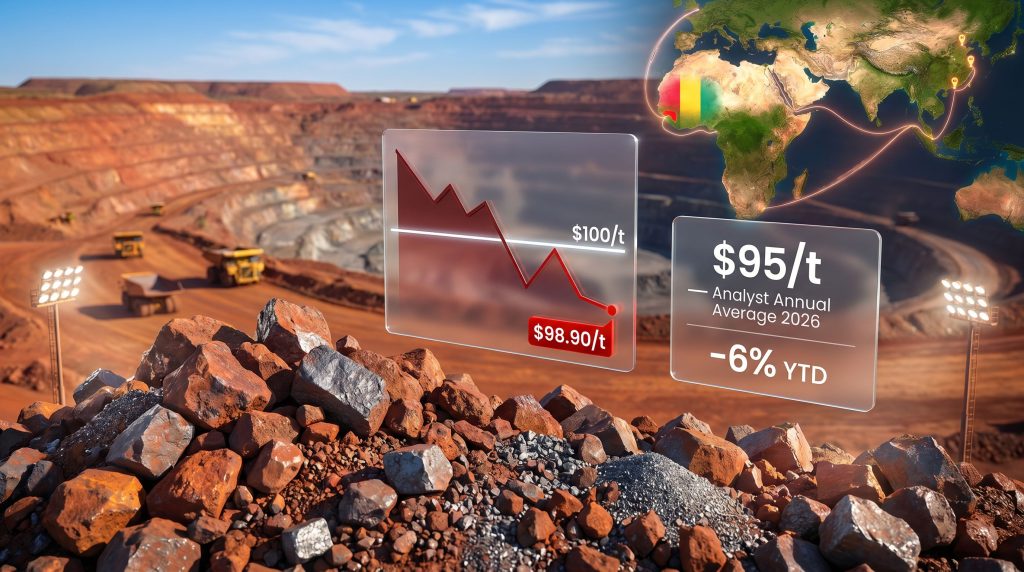
Few numbers carry as much weight in global commodity markets as the $100 per tonne level for iron ore. It sits at the intersection of psychology and fundamentals, representing a line that traders, analysts, and mining executives watch with genuine attention. When iron ore trades comfortably above this mark, it signals a market where demand is absorbing available supply at a pace that sustains healthy producer margins. When it falls through it, as happened in mid-June 2026 when futures dropped 2.3% to $98.90 per tonne, the signal is harder to ignore — and the iron ore price below $100 becomes a headline that moves markets.
The benchmark most commonly referenced in iron ore markets is the 62% iron fines price, delivered to Chinese ports. This grade serves as the global pricing anchor because it reflects the ore quality most widely consumed by Chinese blast furnaces. Higher-grade ore, such as 65% iron content material, typically commands a premium due to its efficiency advantages in steelmaking, while lower-grade material trades at a discount.
The spread between grades is not static and often widens when mill margins tighten, as steelmakers prioritise feed quality to extract maximum output from each blast furnace heat. Understanding where the current price sits historically provides important context:
| Price Level | Market Interpretation | Historical Context |
|---|---|---|
| Above $120/t | Strong demand cycle, supply tightness | 2021-2022 peak period |
| $100-$120/t | Balanced market, moderate demand | Mid-cycle norm |
| $80-$100/t | Oversupply conditions, demand softness | Analyst base case 2025-2026 |
| Below $80/t | Structural bear market territory | Rare; last seen 2015-2016 |
When big ASX news breaks, our subscribers know first
What Is Driving the Iron Ore Price Below $100 Right Now?
Supply Overhang and the Simandou Effect
The forces pressing the iron ore price below $100 are neither isolated nor temporary. On the supply side, global production volumes have expanded at a pace that is outrunning the market's capacity to absorb new tonnes. The most structurally significant contributor to this dynamic is the Simandou iron ore complex in Guinea, West Africa. The broader iron ore surplus outlook suggests this oversupply pressure will persist well into the medium term.
Simandou is widely regarded as the largest untapped high-grade iron ore deposit in the world, with ore quality exceeding 65% iron content at various zones across the four blocks that make up the project. For decades, the deposit sat undeveloped due to a combination of infrastructure challenges, political complexity, and financing hurdles. That situation has fundamentally changed. Exports surged in the six months following the first ore shipments, and as output ramps progressively upward, the project adds structural downward pressure on benchmark pricing that extends well beyond any single quarter.
The Simandou project's high iron content is not merely a quality advantage. It also means that tonne-for-tonne, Simandou ore displaces a larger volume of lower-grade feed in Chinese blast furnaces, amplifying its effective supply impact relative to headline tonnage figures.
Port Inventory Accumulation and Freight Rate Collapse
Chinese port iron ore inventories have climbed to the highest level ever recorded for this time of year, a leading indicator that the market is generating more supply than current steel production rates can absorb. Elevated port stocks signal that mills are not drawing down their buffers aggressively, reflecting cautious purchasing behaviour in an environment of weak margins and uncertain order books.
Adding a less-discussed dimension to the price decline is the collapse in ocean freight rates. Iron ore pricing is, at its core, a delivered cost equation. The landed price at a Chinese port reflects both the FOB (free-on-board) mine price and the ocean freight component. When crude oil prices fell sharply following expectations that the Strait of Hormuz could reopen, freight rates compressed significantly, removing a cost floor that had previously provided indirect price support.
A researcher at Citic Futures noted that expectations surrounding the strait's reopening led to a sharp fall in crude oil prices, which in turn dragged ocean freight rates lower and reduced the cost support previously embedded in iron ore valuations. This cross-commodity transmission mechanism is frequently underappreciated by observers focused purely on steel demand. Freight cost compression effectively makes iron ore cheaper to deliver, which in a well-supplied market does not trigger additional demand but instead reduces the floor price at which arbitrage becomes economic.
Is China's Steel Sector the Real Problem?
Reading the May 2026 Output Data
China's steel production contracted again in May 2026, continuing a trend that reflects both cyclical and structural pressures on the world's dominant steel economy. The country accounts for roughly 55% of global steel output and an even larger share of seaborne iron ore imports, making its production trajectory the single most important variable in global iron ore pricing. Furthermore, the broader China steel and iron ore market dynamics suggest these headwinds are unlikely to ease quickly.
What makes the current period particularly challenging is the simultaneous weakening of both fixed-asset investment and consumer spending, with both indicators falling to levels not seen since the pandemic period. Fixed-asset investment drives steel demand through construction, infrastructure, and industrial plant, while consumer spending affects the downstream manufacturing sectors that also consume steel. When both contract at the same time, the demand signal for ferrous metals deteriorates sharply.
Ferrous metals occupy a unique position in commodity markets because they are simultaneously an industrial input and a financial asset class in China, where steel futures are actively traded. This dual nature means price sentiment can shift faster than physical fundamentals, amplifying moves in both directions.
Steel Mill Margins and Purchasing Behaviour
Chinese steel mill profitability has been under sustained pressure from the combination of softening finished steel prices and elevated input costs. When mill margins compress, procurement teams shift to just-in-time purchasing strategies, reducing the pace at which port stocks are drawn down. This behaviour is self-reinforcing in the short term, as reduced purchasing activity keeps port inventories elevated, which in turn signals weak demand to the market and weighs on prices further.
Iron Ore Price Performance: A 2026 Timeline
The trajectory of iron ore pricing through 2026 reflects a market that began the year with residual optimism around Chinese stimulus before gradually repricing toward a more sober assessment of demand fundamentals. The China iron ore outlook reinforces this cautious narrative, with analysts pointing to persistent structural imbalances.
| Period | Price Range | Key Driver |
|---|---|---|
| Early 2026 | ~$105-$108/t | Moderate optimism on Chinese stimulus |
| March 2026 | ~$100/t (prior breach) | Demand softness emerging |
| Mid-June 2026 | $98.90-$99.35/t | Supply surge and macro deterioration |
| Analyst 12-18 Month Forecast | $80-$100/t | Persistent oversupply, weak Chinese demand |
| Annual Average Forecast (2026) | ~$95/t | Consensus analyst estimate |
The commodity has now shed approximately 6% year-to-date, extending a run of five consecutive weekly losses that represents the longest losing streak since February. Previous iron ore bear cycles, including the 2014-2016 downturn when prices fell from above $130/t to below $40/t, were driven by a similar combination of supply expansion and Chinese demand disappointment. The current cycle shares structural similarities but is unfolding at a less extreme pace, partly because major producers have become more disciplined about capital allocation since that period.
The Crude Oil Connection: An Underappreciated Price Mechanism
The relationship between crude oil prices and iron ore is not immediately obvious to most observers, yet it operates through a clear transmission pathway. Ocean freight rates for dry bulk carriers, the vessels that transport iron ore from Australia, Brazil, and West Africa to Chinese ports, are heavily influenced by bunker fuel costs. When crude oil prices fall, fuel costs for shipping companies decline, freight rates follow, and the delivered cost of iron ore at Chinese ports decreases.
In a demand-constrained market, this reduction in delivered cost does not stimulate additional buying. Instead, it shifts the cost support floor lower, meaning the price level at which further declines would trigger supply-side responses also moves down. The Strait of Hormuz reopening expectations that drove crude oil lower in mid-June 2026 therefore had a two-stage effect on iron ore: first through direct commodity sentiment, and second through the freight rate channel.
This mechanism helps explain why iron ore analysts increasingly track crude oil and dry bulk freight indices, such as the Baltic Dry Index, as leading indicators for iron ore price direction rather than purely lagging confirmation signals.
Can Alternative Demand Sources Fill the Gap?
India's Steel Expansion and Its Realistic Timeline
India is the most frequently cited potential offset to Chinese demand weakness, and for good reason. The country is expanding its steelmaking capacity at a rapid pace, driven by infrastructure investment, urban development, and manufacturing growth. India's crude steel production has been growing consistently, and the country is expected to become the world's second-largest steel producer within this decade.
However, the scale comparison with China is sobering. China produces approximately 1 billion tonnes of crude steel annually, while India's output, despite strong growth, remains a fraction of that volume. Even with aggressive expansion, India's incremental iron ore import demand cannot replace Chinese volume on a near-term basis. The China demand prospects therefore remain central to any realistic recovery scenario for global iron ore pricing.
| Region | Steel Demand Trajectory | Iron Ore Import Dependency | Near-Term Offset Capacity |
|---|---|---|---|
| China | Declining (cyclical and structural) | Very High | Source of weakness |
| India | Rapidly expanding | Growing | Partial offset; multi-year horizon |
| ASEAN | Moderate growth | Moderate | Limited near-term impact |
| Europe | Flat to declining | Low-moderate | Negligible |
Mining executives have acknowledged that India and other Asian nations represent genuine long-term demand growth opportunities. However, the honest assessment from industry leadership is that the overall rise in ex-China demand may not fully offset weaker Chinese consumption over the medium term.
The next major ASX story will hit our subscribers first
What Do Analysts Forecast for Iron Ore Prices?
Consensus View and Bear Case Scenarios
The analyst community has coalesced around a working assumption of approximately $95 per tonne as the annual average for 2026, with major credit rating agencies including Moody's projecting a 12 to 18-month range of $80-$100/t based on persistent supply surplus and subdued Chinese demand. These forecasts are not static and carry meaningful uncertainty in both directions.
The bear case triggers that could push prices toward or below the lower end of this range include:
- Simandou production ramping faster than the market can absorb, adding tonnes ahead of schedule
- Further deterioration in Chinese fixed-asset investment, particularly in the property sector
- Sustained steel production curbs reducing mill ore intake below current levels
- Continued freight rate compression extending the removal of delivered-cost support
- Accelerated adoption of electric arc furnace steelmaking in China, which uses scrap rather than iron ore
The last point deserves particular attention. China's steel industry is at an early but accelerating transition point toward electric arc furnace technology, which uses steel scrap as its primary feedstock rather than iron ore and coking coal. As Chinese scrap availability grows with the maturation of its industrial base, the structural iron ore intensity of Chinese steel production is likely to decline over time, independent of total steel output volumes.
Scenarios That Could Restore $100+ Pricing
A recovery above the $100 threshold would most plausibly require one or more of the following catalysts:
- A meaningful stimulus-driven rebound in Chinese construction and infrastructure activity
- Unexpected supply disruptions at major Australian or Brazilian mining operations
- Slower-than-forecast Simandou ramp-up due to infrastructure constraints or operational challenges
- A sharp recovery in crude oil prices restoring freight cost support
How Sub-$100 Pricing Affects Iron Ore Producers
Cost Curve Dynamics and Margin Buffers
The world's most competitive iron ore producers operate Pilbara-based operations in Western Australia with all-in sustaining costs that remain substantially below current spot prices, providing meaningful margin buffers even in a sub-$100/t environment. The major ASX-listed producers, including BHP, Rio Tinto, and Fortescue, benefit from economies of scale, infrastructure ownership, and decades of operational optimisation that position them well below the global cost curve.
Fortescue, which historically operated at a higher cost position than its Pilbara peers due to its lower-grade product mix, has made significant strides in grade improvement and cost reduction. However, the grade discount applied to its products relative to the 62% benchmark remains a factor that amplifies price weakness relative to higher-grade producers. Consequently, the iron ore market impacts of sustained low pricing extend beyond individual producers to broader trade and investment decisions across the sector.
Higher-cost producers globally, including some African and Asian operations, face genuine margin compression at sustained prices below $90/t. This pressure can lead to reduced capital expenditure, deferred expansions, and in extreme cases, temporary production curtailments that eventually help rebalance the market.
Cost curve positioning is not simply about today's profitability. Investors monitoring iron ore producers need to assess how price weakness affects discretionary capital allocation, dividend sustainability, and long-term reserve development. Sub-$100/t pricing that persists for multiple years has historically led to significant capex reductions across the industry, which plants the seed for the next supply tightening cycle.
Frequently Asked Questions: Iron Ore Price Below $100
Why did the iron ore price fall below $100 per tonne?
Iron ore dropped below $100/t in mid-June 2026 due to a convergence of supply and demand pressures: record seasonal port inventory highs in China, declining Chinese steel production in May 2026, weakening fixed-asset investment and consumer spending, progressive supply additions from Guinea's Simandou project, and a sharp compression in ocean freight rates following crude oil price declines tied to Strait of Hormuz reopening expectations.
What is the current iron ore price forecast for 2026?
Analyst consensus places the annual average iron ore price at approximately $95 per tonne for 2026, with a 12 to 18-month range of $80-$100/t cited by major rating agencies under persistent oversupply and subdued Chinese demand assumptions. For up-to-date live price data, current spot levels can shift rapidly in response to macro developments.
How does China's economy affect iron ore prices?
China accounts for the majority of global seaborne iron ore imports and produces roughly 55% of world steel output. When Chinese economic indicators, particularly fixed-asset investment, construction activity, and manufacturing output, contract simultaneously, steel demand falls and iron ore consumption declines, placing direct downward pressure on global benchmark prices.
What is the Simandou mine and why does it matter?
Simandou is a large-scale, high-grade iron ore project in Guinea, West Africa. It represents one of the most significant new supply sources to enter the seaborne market in decades. Its ore quality exceeds 65% iron content, making it highly competitive in Chinese blast furnace economics. As production volumes increase, Simandou contributes structural oversupply pressure independent of demand cycles.
Could iron ore prices recover above $100 in the near term?
A sustained recovery above $100/t would most likely require a meaningful improvement in Chinese construction and manufacturing activity, a slower Simandou ramp-up, or meaningful supply disruptions elsewhere. Without these catalysts, current analyst consensus suggests prices remain range-bound below $100/t through the medium term.
Key Takeaways: Navigating the Iron Ore Market Below $100
- Iron ore futures fell 2.3% to $98.90/t in mid-June 2026, confirming an iron ore price below $100 for the first time since March
- The commodity has lost approximately 6% year-to-date, extending five consecutive weeks of declines
- Chinese port iron ore inventories have reached record seasonal highs, indicating demand absorption failure
- Analyst consensus points to an annual average of ~$95/t for 2026, with a 12-18 month range of $80-$100/t
- Simandou's high-grade supply additions and freight rate compression represent structural headwinds beyond cyclical demand weakness
- Electric arc furnace adoption in China poses a long-term structural risk to iron ore intensity that is separate from near-term demand cycles
- India and ASEAN demand growth offers a partial but insufficient near-term offset to Chinese volume contraction
- Major low-cost Pilbara producers retain viable margins at current prices, while higher-cost global operations face meaningful profitability pressure
Disclaimer: This article contains forward-looking statements, price forecasts, and analyst projections that are subject to material uncertainty. Iron ore prices are influenced by a wide range of factors including macroeconomic conditions, geopolitical developments, and supply-side variables that can change rapidly. Nothing in this article constitutes financial advice. Readers should conduct their own research and consult qualified financial advisers before making investment decisions.
Want to Identify the Next Major ASX Mineral Discovery Before the Broader Market?
While iron ore market dynamics reward those who act on real-time information, Discovery Alert's proprietary Discovery IQ model instantly scans ASX announcements across 30+ commodities, delivering actionable alerts the moment a significant mineral discovery is made — explore historic discoveries and their returns or start your 14-day free trial today to position yourself ahead of the market.