August 5, 2026
The Architecture of Controlled Supply: How OPEC+ Manages Global Oil Markets
Energy markets rarely move on fundamentals alone. Behind every barrel traded on global exchanges sits a complex web of diplomatic agreements, compliance mechanisms, and strategic calculations that can take years to fully play out. The OPEC+ oil production adjustment from September 2026 is a textbook example of this dynamic, representing not a sudden policy shift, but the carefully choreographed conclusion of a supply management cycle that began more than three years earlier.
Understanding what this adjustment actually means, and what it does not mean, requires stepping back from the headline figure and examining the institutional machinery that produced it. For context on current crude oil prices and how they reflect broader supply dynamics, the September decision is particularly instructive.
When big ASX news breaks, our subscribers know first
Seven Nations, One Output Signal: Breaking Down the 188,000 bpd Decision
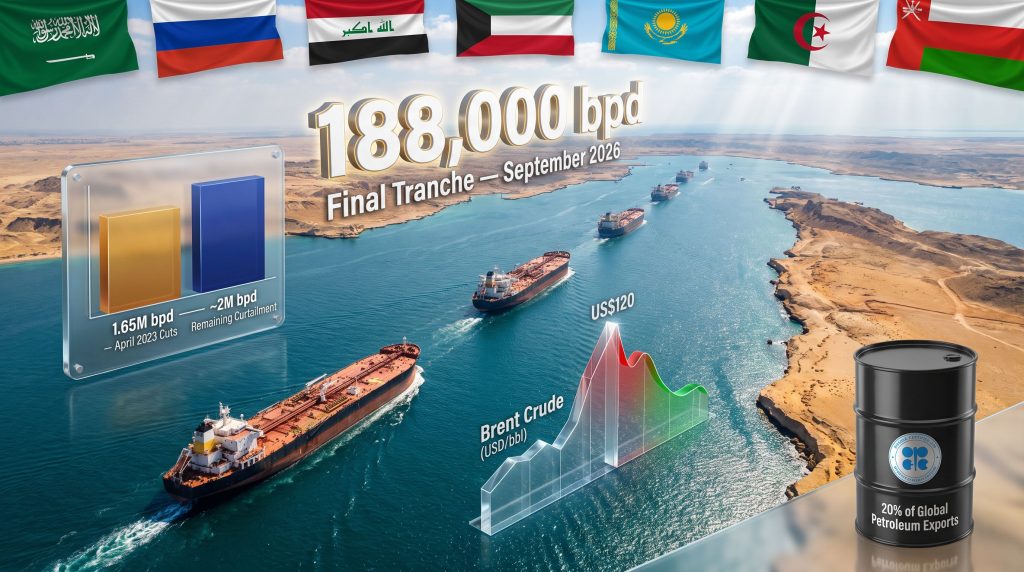
The collective decision by Saudi Arabia, Russia, Iraq, Kuwait, Kazakhstan, Algeria, and Oman to increase combined output by 188,000 barrels per day from September 2026 marks the final tranche of unwinding a 1.65 million bpd voluntary cut package that was originally structured in April 2023. Framed this way, the September move is less a new policy than the closing chapter of an old one.
Critically, this adjustment does not represent a wholesale loosening of OPEC+ supply discipline. A separate and significantly larger curtailment of approximately 2 million bpd remains in place through the end of 2026. The coexistence of these two distinct cut layers, one being methodically unwound and the other being preserved intact, illustrates the growing sophistication of OPEC's market influence as a supply governance institution rather than a simple price-fixing cartel.
| Feature | April 2023 Voluntary Cuts | September 2026 Adjustment |
|---|---|---|
| Volume Involved | 1.65 million bpd | 188,000 bpd (final tranche) |
| Participating Nations | 7 core OPEC+ members | Same 7 members |
| Policy Direction | Restriction | Controlled release |
| Market Context | Pre-emptive demand protection | Post-crisis recalibration |
| Remaining Cuts in Place | N/A | ~2 million bpd (separate layer) |
Against a global daily consumption base of approximately 100 to 103 million bpd, the September addition represents a proportional supply increase of less than 0.2%. The raw arithmetic suggests the physical market impact is modest. However, commodity markets rarely respond to arithmetic alone. Futures pricing is shaped by forward expectations, geopolitical risk premiums, and the signalling intent behind supply decisions, all of which amplify the psychological weight of even small volume changes.
The Strait of Hormuz Shock and Its Lasting Market Imprint
The immediate backdrop to the OPEC+ oil production adjustment from September is the Strait of Hormuz crisis, a geopolitical disruption that exposed the fragility of global energy supply chains with unusual force. Military conflict in the Middle East triggered maritime blockades along a chokepoint that facilitates roughly 20% of global petroleum and liquefied natural gas exports on any given day.
The consequences were swift and severe:
- Brent crude prices surged past US$120 per barrel at peak crisis levels
- Major importing nations activated emergency strategic petroleum reserves to suppress inflationary transmission
- Freight and fuel costs spiked, feeding through to consumer price indices within the standard 6 to 12 week transmission window
- Energy procurement strategies were disrupted across Asia, Europe, and the Americas simultaneously
Furthermore, these disruptions intersected with pre-existing oil price risk factors that had already been building across global energy markets. As transit conditions partially stabilised, benchmark prices retreated from those peaks, but market fragility persisted. The price memory of a supply shock of this magnitude does not dissipate quickly.
Risk premiums remain embedded in futures curves long after the physical disruption resolves, and importing nations face the compounding challenge of rebuilding strategic reserves while managing ongoing price exposure.
The September output adjustment functions partly as a confidence signal to markets, communicating that the seven participating producers are actively managing the post-crisis supply environment rather than allowing it to drift.
This distinction matters for price formation. A producer group that signals active governance tends to anchor market expectations more effectively than one that reacts passively to spot price movements.
Inside the JMMC: The Compliance Engine Powering OPEC+ Cohesion
One of the less publicly discussed dimensions of the September adjustment involves the compliance and compensation framework embedded within the Declaration of Cooperation. Several OPEC+ member states accumulated overproduction volumes relative to their agreed quotas beginning in January 2024, creating an obligation to offset those excess barrels through future cuts.
The Joint Ministerial Monitoring Committee (JMMC) serves as the institutional backbone of this process. Its oversight function operates across three core activities:
- Calculating overproduction gaps by comparing each member's actual output against their assigned quota baseline on a monthly basis
- Issuing compensation schedules that require offending producers to reduce output in subsequent months to fully offset accumulated excesses
- Verifying compliance through ongoing review of production data at scheduled virtual ministerial meetings
The JMMC mechanism is what distinguishes modern OPEC+ from earlier iterations of OPEC coordination, which frequently collapsed under the weight of unenforceable agreements. Historical precedents from the 1980s and the 2014 to 2016 price war period demonstrate that voluntary cartel arrangements without credible enforcement tend to unravel when individual member incentives diverge from collective targets.
Kazakhstan presents the most structurally complex compliance challenge within the current framework. The Tengiz field expansion, operated by Chevron, has created persistent upward pressure on Kazakh output that is difficult to manage through standard quota mechanisms. Infrastructure-driven overproduction of this nature requires compensation schedules calibrated to operational realities rather than purely diplomatic timelines. According to OPEC's official August 2025 communiqué, these compliance obligations remain central to the alliance's ongoing supply governance agenda.
Member Stakes: Why Does Each Nation View This Differently?
The seven participating nations bring distinct fiscal, geopolitical, and operational considerations to every output decision. Understanding those differences is essential to interpreting the durability of any collective agreement.
| Nation | Key Strategic Consideration |
|---|---|
| Saudi Arabia | Fiscal breakeven estimated at US$80 to 90 per barrel; balancing revenue adequacy with long-term market share defence |
| Russia | Sustained revenue dependency amid ongoing Western sanctions pressure; incentive to maximise near-term output value |
| Iraq | Chronic infrastructure constraints and domestic budget pressures create compliance challenges despite political commitment |
| Kuwait | Conservative fiscal management and limited spare capacity incentivise strict quota adherence |
| Kazakhstan | Tengiz field expansion creates structural overproduction risk independent of policy intentions |
| Algeria | Limited spare capacity; concentrated interest in maximising per-barrel revenue rather than volume expansion |
| Oman | Non-OPEC member of the alliance; balances national budget requirements against group solidarity obligations |
Saudi Arabia's position as the de facto architect of OPEC+ strategy means its fiscal breakeven price effectively sets the floor around which group decisions are oriented. When Brent trades comfortably above that threshold, the Saudis have greater flexibility to accommodate incremental production increases. When prices threaten to approach or breach that level, the incentive to tighten supply intensifies rapidly.
Q4 2026: Why a Pause After September Makes Strategic Sense
Three Scenarios Shaping the Outlook
Following the September adjustment, OPEC+ is widely expected to hold further production increases in abeyance through the fourth quarter of 2026. This pause reflects a deliberate assessment window, a period during which the group monitors demand trajectory, inventory levels, and geopolitical conditions before committing additional barrels to the market.
Three plausible scenarios frame the Q4 outlook:
| Scenario | Trigger Conditions | OPEC+ Likely Response |
|---|---|---|
| Demand Recovery | Global growth rebounds; import volumes rise | Gradual unwinding of remaining 2 million bpd cuts |
| Market Equilibrium | Brent stabilises in US$80 to 95 range; inventories balanced | Maintain Q4 pause; reassess in early 2027 |
| Demand Deterioration | Recession signals emerge; oversupply builds | Reimpose voluntary cuts; accelerate compensation schedules |
The next formal JMMC review session is scheduled for September 6, 2026, which will feed directly into public market guidance and influence futures positioning across the curve. Notably, OPEC production decisions made in prior review sessions have consistently demonstrated that the group treats these meetings as active policy instruments rather than ceremonial checkpoints.
The next major ASX story will hit our subscribers first
Price Variables That Will Define the Second Half of 2026
Key Factors Shaping Market Direction
Several interconnected factors will shape how the OPEC+ oil production adjustment from September flows through into actual price outcomes over the remainder of the year. In addition, the trade war oil impact continues to overlay these supply-side variables with demand-side uncertainty that complicates forward projections.
- Brent futures curve structure: A backwardated curve signals physical market tightness and supports producer revenue; a contango structure implies expected oversupply and tends to incentivise storage over immediate consumption
- Strategic reserve replenishment demand: Nations that drew down reserves during the Hormuz crisis face a latent demand obligation to rebuild stockpiles, creating sustained underlying absorption capacity even if headline import volumes appear subdued
- US shale production response: American tight oil producers can respond to sustained price signals within approximately three to six months, making the medium-term non-OPEC supply trajectory highly price-sensitive
- Chinese import volumes: As the world's largest crude importer, China's quarterly demand data remains the single most influential variable for any forward supply-demand balance assessment through 2026
The interaction between strategic reserve replenishment and shale supply response creates a feedback loop that OPEC+ must navigate carefully. Release too much supply too quickly, and the group risks accelerating a price decline before reserves are rebuilt. Hold too tightly, and importing nations face renewed inflationary pressure precisely when central banks are trying to anchor expectations.
What the September Adjustment Reveals About Modern Energy Governance
The OPEC+ oil production adjustment from September carries significance beyond the immediate barrel count. It reflects a broader institutional evolution within the alliance, from a reactive mechanism that responds to price collapses toward a proactive governance framework that attempts to manage market conditions across multiple time horizons simultaneously.
The coexistence of a carefully unwound cut layer alongside a preserved larger curtailment demonstrates that OPEC+ now operates with a more nuanced policy toolkit than at any prior point in its history. The group can calibrate monthly output with a precision that was structurally impossible under older, less monitored agreement frameworks. Rigzone's analysis of the 547,000 bpd production adjustment further contextualises how this latest tranche fits within the broader unwinding sequence.
For energy-importing economies, including Australia, the trajectory of these decisions through Q4 2026 will carry direct implications for:
- Fuel import costs and downstream consumer price dynamics
- LNG pricing benchmarks, given the interconnected nature of petroleum and gas market signals
- Central bank inflation forecasting models, which incorporate energy commodity assumptions as primary inputs
- Sovereign energy procurement strategies for nations managing reserve replenishment obligations simultaneously
The September adjustment is, in isolation, a small volume change. In context, however, it is a data point within a much larger and more consequential supply governance story that will continue to shape global energy economics well into 2027 and beyond.
This article contains forward-looking analysis and scenario projections based on publicly available information as of the date of publication. Energy market conditions are subject to rapid change. Nothing in this article constitutes financial or investment advice. Readers should conduct their own due diligence before making any investment or procurement decisions.
For ongoing coverage of upstream energy developments and OPEC+ production decisions, visit Petroleum Australia.
Want to Track the Next Major Commodity Discovery Before the Market Does?
Discovery Alert's proprietary Discovery IQ model scans ASX announcements in real time, turning complex mineral and commodity data into actionable investment insights across more than 30 commodities — explore historic discovery returns on the dedicated discoveries page to see what early positioning can mean, then start your 14-day free trial at Discovery Alert to secure a market-leading edge.