August 5, 2026
The Hidden Vulnerability in Asia's Third-Largest Energy Economy
Scenario planning exercises conducted by energy security analysts consistently identify one recurring blind spot among major hydrocarbon importers: the assumption that seaborne supply will always flow. For most of the past three decades, India operated under precisely that assumption. Its strategic reserve architecture was built around crude oil alone, leaving two of its most widely consumed fuels, liquefied petroleum gas and liquefied natural gas, entirely without dedicated emergency buffers. The Iran war and the cascading disruptions it triggered across Strait of Hormuz shipping lanes in 2026 transformed that assumption from a policy oversight into an acute national vulnerability.
Now, according to two sources with direct knowledge of the matter as reported by Reuters, India is weighing a consumption-based levy on LPG and natural gas users to finance a $42 billion multi-fuel strategic reserve programme — the most ambitious energy storage buildout the country has ever attempted. This India strategic fuel reserve gas levy represents a fundamental rethinking of how the country finances energy security infrastructure.
When big ASX news breaks, our subscribers know first
Why India's Emergency Fuel Buffers Were Already Dangerously Thin
Understanding why this proposal has arrived with such urgency requires examining what India's strategic reserve position actually looks like today, stripped of political messaging.
India is the world's third-largest oil importer and consumer, sourcing approximately 90% of its crude from overseas. The vast majority of those shipments transit the Strait of Hormuz, a 33-kilometre-wide maritime chokepoint between Oman and Iran through which an estimated 20% of global oil trade passes daily. When conflict involving Iran disrupted shipping patterns through this corridor in 2026, India had fewer tools to absorb the shock than almost any comparable economy. Consequently, the oil price shock that followed exposed just how thinly buffered India's energy system truly was.
The country's current government-controlled emergency fuel position is as follows:
| Reserve Category | Current Capacity | Estimated Coverage | Status |
|---|---|---|---|
| Government-owned crude storage | 5.33 million metric tons | Under 10 days of demand | Operational |
| Crude storage under construction | 6.5 million metric tons | Partial expansion | In progress |
| LNG strategic reserves | Nil | Zero days | Critical gap |
| LPG strategic reserves | Nil | Zero days | Critical gap |
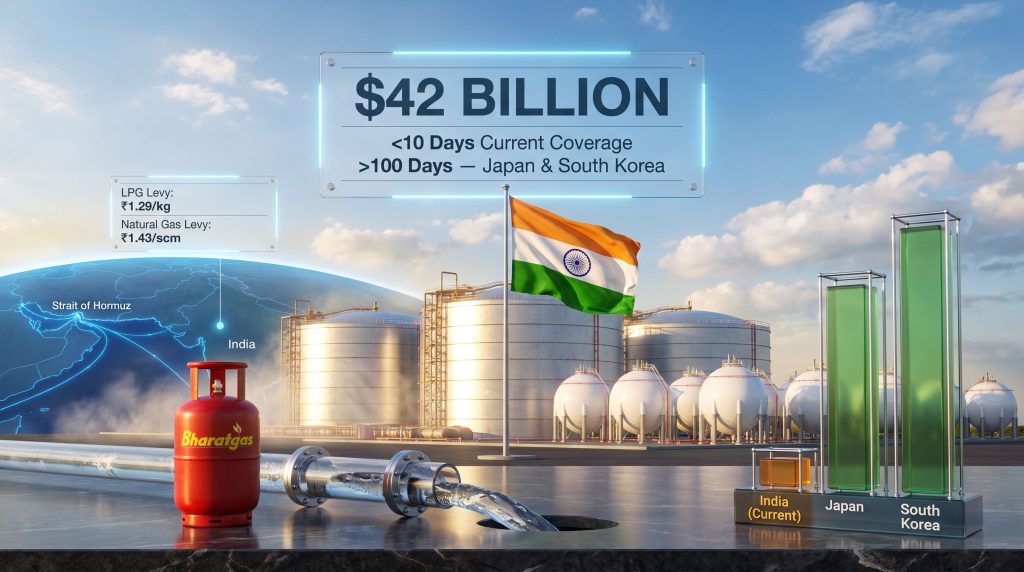
Energy Security Context: Japan and South Korea, both heavily dependent on imported hydrocarbons, maintain government-controlled strategic fuel reserves covering more than 100 days of national consumption. India's current coverage of under 10 days places it among the most exposed major economies in Asia during any sustained supply disruption.
The absence of LNG and LPG reserves is particularly significant. Unlike crude oil, which can theoretically be substituted across processing pathways, LPG is the primary cooking fuel for hundreds of millions of Indian households, many of whom have no practical alternative. A sustained LPG import disruption would not be an inconvenience; it would be a humanitarian event.
What Is the India Strategic Fuel Reserve Gas Levy?
The Proposed Levy Structure and Fiscal Mechanics
The India strategic fuel reserve gas levy, as currently proposed, is a user-pays financing mechanism designed to shift the cost of building LNG and LPG storage infrastructure away from the general federal budget and onto the consumers of those fuels directly. This represents a structural departure from how India has historically financed its crude oil reserves, which have been funded entirely through federal appropriations.
The dual-levy proposal targets two distinct consumption streams:
- LPG (cooking gas): A charge of ₹1.29 per kilogram, estimated to generate approximately $460 million annually based on current consumption volumes, adding roughly ₹18 to the cost of a standard domestic cooking gas cylinder
- Natural gas (piped and industrial): A levy of ₹1.43 per standard cubic metre, projected to raise approximately $1 billion per year at current consumption levels, translating to roughly a 2% increase in household gas bills
Combined, these levies are designed to generate approximately $1.5 billion annually, dedicated specifically to financing LNG and LPG storage construction. Crude oil reserves and strategic fuel inventories would continue to be funded through the federal budget and are explicitly excluded from the levy's scope.
Furthermore, the timing of this proposal intersects with broader shifts in the global LNG supply outlook, adding additional urgency to India's storage ambitions.
What Remains Unresolved
Several critical implementation questions are still open. The collection mechanism for both levies has not yet been formally determined, which raises practical questions about whether charges would be imposed at the point of production, the distribution network, or the consumer billing stage.
Additionally, as of the time of reporting, the proposal remains under active inter-ministerial deliberation involving both the Ministry of Petroleum and Natural Gas and the Ministry of Finance, and has not yet been submitted to Prime Minister Narendra Modi's cabinet for approval. Neither ministry responded to media requests for comment.
Mapping the $42 Billion Programme: Scale, Timeline, and Infrastructure Targets
The reserve-building programme behind the levy is not a modest policy adjustment. At $42 billion over a 10-year horizon, it represents one of the largest energy infrastructure investment commitments India has ever formalised.
Breakdown of New Storage Capacity Required
| Fuel Type | Additional Storage Capacity Required | Programme Timeframe |
|---|---|---|
| Crude oil | 28 million metric tons | 10 years |
| LNG | 9 million metric tons | 10 years |
| LPG | 4 million metric tons | 10 years |
The capital allocation split places more than half of total programme expenditure toward physical infrastructure construction, with the remainder designated for purchasing and maintaining fuel inventories within newly built storage facilities.
Coverage Targets Once Complete
The programme is designed to deliver the following emergency coverage depths upon completion:
- Approximately two months of crude oil demand coverage from government-controlled storage
- Approximately two months of LNG demand coverage
- Approximately six weeks of LPG demand coverage
These targets remain below the International Energy Agency's recommended 90-day minimum for member states, though India is not a full IEA member. The country participates as an association country, and the IEA's 90-day standard serves as a useful global benchmark rather than a binding obligation. India's two-month target represents a pragmatic midpoint between its current near-zero LNG and LPG buffer and full compliance with international best practice.
The Consumer Impact Question: Who Pays and How Much?
LPG as a Politically Loaded Commodity
Few energy policy decisions carry greater political weight in India than changes to the cost of cooking gas. LPG is the primary domestic fuel for a vast share of India's population, including lower-income households enrolled in the government's Pradhan Mantri Ujjwala Yojana scheme, which has connected more than 100 million households to subsidised LPG supply since its 2016 launch.
An additional ₹18 per standard cylinder is a modest absolute number in isolation. In the context of already-elevated fuel prices and a consumer base that closely monitors cooking gas costs, however, it carries outsize political symbolism. The Modi government must weigh a long-term energy security investment against near-term voter sensitivity in a market where LPG price movements have historically generated significant political commentary.
Consumer Segmentation: Who Bears What Burden
| Consumer Segment | Fuel Type Affected | Estimated Cost Impact | Political Sensitivity |
|---|---|---|---|
| Domestic households | LPG cylinders | +₹18 per cylinder | High |
| Residential piped gas users | Natural gas | ~2% bill increase | Medium |
| Industrial and commercial gas users | Natural gas | ₹1.43 per scm | Lower (cost pass-through likely) |
| LNG importers and terminal operators | LNG (potential) | Higher regasification charges | Regulatory and commercial |
For industrial and commercial consumers, the levy's impact is somewhat cushioned by the ability to pass costs downstream through supply chain pricing. Household users lack this mechanism entirely, making them the most exposed segment to any upward adjustment.
Historical Precedent: India Has Done This Before
India has a documented history of using cess mechanisms layered onto petroleum product consumption to cross-subsidise infrastructure development. The Road and Infrastructure Cess applied to petrol and diesel is the most prominent example, channelling fuel excise revenue into road network construction and maintenance.
The proposed gas levy follows a structurally similar logic, substituting the infrastructure asset from roads to strategic fuel storage. This precedent makes the levy model conceptually familiar to both policymakers and regulated industries, even if the specific application to gas consumers is new territory.
Regulatory Risk Assessment: Three Scenarios for What Happens Next
The proposal's path from inter-ministerial discussion to implemented policy is far from certain. Based on the available information, three distinct regulatory outcomes are plausible:
Scenario 1: Full Approval with Rate Modifications
The cabinet endorses the levy framework but adjusts the per-unit rates downward to reduce political friction around household costs. This extends the revenue generation timeline, potentially pushing full reserve capacity completion beyond the initial 10-year horizon.
Scenario 2: Industrial-Only Levy
Political sensitivity around domestic LPG costs, particularly among lower-income beneficiaries of the Ujjwala scheme, leads to exempting household consumers entirely. The levy applies exclusively to industrial and commercial natural gas users, reducing annual revenue to approximately $1 billion and extending the funding gap for the full programme.
Scenario 3: Alternative Financing Blended Approach
The government opts for a combination of sovereign bond issuance and an expanded petroleum product cess mechanism, bypassing a direct consumer-facing charge. This preserves political capital ahead of state elections while still advancing the reserve programme, albeit with higher borrowing costs and a different fiscal footprint.
Policy Watch: The deliberate silence from both the Ministry of Petroleum and the Ministry of Finance in response to media enquiries, combined with the proposal's active circulation across multiple ministries, is more consistent with serious inter-governmental deliberation than early-stage concept testing. It does not, however, confirm imminent implementation.
The next major ASX story will hit our subscribers first
How India Compares Globally: The Strategic Reserve Gap in Context
Benchmarking Against Major Energy-Importing Nations
| Country | Strategic Reserve Coverage | Funding Model | Multi-Fuel Coverage |
|---|---|---|---|
| Japan | Over 100 days | Government and industry obligation | Crude, LNG, LPG |
| South Korea | Over 100 days | Government-funded | Crude, LNG, LPG |
| United States | Approximately 90 days (crude only) | Federal budget via SPR | Crude-focused |
| China | Approximately 90 days (estimated) | State enterprise-funded | Crude and expanding |
| India (current) | Under 10 days | Federal budget, crude only | Crude only |
| India (proposed target) | ~60 days crude and LNG; ~42 days LPG | Federal budget plus user levy | Multi-fuel |
Japan's reserve architecture is worth examining in greater detail as a model of what full multi-fuel coverage looks like in practice. Japan combines government-held reserves with mandatory stockholding obligations on private industry, effectively distributing reserve costs across the supply chain rather than concentrating them on either the government or the end consumer. India's proposed levy-based model sits somewhere between a pure government-funded approach and a full industry-obligation framework.
The Strait of Hormuz Dependency: A Structural Problem No Reserve Can Fully Solve
One dimension of India's energy security challenge that strategic reserves address only partially is the concentration of import routing through a single maritime chokepoint. Approximately 80% of India's oil imports transit the Strait of Hormuz, creating a systemic vulnerability that reserve depth can cushion but not eliminate.
A 60-day crude reserve provides a meaningful buffer against short-term Hormuz disruption, but a prolonged closure or sustained conflict affecting Gulf shipping would eventually exhaust even well-stocked reserves. This reality also intersects with the Asian LNG tariff pressures that are simultaneously reshaping how nations across the region approach energy procurement and security planning.
This is why analysts who study energy security architecture view reserve-building and import route diversification as complementary strategies rather than substitutes. India has been gradually expanding its crude sourcing from the Americas, Africa, and Russia, but the geographic concentration of global LNG liquefaction capacity in the Gulf means that LNG supply diversification is structurally more constrained.
Infrastructure Opportunities Across the Storage Value Chain
The scale of new storage construction implied by the programme — 28 million metric tons of crude capacity, 9 million metric tons of LNG, and 4 million metric tons of LPG — creates substantial procurement and contracting activity across engineering, procurement, and construction sectors over the coming decade.
Several structural questions remain about how this infrastructure will be developed:
- Whether state-owned enterprises such as Indian Strategic Petroleum Reserves Limited will lead construction, or whether private sector participation will be solicited through concession frameworks
- How LNG terminal operators will be incorporated, with parallel proposals reportedly under consideration that would require terminal operators to expand storage capacity with cost recovery built into regulated regasification tariffs
- Whether international financing institutions or bilateral partners will be invited to co-finance components of the programme
Deeper strategic reserves also carry an often-overlooked commercial implication for India's LNG import contracting strategy. A country with only marginal reserve coverage has limited ability to time purchases opportunistically; it is structurally forced to maintain near-continuous import flows. Greater reserve depth, by contrast, creates the operational flexibility to increase spot market participation when prices are favourable and draw down reserves during price spikes, potentially improving India's average landed LNG cost over time. In addition, India LNG import taxes remain a parallel policy lever that will significantly shape how the broader reserve strategy interacts with import economics.
Furthermore, a review of the crude oil market overview underscores why building robust multi-fuel reserves is increasingly viewed as non-negotiable for any major importing economy navigating today's volatile energy landscape. The S&P Global analysis of India's reserve expansion further confirms that international partners and energy majors are closely watching how India's programme takes shape.
Key Facts: India Strategic Fuel Reserve Gas Levy at a Glance
- $42 billion total estimated programme cost over a 10-year implementation period
- $1.5 billion per year targeted annual revenue from the combined LPG and natural gas levy
- ₹1.29 per kilogram proposed LPG levy rate; ₹1.43 per standard cubic metre proposed natural gas levy rate
- ₹18 per cylinder estimated additional cost for standard domestic LPG users
- Under 10 days current Indian government-controlled emergency fuel coverage versus over 100 days in Japan and South Korea
- 28 million MT additional crude storage plus 9 million MT LNG plus 4 million MT LPG storage targeted
- Cabinet approval pending, with no confirmed implementation timeline as of the time of reporting
Disclaimer: This article is based on information reported by Reuters sourced from two individuals with direct knowledge of the matter who requested anonymity. The proposed levy has not been confirmed, approved, or publicly announced by the Indian government. Figures, timelines, and revenue projections represent current proposals and are subject to change. Nothing in this article constitutes financial or investment advice. Readers should consult independent sources for the most current developments on Indian energy policy.
Want to Stay Ahead of the Energy Discoveries Shaping Tomorrow's Markets?
As India's $42 billion strategic reserve programme reshapes global LNG and energy commodity dynamics, Discovery Alert's proprietary Discovery IQ model delivers real-time notifications on significant ASX mineral discoveries — including energy commodities — ensuring subscribers can identify actionable investment opportunities the moment they emerge. Begin your 14-day free trial today and explore historic examples of major discovery returns to understand why positioning early can make all the difference.