August 5, 2026
The Hidden Fault Line in Western Critical Minerals Strategy
Global supply chain strategists have spent years mapping the concentration risks embedded in critical mineral supply chains, yet a fundamental contradiction has been quietly building inside the trade policy architecture of the world's largest economy. The United States has invested considerable diplomatic energy into building allied-nation supply alternatives for materials that underpin modern industrial and clean energy systems. Silicon metal sits squarely within that category, given the surge in critical minerals demand. And yet the regulatory machinery governing trade remedies operates entirely independently of those partnership ambitions, with consequences that are now playing out in real time.
The Simcoa US tariff exit, announced on August 5, 2026, is not simply a corporate withdrawal from a difficult market. It represents a structural collision between two competing arms of US policy, one that reveals how poorly coordinated the trade remedy system is with the broader critical minerals agenda. For Australia, the implications extend well beyond a single producer's commercial calculus.
When big ASX news breaks, our subscribers know first
What Silicon Metal Actually Is, and Why the Distinction Matters
Silicon metal is one of the most routinely misunderstood industrial commodities in mainstream coverage, frequently conflated with silicon the chemical element or with polysilicon, the refined product used in photovoltaic solar cells. These are meaningfully different materials with distinct production processes, end markets, and trade dynamics.
Silicon metal is produced by reducing quartzite or quartz with carbon in electric arc furnaces at extremely high temperatures, typically exceeding 1,800 degrees Celsius. The resulting product contains silicon at purities generally ranging from 98.5% to 99.5%, which places it in a commercially useful but distinct tier below the semiconductor-grade material that requires further purification to parts-per-billion levels. This industrial-grade silicon metal feeds into:
- Aluminium alloys, where it improves strength, corrosion resistance, and castability for automotive and aerospace applications
- Chemical manufacturing, particularly silicone polymers used in sealants, lubricants, and medical devices
- Polysilicon production as a feedstock, giving it a secondary link to the solar energy supply chain
- Electronics manufacturing, including certain semiconductor-adjacent applications
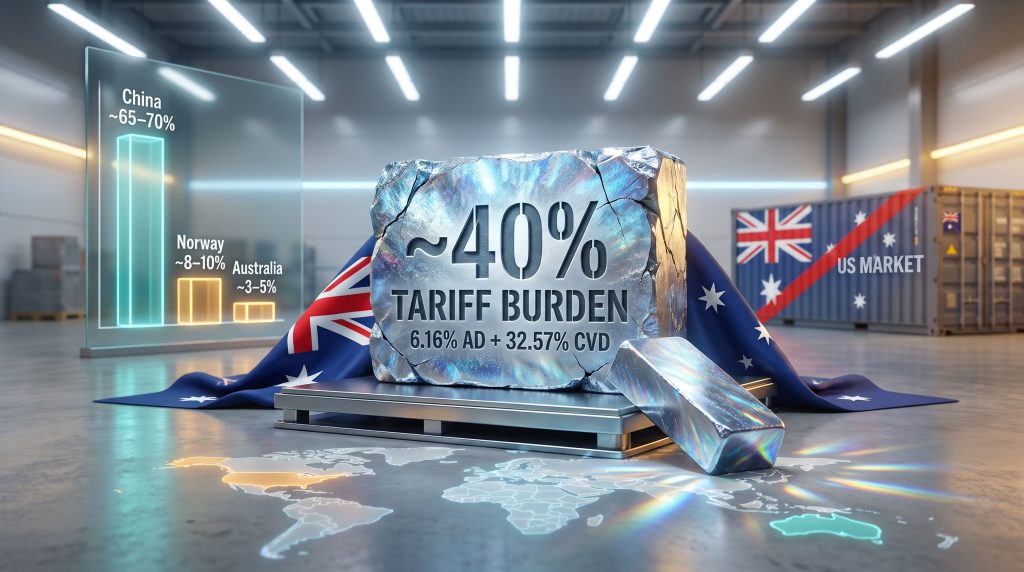
Simcoa Operations, based in Kemerton, Western Australia, is the only silicon metal manufacturer operating in Australia. This geographic and industrial singularity gives the company an outsized strategic profile relative to its production volumes. Australia's estimated share of global silicon metal supply sits in the 3% to 5% range, but the question of which 3% to 5% matters enormously in the context of Western supply chain diversification.
| Producing Region | Estimated Global Supply Share | Strategic Alignment |
|---|---|---|
| China | ~65-70% | Non-allied |
| Norway | ~8-10% | NATO-aligned |
| Australia | ~3-5% | Five Eyes / AUKUS |
| United States (domestic) | ~5-7% | Domestic |
| Other | Remainder | Mixed |
With China commanding roughly two-thirds of global silicon metal output, Australian and Norwegian production represents a small but strategically irreplaceable slice of Western-aligned supply. A trade action that eliminates both from the US market does not reduce Chinese dominance; it entrenches it.
How the US Trade Remedy System Functions, and Where It Conflicts With Alliance Logic
The Antidumping and Countervailing Duty Framework
US trade remedy law operates through two parallel but complementary instruments. Antidumping duties are applied when the US Department of Commerce determines that a foreign exporter is selling goods in the United States at prices below either their home-market price or their fully allocated cost of production. Countervailing duties address a separate but related concern: government subsidies that artificially reduce a foreign producer's cost base, providing an unfair competitive advantage over US domestic manufacturers.
Critically, both instruments are available regardless of the trade relationship between the US and the exporting country. The Australia-United States Free Trade Agreement, which has been in force since 2005, covers standard tariff schedules but provides no immunity from trade remedy proceedings. This is not unique to Australia; Canada has faced long-running softwood lumber CVD disputes with the US despite CUSMA protections, and steel exporters from Japan and South Korea have navigated Section 232 tariff actions through negotiated quota arrangements rather than legal exemptions. Furthermore, understanding the broader critical minerals tariff landscape is essential context for appreciating why these remedy proceedings carry such significant strategic weight.
The Specific Findings Against Simcoa
The US Commerce Department's final affirmative determination, issued on June 25, 2026, produced two separate findings against Simcoa:
- A dumping margin of 6.16%, reflecting a finding that Simcoa's US export prices were below the calculated normal value threshold
- A countervailing duty rate of 32.57%, representing the assessed level of government subsidy embedded in Simcoa's production cost structure
Combined, these produce an effective tariff burden of approximately 40% on Simcoa's silicon metal exports to the United States. At that level, the economics of serving the US market become structurally non-viable for a mid-scale producer operating on typical industrial commodity margins.
Prior to the final determination, US Customs and Border Protection was instructed to suspend liquidation on relevant Simcoa entries following the preliminary findings. This mechanism, standard practice under US trade remedy procedure, creates immediate cash-flow exposure for the exporter because it places the duty liability in suspense, effectively freezing settlement on goods already shipped. For a company of Simcoa's scale, this represents meaningful balance sheet risk even before the final ruling lands.
What the 32.57% CVD Rate Actually Signals
The countervailing duty rate deserves particular attention because it contains a less obvious analytical dimension. A CVD determination requires US authorities to identify specific government programs that confer a measurable financial benefit on the exporting producer. Common categories include below-market loans, direct grants, tax concessions, and concessional access to inputs such as energy or raw materials.
Simcoa operates in Western Australia, where energy and resource policy is administered at the state level rather than the federal level. This creates genuine complexity in how US CVD methodology interprets support arrangements, because the Commerce Department's analytical framework is designed primarily around federal-level subsidy programs. State-level energy pricing structures, infrastructure arrangements, and resource access terms can be captured within CVD calculations even when they are not designed as export subsidies in any conventional sense.
A high CVD rate does not automatically indicate that a producer has received overt government assistance. US CVD methodology can capture indirect arrangements that a reasonable observer would not classify as subsidies, raising questions about whether the analytical framework is fit for purpose when applied to Australian state-level resource and energy policy.
Timeline of the Simcoa US Trade Action
| Date | Event |
|---|---|
| Pre-2026 | US domestic silicon metal producers file AD/CVD petition targeting Australian and Norwegian imports |
| Early 2026 | US Commerce Department opens formal investigation; preliminary determinations issued |
| Early 2026 | CBP suspends liquidation on Simcoa entries; preliminary cash-deposit rates applied |
| June 25, 2026 | Final affirmative determination: 6.16% AD margin + 32.57% CVD rate for Simcoa |
| August 5, 2026 | Simcoa announces full withdrawal from the US market |
The Self-Defeating Logic of Eliminating Western-Aligned Suppliers
Who Captures the Market Share Simcoa Leaves Behind
The most consequential analytical question raised by the Simcoa US tariff exit is not about Simcoa itself. It is about what happens to the US silicon metal supply chain once Australian, and potentially Norwegian, volumes are removed from the accessible import pool.
US domestic silicon metal production is concentrated in a small number of facilities and has historically operated at volumes insufficient to meet total domestic demand. The US imports silicon metal to bridge that gap. If the two most significant Western-aligned import sources are effectively priced out of the market by trade remedy duties, US downstream manufacturers — including aluminium alloy producers, silicone chemical manufacturers, and solar supply chain participants — face a constrained sourcing environment.
The substitution outcome in this scenario is not a resurgence of domestic production, at least not on a timeline relevant to near-term supply dynamics. New silicon metal capacity requires significant capital investment, site permitting, and energy infrastructure, with lead times measured in years rather than months. The more immediate substitution pathway runs through Chinese silicon metal, potentially transited through third countries to complicate direct tariff exposure.
Trade deflection through intermediary jurisdictions is a well-documented response to US trade remedy actions in commodities markets. China's export restrictions on strategic materials have already demonstrated Beijing's willingness to leverage resource control, and Chinese silicon metal routed through Malaysia, Vietnam, or other processing jurisdictions has precedent as a circumvention mechanism. The Commerce Department's enforcement capacity for origin verification in complex supply chains has historically faced resource constraints.
The structural irony embedded in the Simcoa US tariff exit outcome is that a trade action designed to protect US domestic silicon metal producers may, in the medium term, increase the effective dependency of US manufacturers on Chinese-origin material, routed through jurisdictions that face lower tariff exposure.
The Norway Parallel and What It Reveals
The joint nature of the AD/CVD investigation, targeting both Australian and Norwegian silicon metal, amplifies the policy contradiction. Norway is a NATO member, one of Europe's most significant industrial mineral producers, and a country with deep institutional alignment with the United States on defence and security matters. Subjecting Norwegian silicon metal to the same trade remedy proceedings as Australian exports sends a consistent message: the trade remedy system does not distinguish between allies and adversaries at the product category level.
| Country | Affected Commodity | US Trade Action | Producer Response |
|---|---|---|---|
| Australia (Simcoa) | Silicon metal | AD + CVD (~40% effective) | Full US market exit (August 2026) |
| Norway | Silicon metal | AD + CVD (joint investigation) | Outcome pending |
| Canada | Softwood lumber | Long-running CVD dispute | Ongoing legal challenge |
| South Korea | Steel | Section 232 tariffs | Negotiated quota arrangement |
| Japan | Steel | Section 232 tariffs | Negotiated quota arrangement |
The Deeper Policy Contradiction: Partnerships Without Protection
Critical Minerals Frameworks and the Gap in Trade Remedy Carve-Outs
The US has built a substantial architecture of allied-nation critical minerals engagement over recent years. The Minerals Security Partnership, launched in 2022, brings together the United States with Australia, Canada, Japan, South Korea, the United Kingdom, and European Union members in a framework explicitly designed to accelerate development of reliable supply chains outside Chinese dominance. The broader US critical minerals strategy also creates financial incentives for sourcing critical materials from free-trade-agreement partners, with Australia qualifying under AUSFTA.
Silicon metal does not appear on every critical minerals list by every jurisdiction, but its role as a foundational input into aluminium alloys, solar manufacturing, and electronics positions it functionally within the same strategic concern that drives critical minerals policy. The absence of any trade remedy carve-out mechanism for materials sourced from MSP partner nations represents a structural gap that the Simcoa case has now made visible.
What Australia's Policy Response Options Look Like
The Australian government faces a tiered set of response options, each with different risk profiles and timelines. Indeed, the US-Australia tariff dispute has broader ramifications that extend well beyond silicon metal alone. The available pathways include:
- Bilateral diplomatic engagement through the AUSFTA consultation mechanism, raising the CVD methodology concern directly with US trade authorities
- WTO dispute proceedings challenging the countervailing duty determination as inconsistent with obligations under the Agreement on Subsidies and Countervailing Measures, specifically whether the identified programs meet the specificity and benefit thresholds required for actionable subsidy designation
- Market diversification facilitation assisting Simcoa in pivoting export volumes toward the European Union, Japan, South Korea, and India, where no current AD/CVD exposure exists for Australian silicon metal
- Downstream demand development building domestic consumption of silicon metal through manufacturing investment frameworks that reduce export concentration risk over time
The WTO pathway, while legally available, operates on timelines that routinely extend beyond five years from filing to final resolution. This is commercially irrelevant to Simcoa's immediate market exit decision, though it carries significance for the precedent it would either set or fail to contest. According to reporting by the Australian Financial Review, Simcoa's decision to exit was made swiftly once the full tariff burden became clear.
Alternative Markets and the Redirection Opportunity
Simcoa's US export volumes do not disappear from global trade flows simply because the US market becomes inaccessible. They must be redirected, and the destination market landscape for silicon metal is reasonably well-developed outside North America.
- European Union: Strong structural demand from aluminium manufacturing and the growing solar supply chain domestically; no current AD/CVD proceedings against Australian silicon metal
- Japan: A major consumer through aluminium alloy and electronics manufacturing, with an existing free trade framework with Australia under the Japan-Australia Economic Partnership Agreement
- South Korea: Significant industrial demand from steel and aluminium-adjacent manufacturing; growing engagement with Australian critical mineral supply
- India: Rapidly expanding industrial base with limited domestic silicon metal production capacity; rising demand from the construction and automotive sectors
Redirecting volumes carries transitional costs: new logistics arrangements, customer qualification processes, and pricing negotiation in markets where Simcoa may not have established relationships. However, the regulatory certainty offered by these markets compares favourably to the US environment, where trade remedy exposure can materially reshape commercial viability within a single investigation cycle. It is also worth noting that, as Bulk Handling Review reported, an earlier preliminary tariff rate of 51% was overturned before the final determination settled at the combined ~40% level, underscoring just how volatile the regulatory environment proved to be for Simcoa throughout this process.
Frequently Asked Questions: Simcoa US Tariff Exit
What is Simcoa and what does it produce?
Simcoa Operations is Australia's only silicon metal manufacturer. It produces high-purity silicon metal from its facility in Kemerton, Western Australia, supplying industrial customers in aluminium alloys, chemical manufacturing, and electronics-adjacent sectors across domestic and international markets.
Why is Simcoa exiting the US market?
The US Department of Commerce issued a final affirmative determination on June 25, 2026, finding a 6.16% dumping margin and a 32.57% countervailing duty rate against Simcoa's exports. The combined tariff burden of approximately 40% renders US market participation commercially unviable at the company's operating scale and margin structure.
What is the difference between antidumping and countervailing duties?
Antidumping duties respond to below-normal-value pricing in the export market. Countervailing duties address government subsidies that reduce a foreign producer's costs below market levels. Both can be applied simultaneously, compounding the effective duty burden, as in Simcoa's case.
Does the Australia-US Free Trade Agreement protect against these tariffs?
No. AUSFTA governs standard tariff schedules but contains no immunity provisions for trade remedy actions. Antidumping and countervailing duty proceedings operate under separate domestic US law, administered independently of bilateral trade agreements.
Could Simcoa challenge the tariff determination?
Legal avenues exist through the US Court of International Trade and WTO dispute mechanisms, but both pathways operate on multi-year timelines that do not address the immediate commercial impact of the duty obligation.
Who benefits from Simcoa's US exit?
US domestic silicon metal producers gain near-term competitive relief. However, if domestic capacity is insufficient to absorb displaced import volumes, downstream US manufacturers face either higher input costs or increased sourcing exposure to Chinese-origin silicon metal.
The next major ASX story will hit our subscribers first
Key Facts: The Simcoa US Tariff Exit at a Glance
| Dimension | Detail |
|---|---|
| Company | Simcoa Operations (Australia's only silicon metal producer) |
| Operational Base | Kemerton, Western Australia |
| Product | Silicon metal (aluminium alloys, chemicals, electronics) |
| US Trade Action | Combined AD and CVD investigation (Australia and Norway) |
| Final Dumping Margin | 6.16% |
| Final CVD Rate | 32.57% |
| Combined Effective Tariff Burden | ~40% |
| Final Determination Date | June 25, 2026 |
| Market Exit Announcement | August 5, 2026 |
| Core Policy Tension | Allied-nation supplier penalised by US trade remedy system |
| Medium-Term Supply Risk | Increased US reliance on Chinese silicon metal |
This article contains forward-looking analysis and scenario assessments based on publicly available information. It does not constitute financial or investment advice. Trade remedy outcomes, supply chain dynamics, and policy responses are subject to change. Readers should conduct independent research before making decisions based on the information presented.
Want to Track the Next Major ASX Mineral Discovery Before the Market Does?
Discovery Alert's proprietary Discovery IQ model scans ASX announcements in real time, transforming complex commodity data into actionable investment insights across more than 30 minerals — including the critical materials at the centre of today's supply chain tensions. Explore historic examples of major mineral discoveries and their market returns, then begin your 14-day free trial to position yourself ahead of the broader market.