August 5, 2026
The Architecture of Naval Economic Coercion: How Chokepoint Control Reshapes Global Energy Markets
Throughout modern history, the most decisive acts of economic warfare have rarely involved direct financial intervention. Instead, they have targeted the physical infrastructure through which wealth moves. In the energy era, no piece of physical geography concentrates more economic consequence per square kilometre than a maritime chokepoint. When a naval power applies sustained enforcement pressure at one of these narrow passages, the effects cascade outward through shipping markets, refining margins, crude price benchmarks, and sovereign fiscal calculations simultaneously. Understanding this enforcement architecture is essential to interpreting what the Iranian oil tanker blockade means not just for Tehran, but for the entire global energy system in 2026.
When big ASX news breaks, our subscribers know first
The Strait of Hormuz as an Enforcement Lever
The Strait of Hormuz is, by any measure, the single most consequential maritime corridor in the global energy trade. Approximately 20 to 21% of all globally traded oil passes through this narrow passage connecting the Persian Gulf to the Gulf of Oman. Unlike pipeline infrastructure, which can be rerouted or expanded over years, a maritime chokepoint offers no immediate bypass. Ships either pass through or they do not.
This geographic reality transforms the strait into something more than a shipping lane. It becomes a pressure point of enormous strategic leverage, allowing a sufficiently capable naval force to influence the energy revenues of a Persian Gulf producer without deploying a single weapon on land. The Iranian oil tanker blockade operates precisely on this logic, and furthermore, it intersects directly with broader geopolitical trade tensions that have been reshaping energy corridors worldwide.
"The Strait of Hormuz is not merely a shipping route. It is the valve through which a substantial fraction of global crude supply either flows or stalls, making it the world's most consequential intersection of geography and geopolitics."
What makes enforcement at Hormuz particularly powerful is its simultaneity of effect. A blockade does not merely reduce one country's oil revenues. It compresses insurance underwriting across the entire Persian Gulf corridor, forces tanker operators to reassess route risk calculations, and injects uncertainty into crude price benchmarks that influence energy costs across Asian refining markets.
Enforcement Mechanics: What the Blockade Actually Does
The term "blockade" can obscure a range of specific operational activities that collectively produce export suppression. In the current context, U.S. naval enforcement involves several distinct mechanisms:
- Vessel interception at the outer boundary of the Gulf of Oman, preventing laden tankers from clearing the enforcement zone.
- Redirection operations turning ships back toward Iranian waters before they can reach open ocean transit routes.
- Boarding actions on vessels suspected of carrying sanctioned Iranian crude under falsified documentation.
- Empty tanker restriction, preventing unladen vessels from returning to Iranian ports to load fresh cargoes, thereby compounding the supply bottleneck over time.
This last element is particularly significant and often underappreciated. By targeting the return leg of the tanker cycle, U.S. enforcement effectively shrinks the pool of vessels available for Iranian loading operations over successive weeks. Each idle laden tanker represents not just stranded crude but a ship that cannot complete its economic cycle, further reducing Iran's export logistics capacity. In addition, the broader implications for sanctions on oil trading suggest this enforcement model is becoming a template for future coercive energy policy.
A Policy Timeline: From Announcement to Full Enforcement
The blockade did not arrive at its current intensity immediately. Its escalation followed a pattern consistent with graduated coercive pressure strategies, where initial announcements test resolve before enforcement is intensified.
| Period | Key Development | Estimated Laden Tankers Idle |
|---|---|---|
| April 2026 | Blockade first announced and initial enforcement begins | Baseline, limited data |
| Mid-June 2026 | Partial easing during diplomatic pause | Declining idle vessel count |
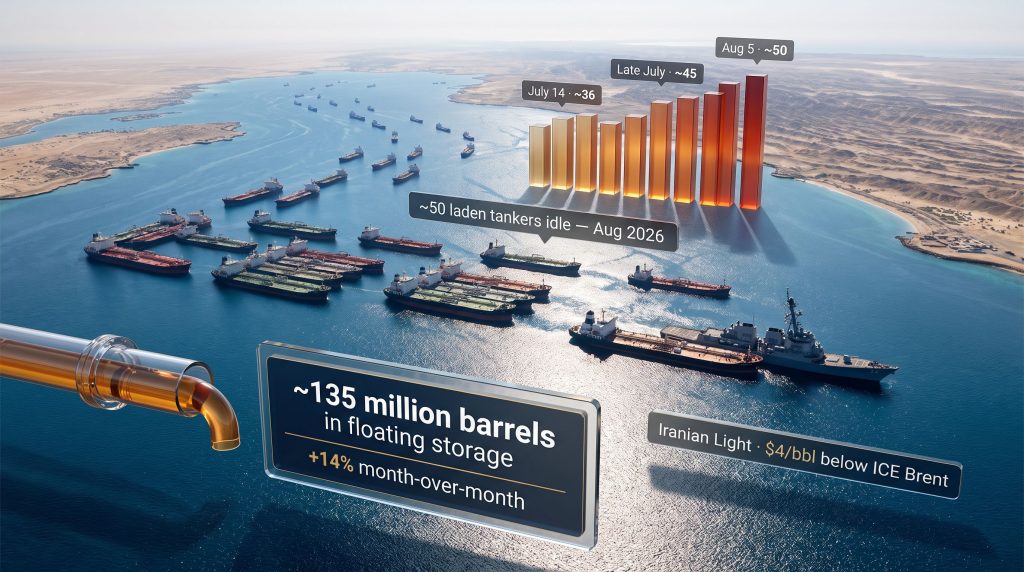
| July 14, 2026 | Blockade formally reimposed | Approximately 36 vessels |
| Late July 2026 | Enforcement intensity increases | Approximately 45 vessels |
| August 5, 2026 | Blockade operating at full capacity | Approximately 50 vessels |
The mid-June diplomatic pause is analytically important. It demonstrated that the enforcement architecture was designed with off-ramps built in, signalling that the blockade functions as a coercive bargaining mechanism rather than a permanent isolation strategy. This interpretation is reinforced by Qatar's active role as a diplomatic intermediary, with a draft proposal for Hormuz reopening reportedly in preparation as of early August 2026.
Reports from Euronews indicate that during this mid-June easing, several Iranian tankers did successfully pass the enforcement zone ahead of a peace deal signing ceremony, underscoring the blockade's role as a political lever rather than a permanent military posture.
Measuring Enforcement Effectiveness Through Shipping Data
How Effective Is the Iranian Oil Tanker Blockade?
Vessel tracking data from organisations monitoring maritime movements provides the most direct evidence available. According to nonprofit shipping watchdog United Against Nuclear Iran (UANI), no confirmed laden Iranian crude tanker has been documented successfully clearing the Gulf of Oman without encountering U.S. enforcement action since the blockade's July 14 reinstatement.
However, the blockade is not absolute. Two significant enforcement gaps deserve attention:
- AIS disabling: Automatic Identification System transponders, which vessels are legally required to operate in most jurisdictions, can be switched off by operators seeking to avoid monitoring. Some Iranian-affiliated tankers have reportedly used this tactic to create gaps in third-party vessel tracking coverage.
- Cargo asymmetry: Enforcement has proven notably more effective against large crude carriers than against smaller vessels transporting LPG and refined petroleum products. The physical and operational profile of crude supertankers makes them far easier to identify, intercept, and redirect than smaller, faster product tankers operating in higher-traffic zones.
This enforcement asymmetry reveals a structural limitation of naval blockades against diversified hydrocarbon exporters. Iran does not export crude oil alone. Its energy export mix includes LPG, condensate, and various refined products, each carried on different vessel classes and routed through varying transit corridors.
The Floating Storage Barometer: 135 Million Barrels and Rising
Perhaps the most revealing single metric of blockade effectiveness is the volume of Iranian crude accumulating in floating storage. In shipping analytics, floating storage is defined as crude held aboard vessels that have remained stationary for a minimum of seven consecutive days. This threshold distinguishes genuinely stranded cargo from normal transit delays.
Data from Vortexa, a leading maritime cargo intelligence provider, indicates that Iranian crude in floating storage has risen 14% over the past month, reaching approximately 135 million barrels as of early August 2026. This figure represents a substantial and growing volume of deferred export revenue.
| Metric | Current Status (August 2026) |
|---|---|
| Total Iranian crude in floating storage | ~135 million barrels |
| Month-over-month change | +14% |
| Primary holding zones | Persian Gulf, Gulf of Oman |
| Secondary accumulation clusters | Offshore Malaysia, near Sri Lanka |
| Floating storage definition threshold | Vessels idle for 7+ consecutive days |
The emergence of secondary clusters offshore Malaysia and near Sri Lanka is analytically significant. These locations historically function as transshipment staging areas, where cargo from sanctioned origins is transferred between vessels or held pending documentation restructuring before onward sale to end buyers. Their appearance on tracking data suggests that a portion of Iranian crude is attempting to move through grey-market routing channels rather than direct export paths.
"If approximately 50 laden tankers remain idle for an extended period, each carrying an estimated 1 to 2 million barrels of crude, the volume of oil locked in limbo could represent 50 to 100 million barrels of deferred export revenue. At current Brent pricing levels, this represents a multi-billion-dollar liquidity constraint on Iran's state energy revenues."
The next major ASX story will hit our subscribers first
The Discount Compression Paradox in Iranian Crude Pricing
Why Are Discounts Narrowing Despite Reduced Demand?
One counterintuitive market dynamic has emerged from the supply disruption. Iranian Light crude, which typically trades at a discount to ICE Brent to incentivise buyers willing to accept sanctions risk, has seen that discount narrow in recent weeks. The differential has moved from approximately $5 per barrel below ICE Brent to around $4 per barrel below ICE Brent within a single week.
This appears paradoxical at first glance. Reduced buyer interest should theoretically widen discounts, not compress them. The explanation lies in supply availability mechanics. As fewer Iranian crude cargoes successfully exit the Gulf, the pool of physically available barrels accessible to buyers outside the enforcement zone shrinks. Scarcity, even of sanctioned and discounted crude, exerts upward pressure on the price sellers can demand. Traders have reported fewer cargo offers alongside higher seller asking prices, consistent with this dynamic.
Furthermore, understanding these oil price movements in the context of ongoing trade disputes adds another layer of complexity to how market participants are pricing risk across the broader crude complex.
China's Refining Sector and the Demand-Side Amplifier
China's independent refining sector, concentrated in Shandong province and often referred to as "teapot refineries," has historically been the dominant buyer of discounted Iranian crude. These operations have absorbed Iranian barrels that larger state-owned Chinese refiners have declined to process due to sanctions exposure concerns.
However, as of mid-2026, Shandong independent refiners are operating below normal utilisation rates due to compressed refining margins. This creates a dual-pressure dynamic with significant implications for floating storage accumulation:
- Supply side: The blockade constrains how much Iranian crude can physically exit the Gulf.
- Demand side: Weak Chinese refining margins reduce the number of buyers willing to absorb stranded cargoes even when they do become accessible.
The interaction between these two forces is accelerating the pace at which floating storage volumes build. Even if evasion tactics allowed some additional crude to leave Iranian waters, the marginal buyer capacity in the Chinese independent refining sector is insufficient to absorb a meaningful volume increase at current margins. Consequently, the crude market dynamics point toward continued upward pressure on floating storage volumes in the near term.
Geopolitical Architecture: Qatar's Intermediary Role
Qatar's emergence as a diplomatic intermediary in Hormuz reopening negotiations reflects both its unique regional positioning and its substantial interest in maintaining unimpeded maritime access. As a major LNG exporter whose tankers transit the Strait of Hormuz, Qatar has direct economic skin in the game, giving it credibility with both Washington and Tehran as a neutral facilitating party. The LNG supply outlook for the region remains closely tied to the resolution of this standoff, particularly given Qatar's export dependency on Hormuz transit.
The existence of a draft proposal for Hormuz restoration suggests that both the United States and Iran are preserving diplomatic off-ramps, a pattern consistent with coercive bargaining theory. Under this framework, the blockade is not intended to destroy Iranian energy export capacity permanently but to generate sufficient economic pain to compel Tehran toward negotiated concessions.
Coverage from CNBC has highlighted how tanker movements through Hormuz have become a closely watched indicator of diplomatic progress, with each confirmed transit or interception serving as a signal of where negotiations stand.
Scenario Analysis: Four Pathways Forward
| Scenario | Primary Driver | Oil Market Impact | Diplomatic Outcome |
|---|---|---|---|
| A: Diplomatic Resolution | Qatar-mediated agreement succeeds | Crude price softening as Iranian supply re-enters | Hormuz reopened under monitoring framework |
| B: Prolonged Stalemate | Negotiations stall, no breakthrough | Floating storage continues building toward capacity limits | Status quo maintained indefinitely |
| C: Enforcement Erosion | AIS evasion and grey-market routing scales | Partial supply leakage undermines blockade credibility | Sanctions enforcement framework weakened |
| D: Escalation Event | Third-party vessel incident occurs | Significant crude price spike, war risk premium surge | Regional security crisis, broader maritime disruption |
Global Shipping and Insurance Market Consequences
Beyond crude oil markets, the Iranian oil tanker blockade is producing measurable secondary effects across the broader maritime industry:
- War risk insurance premiums for vessels transiting Persian Gulf and Gulf of Oman corridors have risen, reflecting underwriter reassessment of route hazard profiles.
- Hull and machinery insurance adjustments are being applied to tankers operating in the enforcement zone, increasing operating costs for all Gulf-transiting operators regardless of cargo origin.
- Non-Iranian LNG and LPG cargo exposure through Hormuz remains a concern for Gulf producers whose export infrastructure depends on the same transit corridor.
- Tanker spot rates for routes originating outside the Persian Gulf have seen upward pressure as operators seek alternatives to Gulf exposure.
FAQ: Iranian Oil Tanker Blockade
Is the Blockade Targeting All Vessels in the Strait of Hormuz?
No. Enforcement actions are directed specifically at Iranian-flagged or Iranian-affiliated tankers. Non-Iranian commercial shipping continues to transit the strait, though with elevated insurance costs and operational uncertainty.
Can Iranian Tankers Legally Disable AIS Transponders?
Under international maritime law, vessels operating in international waters are required to maintain active AIS transmissions. Disabling AIS is considered a violation of SOLAS (Safety of Life at Sea) conventions and is a recognised indicator of illicit cargo movement.
How Does the Blockade Differ From Traditional Sanctions?
Conventional oil sanctions restrict financial transactions, insurance coverage, and port access for sanctioned cargo. A naval blockade adds a direct physical enforcement layer, intercepting vessels before they can complete transit rather than penalising buyers and intermediaries after the fact.
How Long Can Iran Sustain Exports Under Continued Blockade Conditions?
This depends heavily on the rate at which onshore storage fills, the pace of floating storage accumulation, and whether grey-market routing through offshore transshipment points can absorb meaningful export volumes. Analysts broadly view a sustained multi-month blockade as creating significant fiscal stress for Iran's state energy revenues.
Key Structural Takeaways
- Maritime chokepoint enforcement has re-emerged as the most operationally direct form of energy-sector economic coercion available to major naval powers.
- Floating storage volumes function as a real-time barometer of both enforcement effectiveness and buyer market confidence, making the 135-million-barrel figure a critical indicator to monitor in coming weeks.
- The asymmetric enforcement pattern — where crude carriers face near-total constraint while LPG and refined product tankers continue partial movement — reveals the inherent operational limits of naval blockades against diversified hydrocarbon exporters.
- China's refining demand weakness is functioning as an economic amplifier, compounding the blockade's revenue impact on Iran beyond what physical enforcement alone would achieve.
- The diplomatic architecture surrounding the blockade, particularly Qatar's intermediary role and the existence of a draft Hormuz proposal, strongly suggests both parties are managing toward a negotiated resolution rather than indefinite confrontation.
This article is intended for informational and analytical purposes only. It does not constitute financial, investment, or trading advice. Forecasts, scenario analyses, and market projections discussed herein involve inherent uncertainty and should not be relied upon as predictions of future outcomes.
Want to Track How Geopolitical Flashpoints Like Hormuz Shape Commodity Markets in Real Time?
Discovery Alert's proprietary Discovery IQ model instantly identifies significant ASX mineral discoveries the moment they are announced, translating complex commodity and geopolitical shifts into actionable investment opportunities — just as understanding chokepoint disruptions can reveal where capital flows next. Explore how historic discoveries have generated substantial returns and begin your 14-day free trial today to position yourself ahead of the broader market.