August 23, 2026
When Chokepoints Close, Markets Listen
Global commodity markets are not driven solely by supply and demand fundamentals. They are also governed by geography, specifically the handful of narrow maritime passages through which an outsized share of the world's energy and raw material trade must flow. When those passages face disruption, every link in the metals supply chain absorbs the shock, from the smelter burning fuel oil to process ore, to the trader pricing freight risk into every forward contract. When those passages reopen, or when there is credible hope that they might, markets exhale collectively. That exhale is what traders call a relief rally, and it is precisely what played out across the LME base metals complex on August 5, 2026.
When big ASX news breaks, our subscribers know first
How Geopolitical De-escalation Transmits Into Metal Prices
Understanding why LME base metals up as US-Iran peace talks resume became the defining market headline of the session requires unpacking a set of interlocking mechanisms that most general commentary glosses over.
The Dual-Compression Dynamic
Base metals, priced in US dollars on the London Metal Exchange, are simultaneously sensitive to two distinct compounding forces: the strength of the dollar itself, and the perceived risk of supply-chain disruption. During periods of elevated geopolitical tension, both forces typically move against commodity buyers. Safe-haven flows strengthen the USD, making dollar-denominated metals more expensive for international buyers. Simultaneously, supply-disruption fears embed a risk premium into forward pricing that inflates costs independent of actual physical tightness.
When diplomatic progress emerges, both forces reverse at once. Safe-haven USD demand fades, weakening the dollar and lowering the effective purchase price of metals for non-US buyers. Risk premiums simultaneously compress as traders reduce the probability weighting assigned to worst-case supply scenarios. This dual compression, happening in parallel, produces the kind of broad-based, cross-metal rally that characterised the August 5 session.
The Oil-Metals Cost Floor Connection
There is a third mechanism that receives less attention but is equally important. Crude oil volatility fell sharply as US-Iran negotiations showed meaningful progress and markets began pricing in the possibility that the Strait of Hormuz could reopen within 24 hours. That oil price decline matters to metals markets for reasons beyond general risk sentiment:
- Smelting and refining energy costs fall directly as fuel oil and electricity prices soften in response to lower crude benchmarks
- Freight rates decline as bunker fuel costs drop, reducing the delivered cost of metal concentrates and refined product
- Chemical input costs ease, particularly for processing routes that depend on petroleum-derived reagents
The net effect is a compression of the cost-of-production floor across the metals sector, providing a second layer of price support beyond the purely financial currency effect.
LME Three-Month Futures: August 5, 2026 Snapshot
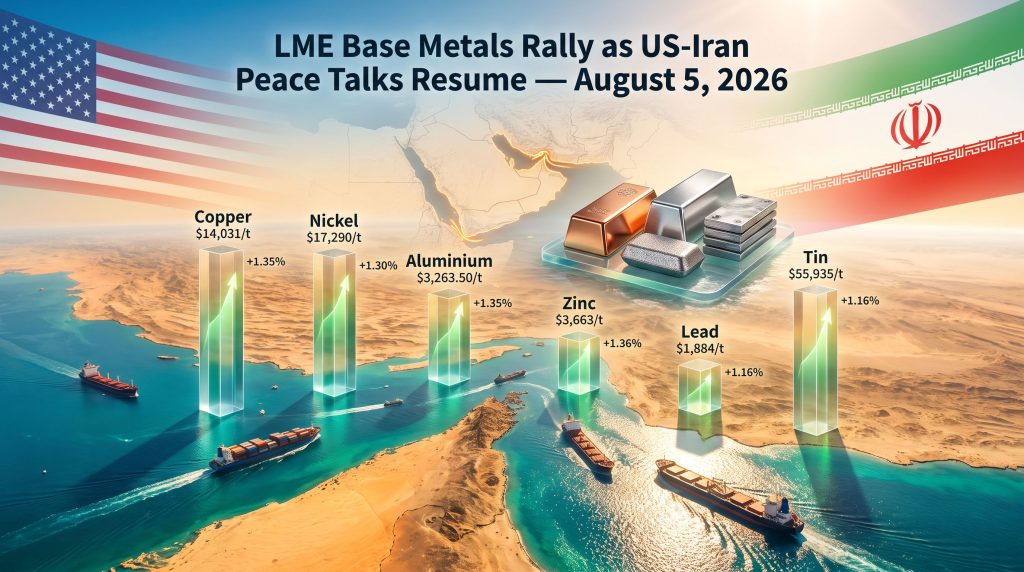
At 10:58am London time on Tuesday August 5, all six LME base metals were trading higher than Monday's 5pm close, confirming the relief rally was not selective but sector-wide.
| Metal | Price (per tonne) | Daily Change |
|---|---|---|
| Copper | $14,031 | +1.16% |
| Aluminium | $3,263.50 | +1.30% |
| Nickel | $17,290 | +1.35% |
| Zinc | $3,663 | +0.60% |
| Lead | $1,884 | +0.91% |
| Tin | $55,935 | +0.88% |
The breadth of the gains across all six metals is analytically significant. Selective rallies, where only one or two metals move, typically reflect metal-specific supply or demand news. A synchronised advance across the entire complex points to a macro-level driver, in this case the geopolitical shift rather than any single commodity fundamental.
Nickel led on a percentage basis at +1.35%, followed by aluminium at +1.30% and copper at +1.16%. Dan Hynes, Chief Strategist at ANZ, attributed the week's opening strength in base metals to two converging forces: a softer US dollar providing a price floor for dollar-denominated commodities, and improving risk appetite as Middle East de-escalation hopes gained credibility. Furthermore, according to Hynes, the oil selloff tied to de-escalation expectations played a meaningful role in lifting sentiment across the commodity complex as a whole. (Source: ANZ, via Fastmarkets, August 2026)
The Strait of Hormuz and Bab-el-Mandeb: Why Two Waterways Can Redirect Global Trade
The Hormuz Chokepoint
The Strait of Hormuz, connecting the Persian Gulf to the Gulf of Oman and onward to global shipping lanes, handles a substantial share of the world's daily seaborne oil and liquefied natural gas flows. Any credible threat to transit through Hormuz creates an immediate energy supply shock that reverberates outward into freight markets, insurance pricing, and ultimately metals production economics. The possibility of a Hormuz reopening decision within 24 hours of the August 4 talks was the single most price-sensitive variable for commodities traders entering Tuesday's session.
The Bab-el-Mandeb Compounding Factor
What made this episode more severe than prior Middle East flare-ups was the simultaneous closure of a second major chokepoint. Escalating hostilities prior to the peace talks had already forced the Bab-el-Mandeb Strait, the narrow passage separating Yemen from Eritrea at the southern end of the Red Sea, to close. This single closure restricted maritime access to three bodies of water simultaneously: the Gulf of Aden, the Red Sea, and the Arabian Sea.
Analysts at Fastmarkets flagged the compounding severity of this dual chokepoint disruption. Their assessment highlighted that the simultaneous constraint of two of the world's most critical maritime passages created unprecedented pressure on global supply chain risks, with cargo vessels forced to divert around the Cape of Good Hope rather than transit the Suez Canal corridor. That diversion adds an estimated 7,000 to 10,000 nautical miles to voyages that would otherwise use the Red Sea route, materially extending transit times and significantly inflating freight and insurance costs for every tonne of metal moving between producing regions and consuming markets. (Source: Fastmarkets, August 2026)
Freight and insurance cost inflation during periods of chokepoint closure tends to persist even after diplomatic resolution, as shipping operators maintain elevated risk pricing until physical security of passage is independently confirmed.
Aluminium: Reclaiming $3,200 per Tonne and the Sustainability Question
Supply-Route Sensitivity
LME aluminium's 1.30% gain to $3,263.50 per tonne on August 5 continued a recovery that had seen the metal reclaim the psychologically important $3,200 level. Aluminium is particularly exposed to maritime route disruption because a meaningful portion of global alumina and bauxite trade, the upstream feedstocks for primary aluminium production, moves through the affected waterways. Rerouting these bulk cargo flows adds cost before a single tonne of primary metal is produced.
LME aluminium warehouse stocks declined by 5,675 tonnes to a total of 238,350 tonnes, providing modest but real inventory support to the price recovery.
The Durability Problem
Analysts at Sucden Financial, Maria Efanova and Victoria Kuszak, noted in a market commentary that while aluminium had successfully reclaimed the $3,200 per tonne area, sustaining prices at or above that level without a renewed supply-risk catalyst or further Middle East escalation remains a meaningful challenge. (Source: Sucden Financial, August 2026)
This framing captures a fundamental tension in the current aluminium market:
| Driver Type | Current Status | Price Impact |
|---|---|---|
| Maritime route disruption | Partially easing | Reducing upward pressure |
| USD weakness | Active | Supportive |
| LME stock levels | Declining slightly | Mildly supportive |
| Demand fundamentals | Stable | Neutral |
| Energy cost (smelting) | Softening with oil | Cost-floor supportive |
The rally is characterised as geopolitically driven rather than fundamentally anchored, meaning price durability hinges heavily on whether diplomatic negotiations produce a durable resolution or collapse back into uncertainty.
Nickel: The HPAL-Sulfur Connection Most Analysts Miss
A Processing Chemistry Most Commentary Overlooks
Nickel's +1.35% gain to $17,290 per tonne is the session's most analytically layered move. Beyond the general macro tailwinds affecting the entire complex, nickel carries a specific and poorly understood sensitivity to Iranian oil flows that runs through the chemistry of its dominant processing technology.
High-Pressure Acid Leaching, universally known in the industry as HPAL, is the primary method used to extract nickel metal from laterite ores, which now account for the dominant share of global nickel reserve growth. HPAL requires large volumes of sulfuric acid as a core processing reagent. Sulfuric acid is manufactured from sulfur, and sulfur is predominantly recovered as a byproduct of petroleum refining. When Iranian crude oil exports are disrupted by sanctions or conflict, the volume of petroleum being refined globally contracts, and global sulfur availability tightens accordingly, pushing sulfuric acid prices higher for HPAL operators.
Fastmarkets analysts noted that improving US-Iran relations reduced immediate market concerns around both oil price trajectory and the availability of Indonesian sulfur supplies, a direct acknowledgment of this processing chemistry linkage. (Source: Fastmarkets, August 2026)
Why This Matters for Indonesian Nickel Producers
The Indonesian nickel market operates the world's largest and fastest-growing concentration of HPAL processing capacity. Indonesian HPAL facilities are the primary production engine for battery-grade nickel sulfate, a critical input for electric vehicle cathode manufacturing. When sulfur supply chains tighten, Indonesian HPAL operating costs rise, squeezing the economics of the world's most strategically important nickel processing hub.
Diplomatic easing between the US and Iran therefore carries a very specific and measurable benefit for Indonesian nickel producers that has nothing to do with trade policy or tariff negotiations. It is a chemistry-driven cost benefit flowing through the global sulfur supply chain.
The RKAB Structural Overlay
Beyond the geopolitical catalyst, nickel market participants remain focused on Indonesian RKAB approvals as the primary structural mechanism governing supply. RKAB, the Indonesian term for government-issued annual mining production quotas, determines how much nickel ore can legally be extracted and processed within Indonesian borders in a given year. Fastmarkets analysts reported that market indications suggest supplementary RKAB approvals will be directed at covering outstanding requirements for existing smelter operations rather than delivering a net increase in overall ore availability. (Source: Fastmarkets, August 2026)
This creates a dual uncertainty structure for nickel that is more complex than for any other metal in the LME complex:
- Geopolitical resolution determines sulfur input costs via Iranian oil production volumes
- Indonesian RKAB governance determines the upstream ore supply ceiling independent of geopolitics
- HPAL capacity utilisation at Indonesian facilities links both variables into a single production economics equation
LME nickel stocks held steady at 264,876 tonnes, unchanged from Monday's close, reflecting the market's holding pattern while these dual uncertainties resolve.
The next major ASX story will hit our subscribers first
Scenario Analysis: Three Possible Outcomes from US-Iran Negotiations
The sustainability of the broader LME base metals up trend depends heavily on how the diplomatic situation resolves. Three distinct scenarios carry materially different implications:
| Scenario | Hormuz Status | USD Direction | Base Metals Outlook |
|---|---|---|---|
| Full diplomatic resolution | Reopens fully | Weakens further | Sustained rally; risk premium fully removed |
| Partial agreement or ceasefire | Partially open | Sideways | Prices consolidate; volatility persists |
| Talks collapse | Remains closed | Strengthens | Sharp reversal; risk premiums re-enter all metals |
Beyond geopolitics, the sustainability question differs by metal:
- Copper market trends at $14,031 per tonne benefit from structural energy-transition demand, including electric vehicle production and grid infrastructure expansion, providing a fundamental floor that exists independently of Middle East dynamics
- Aluminium requires either a renewed supply-risk catalyst or meaningful downstream demand improvement to hold above $3,200 per tonne on a durable basis
- Nickel depends on RKAB clarity in Indonesia and ongoing HPAL cost normalisation through the sulfur supply chain
- Zinc and Lead are more sensitive to global industrial activity and construction sector conditions than to geopolitical factors, making them the least directly exposed to the diplomatic outcome
Long-Term Lessons: Supply Chain Vulnerability and the Case for Resilience
The August 2026 dual chokepoint episode has surfaced a structural vulnerability in global metals logistics that will likely drive strategic responses across the industry for years. The reliance on a small number of maritime corridors for the movement of both raw material feedstocks and refined metals creates systemic fragility that no amount of price hedging can fully offset. Furthermore, China metals demand adds another layer of complexity, given how heavily Chinese import flows depend on these same maritime corridors for ore and energy deliveries.
Several strategic responses are likely to accelerate as a result:
- Regional metal stockpiling by major consumers as a physical buffer against future chokepoint closures
- LME warehouse positioning strategies focused on geographic diversification of inventory
- Freight hedging programme expansion by producers and logistics operators who previously treated route disruption as a tail risk
- Long-term shipping contract restructuring to incorporate force majeure provisions specific to chokepoint closure scenarios
The diversion route around the Cape of Good Hope, adding up to 10,000 nautical miles to affected voyages, is not merely a cost inconvenience. It is a timeline disruption that can extend delivery schedules by weeks, creating downstream inventory mismatches for manufacturers who operate on lean supply models. For a broader understanding of how maritime disruptions intersect with global commodity flows, the London Metal Exchange provides detailed market data and official pricing benchmarks that traders rely on during periods of elevated volatility.
The episode is a reminder that in commodities markets, geography is not a background factor. It is an active price-setting variable that can override months of fundamental supply-demand positioning in a single trading session.
Industry analysts and risk managers increasingly reference Fastmarkets as a primary source for real-time pricing intelligence and supply chain analysis during episodes of this kind, given the granularity of their commodity-specific coverage.
Frequently Asked Questions: LME Base Metals and US-Iran Peace Talks
Why did LME base metals rise when US-Iran peace talks resumed?
Peace talks reduced the perceived probability of prolonged Strait of Hormuz closure, compressing supply-chain disruption risk premiums. Simultaneously, oil prices fell, weakening the USD and lowering metals production cost floors, while improving risk appetite drove broad-based gains across all six LME metals.
Which LME metal gained the most on August 5, 2026?
Nickel recorded the largest percentage gain at +1.35%, reaching $17,290 per tonne, followed by aluminium at +1.30% and copper at +1.16%.
What is HPAL and why does it connect nickel to Iranian oil?
HPAL, or High-Pressure Acid Leaching, is the primary technology for processing nickel from laterite ores. It requires sulfuric acid, which is derived from sulfur recovered during petroleum refining. Disruptions to Iranian oil production reduce global sulfur availability, increasing HPAL operating costs and directly affecting the economics of nickel production, particularly in Indonesia.
What are Indonesian RKAB approvals and why do they matter for nickel?
RKAB approvals are government-issued annual mining production quotas in Indonesia that set the legal ceiling for nickel ore extraction. Supplementary approvals are currently expected to cover existing smelter requirements rather than expand overall ore supply, meaning Indonesian production volumes remain constrained by regulatory governance independent of global price signals.
How does a weaker US dollar support base metals prices?
Since LME base metals are priced in USD, a weaker dollar reduces their effective cost in other currencies, stimulating demand from non-US buyers. This currency mechanism can drive meaningful price gains entirely independent of changes in physical supply or demand fundamentals.
Disclaimer: This article is intended for informational purposes only and does not constitute financial, investment, or trading advice. Commodity prices and geopolitical situations can change rapidly. Forward-looking statements and scenario projections involve inherent uncertainty and should not be relied upon as predictions of actual market outcomes. Readers should conduct their own due diligence before making any investment or trading decisions.
Want to Capitalise on the Next Major Mineral Discovery Before the Broader Market Does?
Discovery Alert's proprietary Discovery IQ model delivers real-time alerts on significant ASX mineral discoveries, instantly transforming complex mineral data into actionable investment insights for both short-term traders and long-term investors — explore historic discoveries and their exceptional returns to understand the opportunity, then begin your 14-day free trial at Discovery Alert to position yourself ahead of the market.