June 17, 2026
UAE Oil Output Above 5 Million BPD After OPEC Exit: What the Numbers Actually Mean
Every major shift in global oil supply begins not with a press release, but with a quiet accumulation of capacity that existing institutional arrangements have held in check. For years, the UAE sat in precisely this position: a producer with growing technical capabilities, steadily expanding infrastructure, and rising ambitions, constrained by the collective quota discipline of OPEC+. The decision to exit that arrangement in 2026 removed the final institutional brake on a production machine that had been building pressure for more than a decade.
But understanding what UAE oil output above 5 million bpd after OPEC exit actually means requires more than reading a headline figure. It demands clarity on what is being measured, what assumptions underpin the forecasts, and what engineering and geopolitical variables must align before the numbers become reality.
When big ASX news breaks, our subscribers know first
Why Quota Compliance Was Always a Constraint, Not a Choice
The UAE's relationship with OPEC+ was, for much of the past decade, one of growing tension between collective obligation and national interest. Understanding how OPEC shapes markets helps clarify why the quota system served Saudi Arabia's fiscal stabilisation goals and preserved cartel pricing power, whilst imposing a progressively heavier opportunity cost on members whose production capacity was expanding faster than their assigned ceilings.
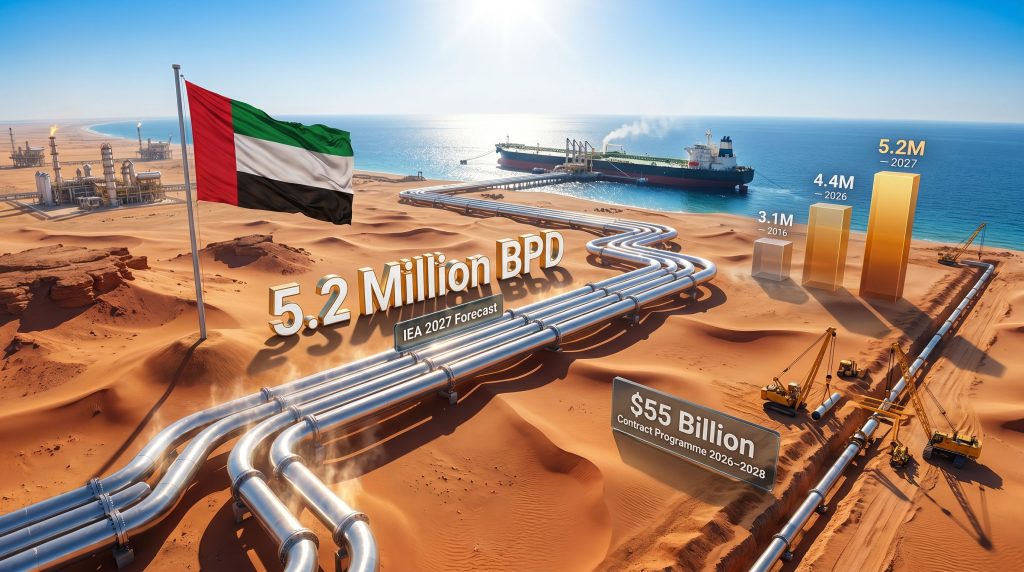
Between 2016 and 2026, the UAE's crude production capacity grew from approximately 3.1 million barrels per day to roughly 4.4 million bpd, a gain of more than 40% driven by sustained upstream investment from the Abu Dhabi National Oil Company (ADNOC). Yet across that same period, actual production averaged well below 3 million bpd, constrained by OPEC+ compliance obligations. The gap between what the UAE could produce and what it was permitted to produce widened steadily, making the eventual break with the cartel economically rational rather than impulsive.
The table below illustrates how this divergence played out across key years:
| Year | Reported Capacity (bpd) | Actual Production (bpd) | Quota Constraint Level |
|---|---|---|---|
| 2016 | ~3.1 million | ~2.9 million | Moderate |
| 2020 | ~4.0 million | ~2.5 million | Severe (COVID-era cuts) |
| 2024 | ~4.3 million | ~2.9 million | Active |
| 2026 | ~4.4 million | ~2.8 million* | Exiting |
*Crude output figure as of mid-2026, reflecting conflict-related disruption
The cumulative fiscal cost of this suppression runs into hundreds of billions of dollars in foregone revenue, a calculation Abu Dhabi's policymakers were clearly factoring into their long-term resource monetisation strategy.
Separating the 5 Million BPD Figure From Current Reality
Production, Capacity, and Total Liquids: Three Very Different Numbers
One of the most persistent sources of confusion in coverage of UAE oil ambitions is the conflation of distinct metrics. Before any credible analysis of the UAE's post-OPEC trajectory is possible, three concepts must be clearly separated:
- Production: The volume of hydrocarbons physically extracted and sold per day at any given point in time
- Capacity: The maximum sustainable extraction rate achievable with installed infrastructure, irrespective of what is actually being sold
- Total liquids output: A broader aggregate encompassing crude oil, condensate, and natural gas liquids (NGLs), which is the basis for the IEA's headline forecast
As of mid-2026, UAE crude output stands at approximately 2.8 million bpd, roughly 835,000 bpd below pre-conflict levels, according to IEA data reported via Zawya/Reuters. This figure reflects the impact of regional disruption stemming from the Iran conflict, not a structural capacity problem.
The 5.2 million bpd figure is a 2027 forecast for total oil output, inclusive of condensate and NGLs, projected by the International Energy Agency. It represents a year-on-year increase of approximately 730,000 bpd from 2026 levels and is contingent on several conditions being met simultaneously.
Key concept: The UAE's crude-only capacity sits at roughly 4.4 million bpd. Adding approximately 1.1 million bpd of condensate and NGL capacity brings the total liquids potential to around 5.5 million bpd. The IEA's 5.2 million bpd forecast therefore assumes near-full utilisation of combined capacity by 2027, which is achievable but not automatic.
What the IEA Forecast Assumes
The IEA's projection embeds several key assumptions that are worth unpacking for investors and energy market participants. Furthermore, OPEC demand revisions offer additional context for evaluating how realistic these projections may prove in practice:
- ADNOC's capital deployment proceeds at scale and on schedule across its upstream and midstream portfolio
- The Strait of Hormuz disruption resolves or is effectively bypassed through alternative export infrastructure
- No material escalation in regional conflict that could damage production or export facilities
- Field development programmes at major Abu Dhabi concessions advance without significant technical or contractual delays
Where the forecast could prove optimistic: if the new West-East pipeline slips its 2027 delivery date or regional tensions persist longer than expected, export constraints rather than production capacity become the binding constraint on realised output.
Where it could prove conservative: if ADNOC's front-loaded capital programme accelerates field commissioning beyond base-case timelines, and if condensate processing expansions come online earlier than modelled.
ADNOC's Capital Programme: The Engineering Engine Behind the Numbers
$55 Billion in Near-Term Contracts, $150 Billion Through 2030
The scale of ADNOC's investment commitment is what gives the IEA's 2027 forecast its credibility. In a move announced prior to mid-2026, ADNOC committed to awarding AED 200 billion (approximately $55 billion) in contracts across 2026 to 2028, specifically to accelerate growth and deliver its strategic expansion objectives. This near-term contract pipeline is embedded within a longer-horizon capital allocation of $150 billion planned between 2026 and 2030, according to ADNOC's published strategy.
The investment programme spans three primary categories:
- Upstream field development and enhanced recovery: Targeting incremental production from existing and new concession areas across Abu Dhabi's onshore and offshore acreage
- Midstream infrastructure and pipeline redundancy: Expanding the physical architecture needed to move crude and NGLs from wellhead to export terminal without relying on a single chokepoint
- Condensate and NGL processing capacity: Increasing the downstream infrastructure needed to monetise the non-crude liquids that form a meaningful portion of total output
The 6 Million BPD Horizon: Aspiration, Not Target
UAE Energy Minister Suhail al-Mazrouei has indicated to media that capacity could theoretically reach 6 million bpd under favourable market conditions. This is an important distinction: it is a scenario-based aspiration tied to price signals and demand trajectories, not an official operational target with a defined timeline. According to Reuters, treating it as the latter would misrepresent where the UAE's production ambitions actually stand.
The Export Equation: Infrastructure as the Real Constraint
Fujairah and the Habshan Bypass Route
Producing additional barrels is only half the equation. Getting those barrels to market without exposure to Strait of Hormuz disruption is equally critical, and Abu Dhabi has been investing in this problem for years.
The existing Habshan-Fujairah pipeline carries a throughput capacity of 1.8 million bpd, connecting onshore production fields directly to the port of Fujairah on the Gulf of Oman coast, entirely bypassing the Strait. Fujairah itself holds 42 million barrels of strategic storage capacity, providing a meaningful buffer against short-term export disruption.
In May 2026, despite ongoing regional conflict, UAE total exports rose 260,000 bpd month-on-month to reach 3.1 million bpd, demonstrating the resilience of the bypass infrastructure. A portion of this export continuity was also supported by tanker activity along the Omani coastline, where vessels have been observed operating without active transponders, a practice that underscores both the adaptability of UAE export logistics and the opacity of volume tracking during conflict periods.
The New West-East Pipeline: 2027 Delivery and Its Strategic Significance
The single most consequential infrastructure development underpinning the IEA's forecast is ADNOC's fast-tracked second West-East pipeline. The project is specifically designed to double Fujairah's export capacity, creating a redundant high-volume corridor that would allow the UAE to route the bulk of its export volumes entirely outside the Strait of Hormuz.
As of mid-2026, the pipeline is approximately 50% complete, with delivery scheduled for 2027. When operational, this infrastructure fundamentally changes the UAE's export risk profile, transforming Fujairah from a supplementary bypass into the UAE's primary export gateway.
This is a point often underappreciated in market analysis: the credibility of UAE oil output above 5 million bpd after OPEC exit depends as much on export infrastructure completion as on upstream capacity. A pipeline 50% built is not yet a pipeline delivering barrels to Asian buyers.
Three Scenarios for UAE Output Through 2027
Scenario 1: Base Case – IEA Forecast Materialises
Total UAE oil output reaches 5.2 million bpd by 2027. The West-East pipeline delivers on schedule, ADNOC's capital programme proceeds without material delays, and regional conflict either stabilises or is effectively managed through bypass routing. In this scenario, the UAE emerges as a primary driver of non-OPEC+ supply growth, contributing meaningfully to what the IEA has already characterised as a significant 2027 global oil surplus.
Scenario 2: Upside Case – Accelerated Capital Front-Loading
Output approaches 5.5 million bpd if ADNOC's $150 billion programme front-loads major capacity additions ahead of schedule. Early pipeline commissioning and faster-than-expected field development in Abu Dhabi's offshore concessions could trigger this outcome. The geopolitical dividend would be substantial: a UAE capable of supplying Asian and European buyers at scale, reliably and outside the Hormuz chokepoint, would command significant long-term offtake relationships.
Scenario 3: Downside Case – Execution Delays and Persistent Disruption
Output remains constrained below 4.5 million bpd if the West-East pipeline slips its delivery date, regional conflict intensifies, or contractor availability becomes a bottleneck. In this scenario, the gap between installed capacity and realised production persists well beyond 2027, and the IEA's surplus forecast requires meaningful downward revision. Consequently, crude oil price trends could shift considerably should this scenario materialise.
The next major ASX story will hit our subscribers first
Global Market Implications: Beyond the UAE's Borders
OPEC+ Cohesion Under Pressure
The UAE's departure creates a structural problem for OPEC+'s ability to manage supply and defend price floors. A member with 4.4 million bpd of crude capacity operating outside quota discipline represents a potential free-rider on any supply restraint that remaining members maintain. More significantly, it sets a precedent: other members with growing capacity ambitions and rising opportunity costs from quota compliance are watching closely.
Saudi Arabia's response calculus is particularly complex. Riyadh's fiscal breakeven price, widely estimated in the mid-to-high $70s per barrel range, requires both volume and price discipline. A UAE supplying unconstrained volumes into a softening market creates downward price pressure that could force Riyadh into either accepting lower revenue or defending price levels through further Saudi output restraint, effectively ceding market share to Abu Dhabi.
Price Sensitivity and Fiscal Viability
Abu Dhabi's fiscal breakeven is structurally lower than Saudi Arabia's, giving ADNOC's expansion programme more resilience to a lower-price environment. However, a sustained period of crude prices in the low-to-mid $60s would likely slow, though not halt, the pace of capital deployment, introducing timeline risk into the 2027 output target.
The UAE's strategic calculus reflects a view that hydrocarbons face long-term demand risk from energy transition forces, making the case for accelerated monetisation now rather than constrained production later. Furthermore, the broader geopolitical trade tensions shaping energy markets reinforce this logic, which prioritises maximising the net present value of reserves over protecting a short-term price floor — a fundamentally different orientation from the one that has historically governed OPEC+ behaviour. The trade war impact on oil adds yet another layer of complexity to this already intricate strategic calculation.
Analysis from Capital Economics further underscores that the UAE stands to gain meaningfully from its exit, particularly if it can lock in long-term supply agreements with Asian buyers whilst competitors remain quota-constrained.
Frequently Asked Questions
Is the UAE currently producing 5 million barrels per day?
No. As of mid-2026, UAE crude production stands at approximately 2.8 million bpd. The 5 million bpd figure refers to a projected total oil output level inclusive of condensate and NGLs, forecast by the IEA for 2027.
What is ADNOC's stated capacity target?
ADNOC's operational capacity target is 5 million bpd by 2027. UAE Energy Minister Suhail al-Mazrouei has indicated capacity could theoretically reach 6 million bpd under supportive market conditions, though this is not an official production target.
How does the UAE bypass the Strait of Hormuz?
The UAE operates the Habshan-Fujairah pipeline with a 1.8 million bpd throughput capacity. A second West-East pipeline, currently around 50% complete, is scheduled for 2027 delivery and will double Fujairah's export handling capacity.
How much is ADNOC investing?
ADNOC has committed to awarding approximately $55 billion in contracts for 2026 to 2028, within a broader programme of $150 billion in capital investment planned through 2030.
This article is for informational purposes only and does not constitute investment advice. Forecasts and projections referenced are forward-looking and subject to material change based on geopolitical, operational, and market conditions. Readers should conduct independent research before making any investment or commercial decisions related to the energy sector.
For ongoing coverage of MENA energy markets and commodity developments, Zawya's commodities section provides detailed regional reporting.
Want to Stay Ahead of the Next Major Commodity Discovery?
While the UAE's post-OPEC output expansion reshapes global oil supply, Discovery Alert's proprietary Discovery IQ model scans ASX announcements in real time, instantly identifying significant mineral discoveries across more than 30 commodities before the broader market reacts. Explore historic discovery returns on Discovery Alert's discoveries page and begin your 14-day free trial to position yourself ahead of the next major find.