June 17, 2026
The World's Most Dangerous Bottleneck: How One Waterway Controls Global Energy
Few geographical features carry the economic weight of a single narrow channel connecting two bodies of water. Maritime chokepoints have shaped trade empires, triggered wars, and dictated the fortunes of oil-dependent economies for decades. The Strait of Hormuz represents the most consequential of these pressure points, a 21-nautical-mile passage at its narrowest that sits between Iran and Oman and functions as the circulatory system of global petroleum supply.
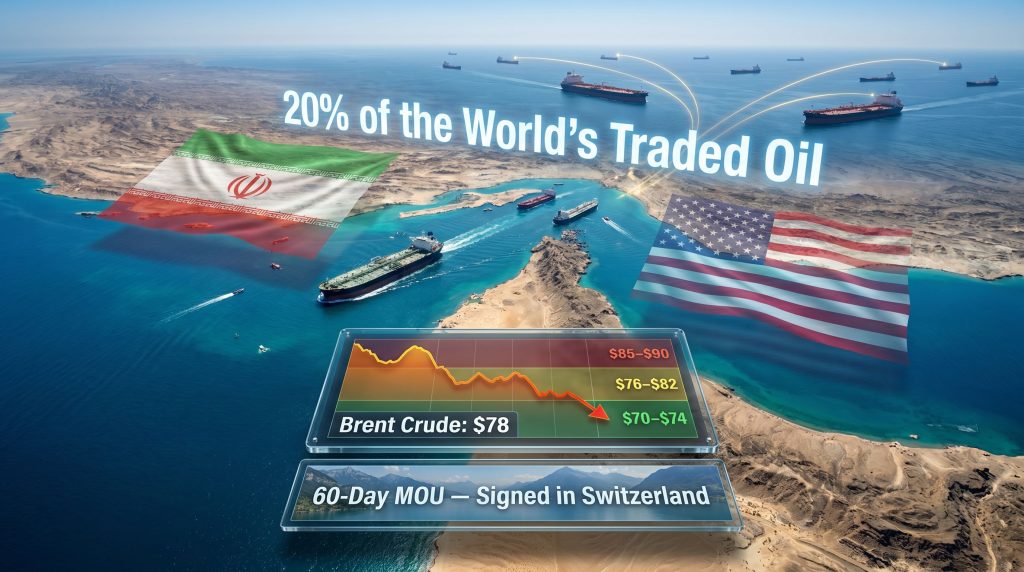
Understanding why the US Iran deal to reopen the Strait of Hormuz carries such outsized significance requires understanding just how structurally irreplaceable this waterway is. According to the U.S. Energy Information Administration's World Oil Transit Chokepoints assessment, approximately 21 million barrels per day of crude oil and refined products transited the Strait of Hormuz in 2018, representing roughly one-fifth of total global petroleum liquids consumption. No other maritime chokepoint comes close in volumetric terms.
The physical geometry of the strait compounds its vulnerability. Two designated shipping lanes, each just two nautical miles wide, carry opposing tanker traffic within a total navigable corridor barely wider than many city thoroughfares. The International Maritime Organization's traffic separation scheme governs this movement, but the underlying reality is that a relatively modest disruption — whether through naval mining, blockades, or targeted attacks on vessels — can send shockwaves through crude benchmarks within hours. Furthermore, the oil price geopolitics surrounding this region have historically amplified every signal of instability.
When big ASX news breaks, our subscribers know first
What the Interim Agreement Actually Contains
The framework now reshaping energy market expectations is structured as a 60-day memorandum of understanding, signed in Switzerland at the Bürgenstock resort overlooking Lake Lucerne, with U.S. Vice President JD Vance leading the American delegation. Bloomberg's reporting, citing a draft copy of the agreement, confirms that the text was circulated among G7 allied nations ahead of formal release, though neither Washington nor Tehran had officially published the document as of mid-June 2026.
What makes this framework commercially significant is the front-loaded nature of its economic provisions. Critically, the U.S. Treasury Department commits to issuing sanctions waivers for Iranian crude oil and petrochemical exports immediately upon signing, without waiting for the 60-day negotiation window to conclude. The PBS NewsHour has reported that significant challenges remain despite this initial progress.
The full scope of the immediate provisions is outlined below:
| Provision | Timeline | Detail |
|---|---|---|
| Iranian crude and petrochemical export waivers | Immediate upon signing | U.S. Treasury to issue directly |
| U.S. naval blockade on Iranian ports | Lifted upon signing | Full port access restored |
| Strait of Hormuz maritime normalisation | Within 30 days | Traffic to return to pre-conflict levels |
| Iranian naval mine clearance | Concurrent with reopening | Iran responsible for clearance |
| Economic development financing | Timeline unspecified | At least $300 billion via U.S. and partners |
Critical distinction: Sanctions waivers for oil exports are immediate. The full dismantlement of the broader sanctions architecture, however, is deferred entirely to the final agreement phase, which must be negotiated within the subsequent 60 days.
Several provisions that Iran and outside observers might expect to be resolved are conspicuously absent from the interim stage. Iran's enriched uranium stockpile receives no specific dismantlement or transfer timeline in the current draft. The document only states that nuclear matters will be adequately addressed in a final agreement. Similarly, while the U.S. commits in principle to releasing frozen Iranian assets, the draft establishes no specific timeline for when those funds become accessible.
Oil Market Arithmetic: Why Brent Fell 15% in Four Sessions
Financial markets responded to the emerging deal framework with immediate and sustained downward pressure on crude benchmarks. Brent crude fell below $78 per barrel, reaching its lowest point in more than three months, while WTI tracked at $76.66. The decline of approximately 15% across four consecutive trading sessions represented the longest losing streak of 2026 for oil prices. For broader context on how such events unfold, the crude oil price analysis from earlier in the year offers useful comparisons.
The market logic driving this reaction is straightforward: Iran holds significant spare production capacity that was effectively locked out of international markets during the conflict and enhanced sanctions period. The immediate issuance of Treasury waivers signals that Iranian barrels could re-enter the global supply mix faster than many traders had anticipated.
Physical market participants responded even before the formal signing. Vessel tracking data cited by Bloomberg confirmed that four Iran-linked oil tankers, including two supertankers each capable of carrying approximately two million barrels of crude, reactivated their transponders and repositioned toward the Strait of Hormuz and Gulf of Oman. This tanker movement is significant because supertankers — technically classified as Very Large Crude Carriers (VLCCs) — represent the most economical method for moving large crude volumes to Asian refining hubs, and their repositioning signals market anticipation of imminent export flows. Indeed, global crude shipments have already been shifting in response to these developments.
How Might Prices Evolve From Here?
Three distinct price trajectories exist depending on how the deal evolves:
Scenario 1: Full Compliance and Smooth Reopening
- Iranian exports resume at scale within 30 days
- Brent could test the $70 to $74 range if OPEC+ does not coordinate offsetting cuts
- War risk insurance premiums normalise, removing freight cost premiums embedded in current pricing
Scenario 2: Partial Reopening with Disputed Access Conditions
- Iran retains conditional control or imposes access fees on non-Iranian shipping
- Brent stabilises in the $76 to $82 range as markets price execution risk
- Tanker operators and insurers maintain elevated premiums pending full navigational clarity
Scenario 3: Deal Collapse or Israeli Veto
- Lebanon provisions fracture negotiations
- Strait remains partially restricted; Brent rebounds above $85 to $90
- Risk premiums re-enter energy markets globally
The $300 Billion Development Programme: Ambiguity by Design
The economic rehabilitation component of the deal is framed around a commitment to provide at least $300 billion in financing for Iranian economic development. The draft document attributes this obligation to the U.S. and its regional partners, deliberately avoiding specificity on which nations contribute, in what proportions, or through which multilateral financing mechanisms.
President Trump publicly clarified that the United States would not be directly paying Iran $300 billion, describing the financing as a coalition obligation shared among multiple partners. This distinction matters politically given Trump's prior criticism of the 2015 Obama-era Joint Comprehensive Plan of Action (JCPOA), which he characterised as a financial giveaway to Tehran when he withdrew the U.S. from the deal in 2018. Additionally, OPEC's market influence is likely to shape how these supply dynamics eventually settle.
Iran's Central Bank Governor Abdolnaser Hemmati added a further layer of complexity when he stated publicly that Tehran would demand full assurance regarding effective access to frozen funds following the MOU signing, and characterised American obligations on asset release as explicitly and actionably stated in the agreement. This interpretation contrasts directly with the draft language, which contains no specific timeline for frozen asset release.
This gap between Tehran's public characterisation of the frozen asset provisions and the actual draft language is one of the most likely flashpoints in the 60-day final negotiation phase.
Geopolitical Architecture: Where the Deal Could Break
The interim MOU contains a provision that creates a structural dependency on a party not directly at the negotiating table. The requirement that the war be ended on all fronts — including in Lebanon — effectively grants Israeli Prime Minister Benjamin Netanyahu a de facto veto over whether the deal can reach its final stage. This dimension of the US Iran deal to reopen the Strait of Hormuz is, consequently, one of its most structurally fragile elements.
Netanyahu has maintained Israeli military operations against Hezbollah in southern Lebanon, declining to end engagement with the Iran-backed group. Former Israeli Ambassador to the UK Mark Regev articulated the Israeli position by describing the continued presence in southern Lebanon as essential infrastructure cleanup operations against Hezbollah's military network.
Iran's chief negotiator Mohammad Bagher Ghalibaf took the opposite position, insisting through Iran's semi-official Mehr news agency that Israel must withdraw from occupied territories in Lebanon as a condition of any durable resolution. This direct contradiction between Israeli and Iranian requirements on the Lebanon dimension is unresolved in the current MOU.
Domestic political risk within the United States represents a secondary but meaningful obstacle. Former Vice President Mike Pence described the immediate sanctions waivers as a lifeline for the Iranian regime and characterised the approach as ill-advised during a CNN appearance. Republican hawks in Congress have similarly expressed concern that the administration is offering substantial economic rewards without securing sufficient concrete commitments on nuclear activities. Furthermore, the trade war oil impact adds yet another layer of uncertainty for markets trying to assess the medium-term outlook.
Structural Comparison: How the 2026 MOU Differs from the 2015 JCPOA
The political sensitivity of this deal is inseparable from its predecessor. Trump withdrew from the JCPOA in 2018 on the basis that it provided insufficient restrictions on Iran's nuclear enrichment and ballistic missile programmes. The 2026 framework must address those same structural deficiencies while simultaneously resolving an active military conflict, a fundamentally more complex negotiating environment.
| Dimension | 2015 JCPOA | 2026 Interim MOU |
|---|---|---|
| Nuclear enrichment limits | Specific caps and timelines | Deferred to final agreement |
| Sanctions relief | Phased and conditional | Partial waivers immediate; full relief deferred |
| Economic incentives | Asset unfreezing | $300B development programme plus asset release |
| Verification mechanisms | IAEA inspections specified | Not detailed in interim draft |
| U.S. domestic opposition | Senate Republicans | Republican hawks and former VP Pence |
| Strait of Hormuz | Not applicable | Central to deal architecture |
| Negotiation window | Multi-year phased implementation | 60-day window for final agreement |
The deferral of Iran's enriched uranium stockpile to the final negotiation phase is particularly notable. Under the JCPOA, Iran agreed to reduce its enriched uranium stockpile by approximately 98% and limit enrichment to 3.67% purity for 15 years, with IAEA verification as the enforcement mechanism. The 2026 MOU contains no equivalent interim restriction, meaning Iran retains full leverage over its nuclear posture throughout the 60-day window.
The next major ASX story will hit our subscribers first
Shipping Infrastructure and Downstream Energy Effects
The tanker market implications of a successful Strait reopening extend well beyond crude oil benchmarks. War risk insurance premiums on vessels transiting the Persian Gulf spiked substantially during the conflict period, adding meaningful cost layers to every barrel moved through the waterway. Normalisation of passage conditions would deflate these premiums rapidly, benefiting refiners globally by reducing the freight cost component embedded in landed crude prices.
Asian refiners represent the primary commercial beneficiaries of restored Iranian crude access. China, India, South Korea, and Japan collectively represent the dominant destination markets for Persian Gulf crude, and all four nations have navigated complex supply chain adjustments during the period of restricted Hormuz passage.
The inclusion of Iranian petrochemical exports within the immediate Treasury waiver scope is a detail that extends the deal's significance beyond crude oil markets. Iran operates one of the Middle East's larger petrochemical sectors, and restored access to those supply chains matters for downstream chemical and plastics industries across Asia and Europe.
One unresolved navigational question concerns whether restored access will be genuinely unrestricted. U.S.-aligned framing describes the reopening as restoring toll-free navigation, however Iranian statements have suggested Tehran may retain the right to impose service fees or conditional access terms on non-Iranian vessels. This ambiguity is not addressed in the current draft and represents a potential friction point for shipping operators and their insurers in the near term. The BBC's coverage of the agreement details further complications that remain unresolved.
What Energy Markets and Policymakers Should Monitor
Several concrete milestones will determine whether the US Iran deal to reopen the Strait of Hormuz supply-side implications materialise or remain theoretical:
-
The 30-day maritime normalisation window is the most immediate market catalyst. Confirmed mine clearance and port reopening will signal whether the supply surge thesis translates from tanker repositioning into actual export volumes.
-
The 60-day negotiation deadline is the critical geopolitical clock. Failure to resolve nuclear enrichment, frozen asset timelines, and Lebanon provisions within this window risks deal collapse and a sharp crude price reversal.
-
Iran's frozen asset demands represent the most likely near-term friction point, given the divergence between Tehran's public characterisation of the draft and the actual draft language on asset release timing.
-
Israel's position on Lebanon remains the single most structurally unpredictable variable, as Netanyahu holds de facto veto power over the Lebanon provisions without being a direct party to the talks.
-
OPEC+ response strategy will shape the medium-term price floor. Whether the cartel adjusts production targets in response to Iranian re-entry will determine whether the bearish price trajectory from Scenario 1 materialises or is partially offset by coordinated supply management.
The interim MOU's architecture reflects a deliberate sequencing choice: deliver immediate economic relief to Iran on oil exports while deferring the hardest structural questions to a compressed follow-on negotiation. Whether that sequencing produces durable resolution or simply a temporary de-escalation will become clear within the 60-day window now underway. The US Iran deal to reopen the Strait of Hormuz remains, in short, a framework built on promise rather than certainty.
This article contains forward-looking analysis and scenario modelling based on publicly available draft agreement language as reported by Bloomberg. Geopolitical negotiations involve inherent uncertainty and outcomes may differ materially from scenarios described. Nothing in this article constitutes financial or investment advice.
Want to Position Yourself Ahead of the Next Major Resource Discovery?
While geopolitical shifts like the US–Iran deal reshape global energy supply chains, Discovery Alert's proprietary Discovery IQ model delivers real-time alerts on significant ASX mineral discoveries — instantly translating complex resource data into actionable opportunities for investors at every level. Explore how historic discoveries have generated substantial returns on Discovery Alert's dedicated discoveries page, and begin your 14-day free trial today to secure a market-leading edge.