June 13, 2026
The Quiet Shift Reshaping Who Owns the World's Steel Fuel
Before a single tonne of steel can be poured, coking coal must survive an industrial gauntlet that no commercially viable alternative has yet replaced. Blast furnaces operating across Asia consume millions of tonnes of metallurgical coal annually, transforming it into coke that provides both the carbon chemistry and the structural support necessary for iron ore reduction. This is not an energy input that can be swapped out by regulatory preference alone. It is a physical constraint embedded in the dominant steelmaking process used across the world's fastest-growing economies.
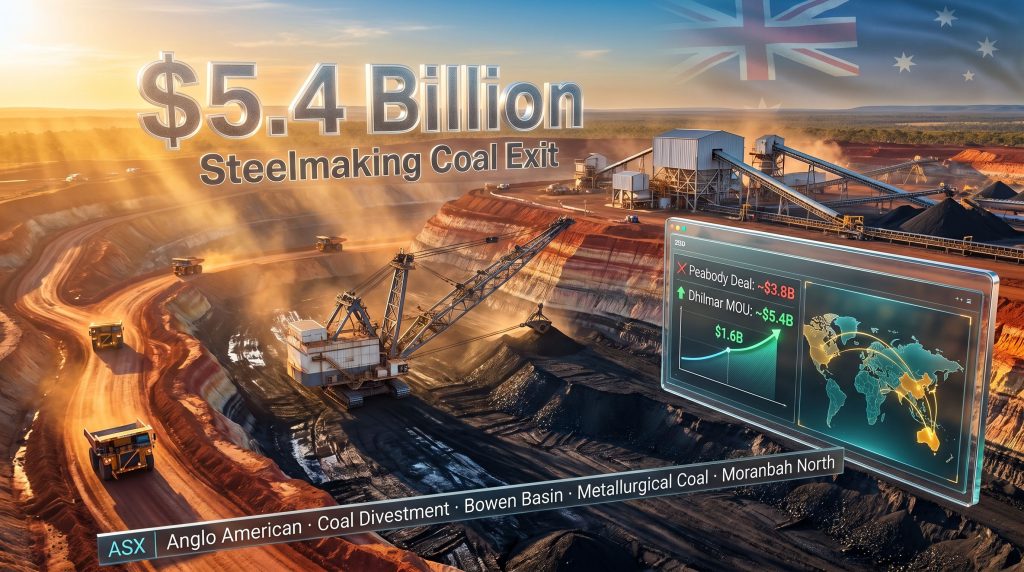
Understanding this industrial reality is essential context for interpreting one of the most significant asset transactions currently unfolding in the global resources sector. The Anglo American coal exit from its Australian steelmaking coal portfolio, valued at $5.4 billion, is not simply a corporate restructuring story. It is, furthermore, a live demonstration of how ESG-driven portfolio decisions interact with persistent industrial demand, operational risk, and the complex deal mechanics of large-scale resource asset sales.
When big ASX news breaks, our subscribers know first
The Strategic Logic Behind Anglo American's Portfolio Retreat
Anglo American's decision to exit steelmaking coal did not emerge from a single board meeting. It reflects a multi-year strategic repositioning that has systematically redirected capital toward commodities the company views as structurally aligned with long-run global demand: copper for electrification infrastructure, iron ore for construction and manufacturing, and crop nutrients for food security. Within this framework, steelmaking coal is treated as a profitable but strategically misaligned asset.
This kind of portfolio simplification logic has precedent across the major mining sector. Rio Tinto completed its full exit from coal by 2018, largely under pressure from ESG-oriented institutional investors and sovereign wealth funds with explicit fossil fuel exclusion mandates. South32 followed a different path, spinning off and ultimately selling its Illawarra Coal operations to M Resources. Each of these exits shared a common thread: the divesting company was not necessarily pessimistic about near-term coal demand, but concluded that owning coal assets created investor relations friction that outweighed financial returns.
| Miner | Exit Method | Primary Motivation | Result |
|---|---|---|---|
| Rio Tinto | Full asset sale (2018) | ESG mandates, investor exclusion lists | Clean exit, capital redeployed to copper and lithium |
| South32 | Spin-off then sale | Portfolio simplification | Illawarra Coal transferred to M Resources |
| Anglo American | Negotiated sale (ongoing) | Strategic refocus on copper, iron ore, nutrients | Deal collapsed, new buyer engaged at higher valuation |
The Anglo American situation is more complex than either precedent, partly because of the quality of the assets involved and partly because of the operational incident that derailed the first transaction. You can follow the latest coal sale status updates as the process continues to evolve.
Queensland's Bowen Basin: Why These Assets Command Premium Attention
The coal portfolio Anglo American is selling is concentrated in Queensland's Bowen Basin, widely regarded as one of the world's preeminent metallurgical coal provinces. The geological characteristics of this region are significant: Bowen Basin hard coking coal is among the highest-quality metallurgical coal available in seaborne markets, typically commanding price premiums above benchmark indices due to its coking properties, low sulfur content, and consistency across mine runs.
Hard coking coal quality is measured along several technical dimensions that matter deeply to steel mill buyers:
- Coking strength after reaction (CSR) reflects how well coke maintains structural integrity inside a blast furnace under high-temperature conditions. Higher CSR values allow steel mills to operate with greater efficiency and reduce the quantity of coke required per tonne of iron produced.
- Fluidity and reflectance characteristics determine how the coal behaves during the coking process itself, influencing the density and porosity of the resulting coke.
- Ash and sulfur content affect downstream steel quality and determine how much of the coal's energy value is converted into useful coke versus waste byproduct.
Bowen Basin premium hard coking coal grades well across all of these measures. Consequently, the seaborne customer base for these assets skews toward sophisticated buyers in Japan, South Korea, India, and China who operate large integrated steel facilities with strict raw material specifications. This customer profile also explains why multiple credible buyers have emerged despite the deal complexity introduced by the Peabody Energy collapse.
Metallurgical Coal vs. Thermal Coal: A Distinction That Changes Everything
A common analytical error when discussing Anglo American's divestment is to conflate steelmaking coal with thermal coal. The two commodities share a geological origin but serve entirely different industrial purposes and face fundamentally different demand trajectories.
Thermal coal is burned in power stations to generate electricity. As renewable energy capacity expands and coal-fired power generation is phased out across developed economies, thermal coal faces genuine structural decline in major markets. The International Energy Agency has been explicit that new thermal coal investment is incompatible with net-zero pathways.
Metallurgical coal occupies a different position entirely:
- Blast furnace steelmaking, which currently accounts for the dominant share of global steel production, requires coke as both a reducing agent and a physical support structure within the furnace. There is no commercially deployable substitute at global scale today.
- Electric arc furnace (EAF) steelmaking can use scrap steel as a feedstock and does not require coking coal, but EAF capacity is constrained by scrap availability, and the high-grade steel required for automotive and certain industrial applications often still favours blast furnace routes.
- Hydrogen iron ore reduction represents the most credible long-term pathway to eliminating metallurgical coal from steel production. However, the technology requires green hydrogen at scale and competitive cost, and commercial deployment at a level sufficient to displace meaningful blast furnace capacity remains years to decades away.
This distinction matters enormously for asset valuation. A met coal mine in the Bowen Basin is not selling the same commodity story as a thermal coal operation in the Hunter Valley. The buyer universe, demand duration assumptions, and price deck inputs are materially different.
India's expanding infrastructure and manufacturing sector is increasingly cited by analysts as the key medium-term demand driver for seaborne metallurgical coal prices and volumes. As Indian steelmakers commission new blast furnace capacity to support domestic construction activity, their appetite for high-quality coking coal from reliable Australian suppliers is expected to grow through the late 2020s and into the 2030s.
The Peabody Deal: How Operational Risk Broke a $3.8 Billion Transaction
Anglo American's first attempt to exit its Australian coal operations centred on a sale to US-based Peabody Energy for approximately $3.8 billion. The Anglo-Peabody coal deal was strategically coherent: Peabody wanted to consolidate its position in high-quality seaborne metallurgical coal to capture demand growth from Asian steel mills, and the Anglo portfolio represented a significant uplift in its seaborne exposure.
However, the deal unravelled following the Moranbah North fire, one of the portfolio's flagship underground longwall operations. Peabody invoked material adverse change (MAC) clauses, arguing the fire fundamentally altered the risk profile and value of the assets. Anglo American contested this characterisation and initiated arbitration proceedings.
The Moranbah North incident illustrates a category of operational risk that is endemic to underground coal mining but often underweighted in pre-acquisition due diligence:
- Underground longwall coal mines operate in environments where methane gas concentration management is a continuous safety priority. The Bowen Basin's coal seams can carry significant gas content, and the intersection of gas, ventilation dynamics, and ignition sources creates fire and explosion risk that surface operations do not face.
- Spontaneous combustion is a separate but related risk. High-volatile coking coals can oxidise and self-heat when exposed to air, particularly in goaf (mined-out) areas behind the longwall. Managing this risk requires active monitoring and goaf gas drainage programmes.
- The financial consequences of a longwall fire extend well beyond immediate production loss. Rehabilitation of the affected panel, ventilation system restoration, regulatory investigation periods, and the insurance claims process can extend disruption timelines significantly.
Anglo American's Australian operations had also attracted prior regulatory scrutiny related to methane management, which contributed to the risk narrative that Peabody's legal team leveraged in arguing for MAC clause applicability. For further context, Anglo American's official press releases provide additional detail on the company's position regarding the transaction.
Key Events in the Anglo American Coal Divestment Process
| Milestone | Detail |
|---|---|
| Steelmaking coal flagged as non-core | Anglo's strategic review identifies coal for divestment |
| Peabody Energy deal announced | Transaction agreed at approximately $3.8 billion |
| Moranbah North mine fire | Operational incident triggers MAC dispute |
| Peabody withdraws from transaction | Buyer exits citing material adverse change provisions |
| Arbitration initiated by Anglo American | Anglo contests the validity of deal termination |
| Competing buyer interest emerges | Stanmore Resources, Mitsubishi, PT Buma express interest |
| Dhilmar MOU signed | UK-based Dhilmar agrees framework for acquisition at ~$5.4 billion |
Who Is Dhilmar and What Does the $5.4 Billion MOU Signal?
Dhilmar is a UK-based mining and resources company that has entered into a Memorandum of Understanding with Anglo American to acquire the Australian steelmaking coal portfolio. The headline figure attached to this framework agreement is $5.4 billion, representing a $1.6 billion uplift over the original Peabody transaction.
Several factors, however, warrant careful interpretation before treating this number at face value:
- An MOU is a non-binding framework. It establishes the intention of both parties to negotiate toward a definitive agreement, but it does not create an enforceable obligation to complete the transaction. Deal collapse at the MOU stage is not uncommon in large mining transactions.
- The $1.6 billion differential between the Peabody and Dhilmar figures may reflect several distinct variables. Metallurgical coal prices have moved materially since the original Peabody agreement was struck. The deal structure may also incorporate earnout mechanisms, royalty streams, or deferred consideration components that inflate the headline number without representing equivalent upfront cash certainty.
- Dhilmar's financing capacity to close a transaction of this scale requires independent validation. Unlike publicly listed acquirers with transparent balance sheets, private or closely held buyers must demonstrate access to committed capital before deal certainty improves.
The gap between a signed MOU and a completed transaction in the resources sector can be substantial. Experienced investors treat MOU announcements as signalling intent rather than confirming outcome.
The next major ASX story will hit our subscribers first
The Competitive Buyer Landscape: Why Multiple Parties Want These Assets
Despite the Peabody collapse and the reputational complexity introduced by the Moranbah North incident, multiple credible parties have expressed interest in the Anglo American coal portfolio. This competitive dynamic reveals something important about how specialist coal operators and resource-focused investors view these assets differently from diversified mining majors.
Stanmore Resources is an ASX-listed metallurgical coal producer with existing operations in the Bowen Basin, including assets acquired from BHP's former Queensland Coal business. Stanmore's interest is strategically logical: the Anglo portfolio would substantially expand its production base, increase its seaborne market share, and allow it to leverage existing operational infrastructure and management capability in the region.
Mitsubishi has deep historical ties to Queensland's coal industry through joint venture participation, including long-standing involvement in Bowen Basin operations. Its interest reflects a defensive as much as an offensive logic: maintaining access to high-quality coking coal supply for its integrated steel and trading operations in Japan and elsewhere.
PT Buma, an Indonesian mining services and resources company, represents a different buyer archetype: an operator expanding its coal footprint from a growth market base, with a longer-horizon view on Asian steel demand and less sensitivity to the ESG constraints that affect listed Western majors.
The presence of these competing interests, even at the MOU stage with Dhilmar, suggests the assets retain strong underlying commercial appeal. It also indicates that, should the Dhilmar process encounter difficulties, Anglo American retains optionality to re-engage alternative parties without needing to restart from scratch. Reporting from the AFR provides additional perspective on the competitive buyer dynamics at play.
Execution Risk: What Could Still Derail the Dhilmar Transaction
Investors and industry observers tracking this transaction should maintain a clear-eyed view of the execution risks that remain unresolved:
- Financing uncertainty: Dhilmar must demonstrate committed capital capacity to fund a $5.4 billion acquisition. Without confirmed financing, the MOU framework has limited practical weight.
- Arbitration overhang: The unresolved dispute with Peabody Energy introduces legal complexity around asset title and indemnification obligations. A new buyer will need comfort on how this dispute resolves before assuming ownership.
- Regulatory approvals: The transaction requires foreign investment review clearance, competition authority assessment, and Queensland government oversight given the workforce, environmental, and community obligations associated with large coal operations.
- Operational remediation status: The condition of Moranbah North following the fire, including the timeline for returning the mine to full production capacity, will affect the asset's earnings contribution and therefore deal economics.
- Commodity price sensitivity: Metallurgical coal prices are cyclical and influenced by global steel demand, Chinese policy settings, and weather disruptions to Australian export supply chains. A sustained price decline between now and deal completion would erode the economic rationale supporting the $5.4 billion figure.
Scenario Outcomes for the Anglo American Coal Exit
| Scenario | Key Condition | Outcome for Anglo American |
|---|---|---|
| Dhilmar deal closes at full value | Financing confirmed, arbitration resolved, prices hold | Clean $5.4B exit, strategic portfolio simplification achieved |
| Deal renegotiated at reduced value | Operational risk repricing or financing gap emerges | Partial exit with reduced headline proceeds |
| Transaction collapses, third process required | Arbitration complications or market deterioration | Extended hold period, new sale process initiated |
The Ownership Transfer Paradox: Divestment Without Demand Destruction
One of the most consequential and least-discussed dimensions of the major miner coal exit trend is that divestment does not remove coal from the global supply mix. When Anglo American sells its Queensland operations, those mines continue producing metallurgical coal. The steel mills receiving that coal continue operating their blast furnaces. The only thing that changes is the entity appearing on the ownership register.
This ownership transfer dynamic has several downstream implications that extend beyond the transaction itself:
- Production volumes at Bowen Basin operations are expected to continue regardless of which entity holds title. Anglo's exit does not reduce Australia's metallurgical coal export capacity.
- Safety, environmental, and community engagement standards may evolve under new ownership. Listed major miners operate under intense institutional and media scrutiny that typically enforces high minimum standards. Specialist or private acquirers may face different accountability structures.
- The consolidation of Bowen Basin assets among a smaller number of specialist operators over time could influence long-run price dynamics in the seaborne metallurgical coal market, particularly if production discipline becomes a strategic tool for the remaining major holders.
For the regional communities and workforce across the Bowen Basin, the identity and operational philosophy of the eventual new owner matters considerably. Continuity of employment, adherence to existing enterprise agreements, and investment in mine infrastructure and safety systems are all variables that depend on the acquirer's operational priorities and financial capacity.
What the Anglo American Coal Exit Reveals About Modern Mining Strategy
The Anglo American coal exit is a multi-layered case study in how the modern mining industry navigates the space between investor-driven portfolio strategy and the physical realities of industrial commodity demand. Several durable insights emerge from examining it closely:
- Strategic portfolio simplification by diversified majors creates acquisition opportunities for specialist operators who are not subject to the same ESG-driven investor mandates, allowing them to absorb high-quality assets at prices that still reflect execution risk discounts.
- Operational risk at underground coal assets is not merely a safety issue. As the Peabody MAC dispute demonstrated, a single incident can unravel a multi-billion dollar transaction, fundamentally reshaping the risk premium that future buyers embed in their valuations.
- The $1.6 billion gap between successive deal valuations for the same asset base is a vivid illustration of how deal structure, commodity price timing, and risk perception interact to produce very different headline numbers for materially similar assets.
- Metallurgical coal's industrial demand fundamentals remain more durable than its association with the broader coal category might suggest, and the buyer appetite evident in this process reflects that durability.
This article is informational in nature and does not constitute financial advice. Transaction timelines, valuations, and deal outcomes referenced here are based on publicly available information and are subject to change. Readers should conduct independent research and seek professional advice before making investment decisions related to any companies or assets discussed.
For ongoing coverage of the Anglo American coal exit and related developments across Australian and international mining, the Australian Mining Review provides regular industry-specific reporting at australianminingreview.com.au.
Want to Stay Ahead of Major ASX Resource Discoveries as They Happen?
Discovery Alert's proprietary Discovery IQ model delivers real-time alerts on significant ASX mineral discoveries, instantly turning complex resource data into actionable investment insights for both short-term traders and long-term investors — explore historic discoveries and their remarkable returns, then begin your 14-day free trial to position yourself ahead of the broader market.