May 19, 2026
When Wartime Economics Collide With Courtroom Valuations
Refinery assets are among the most sensitive instruments in the global energy system. Their profitability can swing hundreds of millions of dollars within a single quarter depending on crude availability, product demand, and the geopolitical conditions that govern both. For decades, investors and courts alike have treated refinery valuations as relatively stable anchors, grounded in throughput capacity, replacement cost, and long-run crack spreads. What the Citgo case has exposed is how quickly those anchors can drag when an armed conflict rewrites the rules of global oil supply.
The legal battle over Citgo Petroleum has evolved into something far larger than a creditor recovery dispute. It now sits at the intersection of wartime commodity economics, post-sanctions diplomacy, sovereign debt restructuring, and the procedural limits of court-ordered asset sales. Venezuela's lawyers say Citgo value is up on war, and their May 2026 filing has forced courts, creditors, and energy analysts to confront a question with no clean precedent: what happens when a major geopolitical shock more than doubles the implied value of an asset after a court has already approved its sale?
When big ASX news breaks, our subscribers know first
Citgo Petroleum: Why This Asset Commands Global Attention
Citgo is not a peripheral refining operation. It controls three major crude processing facilities across the United States, supplemented by lubricant manufacturing plants, midstream pipeline infrastructure, and a retail distribution network. As the primary overseas asset belonging to Petroleos de Venezuela (PdV), Venezuela's state oil company, its fate carries financial consequences that extend well beyond the borders of any single jurisdiction.
Since 2019, Citgo has operated under a board appointed by the Venezuelan opposition and vetted by the U.S. government, following Washington's refusal to recognise the legitimacy of Venezuela's 2018 presidential election. This unusual governance structure created a legal limbo that has defined the asset's trajectory ever since, leaving it simultaneously subject to U.S. court authority and Venezuelan sovereign ownership claims.
The auction itself was triggered by PdV's failure to service its sovereign debt obligations and to satisfy expropriation-related judgments obtained by international creditors. The U.S. District Court for the District of Delaware took jurisdiction over the process, ultimately selecting a $5.9 billion bid from Amber Energy, an affiliate of Elliott Investment Management, as the winning offer in late 2025. That bid also incorporated a $2.13 billion agreement to resolve litigation brought by 75% of a PdV bondholder group. Furthermore, the Venezuela–PdVSA policy shift in early 2026 added yet another layer of complexity to an already intricate legal landscape.
The Strait of Hormuz Factor: How a Military Conflict Became a Valuation Variable
The effective closure of the Strait of Hormuz since early 2026, following the escalation of conflict involving Iran, has produced supply disruptions of a scale that most energy models treat as tail-risk scenarios rather than base cases. The consequences for global refining economics have been immediate and severe.
Northwest Europe received only 1.64 million tonnes of diesel and gasoil by sea in April 2026, the lowest monthly figure recorded in at least a decade, according to Vortexa tracking data reported by Argus Media. That figure represented a year-on-year decline of roughly 40%, with May tracking at a similarly depressed level. Diesel imports from Saudi Arabia, Kuwait, the UAE, and Qatar into northwest Europe collapsed from 1.59 million tonnes in March to just 360,000 tonnes in April, a reduction driven almost entirely by the Hormuz closure. German private diesel tank levels fell to approximately 50% capacity in early May, sitting five percentage points below the floor of the preceding five-year average.
For U.S. independent refiners, constrained global supply has translated directly into elevated fuel prices and materially improved refining margins. Crack spreads, which measure the difference between the cost of crude input and the value of refined output, have widened significantly. Equity markets have responded in kind, pushing refiner stock prices substantially higher since the conflict escalated. For a broader view of these dynamics, the oil geopolitics analysis surrounding 2025 and beyond provides essential context.
"The Strait of Hormuz carries an estimated 20% of global oil trade. When that corridor is disrupted, every refinery outside the immediate conflict zone that holds spare capacity and access to alternative crude supply becomes a more valuable asset almost overnight."
Venezuela's Revised Valuation: The $15.1 Billion Argument
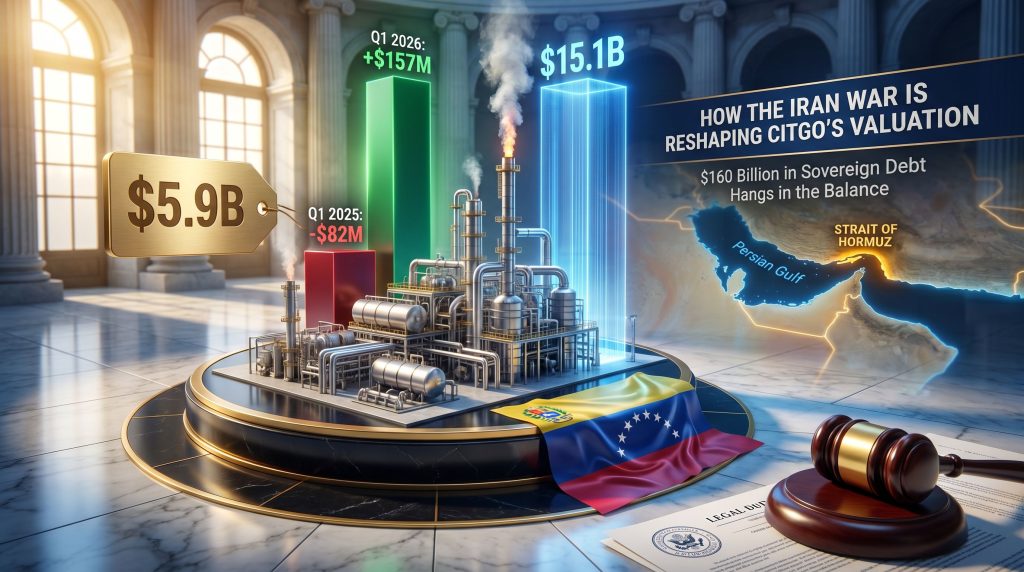
It is within this context that Venezuela's legal team filed a revised valuation analysis on 14 May 2026. Using a methodology that tracks stock price appreciation among comparable U.S. independent refiners since August 2025, the filing concludes that Citgo's current fair market value sits at approximately $15.1 billion. That figure is more than double the Amber Energy bid approved by the court.
The peer-comparison methodology is a standard tool in equity valuation. By benchmarking Citgo against publicly traded refining companies of similar operational profile and then adjusting for the wartime appreciation in those peers' market capitalisations, Venezuela's lawyers produced an estimate that they characterise as conservative. The implication is that a more aggressive application of the same framework would yield an even higher number.
This is not the first time Venezuela has challenged Citgo's auction valuation. During the court proceedings, lawyers for Citgo and PdV argued the refiner was worth $18.6 billion, an argument that U.S. District Judge Leonard Stark rejected as non-credible and unpersuasive in his November 2025 opinion. Judge Stark placed fair market value below $10 billion at that time. The critical shift in 2026 is that Venezuela is no longer relying on internal projections but on observed market data generated by an exogenous geopolitical event.
Citgo's own financial performance has reinforced the revised argument. The company recorded a net profit of $157 million in the first quarter of 2026, a turnaround from a loss of $82 million in the same period of 2025. That represents a swing of nearly $240 million within 12 months, driven by elevated fuel prices and tighter product supply flows. Under standard discounted cash flow and earnings-multiple valuation methodologies, a quarterly earnings reversal of that magnitude shifts implied enterprise value substantially.
| Valuation Reference | Estimated Value | Basis |
|---|---|---|
| Amber Energy winning bid | $5.9 billion | Delaware court auction, 2025 |
| PdV bondholder settlement (within bid) | $2.13 billion | Included within Amber offer |
| Judge Stark fair market value ruling | Below $10 billion | November 2025 court opinion |
| Citgo/PdV original legal claim | $18.6 billion | Rejected by court as non-credible |
| Venezuela's revised wartime estimate | $15.1 billion | May 2026 court filing, peer-refiner comparison |
The Competing Arguments: Closure Versus Reconsideration
Venezuela's Case for Halting the Sale
Venezuela's legal filing advances several interconnected arguments for suspending the sale process:
- The wartime appreciation of comparable U.S. independent refiner equities has rendered the original auction price economically obsolete relative to current market conditions.
- Proceeding with the $5.9 billion sale when conservative market-based estimates place Citgo's value at $15.1 billion would constitute an unjustifiable transfer of wealth away from Venezuelan creditors and citizens to a private hedge fund.
- The Citgo sale should be examined within the context of Venezuela's broader sovereign debt restructuring, which encompasses estimated combined obligations of up to $160 billion across PdV and government liabilities. A piecemeal asset sale that satisfies a subset of creditors at distressed valuations risks prejudicing the broader restructuring process.
Amber Energy's Position: Why the Bid Should Proceed
Amber Energy and the creditor groups aligned with the auction outcome have articulated a clear counter-position:
- Amber has committed to investing more than $11 billion to modernise and expand Citgo's operations, an investment programme that its public communications argue would place downward pressure on U.S. fuel prices at a time of elevated energy costs.
- Legal certainty matters as much as valuation. Prolonged uncertainty around ownership dampens Citgo's operational investment and workforce stability, potentially eroding the very value Venezuela seeks to protect.
- OFAC authorisation remains the final regulatory step before the sale closes. Amber's formal request to the U.S. Office of Foreign Assets Control underscores the company's commitment to completing the transaction within established legal parameters.
The Legal Threshold for Revisiting a Court-Approved Valuation
Perhaps the most technically complex dimension of the dispute involves the procedural question of whether new evidence and changed market conditions can reopen a valuation determination after a court has issued its opinion. Judge Stark's November 2025 ruling established a factual record tied to market conditions at a specific point in time. Venezuela's lawyers are now arguing that a materially different set of market facts, generated by an event no auction process could have anticipated, justifies revisiting that determination.
This is genuinely novel legal territory. Courts overseeing sovereign asset auctions rarely face circumstances where an exogenous geopolitical shock produces a doubling in the comparable valuation framework within months of a ruling. The outcome of Venezuela's challenge could establish precedent governing how future courts handle post-ruling valuation shifts in distressed sovereign asset cases. Consequently, the geopolitical risk landscape affecting resource-linked assets more broadly is being watched closely by market participants.
The Geopolitical Dimension: Sanctions Relief and Diplomatic Normalisation
Valuation is only one layer of the complexity surrounding this case. The removal of Nicolas Maduro from power on 3 January 2026 and the subsequent normalisation of U.S.-Venezuela diplomatic relations has introduced a set of variables that were entirely absent when the auction process was designed.
OFAC lifted most restrictions on financial dealings with Venezuela's central bank, government institutions, and financial sector in April 2026. That action materially altered the regulatory environment in which the Citgo sale is operating. It also raised questions about the continuing legal standing of the opposition-appointed board that has managed Citgo since 2019, given that the U.S. now formally recognises the government led by interim president Delcy Rodriguez. In addition, the broader implications of sanctions and oil trading patterns in 2025 offer useful parallels for understanding how swiftly regulatory environments can shift.
Venezuela's announcement of plans to restructure all sovereign and PdV debt, potentially reaching $160 billion, adds another layer of complexity. Creditors holding judgments against PdV are now watching closely to determine whether satisfying individual claims through a court-ordered asset sale remains viable, or whether a comprehensive restructuring framework will redefine the recovery landscape for all parties.
"The Citgo case is no longer simply a creditor enforcement proceeding. It has become a test case for how sovereign asset recovery intersects with geopolitical transition, sanctions unwinding, and active military conflict reshaping commodity markets simultaneously."
The next major ASX story will hit our subscribers first
What This Means for Sovereign Debt Investors and Distressed Asset Markets
The Citgo dispute illustrates a category of execution risk that sovereign debt recovery strategies must now account for explicitly. The five-stage framework through which court-ordered sovereign asset sales typically progress has proven vulnerable at its most advanced point:
- Creditor claims are established through litigation or arbitration.
- A court orders the sale of a sovereign-linked asset to satisfy those claims.
- An auction is conducted and a winning bid is selected.
- Post-auction, external conditions including sanctions relief, commodity price shocks, or geopolitical events alter the asset's intrinsic value.
- The sovereign entity challenges the sale on grounds of materially changed circumstances.
The Citgo case sits at steps four and five simultaneously, and its resolution will inform how courts and creditors price this risk in future transactions involving resource-rich but politically constrained sovereigns. However, understanding the full picture also requires considering the trade war market implications that have further complicated the global investment environment.
For investors, several practical lessons emerge:
- Geopolitical timing is a valuation variable, not merely a political footnote. Assets subject to court-ordered sale processes can see their implied value shift dramatically between the auction date and the closing date if exogenous shocks intervene.
- Sanctions regimes are not permanent backstops. The rapid unwinding of Venezuela-related sanctions following the political transition demonstrates how quickly the legal framework underpinning a creditor recovery strategy can shift.
- Sovereign debt restructuring proposals can reframe individual creditor enforcement rights. A comprehensive restructuring process involving $160 billion in obligations could alter the practical enforceability of the auction outcome, regardless of its court-approved status.
- Refinery economics are acutely sensitive to energy corridor disruptions. The Hormuz closure's impact on Citgo's quarterly earnings trajectory illustrates how single-corridor supply disruptions can generate valuation changes that outpace legal processes.
Key Figures at a Glance
| Metric | Value |
|---|---|
| Amber Energy winning bid | $5.9 billion |
| Venezuela's revised wartime valuation | $15.1 billion |
| Citgo Q1 2026 profit | $157 million |
| Citgo Q1 2025 result | -$82 million loss |
| Quarterly earnings swing | ~$240 million |
| Amber's pledged investment in Citgo | Over $11 billion |
| Venezuela total restructuring scope | Up to $160 billion |
| PdV bondholder settlement within bid | $2.13 billion |
Frequently Asked Questions
What is Citgo Petroleum and who owns it?
Citgo is a U.S.-based petroleum refining and distribution company operating three major refineries, lubricant production facilities, midstream pipeline assets, and retail infrastructure. It is formally owned by PdV, Venezuela's state oil company, though it has been managed since 2019 by a board appointed by the Venezuelan opposition and approved by the U.S. government.
Why is Citgo being auctioned?
The auction is being conducted under the supervision of the U.S. District Court for the District of Delaware to satisfy debt defaults and expropriation-related judgments owed by PdV to international creditors. The process enforces legal claims against Venezuelan state-linked assets held within U.S. jurisdiction.
Why are Venezuela's lawyers saying Citgo value is up on war?
Venezuela's May 2026 legal filing argues that the Iran conflict and the resulting disruption to the Strait of Hormuz have dramatically elevated refining margins and refiner equity valuations across the U.S. independent sector. Using peer-refiner stock appreciation data since August 2025, their conservative estimate places Citgo's current value at $15.1 billion, more than double the approved $5.9 billion bid. Venezuela decried the forced sale as far back as December 2025, underscoring how longstanding these objections have been.
What is OFAC's role in this process?
The U.S. Office of Foreign Assets Control must grant final authorisation before the Citgo sale can be legally completed. Given the recent lifting of most Venezuela-related sanctions and the normalisation of diplomatic relations, the status and timing of that authorisation has become a central variable in the outcome of the case.
How does Venezuela's debt restructuring plan affect Citgo creditors?
Venezuela's announced intention to restructure combined sovereign and PdV obligations of up to $160 billion could create a competing legal framework for creditor recovery. If Citgo is incorporated into a broader restructuring process, it may alter the enforceability and priority of claims currently being satisfied through the Delaware court auction.
Disclaimer: This article is intended for informational purposes only and does not constitute financial or legal advice. All financial figures, court dates, and market data referenced are drawn from publicly available sources including Argus Media reporting. Readers should conduct independent due diligence before making any investment or legal decisions. Forward-looking statements and valuation estimates discussed in this article are subject to material uncertainty and do not represent confirmed outcomes.
Want to Stay Ahead of the Next Major Resource Discovery Before the Market Reacts?
The Citgo case demonstrates precisely how geopolitical shocks can reshape commodity valuations overnight — and Discovery Alert's proprietary Discovery IQ model is built to ensure subscribers receive real-time alerts on significant ASX mineral discoveries the moment they are announced, turning complex resource data into actionable opportunities. Explore Discovery Alert's discoveries page to understand how historic mineral discoveries have generated substantial returns, and begin your 14-day free trial today to position yourself ahead of the broader market.