
June 13, 2026
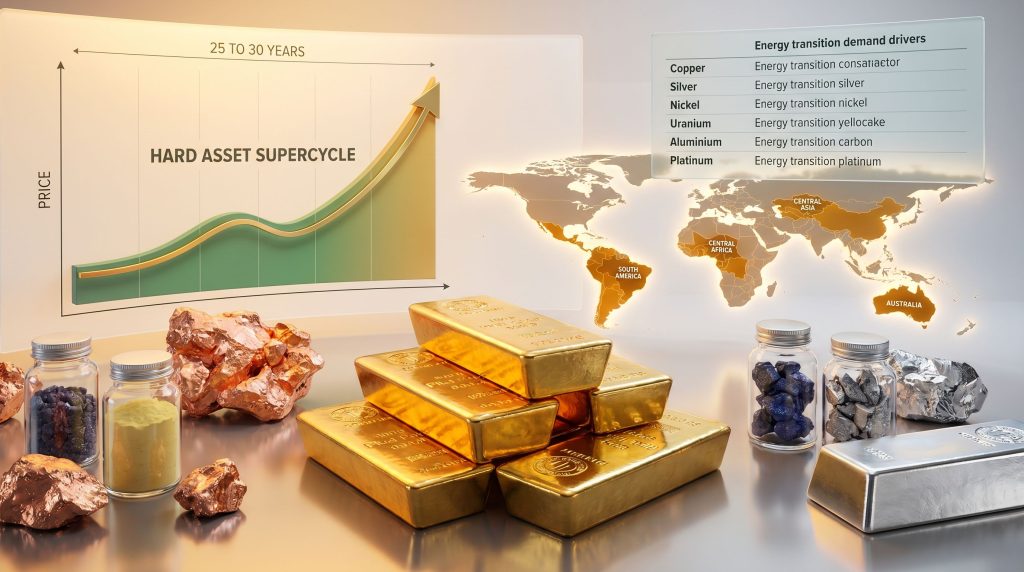
The Physical Economy Is Being Repriced — And Most Investors Are Still Looking Away
There is a particular pattern that repeats itself across financial history. The most consequential macro shifts tend to unfold quietly at first, dismissed as temporary noise by the majority of market participants, until the structural reality becomes undeniable and the window for early positioning has already closed. The hard asset super cycle unfolding right now carries all the hallmarks of that pattern, and the convergence of forces driving it is unlike anything seen in the post-Cold War era.
Understanding why requires stepping back from the headline-driven news cycle and examining the architecture beneath it — the deep structural forces that do not resolve in a quarter or two, but rather define the investment landscape for a generation.
When big ASX news breaks, our subscribers know first
The Foundational Regime Shift Driving the Hard Asset Super Cycle
For approximately three decades following the end of the Cold War, the global economic order was built around a single organising principle: efficiency. Production migrated to wherever costs were lowest. Supply chains were stretched thin across borders in pursuit of margin optimisation. Capital flowed freely, inventories were kept lean, and the assumption that goods, energy, and raw materials would move without political interference was baked into virtually every pricing model in existence.
That architecture is now being systematically dismantled.
The replacement logic is not efficiency — it is security. Governments are reshoring industrial capacity, competing aggressively for critical mineral access, expanding defence infrastructure, and paying significant premiums for supply chain resilience over supply chain speed. The shift from a unipolar, efficiency-driven global economy to a multipolar, security-first one is the single most important structural development underpinning the hard asset super cycle thesis.
In a multipolar world, commodities stop functioning primarily as cyclical economic inputs. They begin functioning as instruments of national power. When supply becomes politicised, when export restrictions become a routine policy tool, and when strategic stockpiling replaces just-in-time inventory management, the pricing logic for hard assets changes fundamentally.
The critical insight here is that supply does not need to disappear for prices to move dramatically higher. It only needs to become less secure, less predictable, or more politically controlled. That is precisely the environment now taking shape.
What Defines a Commodity Supercycle — And Where We Are Now
The term supercycle is frequently misused in financial commentary, conflated with ordinary cyclical commodity rallies that last one to three years before normalising. A genuine commodity supercycle is something categorically different: a structural, multi-decade period of above-trend prices driven by fundamental changes in the global economic order that sustain supply-demand imbalances for 15 to 30 years.
Research from PGIM highlights that commodity supercycles are characterised by demand surges that structurally outpace supply capacity for extended periods, with the inelasticity of supply serving as a defining feature. New mines require 10 to 20 years from discovery to first production. New oil fields demand years of permitting, drilling, and infrastructure development. Even when capital is available and willing, the physical world cannot simply be redirected overnight.
Market analysis from TD suggests the current structural commodity bull phase may have begun as early as 2020, placing today's environment in the early-to-middle stages of a new supercycle rather than anywhere near its conclusion.
The comparison table below illustrates why the distinction matters for investors and traders evaluating entry timing:
| Feature | Cyclical Commodity Rally | Structural Supercycle |
|---|---|---|
| Duration | Months to 2-3 years | 15-30 years |
| Primary Driver | Demand surge or supply shock | Regime-level structural change |
| Supply Response | Relatively rapid | Slow, constrained by capital cycles |
| Inflation Linkage | Moderate | High, feeds broader inflation dynamics |
| Geopolitical Component | Incidental | Central and persistent |
| Asset Class Behaviour | Sector rotation trade | Macro regime trade |
Five Structural Drivers Converging Simultaneously
What makes the current hard asset super cycle analytically distinct from simple cyclical commodity enthusiasm is the simultaneous convergence of multiple independent structural drivers. Each is significant in isolation. Together, they create a macro environment without a direct post-war precedent.
Geopolitical Fragmentation and the Weaponisation of Supply
The foundational assumption that trade flows would remain politically neutral has collapsed. Export restrictions, strategic stockpiling, resource nationalism, and sanctions regimes are now standard features of the global commodity landscape. Nations are hoarding resources, restricting exports, subsidising domestic production, and rebuilding industrial capacity with deliberate intent.
The practical consequence is that access to oil, copper, uranium, rare earth metals, and agricultural inputs is increasingly contingent on political relationships rather than market pricing. Furthermore, the geopolitical mining landscape continues to shift, making supply access more complex and costly for importing nations. When access to a resource becomes uncertain, markets begin pricing in a scarcity premium that traditional supply-demand models systematically underestimate.
Critically, what is now emerging is not analogous to a temporary COVID-style disruption. The scarcity being priced into hard assets is increasingly a strategic policy choice by sovereign actors, not an accidental byproduct of crisis. That is a qualitatively different and more durable market force.
Decades of Supply Underinvestment Creating Structural Deficits
The commodity bear market of the 2010s triggered a prolonged withdrawal of capital from mining, energy exploration, and industrial resource development. The ESG-driven capital discipline of the 2015–2022 period further compressed upstream investment, particularly in oil and gas. The result is a global resource supply base that is structurally under-equipped to respond to the demand surge now materialising.
PGIM's research confirms that supply inelasticity is a defining feature of supercycle dynamics: even when prices rise sharply, supply cannot respond at equivalent speed. This creates the sustained price appreciation environment that distinguishes a supercycle from a short-term rally.
Energy Transition Metals Demand at an Unprecedented Scale
The global shift toward electrification and low-carbon infrastructure is not reducing commodity intensity — it is redirecting and amplifying it. The International Energy Agency projects that a net-zero pathway would require six times more mineral inputs by 2040 than current supply chains can realistically provide. In addition, critical minerals demand is accelerating as nations compete to secure the materials underpinning their clean energy transitions.
The table below maps the primary energy transition demand drivers across key hard assets:
| Hard Asset | Primary Energy Transition Demand Driver |
|---|---|
| Copper | Grid expansion, EV motors, renewable energy infrastructure |
| Silver | Solar photovoltaic panels, electronics, industrial applications |
| Nickel | EV battery cathodes, stainless steel production |
| Uranium | Nuclear baseload power revival |
| Aluminium | Lightweight transport, construction, packaging |
| Platinum | Hydrogen fuel cells, catalytic converters |
Major resource companies including BHP and Rio Tinto have both publicly identified copper as a strategic capital allocation priority, reflecting institutional recognition of what the supply-demand mathematics actually indicate.
Central Bank Gold Accumulation and Reserve Diversification
Central banks globally have been consistent net buyers of gold for consecutive years, marking a structural shift in how sovereign institutions manage reserve assets. The diversification away from US dollar-denominated reserves — particularly among emerging market central banks — has elevated gold's role as a geopolitical hedge and a store of sovereign wealth. Central bank gold reserves have grown substantially as institutions seek neutral assets outside traditional financial systems.
This institutional demand layer is largely independent of retail sentiment or speculative activity. It provides a persistent structural price floor that operates on a different logic to conventional commodity demand cycles.
A Structurally Higher Inflation Regime
The macroeconomic conditions that suppressed inflation for three decades — globalisation, cheap energy, and abundant labour arbitrage — are now reversing in tandem. Fragmented trade routes, military rearmament spending, domestic industrial subsidies, and energy insecurity all exert persistent upward pressure on input costs across the entire economy.
PGIM's historical analysis confirms that commodities have outperformed traditional financial assets in higher-inflation environments and provided stronger portfolio diversification than bonds during such periods. Hard assets carry intrinsic value that cannot be replicated by financial instruments when confidence in paper-based monetary systems comes under pressure.
The Commodity Contagion Effect — Why Isolated Analysis Misses the Bigger Picture
One of the most consequential analytical errors in evaluating the hard asset super cycle is treating individual commodity markets as separate stories. They are not. They are deeply interconnected through production costs, logistics networks, and substitution dynamics.
An energy price shock, for example, does not remain contained within the energy sector. The contagion mechanism works as follows:
- Higher diesel costs elevate freight and transport expenses across all physical goods categories.
- Rising natural gas prices increase fertiliser production costs, placing upward pressure on agricultural commodity prices.
- Energy shortages restrict petrochemical output, affecting plastics and industrial materials throughout manufacturing supply chains.
- Metal supply disruptions create bottlenecks in construction, defence manufacturing, and electrification infrastructure simultaneously.
The systemic implication is that a hard asset super cycle is not a collection of isolated commodity stories. It represents a structural repricing of the entire physical economy, where individual commodity shocks cascade across interconnected systems far faster than consensus pricing models anticipate.
This interconnection is why analysts who evaluate oil, copper, and agricultural inputs as separate thematic trades may systematically underestimate the cumulative pricing pressure building across the commodity complex. Indeed, a multipolar world could ignite the largest commodity repricing in modern history, according to several macro analysts tracking these dynamics.
Which Hard Assets Are Most Structurally Positioned
Gold: The Geopolitical Reserve Asset
Gold's structural bull case rests on three converging pillars: central bank reserve diversification, geopolitical risk hedging, and the erosion of confidence in fiat currency systems under persistent fiscal expansion. Unlike industrial commodities, gold's demand is not primarily cyclical. In a world of expanding sovereign debt, currency debasement concerns, and multipolar reserve competition, gold's role as a neutral store of value strengthens rather than weakens.
Copper: At the Centre of Every Major Demand Theme
Copper carries simultaneous exposure to the three largest structural demand drivers of the current decade: electrification, urbanisation in emerging markets, and defence and industrial infrastructure expansion. The copper supply crunch is already materialising, with major producing regions facing declining ore grades, permitting delays, and significant geopolitical risk concentrated in Chile, Peru, and the Democratic Republic of Congo.
Uranium: The Nuclear Renaissance Commodity
After decades of underinvestment following Fukushima, uranium is experiencing a structural demand revival. Multiple governments including the United States, France, Japan, and the United Kingdom have reversed previous nuclear phase-out positions and committed to new reactor construction programs. Considering copper and uranium outlook together reveals two of the most compelling structural supply-demand stories in the current commodity landscape. Uranium supply is geographically concentrated and politically sensitive, with Kazakhstan, Canada, and Australia accounting for the majority of global production.
Agricultural Commodities: Where Energy, Climate, and Food Security Intersect
Agricultural commodity prices are structurally linked to energy costs through fertiliser production, transport, and irrigation systems. Export restrictions on wheat, rice, and fertiliser inputs by major producing nations have demonstrated that food security is now a geopolitical instrument. The fertiliser supply chain, heavily dependent on natural gas for nitrogen production and on geopolitically sensitive potash and phosphate sources, represents a critical vulnerability in global food systems that markets have not yet fully priced.
The next major ASX story will hit our subscribers first
Risks and Counterarguments — What Could Derail the Thesis
The hard asset super cycle thesis is well-supported by structural evidence, but it is not without material risks. Rigorous analysis requires acknowledging them clearly.
| Dimension | Bull Case | Bear Case |
|---|---|---|
| Geopolitics | Persistent fragmentation drives scarcity premiums | Diplomatic resolution reduces supply risk |
| Supply | Chronic underinvestment creates structural deficits | Higher prices eventually incentivise new supply |
| Demand | Energy transition plus multipolarity drives structural demand | Global recession reduces cyclical demand |
| Inflation | Sticky inflation supports hard asset valuations | Disinflation or deflation reduces commodity appeal |
| Central Banks | Gold buying continues as reserve diversification accelerates | Dollar stabilisation reduces reserve diversification urgency |
| Policy | Resource nationalism and export restrictions persist | Trade liberalisation reduces supply fragmentation |
Key risk considerations include:
- Demand destruction from global growth slowdown: Simultaneous recession across major economies can compress cyclical commodity demand sharply, even within a structural bull market framework.
- Supply eventually responds: Higher prices incentivise new capital deployment, and while supply responses are slow, they are not indefinite. New mines, wells, and processing capacity will eventually come online.
- Selective rather than universal participation: Some analysts argue the supercycle may be concentrated in specific segments — critical minerals and energy transition metals — rather than the entire commodity complex.
- Policy and technology intervention: Government efficiency mandates, technology substitution, and demand-side policy interventions can alter trajectories for individual commodity markets even within a broader structural bull environment.
How Investors Have Historically Positioned During Commodity Supercycles
One of the most consistent findings from historical supercycle analysis is that the most asymmetric returns concentrate in the first third of the cycle, before institutional capital fully rotates into the asset class. The 1970s oil and gold supercycle, the 2000s China-driven commodity boom, and the post-COVID critical minerals repricing all share this characteristic: early movers captured disproportionate returns relative to late entrants who waited for consensus confirmation.
Practical positioning frameworks that have historically served investors during supercycle environments include:
- Direct commodity exposure through physical gold, silver, and commodity ETFs, providing direct price appreciation participation without operational business risk.
- Equity exposure through major resource producers such as BHP, Rio Tinto, and S32 on the ASX, offering leveraged commodity price exposure combined with dividend income and balance sheet strength.
- Diversification across the commodity complex — given the interconnected nature of commodity markets in a supercycle, diversification across energy, metals, and agricultural inputs can reduce single-asset volatility while maintaining structural regime exposure.
- Inflation-linked fixed income as a complement through instruments such as Treasury Inflation-Protected Securities (TIPS), which provide fixed-income returns that adjust for inflationary conditions.
The timing problem in supercycle investing is well-documented. Commodity supercycles do not announce themselves with obvious entry signals. By the time consensus fully recognises the structural shift, the most asymmetric early-stage returns have typically already been captured.
Frequently Asked Questions
What exactly is a hard asset?
Hard assets are tangible, physical resources that hold intrinsic value independent of any issuing authority or counterparty obligation. They include commodities such as gold, silver, copper, oil, natural gas, uranium, agricultural products, and critical minerals, as well as physical real estate and infrastructure. Unlike financial assets — which derive value from contractual claims — hard assets derive value from their physical utility, scarcity, and cost of production.
How does a supercycle differ from a regular commodity bull market?
A regular commodity bull market is typically a cyclical phenomenon lasting one to three years, driven by a demand surge or supply disruption that eventually normalises. A supercycle is a structural, multi-decade phenomenon driven by fundamental changes in the global economic order that sustain above-trend commodity prices for 15 to 30 years. The current cycle is driven by regime-level changes — geopolitical fragmentation, energy transition demand, and a structurally higher inflation environment — that are not temporary in nature.
What is the strongest evidence that a new hard asset super cycle has begun?
The convergence of multiple independent structural drivers — chronic supply underinvestment, energy transition metals demand, central bank gold accumulation, geopolitical fragmentation, and a structurally higher inflation regime — provides a multi-factor case qualitatively different from a simple cyclical rally. Research from PGIM and TD market analysis both identify structural evidence consistent with a new supercycle phase beginning around 2020.
What are the biggest risks to the thesis?
The primary risks include a significant global growth slowdown reducing cyclical demand, a faster-than-expected supply response capping price appreciation, selective rather than universal supercycle dynamics across the commodity complex, and policy interventions such as windfall taxes, export subsidies, or demand-side efficiency mandates that alter commodity market fundamentals.
Key Takeaways
- The hard asset super cycle is a structural, multi-decade phenomenon anchored in regime-level changes to how the world produces, secures, and values tangible resources.
- Five converging structural drivers are simultaneously active: geopolitical fragmentation, chronic supply underinvestment, energy transition metals demand, central bank gold accumulation, and a structurally higher inflation regime.
- The transition from an efficiency-first globalised world to a security-first multipolar world is the foundational macro shift underpinning the hard asset thesis.
- Commodity markets are deeply interconnected — individual supply shocks cascade across the physical economy in ways that traditional isolated sector analysis consistently underestimates.
- Not all commodities will participate equally; rigorous, asset-specific analysis is required to distinguish structural winners from cyclical participants.
- Historical supercycle evidence consistently shows that early-stage positioning before institutional consensus recognises the regime shift captures the most asymmetric returns.
- The risks are real: global recession, new supply responses, and policy intervention can all disrupt individual commodity market trajectories within a broader structural bull environment.
This article is intended for informational and educational purposes only and does not constitute financial advice. Commodity markets involve significant risk, and past performance or historical supercycle patterns are not indicative of future results. Readers should conduct their own independent research and consult a qualified financial adviser before making any investment decisions. Forecasts, projections, and structural analysis referenced herein represent analytical frameworks and not guaranteed outcomes.
Want To Position Yourself Ahead Of The Next Major ASX Mineral Discovery?
Discovery Alert's proprietary Discovery IQ model delivers real-time alerts the moment significant mineral discoveries hit the ASX, transforming complex geological data into clear, actionable insights across 30+ commodities — precisely the kind of edge that matters most when structural commodity supercycles reward early movers over late ones. Explore historic discovery returns on Discovery Alert's dedicated discoveries page to understand the asymmetric potential these moments can generate, then begin a 14-day free trial at discoveryalert.com.au to secure your position ahead of the broader market.