May 19, 2026
The Regulatory Architecture Problem at the Heart of North American Critical Minerals Policy
Large-scale mining investment operates on a fundamental tension between geological time and political time. Copper deposits take decades to develop from discovery to production. Rare earth processing infrastructure requires sustained capital over investment horizons that span multiple election cycles. Lithium brine operations in particular demand patient capital with payback periods that can stretch 20 to 30 years depending on project scale and commodity price assumptions. Political systems, by contrast, tend to operate in four-to-six-year cycles, producing legislative reforms that often prioritise sovereignty signalling over investment-grade certainty.
This mismatch sits at the core of the debate surrounding Mexico mining legislation and its compatibility with the USMCA framework. As the 2026 USMCA review cycle intensifies pressure on North American trade relationships, a critical question has emerged: can Mexico embed meaningful critical minerals commitments into a renegotiated trade architecture when its own domestic legal framework remains structurally misaligned with the investment conditions those commitments would require?
The answer, examined through a rigorous regulatory sequencing lens, is no — at least not yet.
When big ASX news breaks, our subscribers know first
What Mexico's 2023 Mining Reform Actually Changed
Mexico's 2023 overhaul of its mining legislation introduced changes that were sweeping in ambition and consequential in practice. The reform touched nearly every dimension of how mining activity is permitted, governed, and controlled within Mexican territory.
Concession Term Compression and Its Capital Markets Signal
Prior to the 2023 reform, Mexican mining concessions could be granted for initial periods of up to 50 years with renewal options, providing the long-dated legal certainty that large capital projects require. The reformed framework shortened these terms considerably, creating a structural mismatch with the financing requirements of modern mining projects. Underground operations and rare earth developments, which carry the highest capital intensity of any mineral extraction category, are particularly exposed. Lenders and equity sponsors cannot underwrite projects where the concession term expires before the capital recovery period closes.
State Control Over Lithium: Governance Architecture, Not Just Policy
The nationalisation of lithium under Mexico's reformed mining law was not a regulatory adjustment. It was a constitutional repositioning. The legislation established lithium as a strategic resource under exclusive state control, removing it from the concession system entirely and placing oversight under a newly created state body. This mirrors, in some respects, approaches taken in Bolivia, where nationalisation of lithium has effectively suppressed foreign investment flows despite the country holding some of the world's largest lithium deposits.
Chile's lithium strategy offers an instructive contrast. Rather than exclusive state extraction, Chile has pursued a public-private partnership structure for lithium governance that preserves sovereign oversight while allowing private capital participation. The Atacama lithium agreements, which brought SQM and Codelco into a structured collaboration, demonstrate that sovereign resource control and investable project frameworks are not mutually exclusive, provided the governance architecture is designed deliberately. Mexico's current model has not yet reached that design maturity.
The Concession Moratorium: What It Signals Beyond Its Scope
The moratorium on new mining concessions introduced alongside the 2023 reform affects not only the projects directly subject to its terms. Its more significant impact operates through investor psychology and country-risk pricing.
Policy Insight: When a sovereign state imposes a concession moratorium, even one defined as temporary, global capital allocators interpret it as a signal that the regulatory environment is undergoing fundamental recalibration. This elevates country-risk premiums across the entire mining sector, including for existing concession holders who face no direct legal restriction. The suppression of exploration CAPEX and drilling activity that follows is not a secondary effect. It is the primary economic cost.
The moratorium's geographic and mineral-type dimensions matter for understanding its real scope. New entrants seeking exposure to copper, silver, cobalt, and rare earth deposits in Mexico face a closed door at the concession grant stage, regardless of the geological merit of their targets. Existing holders face a different but related problem: the uncertainty surrounding the moratorium's eventual lifting, and the terms under which new concessions will be granted, makes portfolio expansion planning unreliable. Furthermore, mining permitting challenges of this nature tend to compound over time, discouraging even well-capitalised explorers from committing resources to the jurisdiction.
USMCA Review Mechanics and the Critical Minerals Dimension
How the 2026 Review Cycle Functions
The USMCA contains a formal joint review mechanism under Article 34.7, which requires the three signatory governments to conduct a comprehensive evaluation of the agreement's operation by July 2026. This mechanism does not automatically trigger renegotiation, but it creates a structured diplomatic space in which substantive modifications can be proposed and negotiated. The review's scope extends to investment chapter protections, energy sector commitments, labour and environmental standards, and, increasingly, critical minerals supply chain architecture.
Critical minerals have moved from a peripheral technical topic to a central strategic priority in the review cycle for reasons directly connected to the global energy transition. The U.S. government's focus on reducing dependence on Chinese mineral processing, combined with the nearshoring investment wave relocating manufacturing capacity to Mexico, has transformed the review cycle into a de facto industrial policy negotiation. In this context, the broader relationship between critical minerals and energy security has become impossible to separate from the bilateral trade agenda.
The February 2026 Action Plan: Promise and Structural Limits
The U.S.-Mexico Critical Minerals Action Plan, announced in February 2026, established a bilateral framework with several operational components. These include a process for identifying minerals of mutual strategic interest, exploratory work on border-adjusted price floor mechanisms, and a stated pathway toward a binding plurilateral agreement structure.
| Action Plan Component | Current Status | Key Limitation |
|---|---|---|
| Minerals of mutual interest identification | Active | No binding procurement obligation |
| Border-adjusted price floor exploration | Under study | Requires domestic pricing law alignment |
| Plurilateral binding agreement pathway | Proposed | Dependent on domestic legislative reform |
| Private sector investment facilitation | Aspirational | Blocked by concession moratorium conditions |
The action plan's strategic value is real, but its implementation ceiling is defined entirely by Mexico's domestic legal architecture. A bilateral framework that commits to facilitating private investment in Mexican lithium, copper, or rare earth projects cannot be operationalised while the concession moratorium remains in effect and lithium sits outside the concession system altogether.
The Core Regulatory Conflicts Between Mexico's Mining Laws and USMCA Obligations
Investment Chapter Exposure Under USMCA Chapter 14
USMCA Chapter 14 establishes investment protections that include national treatment obligations, minimum standards of treatment, and constraints on regulatory expropriation. Mexico's mining reform creates friction with each of these commitments in distinct ways.
The reduction of concession terms, when applied retroactively to the investment expectations that existing concession holders held at the time of their original grants, raises regulatory expropriation questions under international trade law. The distinction between legitimate sovereign resource governance and compensable regulatory expropriation is not always clean, and the legal boundary shifts depending on the degree of reliance that investors placed on the prior regulatory framework. Consequently, Mexico's strategic pivot toward domestic mineral processing adds yet another layer of complexity to these already contested legal questions.
Environmental and Community Consent: Dual-Use Regulation
Mexico's reformed mining law strengthens free, prior, and informed consent (FPIC) requirements for communities in areas subject to mining activity. The policy rationale is legitimate and in many respects aligns with international best practice under frameworks including ILO Convention 169. However, the implementation architecture matters enormously for investment outcomes.
When FPIC processes lack defined timelines, standardised consultation protocols, and clear criteria for approval or rejection, they function less as rights protections and more as indefinite project holds. The regulatory uncertainty this creates is particularly damaging for exploration-stage projects, where capital is most speculative and investor tolerance for process ambiguity is lowest.
Regulatory Warning: Concession term compression is particularly damaging for underground mining operations and rare earth projects, where capital intensity is highest and payback periods are longest. Investors cannot underwrite projects where the legal right to operate expires before capital is recovered.
What a Coherent Reform Sequence Would Require
A Six-Step Regulatory Alignment Pathway
For Mexico's domestic legal framework to support the USMCA critical minerals commitments being discussed in the 2026 review cycle, the following sequencing is required:
- Clarify the concession moratorium's timeline and exit conditions by publishing a formal schedule for the resumption of new concession grants, with defined eligibility criteria and mineral category parameters.
- Construct a lithium governance framework that accommodates private capital within the state-control model, using Chile's structured public-private partnership architecture as a design reference.
- Standardise FPIC and environmental approval timelines by establishing regulatory windows that are predictable, administration-independent, and enforceable.
- Introduce tiered concession terms calibrated to project type, capital intensity, and mineral category, ensuring that long-cycle projects receive concession terms that match their financing requirements.
- Publish a critical minerals investment registry identifying priority projects eligible for structured regulatory processing under the bilateral action plan framework.
- Use the 2026 USMCA review cycle as a domestic reform accountability mechanism, embedding milestone commitments into the bilateral process rather than treating the review as an external renegotiation event.
Three Scenarios for the USMCA Modification Process
| Scenario | Domestic Reform Status | USMCA Outcome | Investment Impact |
|---|---|---|---|
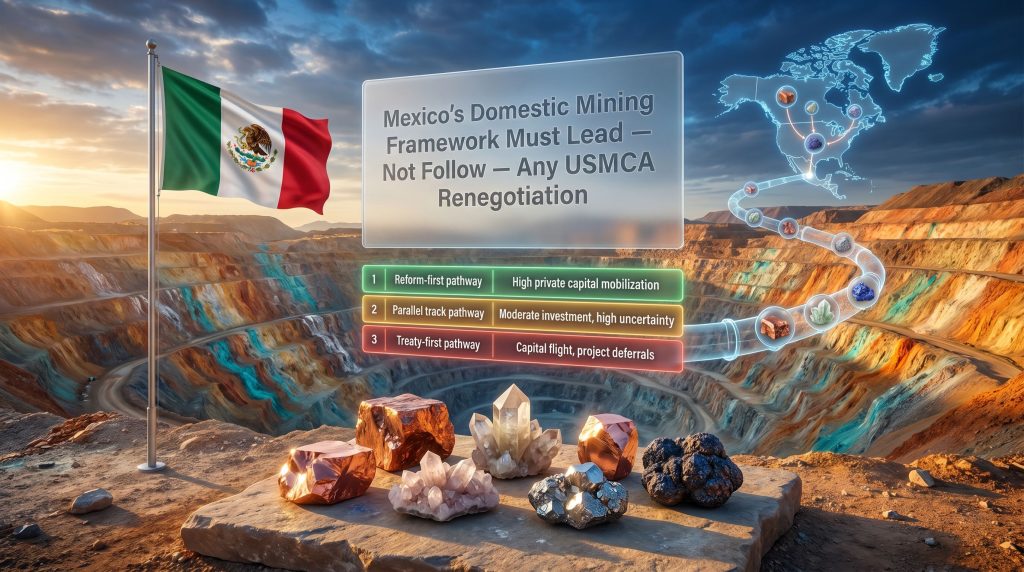
| Reform-first pathway | Completed before treaty talks | Durable, enforceable framework | High private capital mobilisation |
| Parallel track pathway | Reform and treaty talks simultaneous | Fragile, implementation-dependent | Moderate investment, high uncertainty |
| Treaty-first pathway | No domestic reform | Unenforceable obligations, dispute risk | Capital flight, project deferrals |
The treaty-first scenario is not theoretical. Bolivia's lithium nationalisation without an accompanying investable governance framework produced precisely this outcome: formal state control over enormous lithium reserves accompanied by near-zero foreign investment and negligible production growth across more than a decade.
Mexico's Geological Endowment and the Cost of Regulatory Inaction
Mexico's mineral wealth is not marginal. The country is among the world's top producers of silver, a significant copper producer, and holds cobalt, rare earth, and lithium resources that are strategically relevant at the North American supply chain scale. Its geographic proximity to U.S. manufacturing hubs and its existing industrial base, built through decades of maquiladora and nearshoring investment, creates logistics advantages that no other Latin American mining jurisdiction can replicate.
The nearshoring investment wave accelerating since 2022 has a direct mineral consequence that is underappreciated in mainstream policy discussions. As EV assembly, battery manufacturing, and advanced electronics production relocates from Asia to northern Mexico, the demand for domestically proximate mineral inputs intensifies. In addition, the role of the critical raw materials transition in reshaping global supply chains means that Mexico's regulatory posture carries consequences well beyond its own borders.
This supply chain logic elevates the strategic cost of Mexico's current regulatory posture. Every year that the concession moratorium suppresses exploration activity represents a year of lost geological discovery that cannot be recovered on a compressed timeline. Mineral exploration, particularly for complex deposits like rare earth systems or lithium brines, requires sustained multi-year drilling campaigns to convert geological potential into resource estimates that can support investment decisions.
Technologies like direct lithium extraction could, however, accelerate the value realisation timeline for Mexico's lithium resources considerably — provided the governance framework is in place to attract the capital and expertise required to deploy them.
The next major ASX story will hit our subscribers first
Frequently Asked Questions: Mexico Mining Legislation and the USMCA
What is the main conflict between Mexico's mining laws and the USMCA?
Mexico's reformed Mexico mining legislation, including state control over lithium, shortened concession terms, and strengthened environmental requirements, creates structural tension with USMCA investment chapter protections and North American critical minerals cooperation goals. The central issue is that domestic legal architecture must be aligned before treaty-level obligations can be made enforceable.
Why does Mexico control lithium under its mining law?
Mexico's 2023 mining reform established lithium as a strategic resource under exclusive state control, reflecting a sovereign resource governance policy. This model limits direct foreign or private investment in lithium extraction and processing, creating a structural barrier to participation in North American critical minerals supply chains.
What is the U.S.-Mexico Critical Minerals Action Plan?
Announced in February 2026, the bilateral action plan establishes a framework for identifying minerals of mutual strategic interest, exploring price floor mechanisms, and developing pathways toward a binding plurilateral agreement. Implementation depends on Mexico resolving domestic regulatory barriers that currently constrain private investment in its mining sector. According to analysis from the Washington International Trade Association, the plan's success hinges on whether domestic reform can keep pace with the diplomatic commitments being made at the treaty level.
What minerals are most strategically important in the Mexico-USMCA context?
Copper, lithium, cobalt, silver, and rare earth elements represent the highest-priority minerals in the context of North American clean energy supply chain development and USMCA critical minerals cooperation discussions.
Three Conditions for a Functional Mexico-USMCA Mining Framework
The 2026 review cycle represents a bounded opportunity. Treaty review processes do not remain open indefinitely, and the political conditions that make ambitious critical minerals commitments negotiable will not persist through another electoral cycle in any of the three USMCA member states. Mexico's window to align its domestic framework with the treaty ambitions being discussed is narrow.
Three conditions define whether a functional Mexico mining legislation-USMCA critical minerals framework is achievable:
- Regulatory clarity expressed through a stable, predictable concession and approvals regime that investors can underwrite across 20-to-40-year project horizons.
- Sovereign-compatible investment structures that allow private capital participation within Mexico's state-control model for strategic minerals, following the design logic demonstrated in Chile's lithium governance evolution.
- Treaty-domestic alignment ensuring that USMCA critical minerals commitments reflect only what Mexico's domestic legal framework can actually deliver, rather than aspirational positions that cannot survive contact with implementation.
Mexico's geological endowment is not in question. Its regulatory architecture is. The distinction between these two facts is where North American critical minerals policy either advances or stalls.
This article is intended for informational purposes only and does not constitute investment advice. Statements regarding regulatory outcomes, treaty negotiations, and investment scenarios involve inherent uncertainty and should not be relied upon as predictions of future events.
Want To Stay Ahead of Significant ASX Mineral Discoveries in Real Time?
Discovery Alert's proprietary Discovery IQ model instantly translates complex mineral data into actionable insights, delivering real-time alerts on significant ASX discoveries across copper, lithium, rare earths, and beyond — ensuring subscribers are positioned ahead of the broader market. Explore how historic mineral discoveries have generated substantial returns and begin your 14-day free trial today to secure a genuine market-leading edge.