
May 19, 2026
The Metric That Misleads: Why Nickel's Cost Story Begins After the Mill
Most analytical frameworks in resource investing are built around a single intuitive principle: the higher the grade of ore in the ground, the more economic the project. That principle holds reasonably well across gold, copper, and silver, where the cost of converting ore into a saleable product represents a modest fraction of the metal's market value. The same logic applied to nickel, however, introduces a structural blind spot that can lead investors to misread project economics entirely.
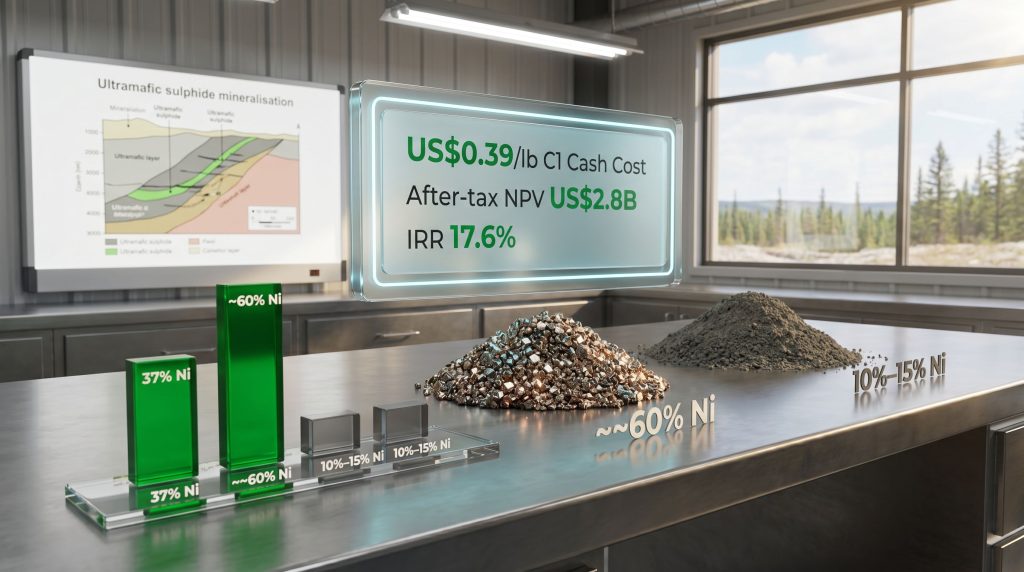
Canada Nickel's Crawford project, located in Ontario's Timmins region, sits at the centre of this analytical gap. With a head grade of 0.22% nickel, the project initially appears unremarkable under conventional screening. Yet its Front-End Engineering and Design (FEED) results, published in March 2025, produced an after-tax NPV at an 8% discount rate of US$2.8 billion and a life-of-mine average net C1 cash cost of US$0.39 per pound — a first-quartile cost outcome that the head grade figure alone would not predict. Understanding why requires examining a variable that rarely appears in introductory mining analysis: Canada Nickel Crawford concentrate grade.
When big ASX news breaks, our subscribers know first
Why Concentrate Grade Is the Defining Variable in Nickel Economics
The Structural Cost Penalty Unique to Nickel
In gold and copper, the concentrate produced at the mill commands downstream processing costs that amount to a small percentage of spot metal value. A copper concentrate typically grades between 25% and 30% copper, meaning refiners receive a dense, high-value intermediate product. Downstream penalties are real but proportionally manageable.
Nickel market fundamentals operate under a fundamentally different cost structure. Conventional nickel concentrates grade between 10% and 15% nickel, a figure that is dramatically lower than copper equivalents on a relative basis. Consequently, the transport and refining penalty structure consumes 15% to 20% of the prevailing nickel price for standard-grade concentrates. This penalty has no meaningful equivalent in the commodities where the low-grade evaluative framework originated.
In nickel, ore grade determines how much rock must be moved through the processing circuit. Concentrate grade determines how much of the recovered metal value the producer actually retains after the downstream chain has taken its share.
This distinction is not academic. Two nickel projects with identical head grades but different concentrate grades carry fundamentally different cost structures from the point of sale forward. Furthermore, applying a gold or copper analytical lens to nickel effectively ignores the portion of the value chain where a significant share of producer economics is determined.
Understanding ore grade vs permitting hurdles is, in fact, only the beginning of a complete project analysis. Similarly, cut-off grade economics play a role in defining what material is economically viable to process — but even this measure stops short of capturing the full downstream cost picture unique to nickel.
How Ultramafic Sulphide Mineralisation Changes the Output Equation
Crawford's geological classification as an ultramafic sulphide deposit is the variable that breaks the conventional nickel analysis. This mineralisation type responds differently through a standard processing circuit compared with conventional nickel ore bodies. The elevated concentrate grade output is not the product of proprietary metallurgical techniques or processing innovations that could be replicated or eroded over time. It is a function of the deposit's inherent geology.
This distinction carries significant implications for how the project's cost advantage should be interpreted. The concentrate grade differential over peers is embedded in the mineralogy, making it a durable structural characteristic rather than an engineered outcome subject to future competitive compression.
Metallurgical testwork has demonstrated a range of concentrate grade outcomes depending on the processing configuration applied:
| Concentrate Configuration | Nickel Grade | Additional Context |
|---|---|---|
| Industry standard nickel concentrate | 10%–15% Ni | Conventional high-grade ore body output |
| Crawford standard concentrate | ~13% Ni | Earlier metallurgical testwork |
| Crawford high-grade sulphide concentrate | ~37% Ni | Locked cycle test results |
| Crawford optimised high-grade concentrate | ~60% Ni | East Zone locked cycle tests |
| Peer comparison multiplier | 2.5x–3x above conventional | Structural output differential |
Total nickel recovery reached 52% in high-grade concentrate testing, with 46% of recovered nickel reporting to the 37% nickel concentrate stream. Separate East Zone locked cycle tests produced a 60% nickel sulphide concentrate alongside total nickel recovery of 47%. Earlier metallurgical optimisation work also reported 62% nickel recovery alongside a magnetite concentrate grading 54% iron.
Crawford's optimised concentrate grade of approximately 60% nickel is described as potentially the highest-grade nickel sulphide concentrate produced globally, representing a concentrate output 2.5 to 3 times richer than what a conventional high-grade nickel ore body typically delivers.
Crawford's Financial Architecture: What First-Quartile Costs Actually Look Like
From Deposit Geology to Cost Quartile
The pathway from ultramafic sulphide mineralisation to first-quartile cost positioning runs through the concentrate grade differential. Higher concentrate grades reduce the per-unit transport and refining burden because more metal value is contained within a smaller physical volume of concentrate shipped to the refinery. The 15%–20% downstream penalty that standard nickel concentrate producers absorb is a structural drag that Crawford's high-grade output materially reduces.
High-grade nickel operations, by comparison, typically carry mining costs of approximately US$100 per tonne, with all-in costs including milling and general administration reaching approximately US$200 per tonne. Crawford's life-of-mine average net C1 cash cost of US$0.39 per pound reflects a cost structure shaped as much by what happens after the mill as by what happens within it.
FEED Results Versus BFS Baseline: Key Financial Metrics
| Financial Metric | FEED Results (March 2025) | BFS Baseline |
|---|---|---|
| After-tax NPV (8% discount rate) | US$2.8 billion | US$2.5 billion |
| Internal Rate of Return | 17.6% | 17.1% |
| Initial Capital Expenditure | US$2.0 billion | US$1.943 billion |
| LOM Average Annual EBITDA | US$811 million | Not reported |
| LOM Average Annual Free Cash Flow | US$546 million | Not reported |
| LOM Average Net C1 Cash Cost | US$0.39/lb | Not reported |
| LOM Average AISC | US$1.54/lb (US$3,395/t) | Not reported |
| Peak Production Period | 27 years | Not reported |
The FEED results represent a 0.5-percentage-point IRR improvement over the BFS baseline, reflecting capital efficiency refinements achieved through the engineering process. The NPV improvement of US$300 million between the two studies illustrates the incremental value generated as project definition tightens.
Six Revenue Streams and the Payability Structure
Crawford's multi-stream recovery profile provides a revenue diversification architecture that single-commodity nickel operations cannot replicate. The project recovers six distinct product streams, each carrying defined payability terms negotiated within the concentrate sales and refining framework:
| Recovered Stream | Payability Term |
|---|---|
| Nickel | 91% |
| Platinum | 76% |
| Palladium | 75% |
| Chromium | 65% |
| Cobalt | 60% |
| Iron | 50% |
This structure means Crawford's economics are partially insulated from single-metal price volatility. In a battery metals market characterised by pronounced price dispersion across the nickel, cobalt, and platinum group element complex, multi-stream payability functions as a natural hedge embedded in the project's product architecture.
The inclusion of platinum and palladium recovery within an ultramafic sulphide nickel deposit is itself noteworthy. Platinum group elements are frequently associated with ultramafic geological environments, and their recovery alongside nickel and cobalt strengthens Crawford's revenue per tonne of ore processed in ways that a conventional nickel sulphide operation would not capture. In addition, the strength of global cobalt supply dynamics makes Crawford's cobalt payability stream an increasingly relevant contributor to overall project revenue.
The NetZero Metals Integration Framework
Canada Nickel's NetZero Metals concept positions Crawford's multi-stream output as feedstock across several industrial end markets simultaneously. Nickel and cobalt feed into battery material production chains. Iron and chromium target the stainless steel and alloy sectors. The high-grade concentrate profile strengthens this integration thesis by delivering a higher-value intermediate product at the point of sale, reducing the downstream processing burden for offtake partners and refiners.
The combination of first-quartile costs, a Canada Nickel Crawford concentrate grade 2.5 to 3 times above conventional peer output, and six-stream payability creates a product and cost quality profile that is structurally differentiated from the majority of the development-stage nickel supply pipeline. For battery supply chain participants seeking Class I sulphide nickel, this profile addresses a sourcing challenge that Indonesian laterite supply cannot resolve. Laterite-derived nickel, while abundant, predominantly produces Class II intermediates that require additional processing steps to reach battery-grade specification.
The Timmins Nickel District: Scale Context Beyond Crawford's Mine Plan
A Geological System Larger Than a Single Deposit
Crawford operates within a geological setting that extends considerably beyond its own mine plan boundaries. The Timmins Nickel District contains more than 20 ultramafic targets with a combined geophysical footprint approximately 25 times larger than Crawford's current mine plan area. Crawford represents the most advanced identified deposit within this broader mineral system, but the full extent of the district's mineralisation has not been delineated.
This scale context matters for how the project is assessed over a longer investment horizon. The current resource and reserve base underpins a 27-year peak production period, but the geological system surrounding Crawford has not been fully interrogated. Investors focused exclusively on the current mine plan may, however, be underweighting the district-scale exploration optionality that the broader ultramafic footprint represents.
Benchmarking Against the Sudbury Nickel District
The Sudbury nickel district, with an estimated 19 million tonnes of contained nickel, serves as the geological reference point for contextualising what a mature ultramafic nickel district can ultimately represent. Sudbury's development trajectory — from initial discovery through to its current status as one of the world's most prolific nickel-producing regions — provides a long-duration framework for assessing the Timmins system's potential.
The comparison does not imply equivalent scale or equivalent mineralisation style. It establishes the geological category within which the Timmins Nickel District is being evaluated and provides a precedent for the type of district-scale value that an ultramafic nickel system can generate over decades of progressive delineation.
Crawford's Permitting Timeline and the Path to First Production
Federal Regulatory Milestone Under Canada's 2019 Impact Assessment Act
The Impact Assessment Agency of Canada (IAAC) published its draft Impact Assessment Report for Crawford in May 2026, marking the penultimate stage of the federal permitting process. Crawford is the first mining project to reach this advanced permitting stage under Canada's 2019 Impact Assessment Act, having progressed from initial drill holes to this regulatory milestone in approximately six years.
The progression timeline reflects both the complexity of the federal regulatory framework and the scale of the project being assessed. Reaching the draft IAR stage is, furthermore, a significant de-risking event for the project, reducing permitting uncertainty and sharpening the near-term timeline.
Three Sequenced Milestones Defining the Investment Thesis
The near-term investment case rests on the sequential delivery of three defined milestones:
| Milestone | Target Timing |
|---|---|
| Final federal permitting decision | Early summer 2026 |
| Physical construction commencement | Year-end 2026 |
| First production | Year-end 2028 |
The permitting decision is the critical precondition for everything that follows. All subsequent milestones are contingent on regulatory clearance. Crawford's targeted US$2.5 billion funding package includes US$100 million expected from the exercise of Samsung SDI's offtake option, linking the financing structure to a strategic battery supply chain partner with direct exposure to electric vehicle nickel demand. For further context on the federal approval pathway, the regulatory timeline represents one of the most closely watched milestones in the Canadian nickel development pipeline.
Disclaimer: This article contains forward-looking statements and financial projections derived from company-reported engineering studies. These figures are subject to change and should not be construed as investment advice. All investment decisions should be made following independent due diligence.
The next major ASX story will hit our subscribers first
Frequently Asked Questions: Canada Nickel Crawford Concentrate Grade and Project Economics
What concentrate grade does Crawford's ultramafic sulphide mineralisation produce?
Metallurgical testwork has demonstrated a range of concentrate grades depending on processing configuration. Standard circuit output has graded approximately 13% nickel. Locked cycle tests have produced a high-grade sulphide concentrate at approximately 37% nickel, with 46% of recovered nickel reporting to that stream. Optimised East Zone testwork produced a concentrate grading approximately 60% nickel, described as potentially the highest-grade nickel sulphide concentrate generated globally. The comparative output is 2.5 to 3 times above conventional high-grade nickel ore body concentrates.
Why does concentrate grade matter more than ore grade in nickel project analysis?
Standard nickel concentrates grading 10%–15% nickel carry transport and refining penalties of 15%–20% of the nickel price. This downstream cost drag has no equivalent in gold, copper, or silver, where processing costs represent a small fraction of metal value. In nickel, ore grade governs the volume of material processed; concentrate grade governs what proportion of recovered metal value the producer retains after the downstream chain.
What are Crawford's key financial metrics from the most recent engineering study?
The FEED results published in March 2025 delivered an after-tax NPV at an 8% discount rate of US$2.8 billion and an IRR of 17.6%. Life-of-mine average net C1 cash cost is US$0.39 per pound, placing Crawford in the global first quartile. Average annual EBITDA over the 27-year peak production period is targeted at US$811 million, with annual free cash flow averaging US$546 million.
What is the Timmins Nickel District and how does it relate to Crawford?
The Timmins Nickel District contains more than 20 ultramafic targets with a combined geophysical footprint approximately 25 times larger than Crawford's mine plan area. Crawford is the most advanced deposit identified within this district-scale geological system. The Sudbury nickel district, with approximately 19 million tonnes of contained nickel, serves as the geological benchmark for contextualising the long-term potential of a mature ultramafic nickel district.
What are the key milestones on Crawford's path to production?
A final federal permitting decision is targeted for early summer 2026, following publication of the draft Impact Assessment Report in May 2026. Construction is targeted to commence by year-end 2026, with first production targeted by year-end 2028. Crawford's US$2.5 billion funding package includes US$100 million linked to Samsung SDI's offtake option.
How many revenue streams does Crawford recover and what are the payability terms?
Crawford recovers six streams: nickel at 91% payability, platinum at 76%, palladium at 75%, chromium at 65%, cobalt at 60%, and iron at 50%. This multi-stream structure provides revenue diversification that reduces dependence on any single metal price, offering a structural hedge within the project's product architecture.
Want to Know When the Next Major Nickel Discovery Hits the ASX?
Discovery Alert's proprietary Discovery IQ model scans ASX announcements in real time, instantly identifying significant mineral discoveries — including nickel sulphide opportunities — and translating complex data into actionable insights for investors at every experience level. Explore why major mineral discoveries have historically delivered exceptional returns and start your 14-day free trial today to position yourself ahead of the broader market.