
May 14, 2026
The Scarcity Premium: Why the World Needs New Nickel Before 2030
The global mining industry is entering a period defined less by discovery and more by delivery. Across the critical minerals landscape, the gap between identified resources and production-ready projects has widened considerably, and nowhere is that divergence more acute than in nickel. Decades of underinvestment, compounded by price volatility and increasingly complex regulatory environments, have left the development pipeline for meaningful new nickel supply dangerously thin. Against this backdrop, a project capable of achieving first production before 2030 is not simply an investment opportunity. It is a structural necessity.
The Canada Nickel Crawford federal approval process has become a closely watched test case for exactly this dynamic, bringing together questions of regulatory design, capital efficiency, supply chain sovereignty, and industrial decarbonisation into a single development narrative. With a draft Impact Assessment report now issued and a final federal permit expected in early summer 2026, Crawford is approaching a threshold that very few nickel projects globally are anywhere near crossing.
When big ASX news breaks, our subscribers know first
Crawford's Scale and Strategic Position in the Ontario Nickel Belt
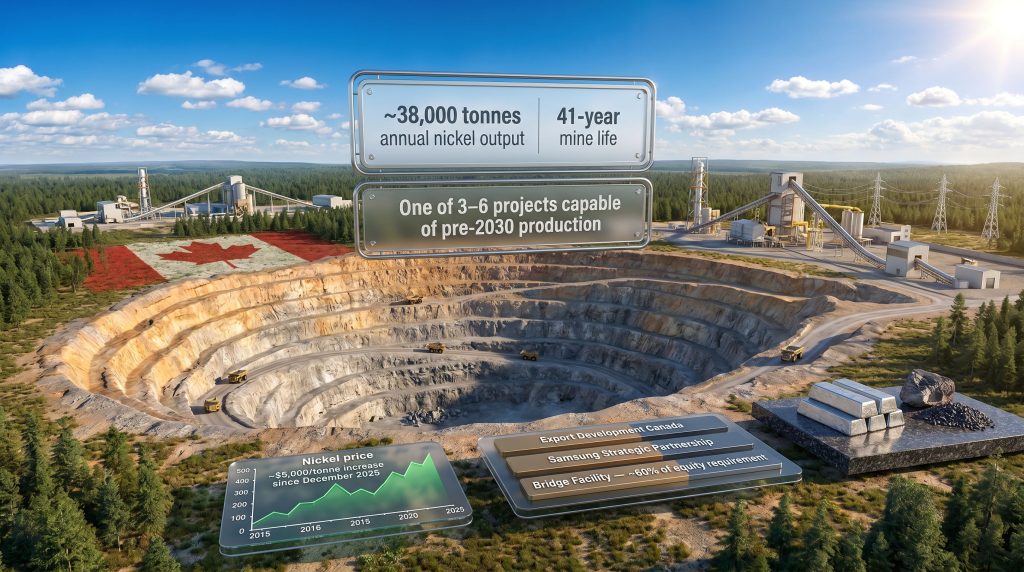
Situated 42 kilometres north of Timmins, Ontario, the Crawford project is one of the largest nickel sulphide discoveries identified in Canada in recent decades. Its scale is not incremental. The project is designed around an open-pit nickel-cobalt sulfide mining operation capable of processing 240,000 tonnes of ore per day, with a projected operational life of 41 years and annual nickel output approaching 38,000 tonnes.
The economic footprint is equally substantial. Over the life of the project, Crawford is estimated to contribute approximately $70 billion to Canadian GDP while generating roughly 185,000 person-years of employment across direct and indirect categories.
Key Project Specifications at a Glance
| Metric | Detail |
|---|---|
| Location | 42 km north of Timmins, Ontario |
| Mine Type | Open-pit nickel-cobalt sulfide |
| Projected Mine Life | 41 years |
| Ore Processing Capacity | 240,000 tonnes per day |
| Annual Nickel Output (projected) | ~38,000 tonnes |
| Estimated GDP Contribution | ~$70 billion over project life |
| Employment Generated | ~185,000 person-years |
| Regulatory Framework | Canada's Impact Assessment Act (2019) |
What distinguishes Crawford beyond its physical dimensions is its jurisdictional context. Ontario's established mining infrastructure, stable legal framework, and proximity to North American industrial markets give the project characteristics that developers in less mature jurisdictions cannot replicate. The region also sits within a geological belt where nickel sulfide mineralisation is known to exhibit the kind of serpentinized host rock that benefits metallurgical recovery, a factor with significant implications for downstream processing economics.
Why Serpentinization Matters for Metallurgical Recovery
Serpentinization refers to a geological process in which ultramafic rocks are chemically altered through interaction with water, producing serpentine mineral assemblages. In the context of nickel sulfide deposits, this process is relevant because it influences how easily nickel can be separated and concentrated during processing. Projects with consistent serpentinization across the ore body tend to deliver more predictable and efficient metallurgical recovery rates, reducing processing costs and improving product consistency.
Crawford's ore body displays this characteristic, and Canada Nickel's pipeline projects, particularly the Reid property, reportedly exhibit even more consistent serpentinization, which the company views as a potential performance advantage over the flagship.
Canada's 2019 Impact Assessment Act: A More Demanding Standard
For the better part of two decades, major Canadian mining projects were assessed under a framework primarily focused on environmental outcomes. The 2019 Impact Assessment Act fundamentally expanded that scope. Federal reviews under this legislation now formally encompass health impacts, socioeconomic consequences, and Indigenous rights considerations alongside traditional environmental criteria.
Key Insight: The 2019 Impact Assessment Act does not merely add procedural steps to the approval process. It changes the nature of the questions regulators are required to answer, creating a more demanding but ultimately more comprehensive pathway for major resource projects.
For project developers, this shift represented both a challenge and an opportunity. The challenge was substantive: satisfying a broader set of assessment criteria required significantly more documentation, community engagement, and technical analysis. Canada Nickel submitted more than 20,000 pages of documentation across the review period, reflecting the depth of scrutiny the framework demands.
The opportunity, however, is that a project successfully navigated through this framework arrives at the construction phase with a more durable social licence and a more thoroughly documented compliance record than would have been required under the previous regime.
Crawford's Regulatory Journey: A Step-by-Step Timeline
| Date | Regulatory Milestone |
|---|---|
| November 22, 2024 | Full Impact Statement submitted to the Impact Assessment Agency of Canada (IAAC) |
| May 30, 2025 | IAAC issues supplementary information requests following public and technical review |
| November 14, 2025 | Federal Major Projects Office designation granted |
| December 30, 2025 | Canada Nickel submits comprehensive responses to IAAC queries |
| March 3, 2026 | IAAC confirms information sufficiency; formal Impact Assessment phase initiated |
| Early May 2026 | Draft Impact Assessment Report published with preliminary conclusions and proposed permit conditions |
| Early Summer 2026 (target) | Final Ministerial decision and permit issuance expected |
The referral to the Major Projects Office in November 2025 was particularly significant. This designation is understood to facilitate streamlined interagency coordination, with estimates suggesting the process acceleration could amount to 12 to 18 months in time savings compared to standard processing. According to Canada Nickel's official announcement, this milestone represented a pivotal step in advancing the project towards construction readiness.
From Draft Report to Final Permit: What Happens Next
The draft Impact Assessment report published in early May 2026 triggers a defined sequence of final steps before the federal permit is formally issued:
- A 30-day public consultation window opens on the published draft permit conditions
- Responses to public submissions are reviewed and incorporated as appropriate
- The Ministerial review of the finalised assessment report is completed
- The federal permit is issued with binding conditions upon Ministerial approval
- Parallel provincial approvals under Ontario's Environmental Assessment Act continue in alignment with federal timelines
The company has indicated satisfaction with the conditions as drafted, which analysts and investors interpret as a low-risk signal for material changes during the final review period.
Global Nickel Supply Before 2030: A Market Operating Near Capacity
Understanding why the Canada Nickel Crawford federal approval carries significance beyond a single company requires placing it within the context of global nickel supply scarcity. The development pipeline for new nickel production is not merely thin. It is, by most informed assessments, critically constrained relative to projected demand.
Critical Supply Context: Across the entire global nickel development landscape, only an estimated 3 to 6 projects possess the technical readiness, regulatory standing, and capital access required to achieve meaningful production before 2030.
This scarcity is partly a consequence of the 2022 to 2024 nickel price downturn, which eliminated capital flows into the sector and stalled numerous development programmes. Projects that might have advanced during a period of sustained price support instead entered care and maintenance or were deferred indefinitely. Furthermore, the broader challenge of battery metals demand continues to intensify, placing additional pressure on an already constrained supply pipeline.
Indonesia's Role in Reshaping the Western Nickel Equation
Indonesia's position as the world's dominant nickel producer introduces a geopolitical and supply management dimension that Western developers are increasingly factoring into their competitive positioning. Indonesian nickel supply, primarily in the form of nickel pig iron and mixed hydroxide precipitate, has historically exerted downward pressure on prices through volume discipline. More recently, export management measures have introduced a degree of supply restraint that markets are beginning to price into forward curves.
This shift matters for projects like Crawford because it reduces the likelihood of a repeat of the 2022 to 2024 oversupply scenario that devastated developer economics. The strategic partnership Canada Nickel has secured with Samsung is partly motivated by Samsung's recognition of this dynamic. Securing offtake from a non-Indonesian source before 2030 addresses supply chain resilience concerns that are increasingly prominent in battery manufacturer procurement strategies.
Nickel Price Recovery: From Multi-Year Lows to a $5,000 Per Tonne Rebound
| Price Metric | Detail |
|---|---|
| Price Recovery Since December 2025 | ~$5,000 per tonne increase |
| Primary Catalysts | Indonesian export management, recovering EV demand, constrained supply pipeline |
| Impact on Project Economics | Materially improves feasibility thresholds for pre-production assets |
The recovery of approximately $5,000 per tonne since December 2025 represents a meaningful shift in the economics of development-stage nickel projects. Consequently, for assets with established feasibility studies, this type of price move can be the difference between marginal and robust internal rates of return, and it directly affects the terms on which project debt can be arranged. The improving nickel price momentum has, in turn, restored investor confidence across the broader sector.
Canada Nickel's Financing Architecture: Designed Around Shareholder Protection
One of the more technically sophisticated aspects of the Crawford development story is the capital structure Canada Nickel is assembling. Rather than pursuing large equity raises that would significantly dilute existing shareholders, the company has constructed a financing approach that uses multiple non-dilutive or minimally dilutive instruments in sequence.
Financing Components Breakdown
| Capital Source | Role in Structure |
|---|---|
| Export Development Canada (EDC) | Primary project debt facility; independent engineer review completed |
| Additional Export Credit Agencies | Supplementary debt participants alongside EDC |
| Bridge Facility (Refundable Tax Credits) | Covers approximately 60% of total equity requirement |
| Samsung Strategic Partnership | Offtake-linked equity participation; non-Indonesian supply motivation |
| Scotia Bank & Deutsche Bank | Broader financing syndication roles |
| Government Funding Tranches | First disbursement expected before end of June 2026 |
The bridge facility for Canada's refundable tax credit programme is perhaps the least understood but most structurally significant component. Canada offers refundable tax credits for qualifying clean technology and critical minerals investments. Because these credits are refundable, they represent real cash returns to the project, not merely offsets against future tax liability. By bridging against these credits, Canada Nickel can satisfy a substantial portion of its equity requirement without issuing new shares. The company has reportedly secured interest from three to four financing groups for this bridge facility, with a formal announcement expected in the September to October 2026 window.
Investor Alert: Rather than executing large equity raises, a common approach among peer developers that has historically resulted in 50 to 100% shareholder dilution, Canada Nickel is targeting periodic capital raises of only $10 to $15 million, representing approximately 2% dilution at current share prices.
This capital discipline is not merely a function of management preference. It reflects the availability of non-market instruments, particularly government funding and export credit agency debt, that reduce the project's reliance on equity markets to fill financing gaps. Indeed, the significance of critical minerals energy security has prompted governments to make such instruments increasingly accessible to qualifying projects.
Crawford's Low-Carbon Production Profile and the European Steel Opportunity
The commercial case for Crawford extends well beyond battery-grade nickel supply. A significant and underappreciated dimension of the project's output involves magnetite concentrate containing nickel and chromium, which feeds into semi-finished specialty steel production. This positions Crawford as a potential supplier to European steelmakers at precisely the moment when European industrial policy is creating powerful economic incentives for low-carbon steel inputs.
Europe's Carbon Border Adjustment Mechanism and What It Means for Steel Producers
Europe's Carbon Border Adjustment Mechanism imposes carbon costs on imported goods based on their embedded emissions intensity. For steel producers, this creates a direct pricing disadvantage for high-carbon inputs and a structural premium for materials produced with clean energy. Ontario's electricity grid, which draws heavily from nuclear and hydroelectric generation, provides Crawford with an intrinsic carbon intensity advantage over producers relying on coal-heavy grids.
The province is also expanding its nuclear generation capacity significantly, with over 10,000 megawatts of new nuclear capacity under development. This trajectory suggests Crawford's carbon advantage is structural rather than temporary, and is likely to deepen rather than erode over the life of the project.
Key features of this market positioning include:
- Crawford produces both battery-grade nickel products and magnetite concentrate containing nickel and chromium
- Magnetite concentrate converts into semi-finished specialty steel through electric arc furnace processes
- Ontario's nuclear and hydroelectric grid provides a structurally low carbon intensity baseline relative to global peers
- Approximately 50 to 67% of Crawford's steel-related output is expected to serve European markets
- North American steel producers represent additional demand through incremental furnace capacity additions, without requiring entirely new facility construction
The next major ASX story will hit our subscribers first
Construction Milestones and the Path to a Final Investment Decision
With technical work complete and regulatory closure in sight, the critical path for Crawford now runs through government funding receipt and long-lead equipment procurement.
Key Construction Milestones and Dependencies
| Milestone | Target Timing |
|---|---|
| First government funding tranche received | Before end of June 2026 |
| Federal permit finalised | Early summer 2026 |
| Long-lead equipment orders placed (transformers, high-voltage infrastructure) | Following initial funding receipt |
| Hydroelectric equipment | Already secured |
| Bridge facility for tax credits announced | September to October 2026 |
| Final construction decision | Early-to-mid 2027 |
The bottleneck for construction commencement is not regulatory or financial in isolation. It is electrical infrastructure. Transformers and high-voltage equipment carry extended manufacturing and delivery lead times that have been further stretched by competing demand from artificial intelligence data centre construction globally. Hydroelectric generation equipment has already been secured, representing one long-lead procurement milestone already achieved.
The sequencing matters for investors: government funding receipt in June 2026 triggers equipment orders, equipment delivery timelines then define when construction can meaningfully commence, and the formal construction decision is therefore targeted for early to mid-2027 rather than earlier. As reported by Crux Investor, this sequencing reflects a deliberate and methodical approach to capital deployment.
Beyond Crawford: The Pipeline Case for Future Value
Crawford's regulatory maturity is the primary reason it leads Canada Nickel's development schedule, but company leadership has been explicit that it may not represent the portfolio's best economic opportunity on a long-run basis. The Nesbitt and Reid projects both warrant attention from investors assessing the company's embedded optionality.
Project Pipeline Comparison
| Project | Key Attributes |
|---|---|
| Crawford | Regulatory maturity; first-mover under 2019 IAA framework; construction-ready |
| Nesbitt | Resource update pending; part of core Ontario nickel belt portfolio |
| Reid | Lower strip ratios, reduced overburden, more consistent serpentinization enhancing metallurgical recovery |
The Reid project's characteristics are particularly noteworthy from a geological standpoint. Lower strip ratios mean less waste rock must be moved per tonne of ore extracted, directly reducing operating costs. Less overburden reduces pre-production stripping requirements. More consistent serpentinization suggests more predictable metallurgical performance. Individually, each of these attributes provides incremental advantage. Together, they suggest a project with a fundamentally lower cost curve than Crawford. A preliminary economic assessment for Reid has been discussed as a potential catalyst for demonstrating this pipeline value to the market.
Frequently Asked Questions: Canada Nickel Crawford Federal Approval
What is the expected date for Crawford's final federal permit?
The final Ministerial decision and formal permit issuance is targeted for early summer 2026, following a 30-day public consultation period on the draft permit conditions published in early May 2026.
How many nickel projects globally can realistically produce before 2030?
Industry analysis suggests only approximately 3 to 6 projects globally possess the combination of technical readiness, regulatory advancement, and capital access required to achieve meaningful production before 2030. Crawford is consistently identified within this group.
What percentage of Crawford's equity financing comes from non-dilutive sources?
The bridge facility for Canada's refundable tax credit programme alone is expected to cover approximately 60% of the total equity requirement. Combined with government funding tranches and export credit agency debt, the structure is designed to limit new equity issuance to approximately 2% of current share capital.
How does Ontario's power grid reduce Crawford's carbon footprint compared to competitors?
Ontario's electricity generation is dominated by nuclear and hydroelectric sources, resulting in a significantly lower carbon intensity than grids reliant on coal or natural gas. This structural advantage translates directly into lower embedded carbon in Crawford's products, which carries commercial value in markets subject to mechanisms like Europe's CBAM that price carbon into imported goods.
What role does Samsung play in Crawford's financing and offtake structure?
Samsung's strategic partnership involves both offtake participation and equity-linked involvement in the financing structure. The partnership is motivated substantially by Samsung's need to secure non-Indonesian nickel supply for battery manufacturing before 2030, reflecting broader supply chain risk management priorities in the battery industry.
What is the significance of Canada's 2019 Impact Assessment Act for mining projects?
The 2019 Act expanded federal review requirements beyond environmental criteria to include health, socioeconomic, and Indigenous rights considerations. Crawford is on track to become the first mining project approved under this framework, establishing a regulatory template that Canada Nickel's subsequent projects in the same portfolio will benefit from as institutional familiarity with the framework increases.
When is Canada Nickel's construction decision expected?
The formal construction decision is targeted for early to mid-2027, contingent on receipt of the first government funding tranche before June 2026 and the subsequent placement of long-lead equipment orders.
Strategic Summary: Where Crawford Sits at the Intersection of Supply, Policy, and Capital
The convergence of regulatory maturity, financing discipline, and market timing that defines Crawford's current position is not the product of a single favourable development. It is the result of methodical advancement through one of the most demanding permitting frameworks a mining project has faced in Canada, combined with a capital structure specifically engineered to preserve equity value through the final stages of development.
Strategic Summary Table
| Dimension | Crawford's Position |
|---|---|
| Regulatory Status | Draft IA Report issued; final permit expected early summer 2026 |
| Global Supply Ranking | One of 3 to 6 projects capable of pre-2030 production |
| Financing Structure | Less than 2% projected equity dilution |
| Carbon Advantage | Ontario nuclear and hydro grid; CBAM-aligned for European steel markets |
| Construction Decision | Targeted early-to-mid 2027 |
| Pipeline Value | Nesbitt and Reid projects potentially superior in long-run economics |
| Price Tailwind | ~$5,000 per tonne nickel recovery since December 2025 |
The multi-vector demand case for Crawford's output adds a further layer of resilience to the investment thesis. Battery-grade nickel demand from the electric vehicle transition, specialty stainless steel requirements from North American manufacturers, and European industrial decarbonisation driven by CBAM represent three distinct and largely independent demand channels. Projects dependent on a single end market carry concentration risk that Crawford's product mix is structured to avoid.
For investors assessing critical minerals exposure, the combination of near-term permit issuance, a capital structure with minimal dilution risk, a recovering price environment, and a project technically ready to proceed on receipt of initial funding represents a convergence of catalysts that is difficult to replicate across the broader nickel development universe. The pipeline value embedded in Nesbitt and Reid provides additional optionality that is not yet reflected in standard project valuations.
This article contains forward-looking statements and projections regarding timelines, production targets, financing outcomes, and market conditions. These statements are based on information available at the time of publication and are subject to material risks, uncertainties, and assumptions that could cause actual outcomes to differ significantly from those described. Readers should conduct their own due diligence and consult a licensed financial adviser before making investment decisions. Nothing in this article constitutes financial, legal, or investment advice.
Want to Position Yourself Ahead of the Next Major Mineral Discovery?
Discovery Alert's proprietary Discovery IQ model delivers real-time alerts the moment significant ASX mineral discoveries are announced, transforming complex geological and market data into actionable investment insights for both short-term traders and long-term investors. Explore historic discoveries and the substantial returns they have generated, then begin your 14-day free trial at Discovery Alert to ensure you are positioned ahead of the broader market when the next critical minerals opportunity emerges.