
May 19, 2026
When Narrative and Reality Diverge: The Coal Cash Flow Story Most Investors Are Missing
There is a category of investment opportunity that emerges not from a company doing something extraordinary, but from a market collectively misfiling what a business actually is. When an entire asset class gets intellectually reassigned from "cash generator" to "legacy asset," the valuations that follow often reflect the narrative more than the numbers. Thermal coal has occupied that uncomfortable space for several years now, and the New Hope Q3 results coal rally playing out in 2026 is forcing a reckoning between story and reality.
Understanding why requires looking past the quarterly earnings headline and examining the structural mechanics of how the coal market actually functions, how operating leverage amplifies modest price moves into significant earnings swings, and why the supply side of this equation is behaving in ways that conventional transition narratives simply do not account for.
When big ASX news breaks, our subscribers know first
The Supply Squeeze Nobody Wants to Talk About
The dominant framing around thermal coal in institutional investment circles focuses almost exclusively on demand destruction. Renewable energy capacity is expanding. Battery storage costs are declining. Government policy in major economies is tilting against fossil fuel consumption. These are real forces, and their long-term directional impact on coal demand is not in dispute.
What receives far less analytical attention is what has happened to supply in parallel. Years of ESG-driven financing restrictions have effectively closed the door on new mine development across major producing regions. The coal supply challenges facing global markets have been compounded by major institutional lenders and global investment banks progressively withdrawing from coal project financing, meaning the supply pipeline has been structurally constrained even as existing mines continue depleting their reserves.
The result is a market dynamic that runs counter to the prevailing narrative:
- Global thermal coal supply is contracting as existing mines approach end-of-life without replacement capacity being built
- No meaningful large-scale thermal coal projects have received institutional financing backing in recent years
- As marginal producers exit the market, the cost curve shifts upward, directly benefiting low-cost incumbents
- The pace of supply withdrawal is, in several recent quarters, outrunning the pace of demand decline
When demand falls gradually but supply falls faster, the price equilibrium does not collapse toward zero. It shifts upward. This is a fundamentally different dynamic than a commodity in structural oversupply, and it has very different implications for the duration and level of producer cash flows.
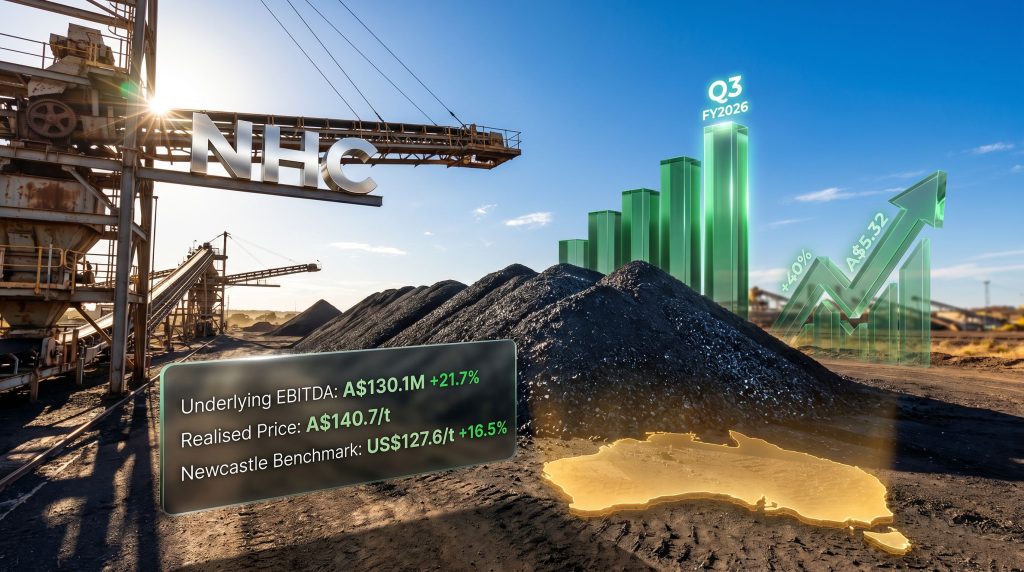
This supply squeeze is the foundational context for evaluating the New Hope Q3 results coal rally. It explains why a company operating in a supposedly declining industry is generating accelerating earnings, and why the Newcastle thermal coal benchmark averaged US$127.6 per tonne in Q3 FY2026, representing a 16.5% increase quarter-on-quarter.
Deconstructing New Hope's Q3 FY2026 Numbers
The headline result from New Hope Corporation (ASX:NHC) for the third quarter of FY2026 was an underlying EBITDA of A$130.1 million, representing a 21.7% increase on the prior period. That is a substantial earnings uplift, and it warrants a careful decomposition to understand what actually drove it.
The Q3 FY2026 Financial Snapshot
| Metric | Q3 FY2026 Result | Change vs Prior Period |
|---|---|---|
| Underlying EBITDA | A$130.1 million | +21.7% |
| Coal sales volume | Quarter-on-quarter increase | +10.4% |
| Realised coal price | A$140.7 per tonne | Modest improvement |
| Newcastle benchmark price | US$127.6 per tonne | +16.5% quarter-on-quarter |
| Bengalla capex revision | Reduced planned spending | -21% vs prior guidance |
The 21.7% EBITDA uplift on what might appear to be a comparatively modest combination of volume and price improvements is a textbook illustration of operating leverage in action. This is one of the most important, and least understood, financial mechanics in large-scale mining. For further context on how commodity prices and mining performance interact across the sector, the broader ASX resources landscape offers instructive comparisons.
How Operating Leverage Amplifies Earnings in Coal Mining
Coal mines carry a significant fixed cost base. Mine infrastructure, equipment, labour, and site overheads do not scale linearly with output. When production and sales volumes increase, those fixed costs are distributed across a larger revenue base, and the incremental revenue generated above the fixed cost threshold flows through to earnings at a far higher margin than the blended rate.
Here is the step-by-step earnings amplification mechanism at work in Q3 FY2026:
- Fixed mine operating costs at Bengalla remained largely stable regardless of the higher output volume
- A 10.4% increase in coal sold distributed those fixed costs across a materially larger revenue base
- A simultaneously higher realised price of A$140.7 per tonne compounded the revenue uplift above the fixed cost line
- The incremental revenue generated by the dual improvement in volume and price carried a near-full margin contribution
- The combined effect produced a 21.7% EBITDA gain from inputs that individually appeared modest
This same mechanism is symmetrical on the downside. A meaningful deterioration in either coal price or production volume would compress EBITDA at an accelerated rate relative to the revenue decline. Investors evaluating New Hope must hold both sides of this equation simultaneously.
Bengalla: Cost Discipline as a Competitive Differentiator
Beyond the volume and price dynamics, the operational performance at the Bengalla mine in New South Wales deserves specific attention. The mine is tracking below management's own full-year cost guidance, a meaningful achievement in an inflationary cost environment that has challenged many Australian mining operations.
More significant from a shareholder value perspective is the 21% reduction in planned capital expenditure at Bengalla relative to prior guidance. In mining, capital discipline at the mine level directly translates to free cash flow conversion. Every dollar of capex that is deferred or eliminated without compromising production capacity is a dollar available for dividends, buybacks, or balance sheet strengthening. You can review the FY26 half-year results directly on New Hope Group's investor page for additional context on the company's capital allocation priorities.
Three Forces Behind the 2026 Coal Price Recovery
The Newcastle thermal coal benchmark's 16.5% quarterly increase to US$127.6 per tonne was not a random market movement. Three distinct forces converged to create the conditions for that price recovery, each operating on a different time horizon.
Force 1: Geopolitical Energy Displacement
Elevated tensions across the Middle East have introduced a sustained risk premium into global natural gas markets. As liquefied natural gas (LNG) prices rise in response to supply uncertainty and shipping route disruption concerns, the economic calculus for power generators in price-sensitive Asian markets shifts materially. When the cost differential between gas-fired and coal-fired power generation widens, utilities do not maintain ideological commitments to fuel choice. They respond to economics, and in 2026, economics have been directing them toward coal.
This fuel-switching dynamic, sometimes referred to in energy markets as inter-fuel substitution, is quantitatively meaningful. A relatively small shift in the fuel mix of large Asian power utilities represents substantial incremental coal demand at the margin.
Force 2: Seasonal Demand Concentration in North Asia
Colder-than-average conditions across North Asia during the quarter accelerated coal drawdowns at power utilities managing peak heating and electricity demand. Japan and South Korea, both structurally dependent on imported energy to maintain grid reliability, increased procurement volumes from Australian suppliers. These countries maintain long-term supply relationships with Australian coal producers, and proximity combined with established shipping infrastructure gives Australian exports a logistical advantage over competing supply sources.
Force 3: Structural Undersupply Amplifying Price Sensitivity
With the supply pipeline constrained by years of restricted investment, the available buffer between global coal supply and demand has narrowed considerably. In a market with thin spare capacity, even moderate demand increases produce outsized spot price responses. This is the structural underpinning that transforms what might otherwise be a modest seasonal demand lift into a 16.5% benchmark price rally within a single quarter.
Scenario Framework: How Long Does the Rally Last?
| Scenario | Primary Driver | Estimated Duration | NHC Earnings Impact |
|---|---|---|---|
| Geopolitical premium sustained | Middle East tensions persist | 6 to 18 months | Continued EBITDA uplift |
| Fuel-switching demand normalises | LNG prices stabilise | 3 to 9 months | Modest earnings moderation |
| Structural supply squeeze deepens | No new mine investment globally | Multi-year | Sustained price floor |
| Global demand shock | Recession compresses industrial output | 12 to 24 months | Significant earnings compression |
| Accelerated renewables deployment | Faster grid transition in Asia | 3 to 5 years | Gradual volume and price erosion |
New Hope's Share Price and the Valuation Disconnect
New Hope shares tested intraday highs of A$5.32 following the Q3 FY2026 results release. Year-to-date price appreciation has reached approximately 32%, with the twelve-month return exceeding 40%. Notably, this performance was generated largely outside the spotlight of mainstream investor attention, which in 2026 has been dominated by artificial intelligence infrastructure plays and battery metals themes.
The more analytically interesting question is not whether New Hope has performed well, but why the market appears to be applying a structural discount to its earnings multiple even after a significant re-rating. Understanding bull vs bear mining markets is essential context here, as the divergence between sentiment and fundamentals often creates exactly the kind of mispricing that long-term investors seek to exploit.
The probable explanation lies in investor psychology around terminal industries. When a consensus view forms that a business is on a path toward obsolescence, market participants apply a discount rate to earnings that assumes a shorter duration of cash flows than the underlying reserve life and production profile would justify. For a company with a long reserve base and a progressive production ramp at the New Acland operation through FY2028, this discount may be materially mispricing the present value of future cash generation.
Markets that price in terminal decline frequently undervalue the duration of cash flows. A business generating strong free cash flow for another decade, even within a structurally declining industry, can represent a substantial intrinsic value that a near-term obsolescence narrative simply does not capture.
The Fully Franked Dividend: An Underappreciated Return Component
New Hope's fully franked dividend yield remains among the more competitive income profiles available within the ASX 200 even after the share price re-rating. For Australian resident investors, the franking credit benefits are not merely a marketing attribute. They represent a tangible enhancement to the after-tax return relative to unfranked alternatives, effectively increasing the real income yield for investors who can utilise those credits against their tax liability.
The combination of capital appreciation, franked dividend income, and ongoing buyback activity creates a multi-channel shareholder return profile that is relatively uncommon among ASX-listed resources companies.
Bull Case, Bear Case, and Entry Timing
The Bull Case Rests on Three Conditions
- Coal price stability above the US$110 to US$120 per tonne range, sufficient to sustain EBITDA margins that support the current dividend and capital return programme
- Progressive New Acland production ramp through FY2028, which adds volume growth to the earnings profile independently of price movements, providing a structural earnings tailwind
- Continued cost and capital discipline at Bengalla, preserving free cash flow conversion and maintaining the mine's competitive cost position within the Australian producer cohort
The Bear Case Centres on Three Risks
- A global economic slowdown reducing industrial and power generation demand in China, Japan, and South Korea, pushing the Newcastle benchmark below the cash flow breakeven range
- Faster-than-expected renewable energy displacement in key Asian markets, compressing the demand timeline more aggressively than current consensus projections anticipate
- Single-commodity concentration risk, with New Hope's earnings entirely exposed to thermal coal pricing, creating asymmetric downside sensitivity with no diversification buffer
Practical Entry Considerations for New Investors
For investors who have not yet established a position, the arithmetic of entry timing matters more after a 40% twelve-month appreciation than it did at earlier cycle entry points. The margin of safety that existed when the market was more aggressively discounting coal cash flows has partially compressed.
A disciplined approach would involve identifying specific fundamental valuation thresholds, such as price-to-free-cash-flow ratios or earnings yield levels relative to the franked dividend return, that represent acceptable risk-reward entry points. ASX market insights suggest that the fully franked dividend provides a partial offset to timing risk by ensuring income accrues during any waiting period.
The next major ASX story will hit our subscribers first
How New Hope Compares Within the ASX Coal Sector
| Attribute | New Hope (ASX:NHC) | Sector Context |
|---|---|---|
| Cost structure | Below full-year guidance at Bengalla | Competitive among Australian thermal coal producers |
| Dividend franking | Fully franked | Premium characteristic vs. partially franked or unfranked peers |
| Production growth profile | New Acland ramp through FY2028 | Near-term volume catalyst independent of price |
| Commodity diversification | Single-commodity thermal coal exposure | Concentration risk relative to diversified miners |
| Index membership | ASX 200 constituent | Institutional accessibility and index-driven demand |
Key Risks Investors Must Stress-Test Before Buying ASX Coal Stocks
Commodity Price Volatility and Operating Leverage Symmetry
The operating leverage that produced a 21.7% EBITDA gain in Q3 FY2026 is a symmetric mechanism. A meaningful decline in the Newcastle benchmark, toward the US$100 per tonne range for instance, would produce an earnings compression that outpaces the revenue decline. Investors must stress-test their return assumptions against price scenarios below current benchmark levels.
ESG-Related Valuation Ceiling
Continued pressure from institutional investors, superannuation funds, and global capital allocators to reduce fossil fuel exposure affects the composition of the shareholder base available to own ASX coal stocks. This creates a structural ceiling on the valuation multiples that the market is willing to assign, even when earnings are strong, because the pool of buyers operating without ESG constraints is narrower than for comparable-quality businesses in other sectors.
Operational Concentration at Bengalla
New Hope's quarterly earnings profile is substantially dependent on the Bengalla mine's continued performance. Weather disruption, equipment failures, or industrial action at a single mine would have a disproportionately negative impact on quarterly production and reported EBITDA. This concentration risk is a practical consideration that diversified mining companies do not carry to the same degree.
Frequently Asked Questions
What drove the New Hope Q3 results EBITDA increase of 21.7%?
The earnings improvement reflected a simultaneous increase in coal sales volumes of approximately 10.4% quarter-on-quarter and a higher realised price per tonne of A$140.7, supported by the Newcastle thermal coal benchmark rising 16.5% to average US$127.6 per tonne. Below-guidance cost performance at Bengalla and a 21% reduction in planned capital expenditure further amplified the free cash flow outcome through reduced spending rather than increased revenue alone.
Why has the Newcastle thermal coal benchmark risen in 2026?
Three intersecting forces drove the price recovery: geopolitical tensions elevating natural gas prices and triggering fuel-switching toward coal in Asian power markets; colder seasonal conditions lifting heating and power demand across North Asia; and a structurally constrained supply environment resulting from years of restricted new mine development financing globally.
What is the New Acland mine and why does it matter?
New Acland is New Hope's coal operation in Queensland, currently in a progressive production ramp-up phase with output expected to increase through FY2028. Its growing contribution provides a volume growth pathway that operates independently of coal price movements, meaning earnings can increase through production expansion even if price levels remain flat. This makes New Acland a critical component of the medium-term investment thesis.
Is New Hope a good dividend stock after the 40% rally?
New Hope continues to offer one of the more compelling fully franked dividend yields within the ASX 200 even after the share price appreciation. The franking credit component materially enhances the effective after-tax return for Australian resident investors. However, dividend sustainability remains directly linked to coal price levels and production volumes, both of which carry cyclical and structural variability that income-focused investors must account for in their modelling.
The Opportunity in Misclassified Assets
The most durable alpha in commodity investing frequently comes from situations where market classification diverges from economic reality. Coal has been classified by consensus as a terminal asset, yet the underlying business mechanics, supply constraints, demand resilience, and cash flow conversion profile of low-cost producers like New Hope reflect something considerably more nuanced than a business approaching imminent obsolescence.
The New Hope Q3 results coal rally is not a random market event. It is the visible expression of a structural supply squeeze interacting with a supportive near-term pricing environment, amplified through the operating leverage of a well-run, below-guidance-cost mining business. Furthermore, the earnings call transcript from New Hope Group's Q3 FY2026 update confirms that management sees continued strong coal demand as a central feature of the near-term outlook. Whether the next phase of that story involves further price appreciation or a correction depends on how the supply-demand mismatch evolves and how long geopolitical energy premiums persist.
What is less ambiguous is the analytical lesson: businesses that generate substantial free cash flow deserve to be evaluated on the duration and certainty of those cash flows, not solely on the narrative arc of the industry in which they operate.
This article is general in nature and does not constitute financial advice. Past performance is not a reliable indicator of future results. Investors should conduct their own independent research and, where appropriate, seek advice from a licensed financial adviser before making any investment decisions. All figures referenced are sourced from publicly available company disclosures and market data.
Want to Catch the Next Major ASX Resource Discovery Before the Market Does?
Discovery Alert's proprietary Discovery IQ model scans ASX announcements in real time, instantly identifying high-potential mineral discoveries across more than 30 commodities — turning complex data into clear, actionable opportunities for both short-term traders and long-term investors. Explore how historic discoveries have generated extraordinary returns on the Discovery Alert discoveries page, and begin your 14-day free trial today to secure a market-leading edge.