
June 27, 2026
The Hidden Architecture of the World's Most Ambitious Copper Partnership
Copper mining rarely rewards impatience. Ore bodies take decades to delineate, permits can consume a generation, and capital outlays for greenfield projects routinely eclipse the GDP of small nations. Yet the global copper market is being asked to deliver something it has never managed before: a rapid, sustained surge in supply during the very decade when demand is accelerating fastest. Understanding why that tension exists, and how the industry is trying to resolve it, is the essential context for appreciating the full weight of the Anglo American and Codelco Chile copper deal finalised on June 24, 2026.
When big ASX news breaks, our subscribers know first
What the Anglo American and Codelco Chile Copper Deal Actually Is
The agreement is frequently described in shorthand as a production deal, but that framing undersells its structural originality. This is not a merger, a joint venture in the traditional equity sense, or an acquisition. Both Anglo American and Codelco retain full, independent ownership of their respective operations: Los Bronces (Anglo American) and Andina (Codelco), two geologically proximate mines situated northeast of Santiago in Chile's central Andes.
What the companies have constructed instead is a coordinated mine planning architecture built across a shared geological corridor. By synchronising extraction sequences, infrastructure use, processing logistics, and planning cycles across two independently owned assets, both operators unlock efficiencies that neither could achieve in isolation. The framework was initially sketched out in September 2025 before years of negotiations involving Anglo American, Codelco, Mitsubishi Corporation, and Mitsui & Co. ultimately produced the definitive agreement.
Deal Snapshot: Core Metrics
| Metric | Detail |
|---|---|
| Agreement Duration | 21 years |
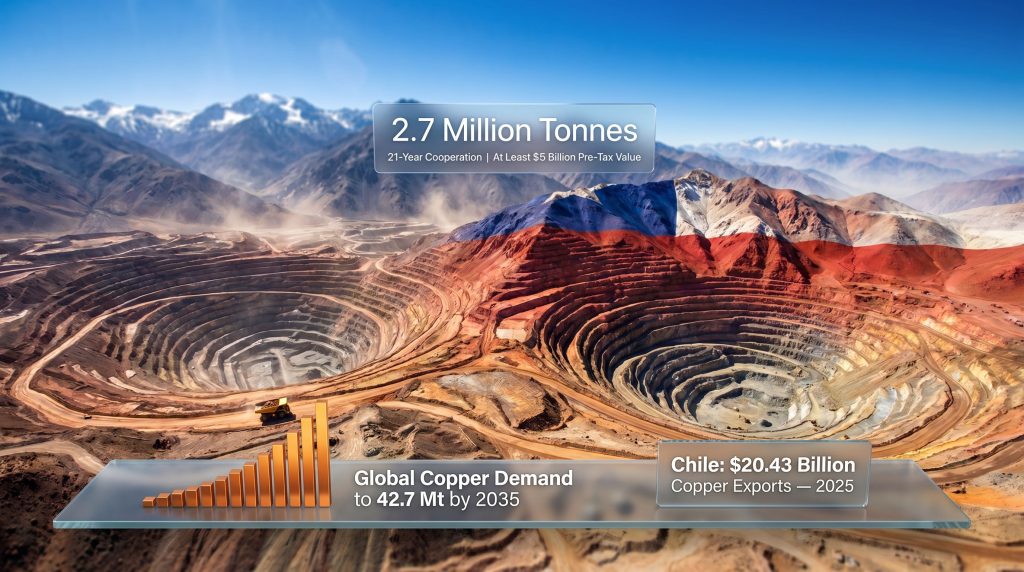
| Additional Copper Production | 2.7 million tonnes total |
| Annual Production Uplift | ~120,000 tonnes per year |
| Pre-Tax Value Creation | At least $5 billion |
| Unit Cost Reduction | ~15% vs. standalone operations |
| Expected Production Start | ~2030 (pending environmental permits) |
| Capital Requirement | Minimal, leverages existing infrastructure |
The 15% reduction in unit costs achieved purely through planning coordination, without new capital-intensive construction, positions this as one of the most capital-efficient copper expansion strategies currently active anywhere in the global mining sector.
Crucially, the agreement preserves each party's ability to pursue independent underground development alongside the joint plan. Sustainability and community obligations are formally embedded within the 21-year term, reflecting a broader industry pivot toward partnership-led, socially accountable resource extraction.
The Geological Logic Behind This Specific Pairing
The reason this arrangement is structurally viable, and why similar deals are so rare, comes down to geology. Los Bronces and Andina share the same copper-porphyry geological corridor, meaning their ore bodies were formed by the same suite of ancient hydrothermal events that deposited copper mineralisation across a continuous zone beneath the Andes.
In copper-porphyry systems, the economic zones of mineralisation can extend laterally for kilometres, and adjacent operations often share structural features, fault systems, and grade distribution patterns. This shared geology creates a situation where mine sequencing decisions at one operation can directly affect recovery economics at the other if left uncoordinated. Conversely, when sequencing is optimised jointly, ore blending, mill feed grade management, and haul route utilisation can all be tuned for maximum combined throughput.
This is a level of geological and operational interdependency that most adjacent mines never formally acknowledge, let alone build a 21-year cooperative framework around. The combined deposit cluster represents one of the largest concentrations of copper resources on the planet, making the value of coordination proportionally enormous.
Chile's Production Pressures and Why Timing Matters
The finalisation of this deal arrives against a backdrop of real strain in Chilean copper output. According to Chile's National Institute of Statistics, copper production fell 13.8% year-over-year to 399,954 metric tons in April 2026, following a further decline in March. Two compounding factors drove the weakness: declining ore grades at multiple operations and an unfavourable comparison base from elevated prior-year production levels.
Ore grade decline is a particularly consequential dynamic that receives insufficient attention outside technical mining circles. As open-pit mines mature, operators progressively mine lower-grade material, meaning more rock must be moved and processed to yield the same amount of copper. This is not a temporary operational setback but a structural characteristic of aging porphyry deposits, and it affects virtually every major copper province globally over multi-decade timescales. The ongoing copper supply crunch further amplifies the urgency of coordinated solutions like this one.
Cochilco's Revised Production Outlook
| Period | Growth Forecast | Expected Output |
|---|---|---|
| 2025 (revised) | 1.5% (down from 3.0%) | 5.58 million metric tons |
| 2026 | 3.0% (maintained) | 5.75 million metric tons |
| 2027 (projection) | Recovery trend | ~510,000 tonnes/month |
| 2028 (projection) | Gradual growth | ~530,000 tonnes/month |
Chile's copper commission Cochilco reduced its 2025 growth forecast from 3% to 1.5%, citing weaker output at BHP's Escondida and Collahuasi. The agency also flagged that a fatal accident at Codelco's El Teniente mine carries meaningful downside risk to the production recovery timeline if remediation and operational review processes extend beyond initial expectations.
Despite these headwinds, copper remains the backbone of the Chilean economy. UN COMTRADE data shows the country exported $20.43 billion worth of copper in 2025, underscoring the strategic importance of any initiative that can sustainably lift national output. Furthermore, Chile's copper supply gap makes Chile's stated national ambition of reaching 6 million tonnes of annual production by 2030 all the more dependent on exactly the kind of incremental, coordination-driven uplift this deal is designed to deliver.
How the Joint Mine Plan Creates Value Without New Capital
The concept of brownfield coordination sits at the heart of why this deal is generating attention far beyond Chile. Building a new copper mine from scratch typically requires a decade or more of exploration, feasibility work, permitting, and construction, with capital outlays measured in billions of dollars. The Anglo American and Codelco Chile copper deal sidesteps this entirely.
Instead, value is created through:
- Aligned ore sequencing that maximises combined grade and throughput across both mines simultaneously
- Shared infrastructure utilisation, including haul roads, processing circuits, and tailings management systems where applicable
- Coordinated workforce and equipment scheduling to reduce downtime and idle capital
- Optimised pit and underground design informed by the full combined resource picture rather than each operation's individual boundaries
- Reduced duplication in planning, logistics, environmental monitoring, and community engagement functions
Each of these efficiency layers compounds the others. The projected ~15% reduction in per-unit operating costs is a direct product of this compounding effect, and it translates into a structurally lower cost position across the full 21-year term. Investors assessing copper investment strategies should take note of how this brownfield model redefines value creation in the sector.
The Global Copper Supply Deficit: Structural, Not Cyclical
Zooming out from Chile, the deal derives its full strategic significance from the global copper demand trajectory that the mining industry is now being asked to serve.
Wood Mackenzie projects global copper demand to reach 42.7 million tonnes per year by 2035, a 24% increase from current consumption levels representing an additional 8.2 million tonnes of annual demand. Three structural forces are driving this acceleration simultaneously.
The Three Demand Engines
1. AI Infrastructure and Data Centers
- AI-driven data centers are forecast to consume an additional 2,200 TWh of electricity by 2035
- Copper demand for power grid infrastructure serving data centers is projected to reach 1.1 million tonnes per year by 2030
- Because copper represents less than 0.5% of total data center construction costs, procurement decisions are largely insensitive to copper price movements, making this demand stream highly inelastic
2. Clean Energy Transition
- Renewable energy deployment is expected to require an additional 2 million tonnes of copper per year over the next decade
- Copper demand attributable to clean energy is projected to more than double, growing from 1.7 million tonnes today to 4.3 million tonnes by 2035
- Solar arrays, offshore wind installations, and grid-scale battery storage facilities are all highly copper-intensive at the infrastructure level
3. Electric Vehicle Proliferation
- A battery electric vehicle contains up to four times more copper than a conventional internal combustion engine vehicle
- As EV penetration scales globally across passenger and commercial transport categories, this copper multiplier compounds cumulative demand in ways that linear forecasting tends to understate
These copper demand drivers are reinforcing one another in ways that make supply-side responses increasingly urgent across every major producing nation.
Regional Demand Concentration
| Region | 2025 Copper Consumption | Growth Outlook to 2035 |
|---|---|---|
| China | 15.7 million tonnes (refined) | Continued market dominance |
| India | Growing at 7.5% annually | Combined with Southeast Asia: +3.3Mt by 2035 |
| Southeast Asia | Rapid industrialisation phase | Integral to regional total above |
On the supply side, Wood Mackenzie estimates the industry requires over 8 million tonnes of new mine capacity plus an additional 3.5 million tonnes of recycled copper to meet 2035 demand. Annual supply disruption rates are expected to climb from 5% to 6%, stripping an estimated 250,000 to 300,000 tonnes from global markets each year due to climate-related events, labour disputes, and operational failures.
When supply disruption rates are rising at the same time that demand is accelerating from three independent structural drivers, the marginal value of every reliably produced tonne of copper increases. This is the macroeconomic environment into which the 2.7 million tonnes unlocked by the Anglo American and Codelco Chile copper deal will flow.
The next major ASX story will hit our subscribers first
Permitting: The Variable That Determines Everything
For all the strategic elegance of the arrangement, one variable remains beyond either party's direct control: Chilean environmental permitting. Large-scale mining projects in Chile undergo a rigorous environmental impact assessment process under the Sistema de Evaluación de Impacto Ambiental (SEIA) framework, and the timeline from application to approval for projects of this complexity can extend considerably.
Both Anglo American and Codelco have publicly identified timely permit receipt as the single most critical near-term milestone for this project. The current target of commencing production under the joint plan around 2030 is contingent on navigating this process without material delay. Any slippage in the permitting timeline directly translates into deferred production, deferred cost savings, and deferred value realisation for both companies.
The competition authority and regulatory clearances required to finalise the definitive agreement itself have already been obtained, which is a meaningful distinction. The remaining approvals are environmental in nature, reflecting Chile's established processes for scrutinising the land use, water consumption, tailings management, and community impact dimensions of large mining expansions. Analysts monitoring the Chile copper outlook will be watching the permitting timeline closely as the most immediate indicator of the deal's near-term trajectory.
What This Deal Signals for the Broader Mining Industry
The Anglo American and Codelco Chile copper deal is, in one sense, a specific transaction between two specific companies across two specific mines. In another sense, it is a proof-of-concept for a model of value creation that the mining industry has historically underutilised.
Several dynamics make the brownfield cooperation model increasingly attractive relative to greenfield development:
- Greenfield timelines of 10 to 15 years from discovery to first production are incompatible with the urgency of near-term supply requirements
- Capital intensity for new mine construction continues to escalate as ore bodies become deeper, more remote, and lower grade
- Permitting complexity for new operations in most major mining jurisdictions has increased substantially over the past decade
- Community and social licence expectations are more demanding for entirely new operations than for expansions or coordinations at established sites
The partnership structure also demonstrates that significant industrial synergies can be captured without triggering the regulatory, financial, and operational complexity of a full corporate merger. Each party retains strategic autonomy, balance sheet independence, and the freedom to pursue additional projects, while sharing the efficiency benefits of coordinated operations.
This model carries obvious potential applicability to other copper districts globally, as well as to lithium and nickel provinces where adjacent but separately owned assets face similar coordination opportunities. According to Global Mining Review, industry analysts have highlighted this as a landmark template for future district-scale cooperation. The question is whether the industry's traditional preference for competitive independence will yield to the mathematical reality that cooperation frequently generates superior returns.
Key Takeaways for Industry Observers
- The Anglo American and Codelco Chile copper deal is fundamentally a response to structural supply inadequacy, not a conventional capacity expansion
- The 21-year term signals genuine long-term commitment from both parties to integrated planning, which is unusual in an industry that often prioritises operational flexibility
- Chile's production challenges, including declining ore grades and forecast revisions from Cochilco, make the incremental uplift from this deal more strategically valuable, not less
- The 2030 production start target hinges entirely on environmental permitting timelines that neither company controls
- As AI infrastructure, clean energy deployment, and EV adoption continue compressing the global copper supply margin, the 2.7 million additional tonnes targeted by this deal will carry increasing economic significance through the 2030s and beyond
Disclaimer: This article contains forward-looking projections sourced from third-party research organisations including Wood Mackenzie and Cochilco. These projections involve assumptions about future market conditions that may not materialise. Nothing in this article constitutes financial advice. Readers should conduct independent due diligence before making investment decisions.
Readers tracking live copper market dynamics, Chilean production data, and global commodity pricing can also explore Anglo American's official copper portfolio for further detail on the company's broader production strategy and ongoing operational commitments across its asset base.
Want to Capitalise on the Next Major Copper Discovery Before the Broader Market Catches On?
Discovery Alert's proprietary Discovery IQ model scans ASX announcements in real time, instantly alerting subscribers to significant mineral discoveries across copper and more than 30 other commodities — translating complex geological data into clear, actionable opportunities. Explore Discovery Alert's dedicated discoveries page to see how historic ASX mineral discoveries have generated substantial returns, and begin a 14-day free trial to position yourself ahead of the market.