
June 26, 2026
The Underground Shift Reshaping North America's Copper Landscape
The economics of open-pit copper mining are reaching a turning point. Across the world's most productive porphyry copper belts, the low-hanging ore has largely been extracted. What remains sits deeper, often under thousands of metres of overlying rock, in formations too expensive to access by simply deepening an existing pit. This geological reality is pushing the global copper industry toward a fundamental methodological transition, and the Red Chris block cave project in northwestern British Columbia sits at the frontier of that shift.
Understanding what this transition means, technically and economically, requires looking beyond the headline approvals and into the mechanics of the mining method itself.
When big ASX news breaks, our subscribers know first
Understanding Block Caving: The Physics Behind the Method
Block caving is one of mining's most elegant solutions to a difficult problem. Rather than extracting ore by drilling, blasting, and hauling from the surface, the method turns gravity into the primary excavation tool. At its core, the technique engineers a controlled collapse of a large ore column from below, allowing broken rock to flow down into waiting extraction drives where it can be crushed and transported to surface.
The process at a site like the Red Chris block cave project follows a well-defined sequence:
- Hydraulic pre-conditioning is applied to the deep ore body, using high-pressure water injection to fracture the rock mass and improve its tendency to cave predictably rather than arching over the undercut.
- An undercut level is excavated beneath the target ore column, removing the support that holds the ore mass in place and initiating the cave.
- Drawbells are blasted open between the undercut and the extraction level below, creating the funnels through which broken ore flows by gravity.
- Ore is collected at extraction drives, fed into an underground primary crusher, and then conveyed to surface processing facilities without the need for large fleets of haulage trucks operating underground.
Why Is Block Caving Suited to the Red Chris Deposit?
What makes this method particularly suited to the Red Chris deposit is the nature of the ore body itself. The deeper porphyry copper-gold mineralisation at Red Chris cannot be economically reached by extending the existing open pit. The stripping ratios at depth become prohibitive, meaning too much waste rock must be moved relative to the ore recovered. Block caving inverts this equation entirely.
Block caving consistently achieves some of the lowest operating costs per tonne in underground mining, making it the method of choice for large, lower-grade, high-tonnage ore bodies that would otherwise be left in the ground.
One nuance often overlooked outside specialist circles is the role of rock mass characterisation in block cave design. The cave's behaviour — how it propagates upward, how uniformly it draws down, and whether it produces dangerous air gaps or uneven stress concentrations — depends critically on the geomechanical properties of the ore and surrounding rock. At Red Chris, hydraulic pre-conditioning is not merely a preliminary step but an ongoing geotechnical management tool that shapes the entire cave's lifetime performance.
Location, Ownership, and the Tahltan Dimension
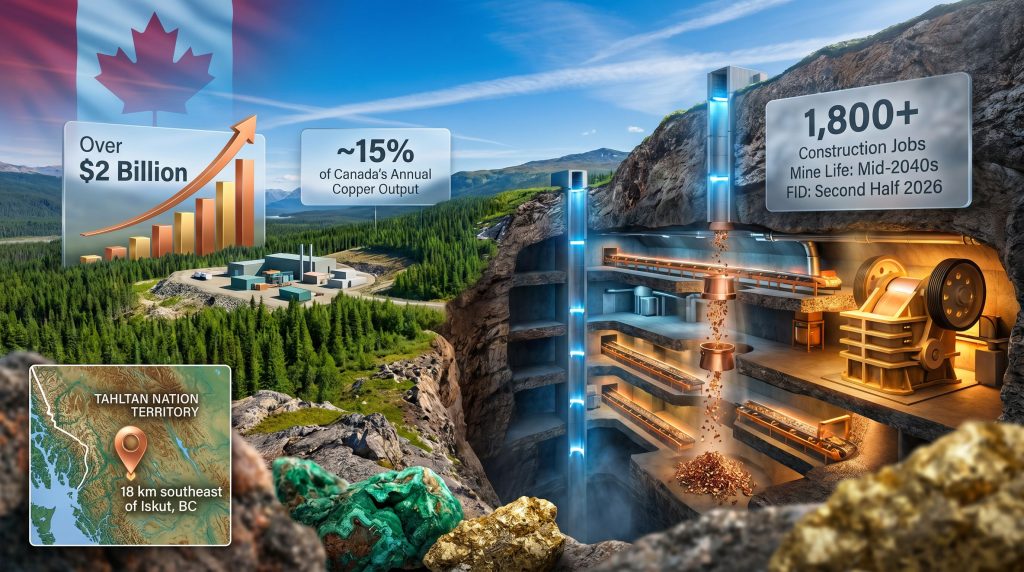
The Red Chris mine is situated approximately 18 kilometres southeast of Iskut in northwestern British Columbia, placing it within one of Canada's most geologically prospective porphyry copper-gold corridors. The region hosts several large-scale mineral systems, and Red Chris represents one of the most advanced.
The project operates as a joint venture between two major partners:
| Partner | Ownership Stake | Role |
|---|---|---|
| Newmont Corporation | 70% | Operator and project lead |
| Imperial Metals | 30% | Joint venture partner |
Critically, the project sits within Tahltan Nation traditional territory. The expansion approval process incorporated a consent-based framework with the Tahltan Nation, embedding revenue-sharing arrangements and community benefit programs into the project's social licence structure. Furthermore, this aspect of the approval carries significance beyond Red Chris itself. Consent-based processes for projects of this scale remain relatively uncommon in Canadian mining history, and the Red Chris model may inform how future large-scale developments are structured under the BC mining claims framework and beyond.
Regulatory Milestones: What Was Approved and Why It Matters
On June 19, 2026, Newmont secured two critical provincial approvals that cleared the primary regulatory gateway for the Red Chris block cave project:
- An amended Environmental Assessment Certificate (EAC) issued by the BC Environmental Assessment Office
- An updated Mines Act permit authorising underground development activities to proceed
Securing both instruments simultaneously is noteworthy. Projects of this scale frequently encounter sequential delays between environmental and operational permitting, where approval of one triggers additional review conditions for the other. The concurrent issuance suggests a high degree of alignment between Newmont's project design and British Columbia's regulatory expectations across both environmental and technical dimensions.
What Comes After Regulatory Approval?
Following these approvals, a definitive feasibility study is now underway alongside a detailed capital cost estimate. Both the DFS and the Final Investment Decision (FID) are targeted for the second half of 2026. The FID is the pivotal moment at which Newmont formally commits the full capital programme to construction, transforming regulatory approvals into active mine development.
The Financial Scale and Economic Footprint of Red Chris
The numbers behind the Red Chris block cave project are substantial, both at the project level and in terms of their national economic significance.
| Metric | Projected Figure |
|---|---|
| Planned Capital Investment | Over $2 billion |
| Mine Life Extension | Extended to the mid-2040s |
| Peak Construction Employment | 1,800+ jobs |
| Peak Operating Employment | 1,500 roles |
| Potential Uplift to Canadian Copper Output | Approximately 15% of annual national production |
The employment figures deserve context. Northwestern British Columbia is a region where large-scale industrial employment has direct multiplier effects on remote and Indigenous communities. A peak construction workforce exceeding 1,800 people, followed by a sustained operating workforce of 1,500, represents a generational economic anchor for the region.
The potential 15% uplift to Canada's annual copper output from a single project is the statistic that most clearly communicates Red Chris's national significance. The copper demand drivers shaping global markets have explicitly elevated copper as a priority commodity under Canada's federal Critical Minerals Strategy, and the country's ability to meet growing domestic and allied-nation demand depends substantially on projects like this advancing through sanction.
A single project capable of increasing a nation's total output of a critical mineral by approximately 15% is rare in modern mining. That scale of contribution places Red Chris in a distinct category within Canada's critical minerals pipeline.
Newmont's Block Cave Capability: The Newcrest Inheritance
One factor frequently underappreciated in discussions of the Red Chris block cave project is the institutional knowledge transfer that accompanied Newmont's 2023 acquisition of Newcrest Mining. Block caving is a technically demanding discipline. It requires geomechanical expertise, cave propagation modelling capability, and operational experience managing the complex, evolving stress environments that develop as a cave matures over years and decades.
Newcrest brought with it deep experience operating the Cadia Valley block cave in New South Wales, Australia, which ranks among the largest copper mines by production globally. That operational template — the design philosophies, the geotechnical monitoring systems, the draw strategy frameworks — now sits within Newmont's institutional toolkit.
This matters for Red Chris because block caving is not a method that can be effectively learned on the job at a single new project. The learning curve carries real financial consequences. Having an operator with proven, scalable block cave execution capability reduces both technical risk and the probability of costly operational adjustments during cave establishment, which is typically the most capital-intensive and technically sensitive phase of a block cave's life.
Newmont's leadership has characterised Red Chris as a long-term growth asset central to the company's strategy of transitioning legacy open-pit operations into higher-value underground mines. Both copper and gold sit at the centre of Newmont's long-term commodity diversification thesis, and Red Chris provides meaningful forward production exposure in both metals from a single, large-scale system.
The next major ASX story will hit our subscribers first
Surface Footprint Comparison: Underground vs. Open-Pit Expansion
One of the less-discussed advantages of the block cave method in a regulatory and community context is its surface footprint. The comparison against a hypothetical open-pit expansion is stark:
| Factor | Open-Pit Expansion | Block Cave Underground |
|---|---|---|
| New Surface Disturbance | High, expanding pit walls and waste dumps | Minimal, existing surface infrastructure reused |
| Community Visual Impact | Significant | Low |
| Long-term Rehabilitation Scope | Larger area requiring remediation | Smaller surface area affected |
| Access to Deeper Ore | Limited by pit economics | Full access to depth |
By directing all new mining activity underground, the Red Chris block cave project avoids the progressive expansion of a visible open pit — a factor likely relevant to both the Tahltan consent process and the BC Environmental Assessment Office's amended certificate review.
Technical Challenges Specific to the Red Chris Block Cave
No honest assessment of the Red Chris block cave project omits the technical challenges inherent to the method at depth.
Geotechnical and Seismic Considerations
Geotechnical complexity is the primary consideration. The ore body must cave reliably and consistently over its designed footprint. Irregular cave propagation — where parts of the ore column arch over and fail to draw down evenly — creates both operational inefficiencies and safety risks. Pre-conditioning through hydraulic fracturing mitigates this, but the efficacy of pre-conditioning depends on accurately characterising the in-situ stress regime and rock mass strength at depth, work that forms a critical component of the ongoing DFS.
Seismic monitoring infrastructure is not optional in block cave operations. As the cave propagates and stress redistributes through the surrounding rock mass, induced seismic events are an expected consequence. Their management through real-time monitoring systems, draw rate adjustments, and ground support protocols is a standard but technically demanding operational discipline.
Underground Infrastructure Requirements
The underground infrastructure requirements are extensive:
- Dedicated haulage levels and ore passes connecting extraction drives to the primary crusher
- Ventilation raises to manage air quality across the expanding underground workings
- Conveyor systems linking the underground crusher to surface processing facilities
- Potentially electrified underground mobile equipment, consistent with broader industry trends toward battery-electric underground fleets that reduce diesel particulate emissions and ventilation loads
Water and tailings management also scale with the project's multi-decade operational horizon. Tailings storage facility design for a mine operating into the mid-2040s must account for significant volumes of process water and tailings solids accumulated over nearly two decades of underground production.
Canada's Copper Race and the Global Demand Backdrop
Industry analysts broadly expect the copper supply crunch to tighten substantially through the late 2020s and into the 2030s as demand growth outpaces new mine supply, driven by electric vehicle manufacturing, transmission grid expansion, and renewable energy infrastructure deployment. The Red Chris block cave project does not exist in isolation from these pressures — it is advancing directly in response to them.
Canada's positioning within this dynamic is defined partly by the depth and quality of its porphyry copper inventory, particularly in British Columbia, and partly by its ability to move projects from resource to production within a regulatory and social licence framework that increasingly demands consent-based Indigenous engagement.
Red Chris's combination of scale, technical readiness, operator capability, and demonstrated consent-based approval pathway makes it one of the most closely watched copper development projects in North America's near-term pipeline. For investors and industry observers tracking how the global copper supply gap gets filled, the second half of 2026 and the expected FID outcome will be a defining data point.
FAQ: Red Chris Block Cave Project
When is the Final Investment Decision expected?
The FID is targeted for the second half of 2026, following completion of the Definitive Feasibility Study.
What is the total planned capital investment?
Newmont has indicated a planned investment exceeding $2 billion for the underground expansion.
How long will the mine operate under the block cave plan?
The expansion is designed to extend Red Chris's operational life into the mid-2040s.
What commodities does Red Chris produce?
Red Chris is a porphyry copper-gold deposit, with copper and gold as its primary products.
Who owns the Red Chris mine?
The joint venture is held 70% by Newmont Corporation as operator, and 30% by Imperial Metals.
What approvals were received in June 2026?
Newmont received an amended Environmental Assessment Certificate from the BC Environmental Assessment Office and an updated Mines Act permit, both granted on June 19, 2026.
How was the Tahltan Nation involved in the approval process?
The expansion received consent-based approval from the Tahltan Nation, with revenue-sharing and community benefit arrangements embedded in the project's social licence framework.
This article is intended for informational purposes only and does not constitute financial or investment advice. Projections regarding capital investment, employment, production uplift, and timelines are based on publicly available statements and are subject to change pending completion of the Definitive Feasibility Study and Final Investment Decision. Readers should consult independent professional advice before making any investment decisions.
Want to Stay Ahead of the Next Major Copper Discovery on the ASX?
Discovery Alert's proprietary Discovery IQ model delivers real-time alerts on significant ASX mineral discoveries — including copper and gold — instantly translating complex geological data into actionable investment insights for both short-term traders and long-term investors. Explore how historic mineral discoveries have generated substantial returns on Discovery Alert's dedicated discoveries page, and begin your 14-day free trial today to position yourself ahead of the broader market.