June 5, 2026
When Technology Meets Accountability: The Verification Problem at the Heart of Modern Mining
Across the global copper industry, a quiet transformation is underway. Open-pit operations that once relied on diesel-powered fleets, manual drilling crews, and analogue instrumentation are being reimagined as interconnected digital ecosystems. Sensors stream real-time data from every corner of the pit. Algorithms model ore flow, water consumption, and energy use simultaneously. Autonomous trucks navigate haul roads without a driver in sight. The language of Silicon Valley has embedded itself firmly into the vocabulary of extractive industry.
Yet this technological leap has created a new and largely unresolved tension. As mining companies increasingly position their operations as models of digital sustainability, a critical question is emerging among civil society organisations, institutional investors, and independent researchers: does technology deployment automatically translate into verifiable environmental and community benefit? At the Quellaveco copper mine in southern Peru, that question — central to evaluating the Anglo American Quellaveco digital mine claims in Peru — has become impossible to ignore.
When big ASX news breaks, our subscribers know first
Quellaveco at a Glance: Scale, Investment, and Strategic Copper Supply
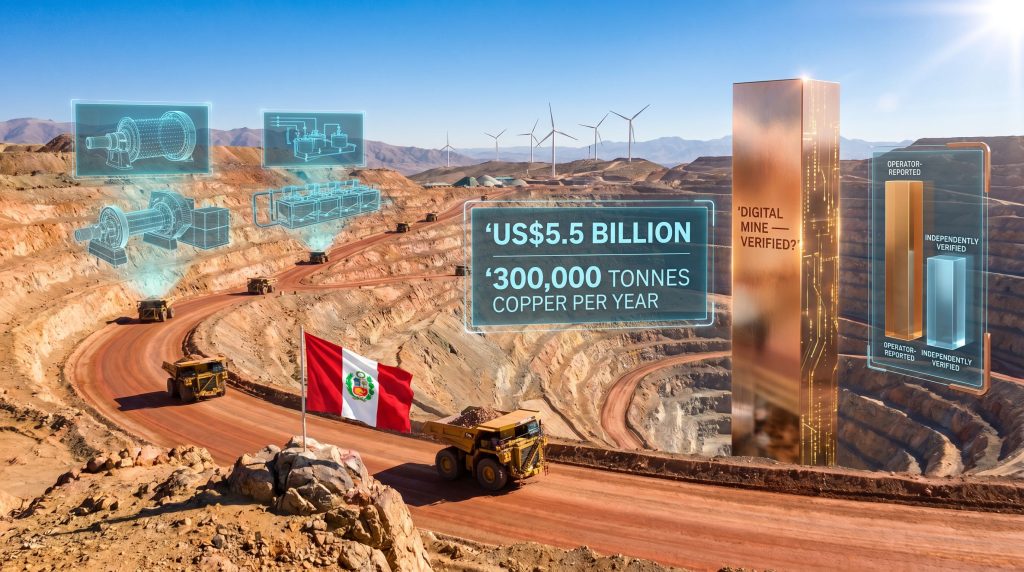
Located in Peru's Moquegua region, a high-altitude and water-stressed area of the country's south, Quellaveco represents one of the most capital-intensive greenfield mining developments in Latin American history. The operation is structured as a joint venture between Anglo American (60%) and Mitsubishi Corporation (40%), and required a total capital investment of US$5.5 billion before the first tonne of copper concentrate was produced.
Copper production commenced in July 2022, and the mine is designed to operate for 36 years, targeting approximately 300,000 tonnes of refined copper annually across its first decade. Production guidance for 2024 to 2025 sits in the range of 300,000 to 330,000 tonnes per year. The mine has already passed the milestone of one million cumulative tonnes of fine copper produced, a benchmark that underscores both its operational scale and its growing importance to global copper supply chains.
The numbers tell a compelling story about strategic significance:
| Metric | Detail |
|---|---|
| Joint Venture Structure | Anglo American (60%), Mitsubishi Corporation (40%) |
| Total Capital Investment | US$5.5 billion |
| Annual Copper Production Target | ~300,000 tonnes (first decade) |
| 2024-2025 Production Guidance | 300,000 to 330,000 tonnes |
| Designed Mine Life | 36 years |
| Production Commencement | July 2022 |
| Renewable Energy Capacity | 187 MW (Punta Lomitas wind facility) |
| Water Recirculation Rate | 85% |
| Water Intensity | 0.41 m³ per tonne processed |
Copper's role in the global energy transition adds another layer of strategic weight to Quellaveco's output. The critical minerals demand driven by electric vehicles, offshore wind installations, grid-scale battery storage, and solar infrastructure all require substantial copper inputs. As demand projections through 2030 and beyond continue to rise, operations of Quellaveco's scale are increasingly viewed as critical nodes in the energy transition supply chain.
The FutureSmart Mining Framework and What It Actually Deploys
Anglo American's positioning of Quellaveco as Peru's first fully digital copper mine rests on its broader FutureSmart Mining corporate strategy, a framework built around four integrated pillars: automation, digitalization, electrification, and AI-driven process optimisation. What distinguishes Quellaveco within this framework is that its digital infrastructure was designed into the operation from inception, rather than retrofitted onto legacy systems built for an analogue era.
The technological architecture at Quellaveco is genuinely comprehensive. Key systems include:
- Autonomous haulage fleet: Between 27 and 30 Caterpillar 794AC trucks operating under remote supervision, with four units operational by 2022 and the fleet progressively expanded since
- Remote blasthole drilling: Six remote-controlled drills capable of completing a 16-metre hole in 12 to 15 minutes, reducing human exposure to hazardous pit environments
- Digital twin infrastructure: Virtual replicas of all major plant processes, including grinding circuits, flotation cells, tailings systems, water management networks, and electrical distribution, built on Siemens COMOS and Simatic PCS-7 platforms
- Integrated Operations Centre (CIO): A centralised AI-driven command facility enabling real-time scenario modelling and simulation across the entire processing value chain
- Gearless drive systems: Applied to mills and conveyor systems, reducing mechanical failure rates and improving energy efficiency over traditional gear-based configurations
- Full IoT sensorization: Continuous data collection from pit face to processing plant, enabling predictive maintenance and resource optimisation at scale
The involvement of Siemens and Innomotics as primary technology partners across process control and digitalisation layers represents one of the most thoroughly documented deployments of integrated mining automation trends in Latin America. The Integrated Operations Centre, in particular, allows operators to model the consequences of operational decisions before implementing them, a capability that previously required days of offline analysis.
Furthermore, data-driven mining operations of this kind generate enormous quantities of performance metrics, yet the critical question remains whether that data is accessible for independent scrutiny.
The central distinction that matters for evaluating Anglo American's digital mine claims is not whether sophisticated technology has been deployed at Quellaveco. The evidence for that is substantial. The critical question is whether those technologies deliver measurable, independently verifiable environmental and community outcomes, or whether the verification of such outcomes remains almost entirely within the operator's own reporting apparatus.
The Renewable Energy Achievement and Water Management Claims
Among Quellaveco's sustainability credentials, two stand out as the most frequently cited. First, the operation achieved 100% renewable electricity supply in April 2023, sourced from the 187 MW Punta Lomitas wind facility. For a high-altitude copper operation of this scale, complete renewable energy in mining coverage is a genuinely significant operational achievement, and one that is verifiable through grid connection data independent of the operator's own reporting.
Second, Anglo American reports a water intensity of 0.41 cubic metres per tonne of ore processed and an 85% water recirculation rate, both of which the company describes as industry-leading benchmarks for high-altitude copper operations. A dual-use water infrastructure arrangement through the Vizcachas dam is also cited as a mechanism through which local agricultural communities benefit from water access alongside the mining operation itself.
However, the verification status of these metrics varies considerably:
| Sustainability Claim | Verification Status |
|---|---|
| 100% Renewable Energy (April 2023) | Operationally confirmed, verifiable via grid connection data |
| 85% Water Recirculation Rate | Operator-reported; subject to ongoing IRMA audit |
| 0.41 m³/tonne Water Intensity | Operator-reported; subject to ongoing IRMA audit |
| Vizcachas Community Water Benefits | Claimed dual-use model; community-level outcomes not independently quantified |
| Digital Infrastructure Environmental Impact | Largely operator-reported; no independent digital performance audit framework exists |
| Community Program Outcomes | Partially documented; independently verified outcomes limited |
The renewable energy claim occupies a meaningfully different verification category from the water and community claims. Grid-connected renewable energy supply is externally confirmable. Water recirculation rates and community benefit outcomes, by contrast, are currently verifiable only through independent audit processes that are still underway.
What NGO Scrutiny Is Actually Challenging
The challenge raised by civil society organisations examining Quellaveco is not a straightforward rejection of the mine's technological achievements. It is a more precise and analytically important argument: that the existence of sophisticated digital infrastructure does not automatically validate the sustainability narrative built around it.
Three specific areas of challenge have emerged from civil society scrutiny:
1. Attribution of environmental gains. Are measurable improvements in water use and energy consumption genuinely attributable to digital systems, or do they reflect baseline design choices that would deliver similar outcomes regardless of whether AI and digital twins were deployed? The distinction matters because technology can be deployed without meaningfully improving outcomes beyond what better engineering alone would achieve.
2. Community benefit depth versus breadth. Quellaveco has a documented history of community engagement stretching back more than 30 years, culminating in the landmark 2011 consultation agreements with 31 stakeholder groups. Programmes including the Moquegua Development Fund, Agro Quellaveco, and Moquegua Crece have channelled mining revenues into regional development. However, civil society groups raise a persistent question: do affected communities exercise meaningful input into operational decisions, or does their participation extend primarily to negotiating the terms of benefit-sharing rather than shaping the decisions that determine impacts in the first place?
3. The structural accountability gap in Peru's regulatory framework. Peru's Environmental Impact Assessment process establishes baseline performance requirements for large-scale mining projects, but ongoing operational monitoring — particularly for digitally-generated sustainability claims — remains less well developed. The absence of a real-time, third-party environmental verification mechanism means that operator-reported data occupies the evidentiary centre of any sustainability evaluation.
A structural issue quietly underpins the digital mine debate: digital systems generate enormous quantities of operational data, but that data is almost exclusively controlled by and accessible to the operator. Until regulatory frameworks require that data relevant to environmental performance be made available to independent auditors and regulators in real time, the digital mine concept risks becoming a sophisticated form of self-reporting rather than a transparent accountability mechanism.
The IRMA Audit: A Turning Point for Accountability
The most consequential near-term development in the Quellaveco accountability debate is the commencement of an IRMA (Initiative for Responsible Mining Assurance) audit in August 2025, conducted by independent assessment firm ERM CVS. This represents the first comprehensive, site-level, third-party evaluation of responsible mining practices at Quellaveco across environmental, social, governance, and labour dimensions.
The IRMA framework is notably demanding. Unlike many industry self-certification schemes, it requires assessors to evaluate not only whether policies and systems exist, but whether they deliver outcomes at the community and ecosystem level. The timing of the audit, arriving during a period of active civil society scrutiny, makes its findings commercially and reputationally material in ways that a routine compliance review would not be.
The range of possible outcomes carries different implications for Anglo American and for the broader industry:
- Full IRMA certification would validate the digital mine narrative with the credibility of independent verification, strengthening Anglo American's ESG positioning with institutional investors and regulators
- Conditional certification would identify specific gaps between claimed and verified performance, potentially the most instructive outcome for the industry because it would specify where digital deployment has not translated into measurable verified benefit
- Material findings requiring remediation could trigger regulatory attention, investor reassessment, or reputational recalibration at a time when Anglo American is navigating significant portfolio restructuring
Simultaneously, Copper Mark certification is in progress at Quellaveco, adding a second layer of industry-standard verification. The convergence of these two processes in 2025 makes this a period of genuine accountability stress-testing for the operation's sustainability claims.
Anglo American's November 2025 announcement of a further US$850 million commitment to ongoing Quellaveco optimisation is being interpreted differently by different stakeholder groups. For investors, it signals confidence in the asset's long-term value and further development of its digital capabilities. For civil society organisations, capital commitment to infrastructure does not, by itself, address the question of whether existing claims are independently verified. Both readings reflect legitimate analytical frameworks applied to the same data point.
The next major ASX story will hit our subscribers first
A Framework for Evaluating Digital Mine Sustainability Claims
The Quellaveco situation offers a practical template for how analysts, investors, and civil society organisations should evaluate digital mine sustainability claims more broadly. A rigorous evaluation requires moving through several distinct analytical steps:
-
Separate technology deployment evidence from outcome verification evidence. These are not equivalent. Documenting that a digital twin exists is not the same as documenting that the digital twin has measurably improved water use or community outcomes.
-
Identify which performance metrics are operator-reported versus independently verified. Track precisely which claims have cleared third-party scrutiny and which have not.
-
Assess whether recognised third-party audit frameworks are in place and current. IRMA, Copper Mark, and ISO 14001 represent different levels and scopes of verification. Understanding what each covers and what it does not is essential.
-
Evaluate whether community engagement processes include meaningful decision-making rights. The distinction between communities that negotiate benefit-sharing and communities that influence operational decisions is analytically significant, and the two are often conflated.
-
Examine whether operational data generated by digital systems is accessible to independent auditors and regulators, not only to operators. Transparency of data architecture is a prerequisite for genuine accountability.
The Broader Industry Implication: Is Digital Mine Becoming ESG Shorthand?
Quellaveco is not an isolated case. Across the copper mining industry — from major Chilean operations to projects in Central Africa and Southeast Asia — digital technology deployment is increasingly used as a primary ESG signifier. The pattern is consistent: autonomous equipment, AI-driven process control, and real-time sensor networks are presented as evidence of environmental responsibility without commensurate investment in independent verification of environmental outcomes.
Institutional investors are beginning to probe this gap with greater sophistication. ESG assessment methodologies within the investment community are gradually differentiating between technology adoption metrics, which measure inputs, and outcome accountability metrics, which measure whether those inputs translate into the promised environmental and social results. In addition, the ongoing copper supply crunch is intensifying investor scrutiny of whether major operations like Quellaveco can sustain both output and credible ESG performance simultaneously.
The Anglo American Quellaveco digital mine claims in Peru are analytically valuable precisely because they involve one of the most thoroughly documented digital mining deployments in the world. If independent verification through the IRMA process and Copper Mark certification reveals a meaningful gap between deployed technology and verified outcomes, that finding will reverberate beyond Peru and beyond Anglo American. It will establish an evidential precedent for how the global copper industry should think about the relationship between digital infrastructure and ESG accountability.
Conversely, if independent verification confirms that Quellaveco's digital systems do deliver the environmental and community outcomes claimed, it will strengthen the case for treating comprehensive digital deployment as a genuine sustainability signal rather than sophisticated corporate positioning.
Either way, the Anglo American Quellaveco digital mine claims in Peru are set to become a defining reference point for how the extractive industry's most consequential ESG question is ultimately resolved: not whether technology works, but whether it can be independently shown to do what it is claimed to do.
This article draws on reporting published by Mining Technology on 14 May 2026. Readers seeking additional industry context can explore the original reporting at mining-technology.com. All financial figures, production data, and technology specifications referenced in this article are sourced from operator disclosures and publicly available reporting, including Anglo American's own project documentation. Forward-looking statements, audit outcomes, and market projections involve uncertainty and should not be construed as investment advice.
Want to Stay Ahead of the Next Major Copper Discovery on the ASX?
While the industry debates digital accountability at operations like Quellaveco, Discovery Alert's proprietary Discovery IQ model scans ASX announcements in real time, instantly identifying significant mineral discoveries — including copper — and delivering actionable alerts before the broader market reacts. Explore the historic returns major discoveries have generated and begin your 14-day free trial today to position yourself ahead of the next major find.