August 14, 2026
The Structural Case for Copper: Why the Supply Crunch Is Just Beginning
Picture a commodity where reserves have actually grown faster than they have been extracted, where geological abundance is well documented, and where price discovery has just broken through all-time highs. Now picture that same commodity facing a structural supply deficit so severe that analysts estimate over 80 new mines must come online by 2030 to avoid prolonged industrial shortages. That paradox is copper, and understanding it requires looking well beyond mine output charts.
The copper supply crunch and copper miners sit at the centre of one of the most consequential commodity stories of the decade. It is not a story of geological scarcity but rather a story about the widening gap between what the ground contains and what industry can actually deliver to market. That distinction carries enormous implications for investors, policymakers, and anyone watching the energy transition unfold in real time.
When big ASX news breaks, our subscribers know first
The Resources Are There. The Infrastructure Is Not.
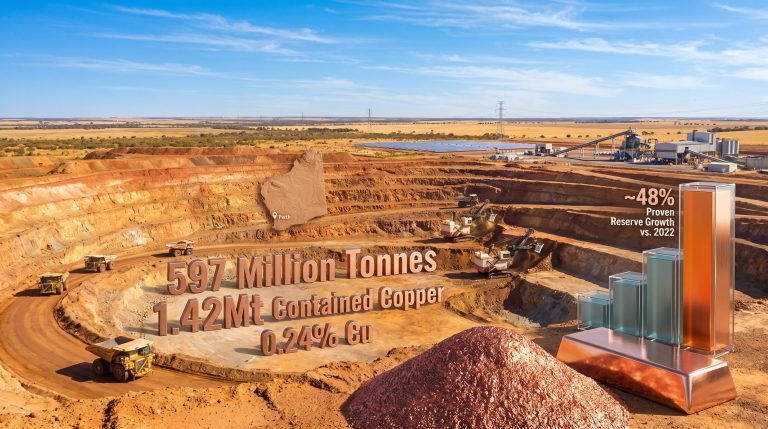
Identified global copper resources are estimated at approximately 5,600 million tonnes, which at current production rates theoretically represents around 243 years of supply. Even more striking, global copper reserves have grown by roughly 547 million tonnes since 2000, a period during which around 441 million tonnes was actually mined. In other words, the industry has been adding to its geological inventory faster than it extracts from it.
Yet the pipeline of new production capacity remains critically thin relative to what demand forecasts require. The bottleneck is not geological. It is operational, jurisdictional, and infrastructural. Specifically, the challenge lies in converting known resources into economically viable, fully permitted, and actively producing mines fast enough to serve a world undergoing simultaneous electrification at scale.
"The world is not running out of copper in the ground. It is running out of time and operational infrastructure to extract it quickly enough to meet near-term demand."
This reframing is crucial. It shifts the policy and investment conversation away from resource exploration and toward development acceleration, permitting reform, and refining infrastructure. Understanding the copper supply crunch in this context makes the structural nature of the deficit far clearer.
Four Structural Bottlenecks Driving the Supply Crunch
The copper supply crunch is best understood as a multi-layer failure across the full supply chain, not a single chokepoint at the mine face. The table below summarises the four structural constraints that interact to suppress available supply even as demand climbs.
| Supply Constraint | Core Issue | Downstream Impact |
|---|---|---|
| Declining Ore Grades | Mature Chilean and Peruvian mines processing significantly more rock per tonne of copper recovered | Rising per-unit production costs; output plateau despite capital investment |
| Development Timelines | New copper mines require 15 to 25 years from discovery to sustained production | Structural lag means decisions made today cannot fill the 2030 supply gap |
| Refining Bottlenecks | China refines over 45% of global supply; US lacks domestic smelting capacity despite raw material output | Raw material surplus masks acute shortages of market-ready refined copper |
| Geopolitical Concentration | Over 50% of global reserves concentrated in five countries | Disruption risk; supply chain vulnerability amplified by resource nationalism |
Ore Grade Decline and Its Hidden Cost
As near-surface, high-grade copper deposits are progressively exhausted, mining operations shift to deeper zones and lower-grade material. The mechanics are straightforward but expensive. If average ore grades decline by half, a mine must process roughly twice the tonnage to produce equivalent copper output.
That means more energy consumption, more water use, more capital equipment, and more waste material per unit of refined metal. Across an industry where major Chilean and Peruvian operations have been producing for decades, this grade compression effect is already measurably constraining throughput per dollar invested.
The Timeline Problem Nobody Talks About Enough
A typical greenfield copper mine follows a development path that looks something like this:
- Exploration and resource definition (5 to 10 years)
- Feasibility study and engineering (2 to 3 years)
- Permitting and regulatory approvals (2 to 5 years, increasingly extended by ESG requirements and community consultation)
- Construction (3 to 5 years)
- Ramp-up to sustained production (1 to 2 years)
The cumulative timeline from initial discovery to meaningful copper output typically spans 15 to 25 years. This creates a structural rigidity that price signals alone cannot override. As Tavi Costa of Aurora Capital has observed, even if the entire global mining industry redirected its focus entirely toward copper supply, it would be virtually impossible to close the projected gap within five years.
That observation has a sharp implication: any mines required to address deficits forecast for the early 2030s should already be well into their development cycle today. Most are not. Industry estimates suggest $250 to $285 billion in new capital investment and more than 80 new mines are required by 2030, targets the current trajectory of project development is not on course to meet. UNCTAD has similarly warned that the copper supply crunch poses a direct threat to both energy and digital transitions globally.
The Refining Crunch Hidden Inside the Apparent Glut
Perhaps the least appreciated dimension of the copper supply crunch and copper miners involves the disconnect between raw copper production and refined copper availability. The United States produces approximately 146% of its domestic raw copper needs, yet remains structurally dependent on imports of processed copper products.
The US currently exports approximately 48% of its copper concentrate because domestic smelting and refining infrastructure is insufficient to process the material produced. China, by contrast, refines over 45% of global copper supply, creating a geopolitical chokepoint that raw production statistics do not reveal. Costa draws an explicit parallel to the US oil situation, where the country exports large volumes of light crude because its refineries are configured for heavier grades.
"The copper supply crunch is not simply a mining problem. It is a full supply chain problem spanning extraction, processing, refining, and distribution."
This insight reshapes where investment in supply chain resilience is most urgently needed. Domestic refining capacity expansion may be as strategically important as opening new mines in the near term.
Demand Forces That Are Not Going Away
Global copper demand is projected to rise 40 to 70% by 2040 to 2050, driven by a convergence of structural forces that did not exist simultaneously in prior commodity cycles. Furthermore, the copper price drivers underpinning this demand growth are broad-based and reinforcing.
The primary demand vectors include:
- Solar photovoltaic installations (approximately 100 kg of copper per megawatt of installed capacity)
- Wind turbines (4 to 8 tonnes per megawatt, depending on generator type)
- Electric vehicles (50 to 100 kg per vehicle versus 10 to 20 kg in conventional cars)
- Grid transmission and distribution infrastructure upgrades
- AI data centres and associated power, cooling, and wiring systems
- Manufacturing onshoring in the US and Europe, requiring redundant copper-intensive infrastructure buildouts
China's position as the consumer of approximately 50% of global copper production means its industrial trajectory remains the single most important demand variable. However, the narrative around AI infrastructure demand is increasingly significant and, as Costa notes, broadly underappreciated relative to how much copper physical data centre buildouts actually require.
Deglobalisation amplifies this picture further. When competing geopolitical blocs each build their own copper-intensive supply chains in parallel rather than sharing consolidated global networks, total copper demand per unit of global economic output rises structurally. This is a demand multiplier that most conventional forecasting models understate.
Price Discovery at All-Time Highs: What History Suggests
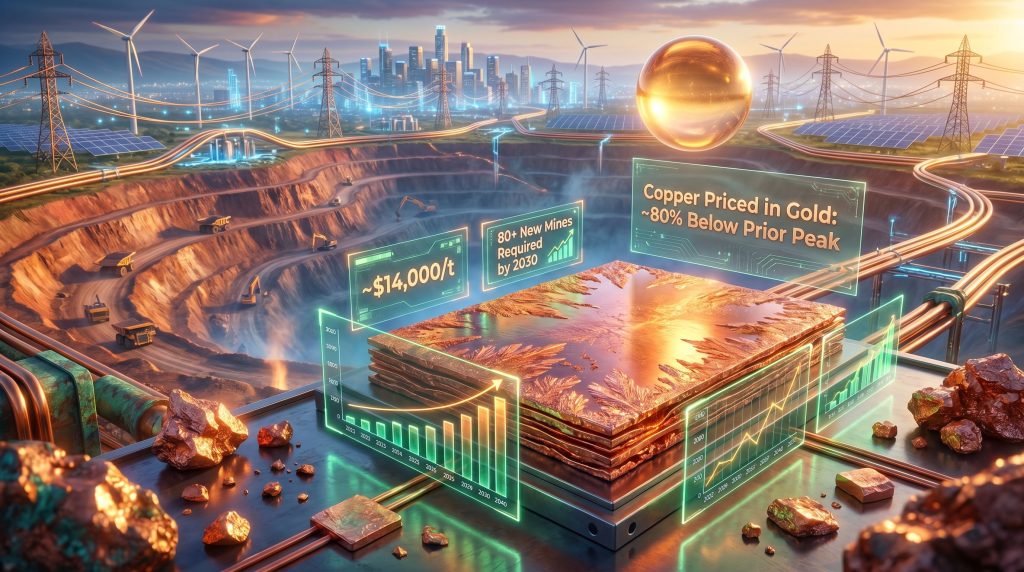
Copper prices approached approximately $14,000 per tonne in 2025 amid supply disruptions and accelerating demand recognition. Nominal all-time highs can discourage entry, but Costa's framing offers a useful counterpoint. Indeed, copper nearing historic highs has been driven by a combination of sulphur shortages and the AI infrastructure boom, reinforcing the structural demand narrative.
When gold broke above the $2,000 per ounce level, the widespread assumption was that the move had run its course. What followed was a sustained acceleration toward $5,500, driven by the same price discovery dynamic that tends to emerge when a commodity breaks through multi-year resistance. Costa applies this pattern directly to copper, arguing that breaking all-time highs is typically the beginning of an accelerated repricing phase rather than a ceiling.
The valuation signal becomes even more compelling when copper is measured against gold rather than US dollars. Despite nominal all-time highs, copper priced in gold terms remains approximately 80% below its prior historical peak. This relative undervaluation suggests that copper has not yet repriced to reflect its true scarcity relative to monetary assets.
| Metric | Current Status |
|---|---|
| Copper nominal price | Near all-time highs (~$14,000/t in 2025) |
| Copper priced in gold | Approximately 80% below prior historical peak |
| Implied signal | Structurally undervalued on a relative basis despite nominal highs |
Why This Cycle Is Structurally Different From Prior Copper Bull Markets
Past copper bull markets shared a self-correcting logic. High prices incentivised new supply development, which eventually rebalanced markets after a lag. The current cycle disrupts that feedback loop in several ways.
First, mine development timelines mean that even capital deployed today at record copper prices cannot generate meaningful new production before the mid-2030s. The corrective mechanism exists in theory but operates on a timeline too slow to address near-term deficits.
Second, permitting complexity, ESG compliance requirements, water scarcity constraints in key producing regions, and community consent processes have extended development timelines beyond historical norms. The lag between price signal and supply response is longer now than in any prior cycle.
Third, declining ore grades mean that existing operations produce less copper per unit of capital invested over time. The base of current supply is eroding even as new capacity fails to keep pace with demand growth.
Copper recycling currently supplies approximately 33% of global copper consumption and requires roughly 85% less energy than primary production, making it economically and environmentally attractive. However, the step-change in demand required by electrification and AI infrastructure is projected to be so large that recycling, even with significant capacity expansion, cannot close the projected supply gap. It is a critical complement to new mine supply, not a substitute.
The next major ASX story will hit our subscribers first
Where Copper Miners Fit in the Investment Landscape
Copper equities have demonstrated notable outperformance relative to gold miners during the current phase of the commodity cycle. This reflects a rotation dynamic that Costa has been vocal about: capital within the resource sector tends to flow toward the commodity with the most acute supply-demand imbalance.
In his assessment, the cycle typically moves from gold leading, to silver following, to copper capturing institutional attention as the structural deficit becomes undeniable. Consequently, exploring copper investment strategies suited to this environment has become increasingly important for resource-focused investors.
The framework below categorises investment options by risk profile and key consideration.
| Investment Category | Risk Profile | Return Driver | Key Consideration |
|---|---|---|---|
| Major producers (BHP, Rio Tinto) | Lower | Copper price leverage; dividend yield | Already widely held; limited upside asymmetry |
| Mid-tier copper producers | Moderate | Operational leverage; M&A target potential | Balance sheet quality; jurisdiction critical |
| Advanced-stage explorers | Higher | Resource definition; acquisition premium potential | Asset quality and management track record |
| Early-stage explorers | Highest | Discovery optionality; land package quality | Minimal valuation anchor; binary risk |
The Strategic Logic of Advanced-Stage Copper Explorers
Major mining companies face a structural imperative: depleting reserves must be replaced and production must grow to meet demand commitments. This creates a natural acquisition market for advanced-stage projects with defined resources and credible development pathways. Costa identifies the key attributes that attract major company interest as resource size, metallurgical simplicity, jurisdictional stability, and proximity to existing infrastructure.
Furthermore, investment in gold and copper exploration has grown significantly as institutional capital seeks exposure to the next generation of significant discoveries. Australian junior explorers have attracted growing global institutional attention due to a combination of geological prospectivity, stable regulatory frameworks, and geographic proximity to Asian demand centres.
Optionality Premium: Gold Resource Anchors and Copper Upside
One of the more sophisticated structures Costa highlights involves companies that combine a defined gold resource (providing a valuation floor) with copper exploration upside on the same land package. The gold resource anchors market capitalisation and limits downside. Successful copper exploration delivers asymmetric upside without requiring the base asset to perform.
This structure effectively provides a funded, low-cost option on copper discovery within the risk envelope of a gold company. In addition, reviewing the largest copper mines globally helps contextualise why new project development in stable jurisdictions commands such a premium.
"Projects that combine a defined gold resource with copper exploration potential represent one of the most structurally attractive configurations in the junior mining sector today."
The Macro Environment Aligns With the Physical Case
The fundamental copper supply crunch and copper miners thesis is reinforced by a macro backdrop that structurally favours hard assets. Global M2 money supply has expanded by approximately $17 trillion over the past 18 months, reflecting continued monetary accommodation even as inflation pressures persist.
Costa's framework for hard asset allocation rests on a clear scenario analysis. Heavily indebted economies face two paths: disorderly default with deeply deflationary consequences, or an inflationary resolution through sustained monetary expansion. He views the inflationary path as the path of least political resistance, a scenario in which hard assets with constrained supply absorb the excess liquidity that financial assets cannot indefinitely contain.
Sovereign debt levels across major economies create a structural incentive to maintain low real interest rates over the medium term. This reduces the opportunity cost of holding non-yielding hard assets and increases the relative attractiveness of commodity producers. If rate cuts occur against a backdrop of rising commodity prices driven by energy, food, and metals, the resulting negative real rate environment would historically be strongly bullish for copper and copper equities.
UNCTAD data on tariff structures adds a further layer of complexity. Processed copper goods face tariffs of up to 8%, compared to less than 2% on raw ore, a structure that traps resource-exporting nations in low-value supply roles while incentivising importing nations to develop domestic processing capacity. This tariff asymmetry is adding momentum to the domestic refining investment thesis in both the US and Europe.
Frequently Asked Questions: Copper Supply Crunch and Copper Miners
How many new copper mines are needed to meet projected demand?
Industry analysis estimates that 80 or more new copper mines must come online by 2030, requiring between $250 billion and $285 billion in new capital investment. At current rates of project development and permitting, this target is unlikely to be achieved, reinforcing the structural supply deficit thesis.
Why can't high prices simply incentivise enough new supply?
The fundamental constraint is time, not capital. Even with abundant investment, a new copper mine typically requires 15 to 25 years from initial discovery through to sustained production. Price signals sent today cannot generate meaningful new supply before the mid-2030s at the earliest, meaning the supply deficit is effectively locked in for the near term regardless of financing conditions.
Is copper recycling a viable solution?
Recycling currently contributes approximately 33% of global copper consumption and plays a vital role in the supply picture. However, the step-change in demand projected from electrification and AI infrastructure is sufficiently large that recycling alone, even with significant expansion, cannot close the gap. New primary supply from mines remains essential.
Why are copper miners outperforming gold miners right now?
Resource sector capital tends to rotate toward the commodity with the most acute supply-demand imbalance. As copper has broken to all-time nominal highs and the structural deficit has become more widely recognised, institutional capital has rotated into copper producers and developers from gold equities, which had already experienced a strong performance run.
What is the copper-to-gold ratio and why does it matter?
The copper-to-gold ratio measures the relative price of copper against gold and serves as a valuation signal for whether copper is cheap or expensive against monetary assets. Currently, copper priced in gold terms remains approximately 80% below its prior historical peak, suggesting significant revaluation potential even at current nominal all-time highs.
Which regions are most important for future copper supply?
Chile and Peru currently dominate global production but face declining ore grades, water scarcity, and social licence challenges. The Democratic Republic of Congo represents a major growth region but carries significant geopolitical risk. Australia is increasingly recognised as a stable, high-potential jurisdiction, particularly for junior explorers targeting global institutional capital.
Key Takeaways: The Copper Supply Crunch Investment Thesis
- The supply deficit is structural, not cyclical: mine development timelines lock in the gap regardless of near-term price signals or capital deployment
- Nominal all-time highs mask relative undervaluation: copper priced in gold remains approximately 80% below its prior peak, suggesting significant repricing room remains
- The macro backdrop is aligned: monetary expansion, structurally low real rates, and deglobalisation all favour copper and copper miners over the medium term
- Advanced explorers in stable jurisdictions offer asymmetric exposure as majors compete to secure future supply through acquisition
- Recycling and refining capacity are underappreciated dimensions of the crunch alongside mine supply
- 80-plus new mines and $250 to $285 billion in investment are required by 2030, a target the industry is not currently on track to meet
- The commodity cycle rotation from gold to silver to copper appears to be in progress, with institutional capital flows beginning to reflect copper's structural position
Disclaimer: This article is for informational and educational purposes only and does not constitute financial advice. All forecasts, projections, and investment frameworks referenced reflect the views of third-party analysts and industry sources and involve inherent uncertainty. Readers should conduct their own due diligence and consult a licensed financial adviser before making investment decisions. Commodity prices and market conditions referenced reflect data available at the time of writing and are subject to change.
Want to Know When the Next Major Copper Discovery Hits the ASX?
Discovery Alert's proprietary Discovery IQ model delivers real-time alerts the moment significant mineral discoveries — including copper — are announced on the ASX, turning complex geological data into actionable investment insights before the broader market reacts. Explore historic examples of major discoveries and their remarkable returns, then start your 14-day free trial at Discovery Alert to position yourself ahead of the next structural opportunity in copper.