June 6, 2026
The Energy Transition's Hidden Supply Chain Imperative
The global race to decarbonise energy systems has quietly engineered one of the most significant commodity demand cycles in modern history. Every electric vehicle rolling off a production line, every solar farm commissioned, and every AI data centre drawing power from a grid requires copper in quantities that existing mine supply pipelines are increasingly struggling to match. The critical minerals transition is, consequently, reshaping how investors evaluate jurisdictional risk and opportunity. Against this structural backdrop, the question facing institutional investors and mining majors alike is not whether copper demand will grow, but rather which jurisdictions possess the geological endowment, governance maturity, and infrastructure connectivity to meet it.
Zambia's answer to that question is becoming increasingly difficult to ignore. With a well-established copper mining heritage, a mineral inventory extending well beyond copper, and a reform agenda actively lowering the barriers to entry for global capital, the favourable outlook for the mining sector in Zambia is grounded in measurable fundamentals rather than speculative optimism.
When big ASX news breaks, our subscribers know first
Zambia's Mineral Endowment in a Global Supply Chain Context
Copper as the Anchor Commodity
Zambia occupies a commanding position in the global copper supply architecture. Mining accounts for over 70% of the country's total export earnings, making the sector not merely economically significant but structurally central to national financial stability. This concentration, while carrying its own risk profile, reflects the scale of the underlying geological endowment rather than a failure of economic diversification alone.
The country's copper resources span two distinct geological systems. The established Copperbelt Province has been the backbone of Zambian copper production for over a century, hosting large-scale, relatively shallow sediment-hosted copper deposits with well-understood metallurgy. Separately, the North-Western Province represents a geologically distinct copper system that differs in mineralisation style, structural controls, and depth profile from the traditional Copperbelt. This distinction matters for investors because it implies different exploration methodologies, extraction technologies, and capital intensity profiles across the two regions.
The geological separation between Zambia's two copper systems means that exploration success in the North-Western Province does not simply replicate the Copperbelt playbook. It represents a genuinely new mineral frontier with its own discovery parameters.
Beyond Copper: The Critical Minerals Diversification Case
Zambia's subsurface holds commercially meaningful quantities of cobalt, lithium, nickel, rare earth elements, and uranium, positioning the country as a potential multi-commodity critical minerals supplier rather than a single-commodity play. Cobalt, in particular, frequently occurs in spatial association with copper mineralisation across the Central African Copperbelt, which straddles the Zambia-DRC border.
To systematically unlock this broader mineral potential, a nationwide high-resolution geophysical survey covering more than half of Zambia's total land mass has been launched, jointly funded by the national government and private sector partners. This public-private approach to geological data generation is strategically significant. In many frontier exploration jurisdictions, the absence of high-quality subsurface data forces incoming investors to fund their own regional surveys before a single drill hole can be justified. Zambia's programme reverses this dynamic by treating geological data as a public good that lowers the information barrier for all market participants simultaneously.
Specific exploration targets advancing through active drilling programmes include:
- Mumbezhi and Chisebuka in the North-Western Province, both of which are generating high-grade copper intercepts through ongoing drilling campaigns
- The Mushima North silver-copper project, which illustrates the polymetallic potential embedded in Zambia's wider mineral system beyond pure copper plays
- Lithium pegmatite targets in underexplored regions, where geological prospectivity for battery-grade lithium is being systematically evaluated
The Investment Case: Capital Flows and Production Ambitions
A Quantified National Production Strategy
Zambia's copper sector growth ambitions are underpinned by a specific, time-bound production target that frames the investment opportunity in concrete terms. Furthermore, the Zambia copper growth forecast aligns closely with global projections for accelerating demand, reinforcing the strategic logic of capital deployment into the country's mining sector.
| Metric | Current Position | Target by 2031-2032 |
|---|---|---|
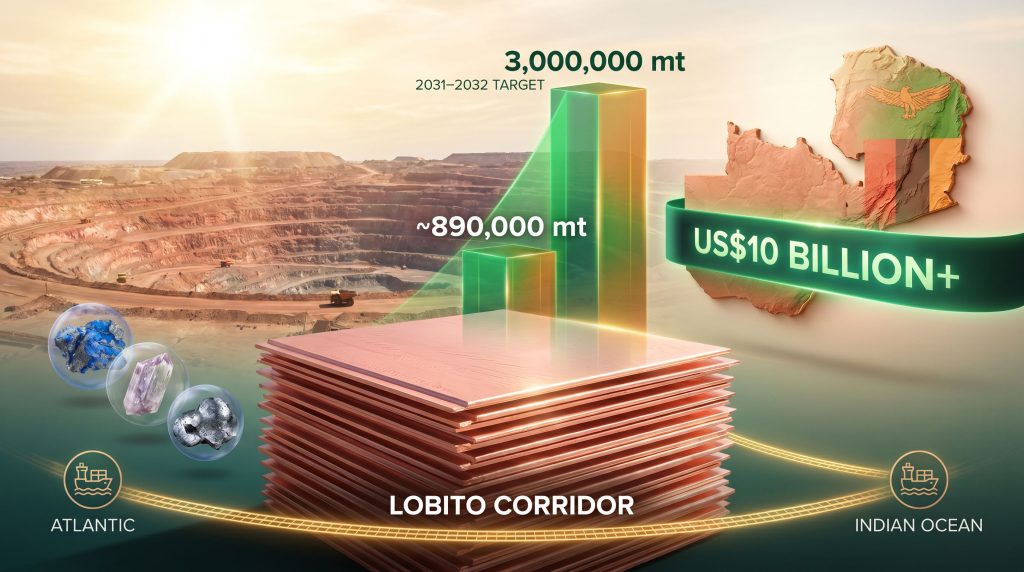
| Annual Refined Copper Output | ~890,346 metric tonnes | 3,000,000 metric tonnes |
| Production Growth Multiple | Baseline | ~3.4x increase |
| Projected Direct Jobs | Baseline | Up to 500,000 roles |
| FDI Attracted (4-year period) | US$10 billion+ committed | Ongoing expansion |
Achieving a 3.4-fold increase in refined copper output within approximately six years is an ambitious engineering and capital deployment challenge. It requires a combination of brownfield expansion at existing operations, greenfield mine development with typical lead times of seven to ten years from discovery to production, and meaningful capacity additions to smelting and refining infrastructure. The distinction between mined copper and refined copper is material here: the production target specifies refined output, implying that Zambia is pursuing downstream value addition within its borders rather than simply exporting concentrate to be processed elsewhere.
Institutional Capital Signals
Several high-profile capital commitments have validated the Zambian investment thesis at an institutional level:
- Anglo American expanded its Zambian presence through the acquisition of Arc Minerals, bringing major mining company capital and technical expertise into the exploration pipeline
- KoBold Metals committed a US$150 million copper exploration investment in the Copperbelt, representing significant early-stage capital from a specialist operator with a data-driven exploration methodology
- Legacy operations including Konkola Copper Mines (KCM), Mopani Copper Mines, and Shaft 28 are undergoing revival and expansion programmes
- New project development is advancing at Mingomba (where a shaft-sinking programme has commenced), Kitumba, and Lubambe Mines
The Mingomba shaft-sinking project is particularly noteworthy from a technical perspective. Shaft sinking is one of the most capital-intensive and operationally complex phases of underground mine development, requiring precision engineering in challenging ground conditions. Its commencement signals that Mingomba has passed feasibility-level scrutiny and is advancing toward production rather than remaining at the prefeasibility stage.
Infrastructure as a Competitive Moat
Zambia's export logistics position is being materially transformed by two infrastructure corridors that between them provide access to both sides of the African continent:
- The Lobito Corridor connects Zambia westward to Angola's Atlantic coast via an upgraded transcontinental rail artery, providing direct access to Atlantic shipping lanes
- A new eastern rail corridor links Zambia to Indian Ocean ports, providing an alternative export route serving Asian and Middle Eastern commodity markets
Together, these corridors position Zambia with rare geographic optionality among landlocked African mining jurisdictions. The ability to route critical minerals exports to either Atlantic or Indian Ocean markets depending on freight economics and buyer location is a structural competitive advantage over single-corridor peers. In addition, addressing the global copper supply gap through improved infrastructure connectivity strengthens the case for Zambia as a reliable long-term supplier to global markets.
Governance Reform and the Investment Climate
Regulatory Modernisation as Market Signalling
Investors in long-cycle mining projects require tenure certainty and administrative transparency above almost all other governance factors. A digital mining cadastre providing online visibility of licence status, tenure security, and land availability directly addresses the opacity that has historically deterred institutional capital from frontier African mining jurisdictions. The system allows prospective investors to evaluate the licensing landscape without bureaucratic intermediaries, reducing both transaction costs and uncertainty.
Business registration and licensing reforms have complemented the cadastral modernisation by streamlining market entry procedures. For mining projects with capital recovery horizons of 20 to 30 years, these governance improvements are not administrative conveniences but material financial factors affecting project NPV through their impact on permitting timelines and development cost certainty. The Canadian Mining Report's analysis of Zambia's sector reforms highlights how these changes are meaningfully reshaping the investment climate for international operators.
Accessibility Advantages Often Overlooked
Several structural features make Zambia operationally accessible in ways that competitors in Francophone and Lusophone Africa cannot match:
- English is the primary language of business, eliminating linguistic barriers for the large cohort of South African mining professionals, engineers, and capital providers who represent a natural investor base
- Relaxed visa arrangements, particularly for South African nationals, reduce the logistical friction associated with site visits, technical assessments, and project development activities
- Political stability provides the operational continuity that long-cycle capital deployments require; civil unrest is relatively uncommon and does not materially threaten business operations
These factors may appear mundane relative to geological endowment and commodity prices, but they compound meaningfully across a multi-decade project lifecycle. Language barriers alone can add substantial cost and timeline risk to technical projects requiring integration of regional expertise.
The 2032 Energy Reliability Mandate
Unreliable electricity supply has been one of the most persistent operational constraints on Zambia's mining and processing sector. The government's commitment to achieving reliable national energy supply by 2032 addresses this directly through a multi-source strategy:
- Solar generation capacity expansion serving domestic consumers
- Renewable energy self-sufficiency incentives for large industrial users, including mining operations
- Grid extension programmes and imported energy as transitional bridging solutions
- Cross-border energy cooperation with the DRC, adding a regional dimension to supply security
For investors evaluating copper smelting and refining investments specifically, energy supply reliability is not a peripheral infrastructure concern. Smelting operations require consistent, high-volume power supply; intermittent availability directly undermines production economics and increases per-unit processing costs. Progress toward the 2032 target will therefore function as a key investment decision variable for downstream processing projects.
Risk Architecture: What Investors Must Quantify
Geotechnical Hazards Specific to Zambia's Geology
The expansion of Zambia's mining sector into deeper extraction methods and new geological settings introduces a risk profile that deserves careful technical assessment:
- Dolomite-related foundation instability creates significant geotechnical challenges in certain regions of the Copperbelt. Dolomite is prone to dissolution by groundwater, creating subsurface voids that can compromise surface and underground infrastructure integrity. Specialist ground investigation is mandatory before infrastructure commitment in affected areas
- Deep extraction methods, including super open pits and underground block caving or sub-level caving operations, introduce elevated geomechanical risk profiles requiring rigorous rock mechanics assessment and monitoring regimes
- Hydrological risks span both the contamination of surface and groundwater systems relied upon by local communities, and the structural performance of tailings storage facilities under extreme weather loading from storms and flood events
The intersection of dolomite geology and tailings management represents a particularly complex risk combination in Zambian conditions. Tailings dams constructed over or near dolomitic ground require enhanced foundation investigation and ongoing performance monitoring beyond standard international benchmarks.
ESG Compliance: From Optional to Mandatory
The compliance landscape for Zambian mining operations is converging with global institutional capital requirements. Adherence to international standards is increasingly a prerequisite for market access rather than a voluntary reputational consideration.
| Standard | Operational Relevance |
|---|---|
| Copper Mark | Responsible sourcing certification increasingly demanded by European and North American buyers |
| Global Industry Standard on Tailings Management (GISTM) | Post-Brumadinho industry benchmark for tailings dam safety governance |
| IFC Performance Standards | Baseline requirement for multilateral development finance access |
| Equator Principles | Applied by major international project finance lenders |
New investor cohorts entering Zambia from the Middle East and India are progressively aligning with these frameworks to access institutional co-financing and offtake agreements from Western buyers. The convergence of ESG requirements across geographically diverse investor pools creates a universal compliance floor regardless of investor origin. However, the broader metals and mining geopolitics surrounding these frameworks continue to evolve, introducing additional layers of complexity for operators navigating multiple regulatory environments simultaneously.
Commodity and Currency Risk Dimensions
The copper supply crunch intensifies the strategic importance of Zambia's production expansion, though investors must nonetheless account for the following risk dimensions:
- Copper price volatility directly affects project economics, with particular sensitivity for higher-cost operations
- Foreign exchange dynamics can erode USD-denominated returns for investors operating with local currency cost structures
- Smaller operators face disproportionate exposure to equipment cost inflation and constrained refinancing options during commodity price downturns
The Professional Services Ecosystem and the Social Licence Imperative
Local Technical Capacity as a Competitive Advantage
Zambia's long mining history has produced a substantial domestic pool of qualified engineers, geologists, metallurgists, and environmental scientists. This local technical talent base reduces the dependency on expatriate specialists that inflates operating costs in emerging mining jurisdictions with shorter industrial histories.
Kitwe, situated at the geographic and commercial heart of the Copperbelt, is consolidating its position as the primary hub for mining professional services. Its proximity to active operations, regulatory agencies, and the technical workforce makes it the logical anchor point for engineering and advisory practices serving both established operators and new entrants. Employee-owned business models operating out of Kitwe align consulting firm incentives with long-term client outcomes, supporting knowledge transfer and sustained local capacity development.
Social Licence to Operate: A Non-Negotiable Prerequisite
The concept of social licence to operate has evolved from a corporate social responsibility abstraction into a hard operational prerequisite. Mining operations that fail to secure and maintain community acceptance face project delays, regulatory intervention, and reputational consequences in global capital markets.
Key social licence dimensions in the Zambian context include:
- Transparent benefit-sharing arrangements with host communities
- Environmental stewardship commitments that go beyond minimum regulatory compliance
- Employment and procurement localisation strategies that generate visible community economic benefit
- Genuine community consultation processes integrated into project planning rather than appended as compliance formalities
Zambia's regulatory framework is increasingly formalising social licence requirements within permitting processes, signalling that community acceptance is transitioning from an informal expectation to a legally cognisable project condition.
The next major ASX story will hit our subscribers first
Looking Toward 2032 and Beyond
Milestones That Will Define the Investment Narrative
The credibility of Zambia's mining growth story will be tested against a series of measurable milestones over the next several years. Investors monitoring sector progress should track:
- Annual copper production trajectory toward the 3 million tonne target by 2031-2032
- Completion of the nationwide geophysical survey and public release of resulting data
- Grid reliability improvements and progress against the 2032 energy security commitment
- Infrastructure advancement along both the Lobito Corridor and the eastern rail route
- ESG certification adoption rates among new market entrants, particularly from emerging investor geographies
- Exploration drilling results from lithium, rare earth, and uranium targets in underexplored regions
- Production ramp-up schedules at Mingomba, Lubambe, and North-Western Province copper projects
The Structural Demand Case
Africa holds approximately 30% of the world's known mineral reserves, and Zambia occupies one of the continent's most strategically positioned nodes within that endowment. The structural demand drivers underpinning the favourable outlook for the mining sector in Zambia are not cyclical phenomena that will reverse with the next commodity price downturn. Electric vehicle adoption curves, renewable energy installation rates, and AI infrastructure buildout are multi-decade demand commitments that will require sustained copper supply growth well beyond any single project's production life.
The country's investment narrative is substantively shifting from one defined by geological potential to one evidenced by deployed capital, advancing project pipelines, and quantified production targets. That transition from promise to delivery is precisely the inflection point at which long-cycle investment commitments generate their strongest risk-adjusted returns. Consequently, the favourable outlook for the mining sector in Zambia reflects not just future promise but a present-day mobilisation of capital, expertise, and policy reform that is already reshaping the country's position in global commodity supply chains. Africa's mining sector outlook broadly supports this view, with Zambia consistently emerging as one of the continent's most compelling investment destinations for the decade ahead.
Disclaimer: This article is intended for informational purposes only and does not constitute financial or investment advice. All production targets, investment figures, and project timelines referenced reflect publicly available information and are subject to change. Readers should conduct their own due diligence and consult qualified financial advisors before making investment decisions. Forward-looking statements involve inherent uncertainty and actual outcomes may differ materially from projections.
Want To Be First When the Next Major Copper Discovery Hits the ASX?
Discovery Alert's proprietary Discovery IQ model delivers real-time alerts on significant ASX mineral discoveries — including copper and critical minerals plays directly tied to the energy transition demand surge — transforming complex geological data into actionable investment insights. Explore how historic discoveries have generated substantial returns on Discovery Alert's dedicated discoveries page, and begin your 14-day free trial today to position yourself ahead of the broader market.