
May 14, 2026
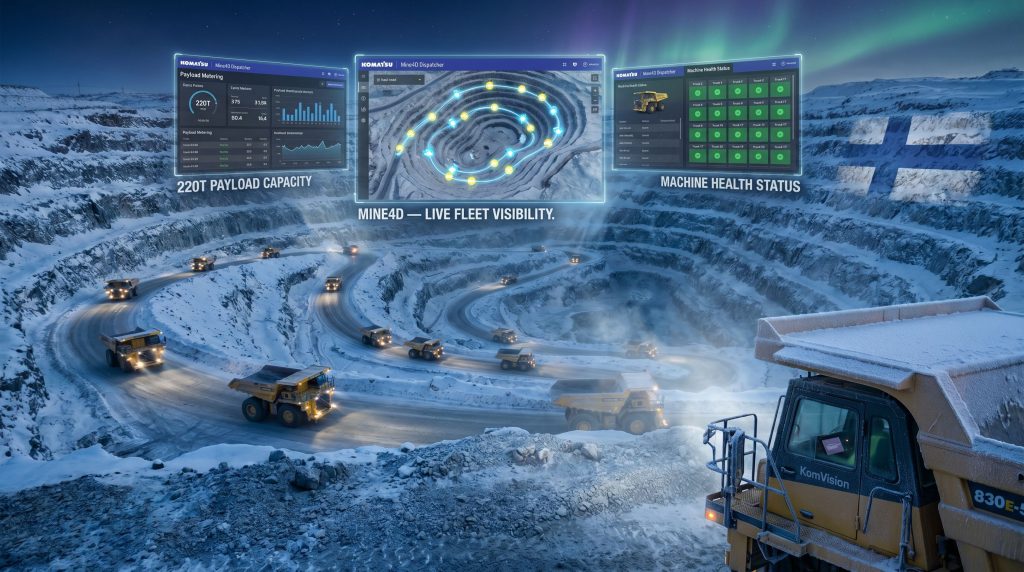
When Visibility Becomes the Variable That Controls Profitability
Across the world's most demanding open-pit mining environments, the difference between a profitable shift and a costly one rarely comes down to ore grade alone. More often, it traces back to something less glamorous: whether the people making decisions in real time actually know what is happening on the pit floor. In extreme-climate operations, this visibility gap compounds with every degree the temperature drops and every hour of daylight that disappears during winter.
The broader mining industry has spent the better part of two decades debating when digital transformation would move from aspirational to operational. The answer, it turns out, has not arrived uniformly. It has arrived first in the places where the cost of not knowing is highest, and few environments on earth make that cost more immediate than a sub-Arctic open-pit mine operating through polar night conditions.
The deployment of Komatsu Mine4D at Boliden's Kevitsa nickel-copper operation in northern Finland represents exactly this kind of pressure-tested case study. It is not simply a technology adoption story. It is a window into how integrated fleet intelligence functions when the environmental and operational variables are stacked against manual systems.
When big ASX news breaks, our subscribers know first
Understanding Kevitsa: An Open-Pit Operation Where Conditions Demand More
Boliden's Kevitsa mine is located in Finnish Lapland, operating as a large-scale open-pit nickel-copper mine in one of the most geographically unforgiving regions of northern Europe. The operation produces nickel, copper, cobalt, and platinum group elements from a low-grade disseminated sulphide deposit, meaning production economics depend heavily on processing large volumes of material efficiently.
The operating environment introduces compounding pressures that simply do not exist at lower latitudes:
- Polar night conditions during winter months reduce natural light to near zero for extended periods, degrading operator situational awareness and increasing the cognitive load on supervisors
- Temperatures regularly reaching -40°C affect equipment response times, lubrication performance, hydraulic system reliability, and the physical endurance of ground-level operations staff
- Large pit footprints typical of bulk-tonnage open-pit operations create radio coverage gaps that interrupt real-time data transmission
- GNSS signal reliability can degrade under extreme cold, particularly where temperature-related hardware stress affects positioning accuracy
Against this backdrop, contractor-managed haulage fleets introduce an additional variable that magnifies the cost of poor visibility. When billing validation depends on manual payload reporting, the gap between what is loaded, what is transported, and what is ultimately invoiced creates a persistent uncertainty that erodes both margin and trust between operators and contractors.
Furthermore, real-time ore sensing technologies demonstrate how continuous measurement systems can eliminate exactly this kind of uncertainty, and the principle applies equally to payload and fleet management in open-pit environments.
In high-throughput open-pit mining, every tonne of payload uncertainty represents both a financial reconciliation problem and a productivity signal that goes unread until it is too late to act on it.
The hidden cost is not limited to billing disputes. Rehandling of misrouted material, delayed identification of haul road deterioration, and shovel-truck cycle time drift across 24-hour shift rotations all share a common root cause: decisions made without accurate, real-time operational data.
What Mine4D Actually Does: A System-Level Explanation
Komatsu Mine4D is a unified fleet management and production intelligence platform designed to consolidate data streams from across an active mining operation into a single, time-synchronised interface. Understanding how it works requires stepping through its functional layers rather than treating it as a single technology.
The Core Data Architecture
Mine4D operates across four integrated layers that together create a live operational picture:
- GNSS Positioning – High-precision satellite tracking synchronised across all mobile equipment in the fleet, providing real-time location data that feeds dispatcher visualisation tools
- Machine Health Monitoring – Continuous ingestion of mechanical and operational diagnostics from haul trucks, shovels, and auxiliary equipment, enabling early identification of developing faults
- Production Data Integration – Payload metering outputs, cycle tracking records, and material routing data consolidated into a unified database with consistent timestamps across all data sources
- Dispatcher Visualisation Interface – A map-based live display showing equipment locations, operational statuses, queue positions, and performance deviations as they develop
Designed for Operational Resilience in Hostile Environments
What separates Mine4D from conventional fleet management software is not the individual capabilities but the system architecture's tolerance for the conditions under which it must operate. The platform is built to maintain functionality despite variable radio coverage across wide pit footprints, temperature extremes that would compromise standard hardware, and the continuous data demands of 24/7 shift operations without scheduled downtime windows.
Mine-specific configuration capabilities allow routing protocols, stockpile destination rules, and priority queue logic to be encoded directly into the platform rather than applied as manual overrides by dispatchers under pressure. This aligns closely with broader data-driven mining operations principles that are increasingly shaping how modern mines are managed.
| Mine4D Capability | Operational Function | Relevance to Arctic Operations |
|---|---|---|
| Live GNSS fleet tracking | Real-time equipment location mapping | Critical for pit-wide visibility during polar night |
| Payload metering integration | Automated production and billing reporting | Eliminates manual reconciliation errors in contractor environments |
| Machine health data ingestion | Predictive maintenance alerting | Faster fault detection under cold-weather equipment stress |
| Dig line compliance monitoring | Material routing enforcement | Reduces rehandling and destination misrouting |
| Shovel-truck cycle analytics | Shift-level productivity benchmarking | Optimises continuous haulage across 24/7 rotations |
The 830E-5 Fleet: Hardware as the Foundation of Digital Intelligence
The Mine4D deployment at Kevitsa does not operate in isolation from the equipment it monitors. The integration is enabled in large part by the capabilities built into Komatsu's 830E-5 diesel-electric haul trucks, which form the backbone of Kevitsa's haulage fleet.
Key Specifications of the Komatsu 830E-5
- Payload capacity: 220 tonnes per cycle, suited to Kevitsa's bulk-tonnage production requirements
- Emissions compliance: EU Stage-V certified, representing a significant reduction in diesel particulate and nitrogen oxide output compared to prior-generation equipment
- Drivetrain: Diesel-electric architecture providing efficiency advantages and the mechanical foundation for future electrification pathways
- Electrification readiness: Hybrid trolley-capable design, with conversion to full electric haulage achievable within approximately a four-week retrofit window
- Cabin systems: KomVision display technology enhancing operator situational awareness, particularly relevant during polar night operations
- Data infrastructure: Onboard payload metering and cycle monitoring systems that feed production data directly into Mine4D's reporting layer
This final specification is arguably the most consequential from a digital operations perspective. The 830E-5's payload metering system transforms the truck from a haulage asset into a data-generating node within the Mine4D ecosystem. Each completed haul cycle produces verified payload data that flows directly into billing validation and production reporting functions, eliminating the manual reconciliation step that previously created uncertainty in contractor-managed fleet environments.
The architectural relationship between the 830E-5's onboard measurement capabilities and Mine4D's production layer illustrates a broader principle in mining technology: hardware investment only delivers its full return when it is integrated into a platform capable of converting raw machine data into actionable operational intelligence.
Modular Mining Systems: Adding a Third Layer
Kevitsa's digital infrastructure extends beyond the Komatsu ecosystem. Dispatch and maintenance optimisation systems from Modular Mining are integrated alongside Mine4D, creating a multi-vendor data environment where different systems contribute complementary intelligence. Mine4D functions as the unifying visualisation and reporting layer, drawing on Komatsu machine health data and Modular Mining dispatch logic simultaneously to produce a more complete operational picture than either system could generate independently.
This multi-vendor integration approach reflects a maturing understanding within the mining innovation trends landscape that no single technology provider can supply every component of a fully optimised digital operation. The strategic question for mine operators is not which single platform to adopt, but how to architect a data ecosystem where multiple systems communicate effectively.
From Reactive to Predictive: The Operational Transformation at Kevitsa
The practical impact of Mine4D deployment at Kevitsa is most clearly understood by examining what changed at the dispatcher and supervisor level. The contrast between pre-deployment and post-deployment operational management illustrates the scope of the shift.
Before Mine4D: Managing by Approximation
Prior to real-time fleet intelligence, supervisors at operations like Kevitsa relied on a combination of radio check-ins, manual production logs, and delayed end-of-shift tallies to understand what was happening across the pit. This methodology has several structural weaknesses:
- Equipment positions were known at the moment of a radio call, not continuously
- Payload data was self-reported or estimated, creating billing uncertainty
- Haul road deterioration was identified reactively, after it had already affected cycle times
- Shovel-truck matching inefficiencies accumulated invisibly across shift rotations
- Shift handover was based on supervisor recollection and manual records rather than verified data
After Mine4D: Managing by Evidence
The live map interface gives dispatchers and supervisors a continuously updated operational picture that enables intervention before problems compound:
- Truck positions, shovel queue status, and cycle time deviations are visible as they develop
- Payload data from onboard metering is validated in real time, removing billing uncertainty from contractor relationships
- Equipment health diagnostics allow maintenance teams to respond to developing faults before they cause unplanned downtime
- Dig line boundary compliance is monitored automatically, reducing the risk of material misrouting
- Shift handover quality improves as outgoing supervisors can provide data-verified operational summaries rather than anecdotal accounts
The reduction in administrative workload for supervisory teams is a direct consequence of this shift. Time previously consumed by manual data reconciliation, radio-based position tracking, and post-shift reporting becomes available for higher-value operational decision-making. In addition, AI mining efficiency tools are increasingly being integrated alongside platforms like Mine4D to further reduce the burden on human supervisors.
Kevitsa as a Cold-Climate Benchmark for Global Mine Digitalisation
The significance of the Komatsu Mine4D at Boliden Kevitsa deployment extends beyond the single operation. Kevitsa's operating conditions represent one of the most demanding test environments for fleet management technology anywhere in the world. A platform that performs reliably at -40°C, across large pit footprints with variable radio coverage and during polar night conditions, has demonstrated capabilities that are directly transferable to other extreme-climate operations globally.
The replicable deployment model this creates is relevant to open-pit operations across:
- Northern Canada and Alaska, where temperature extremes and remote locations create similar visibility challenges
- Greenland, where emerging mineral development faces comparable Arctic operating conditions
- Northern Sweden and Norway, where established mining regions operate under comparable seasonal constraints
- Parts of Russia and Central Asia, where bulk-commodity open-pit mines operate through extended winter periods
Boliden's Broader Digitalisation Strategy
Kevitsa does not stand alone within Boliden's operational technology roadmap. The company has deployed Komatsu's FrontRunner autonomous haulage system across its Aitik copper mine in northern Sweden, where 11 trucks now operate under autonomous control. Komatsu recently reached the milestone of commissioning its 1,000th FrontRunner autonomous haul truck, marking a significant threshold in the industrialisation of autonomous surface mining equipment.
| Boliden Operation | Technology Platform | Fleet Scale | Primary Objective |
|---|---|---|---|
| Kevitsa, Finland | Mine4D + 830E-5 trucks + Modular Mining | 17 haul trucks | Real-time visibility and payload accuracy |
| Aitik, Sweden | FrontRunner Autonomous Haulage | 11 autonomous trucks | Reduced operator dependency and productivity optimisation |
The logical progression between these deployments is worth examining carefully. Mine4D provides the real-time data foundation, including continuous equipment positioning, machine health monitoring, and production reporting, that autonomous haulage systems require to operate safely and efficiently. The Kevitsa deployment may therefore represent not just a standalone productivity tool but a foundational data layer that positions the operation for a future autonomous integration pathway.
The next major ASX story will hit our subscribers first
Evaluating Real-Time Fleet Platforms: What the Mine4D Model Reveals About Industry Direction
The contrast between Mine4D's approach and conventional fleet management systems is instructive for mining operators evaluating digital investment decisions. Mining automation trends increasingly point towards the same architectural principles that Mine4D embodies: continuous data ingestion, real-time visualisation, and configurable rule-based logic.
| Capability Dimension | Conventional Fleet Management | Mine4D Approach |
|---|---|---|
| Data synchronisation | Periodic batch updates | Continuous real-time ingestion |
| Environmental resilience | Standard operating conditions | Designed for -40°C and variable radio coverage |
| Payload validation | Manual post-shift reconciliation | Automated real-time metering |
| Autonomous integration | Limited architectural compatibility | Aligned with FrontRunner integration pathway |
| Mine-specific configuration | Rigid preset rules | Fully configurable routing, destination, and priority logic |
| Multi-system integration | Single-vendor dependency | Open architecture supporting third-party platforms |
For mining operators considering comparable deployments, several evaluation priorities emerge from the Kevitsa case:
- Radio coverage mapping across the full pit footprint should precede any deployment commitment, as gaps in coverage directly limit real-time data transmission reliability
- Hardware compatibility assessment between existing truck fleets and the platform's data ingestion requirements determines whether legacy equipment can participate or requires replacement
- Dispatcher training investment is a non-negotiable component of realising the platform's full operational value; technology that supervisors do not use effectively delivers only a fraction of its potential benefit
- Third-party integration planning for systems such as Modular Mining or other dispatch platforms requires architectural pre-work to ensure data flows are coherent and non-duplicative
- Baseline metric capture before deployment is essential for documenting the before-and-after performance differential that justifies continued investment and future expansion
The Broader Significance: Digital Transformation as a System-Level Challenge
Perhaps the most instructive dimension of Komatsu Mine4D at Boliden Kevitsa is what it reveals about the nature of digital transformation in mining more broadly. The deployment is not a point solution. It is the integration of hardware capability, specifically the 830E-5's onboard payload metering and cycle monitoring systems, with software intelligence in the form of Mine4D's visualisation and reporting platform, supported by third-party dispatch logic from Modular Mining.
Each component delivers limited value in isolation. Together, they create an operational intelligence infrastructure that converts machine activity into decision-ready information continuously and automatically.
This systems-level framing has important implications for how mining companies approach technology investment. The question is not whether to invest in fleet management software or new haul trucks or dispatch optimisation tools. The question is how to architect an integrated data ecosystem where each investment amplifies the value of the others.
In extreme-climate, high-cost mining jurisdictions like Finnish Lapland, where operating margins are under constant pressure from energy costs, maintenance demands, and the sheer physical challenge of continuous operations, the ability to extract maximum intelligence from every machine cycle is not a competitive differentiator. It is becoming a prerequisite for sustained operational viability. Coverage of the Kevitsa operation during polar night further illustrates precisely why real-time visibility has become so critical in this environment.
Real-time fleet intelligence in sub-Arctic open-pit mining has crossed the threshold from advantageous to necessary. The Kevitsa deployment demonstrates that this threshold was crossed not by theoretical argument but by demonstrated operational outcome.
Furthermore, detailed technical reporting on Mine4D's real-time fleet control capabilities at Kevitsa confirms that the platform's performance under Arctic conditions represents a meaningful benchmark for the global industry.
Disclaimer: This article contains forward-looking statements and references to operational outcomes based on available industry information. Specific performance metrics attributed to Mine4D deployment at Kevitsa should be verified against official Boliden and Komatsu documentation. Technology capabilities and specifications referenced are subject to change. This article does not constitute financial or investment advice.
Want to Identify the Next Major Mining Discovery Before the Broader Market Does?
Discovery Alert's proprietary Discovery IQ model scans ASX announcements in real time, instantly converting complex mineral data into actionable investment insights across more than 30 commodities — the same kind of operational intelligence that separates informed investors from the rest. Explore historic discoveries and their market returns, then begin your 14-day free trial at Discovery Alert to position yourself ahead of the next significant ASX mineral find.