July 30, 2026
The Copper Consolidation Imperative: Why Scale Has Become Survival in Global Mining
The mining industry has spent the better part of a decade wrestling with a structural paradox: copper demand is accelerating at a pace that individual project pipelines cannot match, yet the assets capable of moving the needle on supply are increasingly concentrated in the hands of a shrinking number of major producers. Organic growth alone cannot close the coming supply-demand gap. The arithmetic of electrification, combined with the capital intensity of building new copper mines from scratch, has made consolidation not merely attractive but logically inevitable.
Against this backdrop, the Anglo American Teck merger approval process stands as the defining transaction of this mining cycle. It is not simply a large deal. It is the only large deal of its kind that has actually progressed through shareholder gates, national security frameworks, and court orders to reach the threshold of final regulatory clearance. No other major mining company has managed to execute a comparable copper-focused consolidation at this scale. Furthermore, understanding why this transaction matters, where it stands, and what it signals for the broader sector requires looking well beyond the headline numbers. These mining consolidation trends reflect a fundamental reshaping of how the industry approaches scale.
When big ASX news breaks, our subscribers know first
Regulatory Milestones: Where the Deal Stands Right Now
The Anglo American Teck merger approval has cleared several of its most critical hurdles, though the final and most consequential approval remains outstanding.
The Approval Scorecard
| Jurisdiction | Regulatory Body | Status | Date |
|---|---|---|---|
| Canada | Investment Canada Act | Approved | 16 December 2025 |
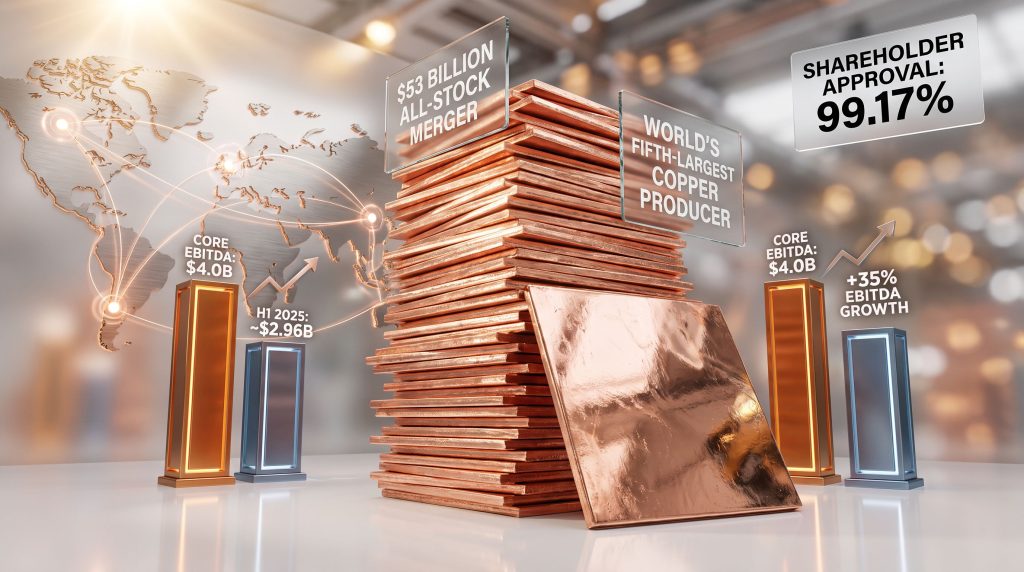
| Anglo American Shareholders | General Meeting Vote | Approved (99.17%) | 9 December 2025 |
| Teck Shareholders | Special Meeting Vote | Approved | December 2025 |
| British Columbia Courts | Supreme Court of BC | Final Court Order Granted | December 2025 |
| European Union | EU Antitrust Review | In Progress | January 2026 onward |
| China | Chinese Regulatory Authorities | Pending | Expected Q3 2026 to Q1 2027 |
The shareholder mandate is worth pausing on. 99.17% approval from Anglo American shareholders at the December 2025 general meeting is a level of institutional consensus rarely achieved for transactions of this complexity. It reflects not just endorsement of the deal itself but a broad investor conviction that the combined copper-focused entity represents a structurally superior vehicle compared to the pre-restructuring Anglo American conglomerate.
Canada's Investment Canada Act clearance, granted on 16 December 2025, removed one of the earlier perceived obstacles given Teck's status as a Canadian company with strategic national assets. The British Columbia Supreme Court's final order in December 2025 completed the domestic legal framework for the transaction.
The China Variable: Complexity at the Final Stage
The remaining approval from Chinese regulators is where the timeline uncertainty concentrates. China's antitrust review process operates under the Anti-Monopoly Law framework, and for major commodity transactions, the review window can extend considerably beyond standard international timeframes. The combined Anglo-Teck entity would control a meaningful share of global copper production, and China, as the world's dominant copper consumer, has both legitimate commercial and strategic reasons to scrutinise the deal thoroughly.
CEO Duncan Wanblad has confirmed that active engagement with Chinese regulators is ongoing. The expected closing window sits between September 2026 and March 2027, a range that reflects the genuine uncertainty embedded in Chinese merger control timelines rather than any signal of regulatory hostility.
It is worth noting that China's use of antitrust review processes in cross-border mining M&A has historically served purposes that extend beyond purely competition-law considerations. The Zijin Mining-Allied Gold transaction collapsing in July 2026 due to Chinese approval delays serves as a contemporaneous reminder that this risk is real and material, not theoretical.
The precedent from other major mining transactions subjected to Chinese review suggests that constructive engagement, asset-level analysis, and patience are the relevant strategic variables during this phase.
Anglo American's H1 2026 Financial Performance: Recovering from Within
While the Anglo American Teck merger approval process works through its final regulatory stage, Anglo's underlying financial performance has been strengthening in ways that validate the strategic direction management has pursued.
Key Financial Metrics: H1 2026 vs H1 2025
| Financial Metric | H1 2026 | H1 2025 | Change |
|---|---|---|---|
| Net Loss | $858 million | $1.9 billion | Loss more than halved |
| Core EBITDA | $4.0 billion | ~$2.96 billion | +35% |
| Analyst EBITDA Consensus | $3.9 billion | N/A | Beat by $100 million |
| Interim Dividend Per Share | $0.23 | $0.07 | +229% |
| Analyst Dividend Consensus | $0.27 | N/A | Below by $0.04 |
The EBITDA beat is particularly meaningful in context. Strong copper earnings were the primary driver, which is not incidental to the merger thesis. It is direct confirmation that the asset Anglo American is building its future around is already generating earnings momentum at current copper prices. With copper trading at approximately $5.64 per pound at the time of H1 2026 reporting, the commodity price environment has been broadly supportive, though investors should note that all-stock deal economics are sensitive to relative share price movements rather than absolute commodity levels.
Reading the Dividend Signal
The interim dividend increase from $0.07 to $0.23 per share represents a 229% year-on-year increase, and while it fell short of the $0.27 analyst consensus, the directional signal is unambiguous. Management is demonstrating enough financial confidence to meaningfully expand shareholder returns while simultaneously funding merger-related transaction costs and ongoing portfolio restructuring activity. The gap versus consensus may reflect a deliberate capital allocation decision rather than financial constraint, preserving flexibility as the deal approaches close.
Portfolio Restructuring: The Architecture of a Focused Copper Miner
The transformation Anglo American has executed since fending off BHP's unsolicited takeover approach in 2024 is among the most aggressive portfolio restructurings undertaken by a major diversified miner in recent decades. CEO Duncan Wanblad accelerated a strategic review that had been building for years, and the results are reshaping the company's asset mix at speed.
Asset Disposal Tracker
| Asset | Category | Status |
|---|---|---|
| Anglo American Platinum (Amplats) | PGMs | Demerged, completed 2025 |
| Steelmaking Coal Business | Metallurgical Coal | Exit in progress |
| Nickel Operations | Base Metals | Exit in progress |
| De Beers Diamond Unit | Diamonds | Sale process underway |
The De Beers Divestiture: A Structural Reckoning
De Beers represents the most strategically complex and financially sobering element of Anglo's restructuring. The business that was once valued at approximately $18 billion is now subject to a sale process where realistic transaction values are reported to potentially be as low as $1 billion, reflecting a carrying value written down to $2.3 billion at end-2025 from over $4 billion previously.
The H1 2026 underlying EBITDA loss of $113 million from De Beers tells the operational story. This is not a cyclical dip. The diamond market faces structural headwinds from multiple directions simultaneously:
- The rapid scaling of lab-grown diamond production has compressed natural diamond pricing, particularly in the jewellery segment
- Luxury demand softness, concentrated in key Chinese consumer markets, has persisted longer than most industry participants anticipated
- Midstream inventory overhang continues to suppress spot market pricing despite upstream production cuts
- Botswana's 15% ownership stake and its contractual right of first refusal introduces sovereign complexity into any transaction, requiring alignment between commercial bidders and a national government with its own strategic agenda
Anglo CEO Duncan Wanblad has indicated that no preferred bidding consortium has been selected, with multiple parties remaining active in the process. Reported bidder profiles include representatives of diamond-producing countries, former De Beers CEO Gareth Penny (now chairman of Ninety One), a Qatari investment fund, and Israeli businessman Nir Livnat. An update on the preferred bidder is expected in the second half of 2026.
The De Beers situation illustrates a broader principle about commodity business valuations: when the structural dynamics of an industry shift, as they have in diamonds due to lab-grown substitution, no amount of heritage or brand equity insulates a business from fundamental repricing. The gap between peak valuation and current sale trajectory is measured in tens of billions of dollars.
What the Combined Anglo-Teck Entity Will Look Like
The post-merger copper portfolio is the ultimate destination of this multi-year strategic transformation. Understanding the scale and quality of what will be created helps frame why analysts at Jefferies have characterised the combined entity's copper business as transformational.
Global Copper Producer Rankings Post-Merger
| Company | Estimated Annual Copper Output | Global Rank (Approximate) |
|---|---|---|
| Freeport-McMoRan | ~1.8 million tonnes | 1-2 |
| BHP | ~1.7 million tonnes | 2-3 |
| Codelco | ~1.4 million tonnes | 1-3 |
| Glencore | ~1.0 million tonnes | 4 |
| Anglo-Teck Combined (estimated) | ~800,000 to 1,000,000 tonnes | 5 |
| Rio Tinto | ~700,000 tonnes | 6 |
Note: Output figures are approximate, based on publicly available production guidance. Exact combined production will depend on ramp-up trajectories, particularly at Teck's QB2 operation in Chile.
Notably, Codelco remains the top copper producer by reputation and state-owned significance, though the combined Anglo-Teck entity would meaningfully close the competitive gap with the industry's leading players.
Teck's QB2: The Anchor Asset That Changes Everything
Teck's Quebrada Blanca Phase 2 operation in northern Chile is one of the most significant new copper mines brought into production globally in recent years. QB2 is a large-scale, long-life, open-pit sulphide deposit with a mine life extending several decades. Its importance to the combined entity cannot be overstated: it provides brownfield expansion optionality, infrastructure already in place, and a reserve base that underpins long-duration production growth rather than just near-term output.
This complements Anglo's existing tier-one copper portfolio anchored by:
- Quellaveco in Peru, a world-class operation that only recently reached full production capacity
- Los Bronces in Chile, a long-established and well-understood asset with meaningful remaining mine life
- Collahuasi (joint venture), one of the world's largest copper mines by contained metal
The geographic concentration in Chile and Peru is a point of analytical interest. Both jurisdictions carry royalty and regulatory risks that have been elevated in recent years as governments across Latin America have sought greater resource revenue participation. Investors should factor jurisdiction risk into any valuation framework, even acknowledging these are classified as lower-risk mining environments relative to global alternatives.
Synergy Capture: What Management Has Committed To
Management at both Anglo and Teck has confirmed that integration planning is being prepared in advance of regulatory clearance, with an intention to begin capturing synergies immediately upon close. The synergy framework is expected to cover:
- Procurement consolidation across a combined copper asset base spanning two major jurisdictions
- Technical expertise transfer between Anglo's established operational teams and Teck's QB2 ramp-up team
- Shared infrastructure planning for future capital projects, reducing per-unit development costs
- Consolidated exploration budgets applied against a combined greenfields portfolio
The Demand Side: Why Copper Scarcity Is Structural, Not Cyclical
The Anglo American Teck merger approval process is unfolding against a copper demand backdrop that most market participants accept is structurally different from prior commodity cycles. In addition, the copper demand drivers underpinning this transaction are increasingly well-understood by institutional investors.
The Copper Intensity Multiplier
Copper consumption per unit of economic activity is increasing, not decreasing. The key demand vectors are well-documented but worth understanding in their specificity:
- A battery electric vehicle contains approximately 2.5 to 4 times more copper than a comparable internal combustion engine vehicle, with high-end estimates placing EV copper content at 80 to 100 kilograms per vehicle
- Grid infrastructure upgrades required to support electrification represent a demand category that grows independently of EV adoption rates
- AI data centre buildout has emerged as a newer and less-appreciated copper demand category, with the power delivery infrastructure, cooling systems, and cabling within large-scale computing facilities representing meaningful incremental consumption per facility
Why New Supply Cannot Close the Gap Quickly
The supply response to higher copper prices faces structural delays that are not fully appreciated by investors unfamiliar with mine development timelines. Consequently, the copper supply crunch facing the market over the coming decade is not simply a function of underinvestment but of structural project development constraints:
- The average time from initial discovery to first production for a greenfields copper project is now estimated at 16 to 20 years, an increase from historical averages driven by more complex permitting environments, deeper deposits, and greater community engagement requirements
- Average copper ore grades at operating mines have declined steadily over the past two decades, meaning more rock must be processed to produce the same amount of metal
- The remaining undeveloped copper resources of genuine scale are increasingly located in jurisdictions with higher political or infrastructure risk
This supply-demand asymmetry is precisely what makes the combined Anglo-Teck portfolio strategically valuable. It is not a collection of development-stage projects. It is an operating, cash-generating copper system with long mine lives and brownfield expansion potential.
The next major ASX story will hit our subscribers first
Risk Factors That Investors Should Monitor
No analysis of this transaction is complete without an honest assessment of the risks that could delay or complicate the final outcome.
Chinese Regulatory Timeline Risk
This is the dominant near-term uncertainty. Chinese merger control reviews for major commodity transactions have ranged from several months to over two years in precedent cases. The outcome for Anglo-Teck is not predetermined, and the range of September 2026 to March 2027 for closing should be treated as a central estimate with real tail risk on both sides. Anglo American's merger timeline documentation confirms the company is actively managing this regulatory stage with dedicated engagement resources.
Copper Price Volatility and Deal Economics
As an all-stock transaction, the implied deal value is a function of share prices rather than a fixed cash consideration. A sustained deterioration in copper prices would affect both companies' valuations and could alter the relative economics for shareholders on either side. Copper at $5.64 per pound provides a comfortable backdrop, but commodity markets are inherently volatile.
Portfolio Execution Risk
Anglo is simultaneously managing three major asset exits (coal, nickel, De Beers), pursuing EU antitrust clearance, awaiting Chinese approval, and preparing merger integration frameworks. This represents an exceptional level of concurrent strategic execution. Sovereign complications, including Botswana's De Beers stake and Chile's evolving royalty framework for copper assets, add layers of complexity that cannot be fully controlled by management.
This article contains forward-looking statements and analysis that involve inherent uncertainty. Regulatory outcomes, commodity prices, and transaction timelines are subject to change. Nothing in this article constitutes financial or investment advice. Readers should conduct their own due diligence and consult a licensed financial adviser before making any investment decisions.
Want to Identify the Next Major Copper Discovery Before the Market Does?
Discovery Alert's proprietary Discovery IQ model delivers real-time alerts on significant ASX mineral discoveries, instantly cutting through complex data to surface actionable opportunities — explore the historic returns major mineral discoveries have generated to understand the scale of what's possible, and begin your 14-day free trial at Discovery Alert to position yourself ahead of the market.