July 30, 2026
When Benchmark Gaps Become Market Risks: The Case for a CFR Chile Sulfuric Acid Assessment
Price reporting infrastructure rarely captures public attention, yet its absence creates some of the most consequential disruptions in industrial commodity markets. When a benchmark disappears or fails to exist in the first place, buyers and sellers are forced into opaque bilateral negotiations where information asymmetry systematically favours the better-connected counterparty. For Chile's copper mining industry, which depends on imported sulfuric acid as a fundamental processing input, the lack of a dedicated, methodology-backed CFR Chile sulfuric acid assessment has exposed procurement teams, traders, and risk managers to exactly this kind of structural disadvantage.
The convergence of supply chain disruptions, historic price swings in 2026, and the discontinuation of prior benchmark coverage by at least one price reporting agency has created both the need and the opportunity for a new transparent reference price anchored to CFR Mejillones delivery terms.
When big ASX news breaks, our subscribers know first
Chile's Structural Dependence on Imported Sulfuric Acid
Chile produces more copper than any other nation on earth, accounting for roughly 27% of global mine supply. Much of that output comes not from traditional concentrator-smelter routes but from hydrometallurgical heap leaching operations, where dilute sulfuric acid is applied to crushed ore to dissolve copper minerals. The dissolved copper solution is then processed through solvent extraction and electrowinning (SX-EW) to produce refined copper cathode.
This process is extraordinarily acid-intensive. Depending on ore grade and mineralogy, heap leach operations can consume anywhere from 5 to 35 kilograms of sulfuric acid per kilogram of copper cathode produced, with the wide range reflecting differences in ore composition, acid consumption by gangue minerals, and operational efficiency. The Chile copper price outlook is closely tied to Chile's domestic sulfuric acid production, largely derived from SO₂ capture at copper smelters, which cannot meet the scale of demand generated by its own leaching operations. The shortfall is filled by imports, predominantly from Japan, South Korea, and China, where large copper and zinc smelters produce acid as a mandatory byproduct of SO₂ emissions control.
This import dependency creates a structural pricing vulnerability. When smelter operating rates fall in Asia, or when freight markets tighten on trans-Pacific routes, Chile's acid supply tightens rapidly and prices can escalate far faster than procurement teams can respond without a reliable reference benchmark.
Why Mejillones Is the Only Logical Delivery Hub
The port of Mejillones, located in Chile's Antofagasta Region, is not simply a convenient geographic reference. It is the purpose-built entry point for bulk chemical imports serving the Atacama mining corridor, home to some of the world's largest and most productive copper leaching operations. The port's infrastructure includes dedicated chemical storage terminals, road and rail connections to mine sites, and the handling capacity to receive the large-volume shipments that define this market. No other Chilean port offers an equivalent combination of throughput capacity and proximity to acid-consuming operations, which is precisely why CFR Mejillones has become the industry-standard delivery specification for import price discussions.
How the Proposed CFR Chile Sulfuric Acid Assessment Works
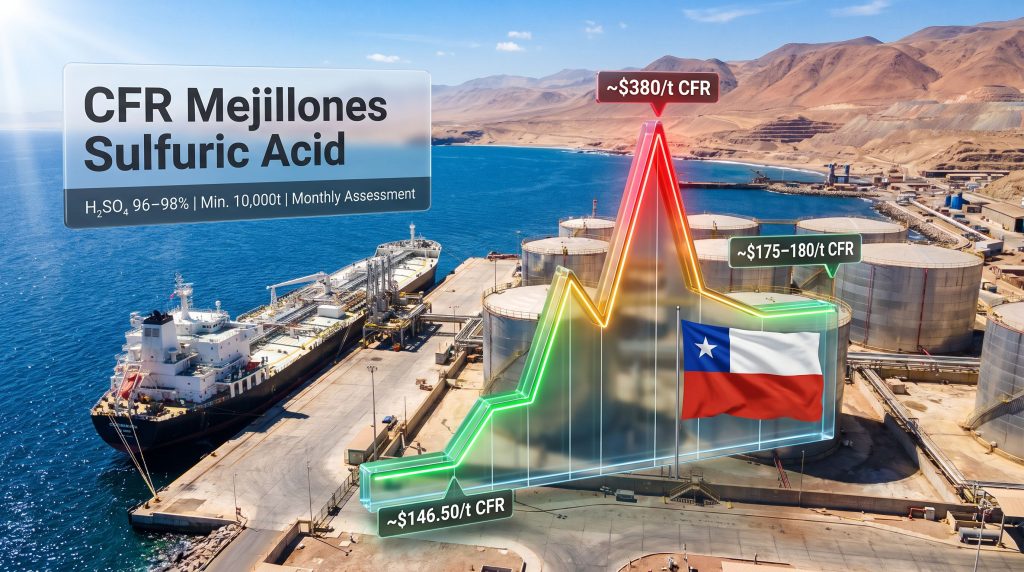
Fastmarkets has proposed launching a monthly sulfuric acid price assessment on a CFR Mejillones basis, with an effective start date of September 3, 2026. The full specification parameters are detailed below.
| Parameter | Specification |
|---|---|
| Assessment name | Sulfuric Acid 96-98%, spot price, CFR Chile |
| Unit and currency | USD per tonne, cash-equivalent normalized |
| Minimum quantity | 10,000 tonnes |
| Incoterm | CFR (Cost and Freight) |
| Delivery location | Mejillones, Chile |
| Specification | H₂SO₄ concentration of 96-98% |
| Delivery period | Within four weeks |
| Publication frequency | Monthly |
| Publication window | First Thursday of each month, 3-4pm London time |
| Data collection window | First Thursday of prior month (4pm London time) to assessment date (3pm London time) |
| Payment terms | Cash against documents, seven days after bill of lading date; other terms normalized |
| Holiday schedule | Non-ferrous metals price reporting calendar |
Understanding the CFR Incoterm in Acid Trade
The CFR incoterm means the seller is responsible for arranging and paying ocean freight to the destination port, in this case Mejillones, while the buyer assumes risk from the moment cargo is loaded at the origin port. This structure is commercially preferred by Chilean acid importers because it simplifies landed cost calculations, removes the need for buyers to separately manage vessel chartering, and allows more straightforward comparison of offers from different origin markets.
It differs meaningfully from FOB pricing, where the buyer arranges their own freight and therefore bears direct exposure to vessel market fluctuations, and from CIF pricing, where the seller also provides cargo insurance. The CFR structure places freight cost risk with the seller but leaves buyers fully exposed to origin-market supply disruptions, a nuance that becomes critically important during periods of smelter curtailment or geopolitical disruption.
Why the 96-98% Concentration Specification Matters
Industrial sulfuric acid is commercially traded across a range of concentrations, but the 96-98% H₂SO₄ range represents the standard-grade product used in copper heap leaching and most other mining applications in Chile. Lower concentrations require higher volumes to achieve equivalent leaching performance and introduce additional water loading into already water-constrained mine sites in the Atacama Desert. Higher concentrations, while technically available from some producers, offer diminishing practical benefit and carry additional handling risks. The 96-98% specification is therefore not arbitrary but reflects the actual operational requirements of the industry the benchmark is designed to serve.
Payment Term Normalisation: A Technical Detail With Real Consequences
One of the less visible but critically important aspects of the proposed methodology is the normalisation of all transactions to cash-equivalent USD per tonne values. In physical commodity trade, payment terms can vary significantly between counterparties, with some transactions settled cash against documents within seven days of bill of lading and others carrying 30-day or even 60-day credit terms.
The financing cost embedded in extended payment terms creates a real price difference between transactions that would otherwise appear comparable. Without normalisation, a transaction settled on 60-day credit terms would show a nominally lower price than a cash transaction for the same physical cargo, distorting the benchmark. By mathematically converting all transactions to a cash-equivalent basis using prevailing short-term interest rates, the assessment captures the true market clearing price rather than an artefact of counterparty financing arrangements.
The 2026 Price Volatility That Made This Benchmark Necessary
The case for a dedicated CFR Chile sulfuric acid assessment is not theoretical. The price history of this market in 2026 provides a compelling empirical argument for why transparent, independently verified reference prices are essential.
| Period | Reported Spot Price (CFR Chile) | Market Condition |
|---|---|---|
| October 2023 | ~$146.50/t | Base period reference |
| February 2026 | ~$190/t | Recovery from prior trough |
| April 8, 2026 | ~$300/t | Sharp escalation phase |
| April 15, 2026 | ~$380/t | Near-term cycle peak |
| July 2026 | ~$175-180/t | Correction and stabilisation |
The price trajectory between February and mid-April 2026 represents a ~$190/t escalation within approximately six weeks, driven by a confluence of factors including geopolitical disruptions affecting global supply chains, constrained smelter operating rates in key exporting nations, and trans-Pacific freight market tightening. Furthermore, the subsequent correction of roughly $200/t from the April peak back toward the $175-180/t range by July 2026 reflects a combination of demand destruction at extreme price levels, new supply volumes entering the market, and freight cost normalisation. According to analysis from Hellenic Shipping News, there is no quick fix for Chile's sulfuric acid supply challenges, reinforcing the urgency of a credible benchmark.
"A price range of $175/t to $380/t within a single calendar year represents more than a 100% peak-to-trough swing. For copper producers running on tight operating margins, this level of input cost volatility is not merely inconvenient — it is a genuine threat to project economics and capital planning."
What amplified the damage during this period was the absence of a robust, transparent benchmark. Without a credible reference price, buyers and sellers relied on bilateral information sharing, informal market consultations, and in some cases historical contract terms that bore little relationship to prevailing spot conditions. The result was wider bid-ask spreads, slower contract execution, and significant procurement cost dispersion across market participants with different levels of market access.
Spot vs. Annual Contract Assessments: Two Different Tools for Different Needs
The proposed CFR Chile assessment framework includes both a monthly spot price and an annual contract price range, each serving distinct functions within the market ecosystem.
| Feature | Annual Contract Assessment | Spot Assessment |
|---|---|---|
| Publication frequency | Once per year (January) | Monthly |
| Price format | High/low range, no single close | Single normalised value |
| Reference period | Full contract year | Rolling four-week data window |
| Primary users | Long-term supply agreement parties | Traders, spot buyers, risk managers |
| Volatility sensitivity | Low, locked in annually | High, reflects current market conditions |
Large copper producers have historically preferred annual contract pricing because it delivers budget certainty and simplifies multi-year capital planning. When acid consumption is locked in at a known annual price, mine site operating cost models become far more predictable. However, the supply chain disruptions of 2025-2026 demonstrated that annual contracts are not immune to stress.
When spot prices deviate dramatically from contracted levels, counterparties face pressure to renegotiate or honour agreements that have become economically irrational, a dynamic that ultimately undermines the very certainty that annual contracts are supposed to provide. The copper supply crunch has highlighted precisely this tension between long-term contract stability and volatile spot market realities.
The monthly spot assessment addresses this by offering a continuously updated market signal that index-linked supply agreements can reference directly. Sophisticated market participants are increasingly structuring contracts with floating price components tied to published assessments, reducing the renegotiation risk that rigid annual pricing creates during volatile periods.
The Copper-Acid Circular Economy: A Market Dynamic Few Outsiders Understand
One of the more counterintuitive aspects of the sulfuric acid market is that copper production simultaneously creates and consumes the commodity. Copper smelters capture SO₂ emissions from concentrate roasting and convert them to sulfuric acid, which is then sold into the market. Chile's own smelters, including the large Codelco facilities, produce meaningful volumes of domestic acid. Yet because the majority of Chilean copper comes from leach operations rather than smelter-fed concentrators, domestic acid production from smelting falls well short of leaching demand.
This creates a feedback loop with important pricing implications:
- When global copper smelter operating rates rise, more acid enters the market from smelter byproduct production, putting downward pressure on CFR Chile prices
- When smelter rates fall due to concentrate shortages, maintenance shutdowns, or economic curtailments, acid supply tightens simultaneously with any copper supply reduction, amplifying price pressure
- Japan, South Korea, and China collectively represent the dominant export origins for acid shipped to Chile, meaning that domestic energy policy, environmental regulations, and smelter capacity decisions in these countries directly influence Chilean mining input costs
This structural interdependency means that acid price analysts must monitor copper smelter utilisation data from East Asia with the same attention they give to Chilean import volumes. Furthermore, the Codelco copper strategy for managing trade tariffs and global supply adds another layer of complexity to this circular relationship. Consequently, a level of cross-market analytical sophistication only becomes practical when underpinned by transparent price assessments.
The next major ASX story will hit our subscribers first
Who Relies on the CFR Chile Sulfuric Acid Assessment
The market participants who stand to benefit most from a transparent, methodology-backed CFR Chile sulfuric acid assessment span the full length of the acid supply chain.
- Copper miners and heap leach operators can use the monthly assessment to benchmark procurement performance, validate spot purchase prices against independent market levels, and structure floating-price import contracts that reduce renegotiation risk
- Commodity traders active in acid markets gain a credible reference for back-to-back trading structures, arbitrage analysis between origin markets, and risk management against open positions
- Acid importers and distributors can anchor offtake agreements to a transparent third-party price rather than relying on seller-provided market indications
- Financial institutions and trade finance providers incorporate the benchmark into commodity price risk models, structured lending facilities, and internal audit frameworks for commodity procurement
- Index-linked contract users benefit from automatic price adjustment mechanisms that eliminate the need for periodic renegotiation, replacing relationship-dependent pricing with objective market signals
The Consultation Process and What Happens Next
Fastmarkets conducted informal consultations with base metals market participants prior to issuing the formal proposal, with feedback from those discussions confirming market interest in a dedicated Chile CFR assessment. The formal consultation period runs until August 27, after which Fastmarkets will review all submissions, finalise the methodology, and target a launch date of September 3, 2026.
Market participants wishing to provide input can submit comments, including technical feedback on specification parameters, methodology design, or data collection approaches. Comments marked as confidential will be treated accordingly, while non-confidential submissions will be made available to other market participants upon request. This transparency in the consultation process itself reflects the broader governance standards that credible price reporting agencies apply to new benchmark development.
Fastmarkets serves more than 14,000 global customers across metals, mining, agriculture, and forest products markets, and its existing relationships across the base metals ecosystem provide a meaningful distribution advantage for a new assessment entering a market that has recently experienced benchmark discontinuation by a prior provider.
The methodology documentation for all Fastmarkets price assessments is publicly available at fastmarkets.com/methodology, enabling market participants to fully understand the derivation logic behind any assessment before incorporating it into contract structures or risk models.
Beyond Copper: The Long-Term Demand Trajectory for Chilean Acid Imports
Looking further ahead, Chile's acid import requirements are unlikely to diminish. The country's lithium production expansion, while primarily associated with brine extraction rather than acid-intensive leaching, does create secondary acid demand in downstream processing. More significantly, as higher-grade copper oxide ores are progressively depleted, mining companies are increasingly turning to mixed ores and secondary sulphide deposits that require modified leaching approaches, in some cases with higher acid consumption per tonne of copper recovered.
Simultaneously, the China industrial demand outlook and the global energy transition are driving copper demand to record levels as electrification accelerates across power grids, electric vehicles, and renewable generation infrastructure. Higher copper demand means higher leach throughput at existing operations and greenfield expansion at new projects, both of which translate directly into sustained or growing sulfuric acid import volumes.
In addition, the copper price drivers underpinning 2025 investment decisions will continue to shape the scale and pace of Chilean mining expansion, further entrenching the structural acid import dependency that makes a robust benchmark so essential. Moreover, when considering supply chain fragility, understanding force majeure implications in sulfuric acid contracts has become an increasingly important legal and commercial consideration for market participants navigating disruption risk.
Against this structural demand backdrop, the timing of the proposed CFR Chile sulfuric acid assessment reflects not just a short-term response to 2026 price volatility but a recognition that this market will require robust pricing infrastructure for decades to come.
This article is intended for informational purposes only and does not constitute financial, investment, or procurement advice. Price data referenced reflects reported market levels at the time of publication and should not be relied upon as a basis for commercial decision-making without independent verification. Readers are encouraged to consult publicly available methodology documentation and market analysis resources, including Fastmarkets' methodology library at fastmarkets.com/methodology.
Want to Stay Ahead of the Next Major Commodity Discovery?
Discovery Alert's proprietary Discovery IQ model delivers real-time alerts on significant ASX mineral discoveries — including those tied to copper and other base metals at the heart of global supply chains — transforming complex market data into actionable investment insights. Explore how historic mineral discoveries have generated substantial returns on Discovery Alert's dedicated discoveries page, and begin your 14-day free trial today to position yourself ahead of the broader market.