July 30, 2026
When By-Product Credits Become a Competitive Weapon: Lessons From Mid-Tier Copper Mining
The economics of copper mining are rarely as straightforward as they appear on a production report. Behind every tonne of copper produced lies a complex web of co-produced metals, fluctuating input costs, and multi-jurisdictional operational variables that can dramatically alter the true cost of extraction. For producers with diversified mineral portfolios, the relationship between primary and secondary metals is not incidental — it is often the defining factor separating those who thrive in volatile commodity cycles from those who merely survive them.
This dynamic sits at the heart of Hudbay Minerals' 2026 performance narrative. Rather than beginning with what the company produced, it is worth understanding why its cost structure has improved while peers across the sector have faced mounting pressure from fuel inflation, labour costs, and grade deterioration.
When big ASX news breaks, our subscribers know first
Understanding Hudbay's Full-Year 2026 Production Guidance Framework
Hudbay has maintained its Hudbay full-year output guidance without revision through the midpoint of 2026, a signal that carries more weight than the numbers alone suggest. In a sector where guidance downgrades have become almost routine, reaffirmation is itself a form of operational communication.
The company's confirmed production targets for 2026 are as follows:
| Metal | Full-Year Guidance Range | Midpoint Estimate |
|---|---|---|
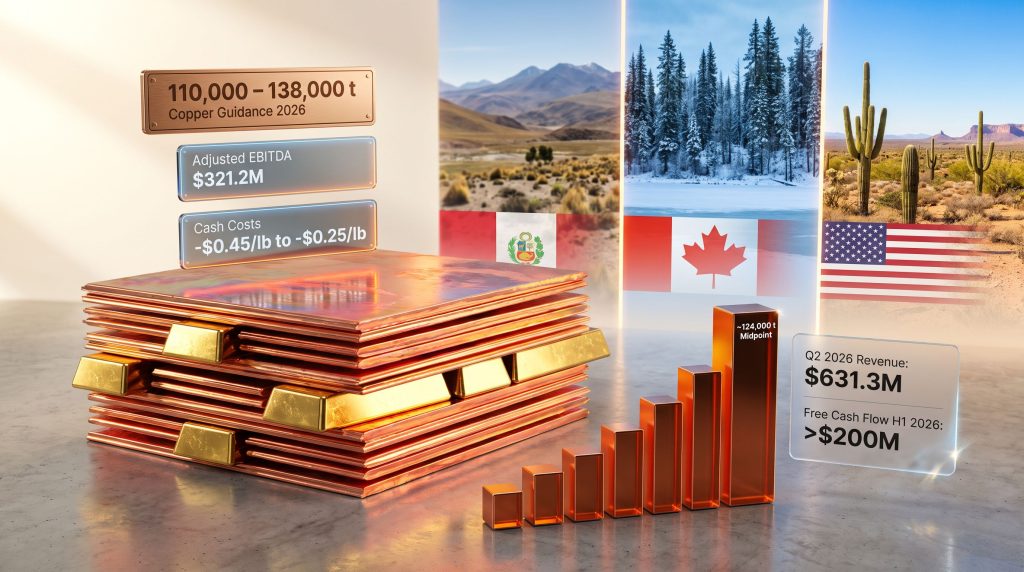
| Copper | 110,000 t – 138,000 t | ~124,000 t |
| Gold | 217,000 oz – 272,000 oz | ~244,500 oz |
The copper midpoint of approximately 124,000 tonnes implies roughly 5% year-on-year volume growth versus consolidated 2025 output. In absolute terms this may appear modest, but in the context of copper market trends where new supply additions have consistently disappointed against projections over the past decade, incremental volume from an established, low-cost producer carries disproportionate significance.
Analysts and institutional investors typically focus on guidance midpoints rather than ranges when modelling revenue sensitivity. The range itself reflects genuine operational variability — quarterly grade fluctuations, maintenance scheduling, and weather-related throughput interruptions — but the midpoint represents management's internal base-case expectation, grounded in mine planning assumptions.
What Q2 2026 Financial Results Reveal About Operational Discipline
The second quarter of 2026 delivered a financially robust result across virtually every key metric, reinforcing the credibility of Hudbay's full-year targets. Hudbay's Q2 2026 results confirm that operational discipline has translated directly into improved financial performance.
| Metric | Q2 2026 Result |
|---|---|
| Revenue | $631.3 million |
| Net Earnings (attributable to owners) | $137.4 million |
| Adjusted EBITDA | $321.2 million |
| Adjusted Net Earnings | $113.5 million |
| Earnings Per Share | $0.34 |
| Adjusted EPS | $0.28 |
| Operating Cash Flow | $297 million |
| Free Cash Flow (Q2) | $101.8 million |
| Free Cash Flow (H1 2026) | >$200 million |
Copper production of 28,267 tonnes tracked in line with internal quarterly expectations. Gold output of 51,234 ounces came in marginally below plan — a distinction that matters beyond the production count itself. Gold functions as Hudbay's most significant by-product credit, meaning any shortfall in gold output has a secondary effect on reported net cash costs per pound of copper.
Furthermore, despite this modest underperformance on gold, consolidated cash costs still improved relative to prior guidance. This speaks to the strength of gold's pricing environment in 2026 rather than production volume alone, and the gold price impact on by-product credit generation has been considerable.
The combination of an elevated gold price environment and multi-jurisdictional operational efficiencies allowed Hudbay to deepen its cash cost advantage even when individual quarterly production targets were not fully met — a demonstration of structural resilience rather than point-in-time luck.
The By-Product Credit Mechanism: Why This Model Creates a Structural Cost Moat
How By-Product Credits Work in Copper Mining
The concept of by-product credits is fundamental to understanding cost reporting in polymetallic mining, yet it remains poorly understood outside the sector. When a copper mine also produces gold, silver, or zinc, the revenue generated from those secondary metals is subtracted from the total cost of producing copper, yielding a net cash cost figure that can be substantially — and in Hudbay's case, dramatically — lower than the gross cost.
In practical terms, if a mine spends $2.00 per pound to produce copper but generates $2.40 per pound in equivalent gold and silver revenue from the same ore body, the net cash cost becomes negative — meaning the mine is effectively being paid to produce copper after accounting for its co-produced metals.
This is not a theoretical construct. Hudbay's Q2 2026 consolidated cash costs came in at negative $0.40 per pound, and the company subsequently improved its full-year guidance range to between negative $0.45/lb and negative $0.25/lb, compared to the previous guidance of negative $0.30/lb to negative $0.10/lb.
Revised vs. Previous Consolidated Cash Cost Guidance
| Metric | Previous Guidance | Revised 2026 Guidance |
|---|---|---|
| Consolidated Cash Costs (net of by-product credits) | -$0.30/lb to -$0.10/lb | -$0.45/lb to -$0.25/lb |
| Q2 2026 Actual Cash Costs | — | -$0.40/lb |
| Q2 2026 Sustaining Cash Costs | — | $1.39/lb |
The improvement was driven by two converging forces:
- Stronger gold prices in 2026 amplifying the value of by-product credits generated across the Manitoba and Peru operations
- Continued operational efficiencies at the portfolio level, reflecting ongoing optimisation of energy consumption, reagent usage, and plant throughput
- Partial offset from higher fuel and consumables costs, particularly in British Columbia, which moderately increased gross production costs
The net effect was a meaningful shift deeper into negative cash cost territory — a competitive position that very few mid-tier copper producers globally can claim.
Jurisdictional Performance: How Each Operation Contributed in Q2 2026
Peru: Constancia Mine
The Constancia operation in Peru delivered 19,446 tonnes of copper and 5,282 ounces of gold during Q2 2026, achieving this despite a planned semi-annual maintenance shutdown. Cash costs of $1.66 per pound outperformed the lower boundary of annual guidance, which sits at $1.70/lb to $2.10/lb for the full year.
A particularly significant regulatory development occurred in Peru during the period. The Peruvian government approved an increase in the permitted annual mill processing capacity at Constancia from 31 million tonnes per year to 34 million tonnes per year — a throughput expansion of approximately 10% that creates meaningful medium-term production upside without requiring a proportional increase in capital expenditure.
This type of regulatory approval — expanding permitted processing rates at an existing operation — is often overlooked by investors focused on greenfield development, yet it can represent some of the highest-returning capital deployment in the mining sector. The incremental cost of processing an additional 3 million tonnes annually through an existing mill is substantially lower than the cost of building new capacity from scratch.
One structural headwind to monitor at Constancia is the post-Pampacancha grade depletion dynamic. As the high-grade Pampacancha satellite deposit has progressively been mined out, the feed grade profile has moderated. This is a known and well-documented factor already embedded in guidance, but it remains a variable that could exert additional pressure on H2 2026 output if mine sequencing encounters any disruption.
Manitoba: Snow Lake District
| Metal | Q2 2026 Production |
|---|---|
| Gold | 40,344 ounces |
| Copper | 2,366 tonnes |
| Zinc | 4,760 tonnes |
| Silver | 209,478 ounces |
Manitoba is Hudbay's most geologically diverse jurisdiction and the primary engine of its by-product credit generation. Gold cash costs of $776 per ounce remained within the full-year guidance band of $500/oz to $800/oz, confirming that the operation is tracking within acceptable parameters as it approaches the upper bound of annual guidance.
The Snow Lake district is also the focus of an active exploration programme aimed at expanding mineral reserves and identifying new mill feed sources. Reserve replacement in underground hard-rock mining is a continuous challenge, and the quality of Snow Lake's geological prospectivity makes it a meaningful source of future reserve additions.
British Columbia: Near-Term Cost Pressure With a Recovery Path
| Metal | Q2 2026 Production |
|---|---|
| Copper | 6,455 tonnes |
| Gold | 5,608 ounces |
| Silver | 71,178 ounces |
British Columbia was the portfolio's most challenged jurisdiction in Q2, with cash costs of $3.22 per pound exceeding annual guidance due to elevated fuel prices and the timing of maintenance activities. Management has indicated that cost improvement is expected in the second half of 2026 as maintenance cycles normalise and fuel cost pressures moderate.
Importantly, the BC operations are projected to deliver higher copper output for the full year relative to 2025, which provides a partial volume-based offset to grade-driven softness in Peru.
Balance Sheet Architecture and Capital Allocation Strategy
Liquidity Position at Mid-Year 2026
| Balance Sheet Metric | Value |
|---|---|
| Cash and Cash Equivalents (end of Q2) | $890.9 million |
| Total Liquidity | $1.04 billion |
| Long-Term Debt Repaid (Q2) | >$200 million |
| Senior Unsecured Notes Repaid | $472.5 million |
| Solid Waste Disposal Revenue Bond Raised | $52 million |
| Mitsubishi Copper World JV Initial Contribution | ~$420 million |
The receipt of approximately $420 million as Mitsubishi Corporation's initial cash contribution upon completion of the Copper World project joint venture transaction materially transformed Hudbay's liquidity profile in a single quarter. This inflow, combined with operating cash generation of $297 million during Q2, enabled the company to simultaneously retire $472.5 million of senior unsecured notes while maintaining over $1 billion in total liquidity.
The $52 million solid waste disposal revenue bond raised in Q2 is a lesser-discussed but technically interesting financing instrument. Revenue bonds of this type are issued against projected revenues or specific project cash flows and are commonly used in US infrastructure and industrial development contexts. Their deployment for copper development expenditure in Arizona reflects the creative capital structure Hudbay is assembling for Copper World.
Capital Allocation Hierarchy for 2026 and Beyond
Hudbay's stated capital allocation framework reflects a deliberate sequencing of priorities:
- Brownfield and greenfield project investment — led by the Arizona copper pipeline
- Exploration — reserve replacement and expansion across all operating jurisdictions
- Strategic investments and partnerships — exemplified by the Mitsubishi joint venture structure
- Debt reduction — ongoing, with $472.5 million in senior notes retired in Q2 2026
- Shareholder returns — share buybacks and dividends, positioned as secondary to growth and debt management
The next major ASX story will hit our subscribers first
The Arizona Copper Growth Pipeline: Copper World, Cactus, and Mason
Copper World: Approaching a Sanctioning Decision
The Copper World project in Arizona represents Hudbay's most advanced development asset and the centrepiece of its US growth strategy. A definitive feasibility study is on schedule for completion in H2 2026, with a project sanctioning decision anticipated before year-end.
The Mitsubishi joint venture structure is significant beyond its capital contribution. The involvement of a major integrated trading and investment company signals that the project's development economics have been subjected to rigorous third-party scrutiny. Furthermore, mining joint ventures of this nature in copper development are uncommon precisely because the due diligence threshold is high.
Cactus Project: Building a Two-Asset Arizona Platform
The acquisition of Arizona Sonoran Copper Company consolidated the Cactus project alongside Copper World under a single operational framework. Approximately $30 million will be deployed in H2 2026 to advance prefeasibility study work, exploration drilling, and site derisking at Cactus.
The Cactus deposit is geologically distinct from Copper World but occupies the same Arizona copper belt, creating potential future operational synergies around infrastructure sharing, processing logistics, and permitting frameworks. The staged development sequencing — Copper World first, Cactus following — reflects a capital-disciplined approach to building a multi-asset US copper platform.
Mason Project: Early-Stage Nevada Optionality
Initial prefeasibility study work continues at the Mason copper project in Nevada, providing additional long-term optionality within the US portfolio. Mason remains at a considerably earlier development stage than the Arizona assets and should be viewed as a prospective volume contributor beyond the current planning horizon rather than a near-term production catalyst.
Jurisdictional Risk Matrix: How Hudbay's Portfolio Compares
| Jurisdiction | Primary Assets | Key Metals | Risk Profile |
|---|---|---|---|
| Peru | Constancia | Copper, Gold | Moderate (grade depletion, regulatory) |
| Manitoba, Canada | Snow Lake District | Gold, Copper, Zinc, Silver | Low-Moderate |
| British Columbia, Canada | Various | Copper, Gold, Silver | Low (near-term cost pressure) |
| Arizona, USA | Copper World, Cactus | Copper | Development-stage |
| Nevada, USA | Mason | Copper | Early-stage PFS |
The concentration of development-stage assets in the United States is a deliberate strategic choice. Tier 1 jurisdictions — those with stable legal frameworks, established permitting processes, and low sovereign risk — command a premium valuation in the eyes of institutional capital allocators. For Hudbay, building a US copper pipeline reduces the geopolitical risk premium embedded in its equity valuation compared to peers more heavily exposed to Latin America or Africa.
Key Risks and Catalysts for H2 2026
Near-Term Catalysts to Monitor
- Copper World DFS completion — outcome will determine project economics and the sanctioning decision timeline
- British Columbia cost normalisation — H2 improvement is expected; execution fidelity will be closely tracked by analysts
- Constancia throughput expansion — the approved increase from 31 Mt/y to 34 Mt/y creates meaningful medium-term production upside
- Gold price trajectory — continued strength directly improves consolidated net cash costs through by-product credit amplification
- Cactus PFS advancement — $30 million H2 investment signals development momentum is accelerating
Structural Risk Factors
- Peru grade depletion post-Pampacancha — a known headwind embedded in guidance but susceptible to mine sequencing disruptions
- Fuel and consumables inflation — already impacting British Columbia; broader inflationary exposure persists across all jurisdictions
- Copper price volatility — while Hudbay operates at negative consolidated cash costs, revenue sensitivity to copper price movements remains material at current production scale
- Development execution risk — the Arizona pipeline requires significant capital commitment; DFS delays or cost escalation could affect sanctioning timelines and joint venture dynamics
What Guidance Stability Signals in a Volatile Sector
The broader significance of Hudbay's reaffirmed Hudbay full-year output guidance extends beyond the company itself. Across the mid-tier copper producer universe, 2026 has been characterised by mounting operational complexity: grade deterioration at aging mines, permitting delays at newer projects, and inflationary pressure on operating costs that has compressed margins even at elevated copper prices.
Against this backdrop, a producer that simultaneously maintains production guidance and improves cost guidance at the midyear mark is communicating something meaningful about operational quality. Hudbay's 2025 full-year results demonstrated a similar pattern of disciplined delivery, providing further evidence that this is a structural characteristic rather than a cyclical coincidence.
The combination of a structurally advantaged by-product credit model, a geographically diversified production base, a maturing US development pipeline backed by institutional joint venture capital, and a balance sheet carrying more than $1 billion in liquidity positions Hudbay as one of the more operationally resilient mid-tier copper producers entering the second half of 2026.
Hudbay's chief executive Peter Kukielski has consistently articulated a strategic vision centred on building a premier Americas-focused copper producer anchored in Tier 1 jurisdictions with long-life, low-cost assets. The Q2 2026 results and reaffirmed Hudbay full-year output guidance represent a material step toward that objective, with the Copper World sanctioning decision later this year set to become the next major inflection point in that strategic narrative.
Disclaimer: This article is intended for informational purposes only and does not constitute financial advice. All production figures, financial metrics, and forward-looking statements are sourced from publicly available company disclosures. Forecasts and projections involve inherent uncertainty and actual outcomes may differ materially from those discussed. Readers should conduct their own independent research before making any investment decisions.
Want To Track the Next Major Copper or Gold Discovery Before the Broader Market Does?
Discovery Alert's proprietary Discovery IQ model scans ASX announcements in real time, instantly converting complex polymetallic data across 30+ commodities into actionable insights — exactly the kind of structural edge that matters in volatile commodity cycles. Explore historic examples of major mineral discoveries and their market returns, then begin your 14-day free trial to position yourself ahead of the market.