July 30, 2026
Why South America's Copper Belt Is the Backbone of Global Supply
Every major decarbonisation scenario converges on one inescapable bottleneck: copper. The metal underpins virtually every technology in the clean energy transition, from high-voltage transmission infrastructure to the motor windings inside electric vehicles. Yet the world's ability to produce it at scale remains highly concentrated. Chile and Peru together account for roughly 40% of global mined copper output, a geographic reality that has shaped the investment logic of every major mining house operating at the commodity's frontier.
Within that landscape, Glencore has constructed one of the most architecturally sophisticated copper portfolios in the industry. Across both countries, the company holds stakes in five distinct assets spanning the full spectrum from producing open-pit operations through to pre-development projects with significant reserve optionality. Understanding how these Glencore copper mines in Peru and Chile are structured, financed, and positioned for growth requires looking well beyond headline production figures.
When big ASX news breaks, our subscribers know first
The Portfolio Architecture: Why Mixed Ownership Structures Make Strategic Sense
Glencore's approach to copper ownership in South America deliberately avoids the concentrated balance sheet exposure that comes with operating a single flagship mine. Instead, the company has assembled a layered capital structure that blends wholly owned subsidiaries with joint venture participations, distributing risk across jurisdictions while retaining access to some of the world's most significant ore bodies.
The holding entities underpinning this structure include:
- Glencore Peru Holding serving as the umbrella vehicle for the company's Peruvian copper interests
- Compañía Minera Quechua S.A., a 100%-owned entity managing undeveloped copper projects in Peru
- Compania Minera Lomas Bayas, the wholly owned Chilean subsidiary responsible for cathode production in the Antofagasta Region
The commercial logic of this approach is well established in the mining industry. Joint venture structures allow large miners to participate in world-class ore bodies without bearing the full capital expenditure burden on their balance sheets. At the same time, wholly owned assets provide direct cash flow control and operational flexibility. Glencore's South American copper portfolio is engineered to deliver both.
The portfolio's layered ownership model is not a product of opportunistic deal-making. It reflects a deliberate strategy to balance near-term cash generation from mature producing assets with longer-duration optionality embedded in expansion projects and undeveloped deposits.
Glencore's Copper Mines in Peru: From Polymetallic Giants to Expansion Frontiers
Antamina: Scale, Complexity, and Revenue Diversification
Situated in the Ancash Region of northern Peru at high altitude in the Andes, Antamina ranks among the world's largest copper-zinc mines by annual output. Glencore holds a 33.75% stake, with co-owners including BHP, Teck Resources, and Mitsubishi Corporation.
What distinguishes Antamina from many of its peer operations is its polymetallic character. The deposit produces copper and zinc concentrates alongside meaningful quantities of silver and molybdenum as by-products. This multi-commodity revenue stream provides a natural hedge against single-metal price cycles, a characteristic that becomes particularly valuable during periods of copper price softness.
When zinc markets tighten, Antamina's economics can remain robust even if copper pricing is subdued, and vice versa. The operation processes ore through a large-scale concentrator and ships product via a dedicated slurry pipeline to the Punta Lobos port facility on the Peruvian coast, a logistics infrastructure investment that took years to construct and represents a meaningful competitive moat for the asset.
Antapaccay: The Concentrates Producer With a US$1.5 Billion Growth Engine
Located in the Espinar Province of the Cusco Region in southern Peru, Antapaccay operates as a majority-controlled open-pit copper concentrates producer under the Glencore Peru Holding structure. The operation has a well-established production profile, but its most significant strategic value lies in what comes next.
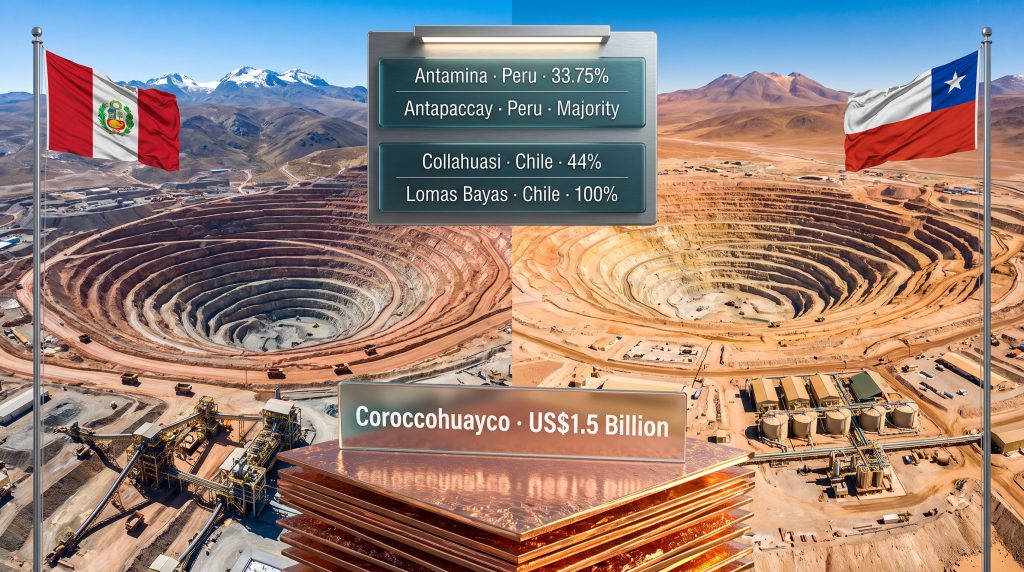
The Coroccohuayco extension project represents one of the most consequential expansion decisions in Glencore's near-term copper growth pipeline. Furthermore, the project involves underground mine development directly adjacent to the existing Antapaccay open pit, with a reported capital commitment of approximately US$1.5 billion. The intended outcomes are an extended operational life for the combined operation and a material increase in annual copper concentrate output.
The Espinar region has historically been one of Peru's more socially sensitive mining environments, with communities in the district maintaining a long and complex relationship with the extractive sector. Managing social licence renewal in this context is not a peripheral concern — it is a core operational variable that directly affects permitting timelines and community benefit agreement structures. Understanding the copper supply crunch helps contextualise why projects like Coroccohuayco are so strategically important globally.
The Quechua Project: Embedded Optionality Adjacent to Antapaccay
Less prominently discussed in mainstream coverage, Compañía Minera Quechua S.A. holds a 100%-owned undeveloped copper project in the Espinar Province, positioned adjacent to the Antapaccay operation. This geographic proximity is strategically significant for several reasons:
- Geological continuity between the Antapaccay deposit and the Quechua resource may allow for shared processing infrastructure, reducing per-tonne capital costs for any future development
- Existing community and regulatory relationships established through Antapaccay's operations could reduce the time and cost required to advance social licence processes for Quechua
- The project provides Glencore with long-duration mine life optionality in a region where the company already has operating presence and institutional knowledge
The Quechua project is currently pre-development, with permitting timelines subject to the broader regulatory environment in Peru.
Glencore's Copper Mines in Chile: World-Class Scale and Cathode Production Efficiency
Collahuasi: A Generational Asset in the Atacama Highlands
Positioned in the Tarapacá Region of northern Chile at approximately 4,500 metres above sea level, Collahuasi is consistently ranked among the world's five largest copper mines by annual production capacity. Glencore holds a 44% stake in the operation, alongside Anglo American at a matching 44%, with a smaller consortium holding the remainder.
The asset produces both copper concentrates and copper cathodes, offering product flexibility that few operations at its scale can match. Collahuasi's ore reserve base and mine life outlook have led analysts to characterise it as a generational asset, meaning its economic life extends well beyond the typical planning horizon of most mines. The Chile copper price outlook further reinforces the long-term strategic value of assets such as Collahuasi within this regional context.
Operating at this altitude in the Atacama creates specific challenges. Water scarcity is structurally acute in this region, and the mining industry has increasingly turned to large-scale desalination as a long-term solution. Energy transition pressures, including Chile's movement toward renewable-powered mining operations, add another layer of capital planning complexity for any expansion programme at Collahuasi.
Lomas Bayas: The Efficiency of Heap-Leach Cathode Production
While Collahuasi commands attention through scale, Lomas Bayas in the Antofagasta Region plays a different but complementary role within Glencore's Chilean copper strategy. The operation is 100% owned through Compania Minera Lomas Bayas and produces copper cathode directly on-site using solvent extraction and electrowinning, the SX-EW process.
This distinction matters more than it might initially appear. Heap-leach SX-EW operations process oxide ore rather than sulphide ore, applying an acidic solution to crushed rock piled in engineered heaps. The leachate is then processed through a solvent extraction circuit before electrowinning deposits pure copper cathode onto metal blanks. The result is a registered-grade copper cathode that can be sold directly to wire and cable manufacturers without the intermediate step of smelting and refining that concentrate producers require.
For downstream customers, cathode purchases eliminate smelting charges and treatment cost negotiations, making SX-EW product commercially attractive. For Glencore, Lomas Bayas functions as a lower-capital-intensity, cash-generative asset that provides a different customer base exposure compared to the concentrate stream from Collahuasi. In addition, Chile's copper supply gap underscores just how critical wholly owned assets like Lomas Bayas are to meeting future global demand.
Comparative Overview: Glencore's Chilean Copper Assets
| Attribute | Collahuasi | Lomas Bayas |
|---|---|---|
| Mine Type | Open-pit concentrates + cathode | Open-pit heap-leach cathode |
| Glencore Ownership | 44% (JV) | 100% (wholly owned) |
| Product Output | Copper concentrate and cathode | Copper cathode (SX-EW) |
| Scale | World top-5 copper mine | Mid-tier, cash-generative |
| Capital Intensity | High (expansions planned) | Lower (established operations) |
| Location | Tarapacá Region, ~4,500m altitude | Antofagasta Region |
| Water Risk | High (Atacama scarcity) | Moderate |
Full Portfolio Comparison: Peru vs. Chile
| Asset | Country | Glencore Stake | Mine Type | Stage | Key Feature |
|---|---|---|---|---|---|
| Antamina | Peru | 33.75% | Open-pit Cu/Zn | Producing | Polymetallic, world-scale |
| Antapaccay | Peru | Majority | Open-pit Cu concentrates | Producing + Expansion | Coroccohuayco US$1.5B project |
| Quechua Project | Peru | 100% | Undeveloped Cu project | Pre-development | Adjacent to Antapaccay |
| Collahuasi | Chile | 44% | Open-pit Cu concentrates + cathode | Producing | Global top-5 copper mine |
| Lomas Bayas | Chile | 100% | Heap-leach Cu cathode | Producing | SX-EW, fully owned |
Copper Streaming: A Financing Mechanism With Major Implications
How Streaming Agreements Work in Practice
A copper streaming deal involves a streaming company providing an upfront capital payment to a miner in exchange for the contractual right to purchase a fixed percentage of future metal production at a predetermined, below-spot price. The streaming counterparty profits from the spread between the contracted purchase price and the prevailing market price over the life of the agreement.
For miners, streaming offers several structural advantages over conventional project debt:
- No interest burden or debt covenant restrictions attached to the capital received
- The obligation to deliver metal rather than cash, which aligns with the mine's natural production profile
- Off-balance-sheet treatment in some accounting structures, preserving reported leverage metrics
- Speed of execution relative to traditional project finance syndication
The trade-off is permanent revenue dilution. Once a streaming agreement is executed against a long-life asset, the miner permanently foregoes a portion of the price upside on that production for the duration of the contract.
Reported Streaming Activity Linked to Glencore's South American Portfolio
Market discussions have periodically referenced potential streaming arrangements involving production from Antamina, Antapaccay, and Collahuasi. The scale of these assets makes any confirmed streaming transaction at this level genuinely significant within the broader mining finance landscape.
Streaming deals tied to Tier-1 copper assets like Antamina and Collahuasi are rare precisely because of the assets' scale and long mine lives. If confirmed, arrangements of this nature would represent some of the largest copper streaming transactions in South American mining history.
Potential counterparties operating at this scale typically include established precious and base metal streaming companies. The strategic question for Glencore centres on whether the immediate capital benefit — potentially allocated toward Coroccohuayco or other growth expenditure — justifies the long-term revenue dilution on assets that could benefit significantly from sustained elevated copper prices. Exploring broader copper investment strategies provides useful context for evaluating how streaming fits within a diversified capital allocation framework.
The next major ASX story will hit our subscribers first
Geopolitical and Operational Risk: A Balanced Assessment
Peru: Social Licence, Taxation, and Permitting Complexity
Peru's mining regions carry a documented history of community-level conflict, particularly in areas with established indigenous communities. The Espinar district, where both Antapaccay and the Quechua project sit, has experienced periods of significant tension between mining operators and local populations. These dynamics are not static — they evolve with changes in local leadership, benefit agreement structures, and broader political cycles in Lima.
Peru's mining taxation framework has also undergone periodic revision, with royalty structures and profit participation mechanisms adjusted over multiple government cycles. For development projects like Quechua and Coroccohuayco, fiscal regime uncertainty adds a layer of complexity to long-term capital commitment decisions. Analysts tracking activity at copper mining in Chile note that by comparison, Chile's regulatory environment has historically offered a more stable operating framework for major mining investments.
Chile: Water, Energy, and Regulatory Evolution
Chile's challenge is different in character. The Atacama's chronic water stress is a geological and hydrological constraint, not a political one, and its severity increases as mine operations at altitude require larger volumes of water for processing. The industry's response has centred on desalination plant investment along the coast with pipeline infrastructure carrying water to elevation.
Chile has also been navigating proposed mining royalty reforms that, if enacted in their more aggressive forms, could meaningfully alter project-level economics for major operations including Collahuasi. The Codelco-Glencore copper smelter discussions further illustrate the depth of Glencore's strategic engagement with Chile's broader copper processing infrastructure.
Comparative Risk Matrix
| Risk Category | Peru Exposure | Chile Exposure |
|---|---|---|
| Social Licence / Community | High (Espinar, Ancash) | Moderate |
| Regulatory / Tax Risk | Moderate-High | Moderate (royalty reform pending) |
| Water / Environmental | Moderate | High (Atacama water stress) |
| Political Stability | Moderate | Moderate-Low |
| Infrastructure Logistics | Moderate | Low-Moderate |
Copper's Energy Transition Demand Story: Quantifying the Structural Tailwind
The demand case for copper is not speculative. It is embedded in the physics of electrification. Electric vehicles require approximately three to four times more copper than internal combustion engine vehicles. Offshore wind turbines require up to 9.5 tonnes of copper per megawatt of installed capacity. Grid infrastructure expansion, data centre construction driven by artificial intelligence workloads, and heat pump deployment all represent additional demand vectors that are growing simultaneously.
The International Energy Agency has projected that under net-zero scenarios, copper demand could increase significantly through 2040, with supply-demand deficits potentially emerging if mine development does not accelerate. South American copper, and particularly the large-scale, long-life assets that Glencore operates, is structurally positioned to serve this demand given the depth of the ore bodies and the existing processing and logistics infrastructure already in place.
A sustained copper price above US$4.50 per pound would materially transform the financial case for developing both Coroccohuayco and the Quechua project, bringing capital commitments that might otherwise sit in queue to the front of Glencore's allocation decisions. Consequently, understanding the copper price growth drivers provides essential context for evaluating these development timelines.
Frequently Asked Questions: Glencore Copper Mines in Peru and Chile
What copper mines does Glencore operate in Peru?
Glencore holds interests in two producing copper mines in Peru. It owns a 33.75% stake in Antamina, a large-scale polymetallic open-pit mine in the Ancash Region co-owned with BHP, Teck Resources, and Mitsubishi Corporation. It also holds a majority interest in Antapaccay, an open-pit copper concentrates producer in the Espinar Province of the Cusco Region. Additionally, through Compañía Minera Quechua S.A., Glencore holds a 100% interest in an undeveloped copper project adjacent to Antapaccay.
What copper mines does Glencore own in Chile?
Glencore's Chilean copper portfolio consists of two assets. It holds a 44% stake in Collahuasi, one of the world's five largest copper mines, located in the Tarapacá Region. It also fully owns Lomas Bayas, a heap-leach copper cathode operation in the Antofagasta Region operated through Compania Minera Lomas Bayas.
What is the Coroccohuayco project?
Coroccohuayco is a planned underground copper mine development adjacent to the existing Antapaccay open-pit operation in Peru's Espinar Province. The project carries a reported capital commitment of approximately US$1.5 billion and is designed to extend Antapaccay's operational life while increasing annual copper concentrate production capacity.
What is the difference between Collahuasi and Lomas Bayas?
Collahuasi is one of the world's largest copper mines, operating at approximately 4,500 metres altitude and producing both copper concentrates and cathodes as a joint venture in which Glencore holds 44%. Lomas Bayas, however, is a 100%-owned, mid-tier heap-leach operation that produces copper cathode through SX-EW processing, functioning as a lower-capital-intensity, cash-generative asset within Glencore's Chilean portfolio.
Key Takeaways
- Glencore's South American copper footprint spans five distinct assets across Peru and Chile, structured across a deliberate mix of joint venture participations and wholly owned subsidiaries
- The portfolio's design balances near-term cash generation from mature producing mines with longer-duration growth optionality through Coroccohuayco and the Quechua project
- The US$1.5 billion Coroccohuayco expansion represents the most significant near-term capital commitment within the portfolio and the clearest growth catalyst for Antapaccay's production trajectory
- Streaming deal activity linked to Antamina, Antapaccay, and Collahuasi — if confirmed — would represent a major financing event in South American mining history
- Geographic diversification across Peru and Chile provides risk distribution across two distinct regulatory, fiscal, and operational environments
- Copper's role in the energy transition, from EV manufacturing to grid expansion and data centre infrastructure, creates a structural long-term demand backdrop that strengthens the investment case for all five assets in this portfolio
Disclaimer: This article contains forward-looking statements and projections regarding copper demand, capital expenditure plans, and development timelines. These involve inherent uncertainty and should not be interpreted as financial advice. Readers should conduct independent research before making any investment decisions. Production figures and project capital estimates are subject to revision.
Want to Capitalise on the Next Major Copper Discovery Before the Market Moves?
Discovery Alert's proprietary Discovery IQ model delivers real-time alerts on significant ASX mineral discoveries — including copper — instantly converting complex geological announcements into actionable investment insights for both short-term traders and long-term investors. Explore historic mineral discovery returns on Discovery Alert's dedicated discoveries page and begin your 14-day free trial today to position yourself ahead of the broader market.