July 30, 2026
Why Mine Restarts Are Never as Simple as Flipping a Switch
The global mining industry has a well-documented pattern: when a large asset goes offline, the financial damage rarely ends at the point of closure. It compounds. Preservation costs accumulate. Infrastructure deteriorates. Skilled workforces disperse. And when the eventual restart process begins, operators often discover they are burning capital at rates that rival active production — without the revenue to offset it.
This is precisely the situation unfolding at Cobre Panamá, one of the Western Hemisphere's largest copper mines, where the First Quantum Cobre Panamá restart loss has become one of the most closely watched financial and geopolitical stories in global mining. Understanding what these losses actually represent, why they persist, and what needs to happen before they reverse course requires examining the economics of mine suspension and restart from the ground up.
When big ASX news breaks, our subscribers know first
The True Cost Architecture of a Suspended Giant
Most industry observers focus on the headline loss figures when analysing suspended mining operations. What receives far less attention is the structural cost architecture that locks operators into expenditure even when zero production is occurring. For Cobre Panamá, this architecture has two distinct layers.
The first is preservation and safe management. A mine of this scale cannot simply be left idle. Ongoing drainage, structural monitoring, environmental containment, and equipment maintenance are not discretionary activities. They are legal and technical obligations. The second layer is recommissioning expenditure, which accelerates as the operator moves from passive care-and-maintenance mode into active restart preparation.
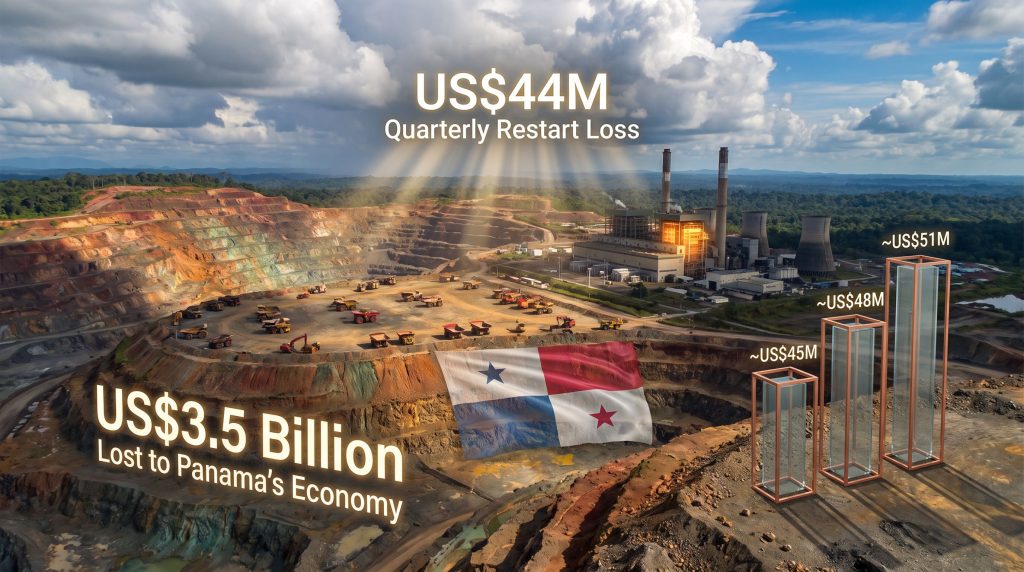
First Quantum has reported that these combined costs were tracking at approximately US$15 million to US$17 million per month during the period in which power plant recommissioning commenced. On a quarterly basis, this translates to a financial drag of roughly US$45 million to US$51 million before a single tonne of copper concentrate is produced. This cost structure is not unusual for a large-scale open-pit copper operation, but it is devastating when applied over an extended suspension period measured in years rather than months.
The Q3 2025 Numbers and What They Reveal
First Quantum reported a net loss of US$48 million for Q3 2025, with an adjusted loss of US$16 million for the same period. The gap between these two figures is significant and often misread. The adjusted figure strips out non-cash items including depreciation, certain provisions, and asset-related charges that do not represent immediate cash outflows. The net loss figure, by contrast, captures the full accounting impact including these non-cash elements.
Of the total net loss, a US$44 million quarterly loss was directly attributed to Cobre Panamá restart activities. This means the mine was absorbing nearly all of the company's reported losses during this period, with the adjusted figure suggesting the underlying operational business outside Panama remained marginally profitable. Furthermore, understanding the broader commodity price impacts helps contextualise why these numbers matter so significantly to investor confidence.
Key analytical insight: The divergence between net and adjusted losses is common in capital-intensive mining operations undergoing restart phases. Investors who focus exclusively on net loss figures without decomposing non-cash components can significantly overstate or understate the cash burn trajectory of an asset.
Cost Breakdown: Preservation and Restart Phase
| Cost Category | Q3 2025 Monthly Rate | Projected Q4 2025 Monthly Rate |
|---|---|---|
| Preservation and Safe Management | ~US$15M | US$15M to US$17M |
| Power Plant Recommissioning | Included above | Escalating |
| Total Quarterly Drag (Estimated) | ~US$45M | ~US$45M to US$51M |
Power Before Processing: The Sequencing Logic of a Restart
One detail that rarely receives adequate attention in mainstream reporting is the technical sequencing required to bring a large copper mine back into production. Cobre Panamá is not a simple operation. It is a large-scale, open-pit porphyry copper system with integrated processing infrastructure, a dedicated port facility, and a captive power generation complex.
The mine's power plant is the critical gateway to everything else. Without stable, grid-synchronised electrical supply, no processing equipment can operate safely or reliably. First Quantum targeted grid synchronisation of the first 150 megawatt unit in November 2025 as the initial threshold milestone in the restart sequence.
The operational logic flows in strict order:
- Power plant recommissioning and grid synchronisation
- Rehabilitation of processing circuits including crushers, ball mills, and flotation cells
- Water management and tailings system reactivation
- Concentrate production and quality certification
- Port operations and offtake logistics
- Full ramp-up to nameplate capacity
Each stage carries its own execution risk. Ball mills and flotation cells that have sat idle for extended periods require careful inspection and rehabilitation. Reagent supply chains need to be reconstituted. Labour forces that were stood down must be rehired and retrained. These are not trivial operational steps, and each one introduces timeline risk that can push revenue generation further into the future.
Porphyry Copper Deposits and Why Cobre Panamá Is Strategically Significant
Cobre Panamá sits within a large porphyry copper system, a deposit type characterised by disseminated copper mineralisation across enormous rock volumes. Porphyry copper deposits are typically lower in average grade than other copper deposit types, but their sheer scale makes them among the world's most important copper sources. Cobre Panamá's ore body supported production at a scale that placed it among the top copper producers globally prior to its closure.
What makes porphyry systems particularly relevant to the restart narrative is that the ore body itself does not degrade during a suspension period. Unlike some deposit types where groundwater intrusion, oxidation fronts, or structural instability can materially alter ore quality during idle periods, properly managed porphyry copper operations retain their geological value. This means the resource case for Cobre Panamá remains intact, even as the financial case depends entirely on resolving the political and regulatory barriers to production.
The US$3.5 Billion Economic Damage Equation and Its Negotiating Implications
Panama's national economy absorbed an estimated US$3.5 billion in lost economic contribution across the two years following the mine's suspension. Under the fiscal framework that was in place prior to closure, the mine had been projected to contribute at least US$1.8 billion to Panama's economy in 2025 alone through royalties, taxes, employment, and flow-on economic activity. According to First Quantum's own analysis, these figures underscore just how consequential the ongoing suspension has become for both parties.
These figures create a complex dynamic that shapes the negotiating environment in ways that are not always visible in corporate reporting.
Strategic consideration: When a single industrial asset represents billions of dollars in annual national economic contribution, the political pressure to restore production is significant. However, that same pressure can also incentivise governments to negotiate harder on fiscal terms before granting authorisation, seeking a larger share of future revenues as the price of reopening.
This tension between sovereign economic need and fiscal renegotiation ambition is the defining uncertainty for the First Quantum Cobre Panamá restart loss timeline. A government facing fiscal pressure from lost mining revenues may simultaneously want the mine open and want improved financial terms before authorising a restart, creating negotiating dynamics that can extend timelines considerably.
Regulatory Compliance vs. Political Authorization: A Critical Distinction
A June 2026 environmental and operational compliance audit determined that Cobre Panamá was broadly compliant with applicable regulatory standards. This finding is operationally significant but is frequently misunderstood as clearing the path to a full restart. It does not.
There are two separate gating conditions for full production:
- Environmental and operational compliance (assessed via formal audit processes)
- Government authorisation under agreed fiscal terms (a political and contractual determination)
The compliance audit addresses the first condition. The second condition requires a negotiated agreement on the fiscal framework that will govern the mine's operations going forward. Until that agreement is reached, environmental compliance certification is a necessary but insufficient condition for resuming full copper production.
This distinction matters enormously for investors modelling recovery timelines. Compliance milestones are technical achievements. Fiscal term agreements are political outcomes, and political outcomes in Latin American mining jurisdictions have historically proven far less predictable than technical milestones. In addition, the Cobre Panamá arbitration process adds yet another layer of complexity to an already intricate regulatory environment.
Suspension Typology: How Cobre Panamá Compares to Other Major Mine Closures
| Suspension Type | Recovery Timeline (Typical) | Primary Risk Factor | Financial Drag Profile |
|---|---|---|---|
| Political and Regulatory Closure | 2 to 5+ years | Fiscal renegotiation | High fixed carrying costs |
| Operational Failure | 6 to 18 months | Technical rehabilitation | Capital-intensive rebuild |
| Commodity Price Suspension | 12 to 36 months | Market conditions | Lower preservation costs |
| Environmental Compliance Hold | 1 to 3 years | Regulatory certification | Moderate ongoing costs |
Cobre Panamá falls squarely into the political and regulatory closure category, which historically carries the longest and most uncertain recovery timelines. Unlike operationally-driven suspensions where the path to restart is largely within the operator's control, politically-driven closures involve external decision-makers whose timelines and priorities can shift based on electoral cycles, public sentiment, and international diplomatic dynamics.
The next major ASX story will hit our subscribers first
Three Scenarios That Could Define First Quantum's Path to Profitability
Scenario 1: Accelerated Restart With Favourable Fiscal Resolution
If Panama's government approves a revised fiscal framework by mid-2026 and both parties move efficiently through the authorisation process, a production ramp-up within 12 months of approval becomes plausible. Under this scenario, quarterly losses attributable to Cobre Panamá could be eliminated within two to three quarters of restart. The key risks include labour re-engagement at scale, supply chain reconstitution, and concentrate offtake agreement renewal.
Scenario 2: Partial Restart Under an Interim Operating Agreement
A more cautious middle path would see limited production authorised while full fiscal term negotiations continue in parallel. This scenario partially offsets carrying costs but does not eliminate the quarterly loss burden. The financial mathematics are challenging: if carrying costs remain at US$15M to US$17M per month and partial production contributes only a fraction of full-capacity revenues, the net financial improvement may be modest even as the operational milestone appears significant.
Scenario 3: Extended Suspension Beyond 2026
If fiscal negotiations stall and no government authorisation is granted through 2026, the cumulative financial impact becomes severe. Annual losses attributable to the First Quantum Cobre Panamá restart loss alone could exceed US$200 million under this scenario, with compounding pressure on debt covenants, credit ratings, and investor confidence. This scenario also carries asset impairment risk, as prolonged suspension at some point shifts from a temporary setback to a structural question about the project's recoverable value.
What This Means for Global Copper Supply and Clean Energy Demand
Cobre Panamá was, prior to its suspension, one of the most significant copper producing assets in the Western Hemisphere. Its absence from global supply has contributed to a structural tightening in copper concentrate availability that has affected smelter utilisation rates in Asia and processing economics globally. Consequently, copper supply trends in 2025 have become increasingly important to monitor as the gap left by this mine's closure becomes more pronounced.
Copper's role in the clean energy transition is well established. Electric vehicles, power grids, wind turbines, and solar installations are all copper-intensive technologies. Analysts tracking the energy transition have repeatedly identified supply constraints as a material risk to electrification timelines. When large producing assets like Cobre Panamá remain offline, these constraints deepen.
The Cobre Panamá situation also carries a broader signal for mining investment in Latin America. Political risk has always been a feature of resource extraction in the region, but the scale of this closure and its duration has sharpened investor scrutiny of jurisdictional risk assessment frameworks. Furthermore, future copper mining innovation will need to account for these political risk realities as the industry evolves. Future project financing and investment decisions in politically sensitive jurisdictions will almost certainly incorporate the Cobre Panamá experience as a reference case for worst-case political risk scenarios.
A recent CSIS analysis has also highlighted that reviving Cobre Panamá could carry significant strategic implications for US minerals security, adding a geopolitical dimension that extends well beyond bilateral negotiations between First Quantum and the Panamanian government.
FAQ: First Quantum Cobre Panamá Restart Loss
What is the First Quantum Cobre Panamá restart loss?
The restart loss refers to the ongoing financial cost First Quantum incurs while keeping the mine in preservation and advancing recommissioning activities, without generating production revenue. The company reported a US$44 million quarterly loss attributable to restart-phase operations, with monthly carrying costs of US$15M to US$17M.
What was First Quantum's overall reported loss for Q3 2025?
First Quantum reported a net loss of US$48 million for Q3 2025, with an adjusted loss of US$16 million for the same period. The difference reflects non-cash accounting items including depreciation and provisions.
What is the current operational status of the mine?
Pre-commissioning of the mine's power generation complex was underway as of the most recent reporting period, with the first 150MW unit targeted for grid synchronisation in November 2025. Full production restart remains subject to Panamanian government authorisation and fiscal term resolution.
What has the mine closure cost Panama's economy?
The mine's suspension has been associated with approximately US$3.5 billion in lost economic contribution over the two years since operations ceased. Under the prior fiscal framework, the mine was projected to contribute at least US$1.8 billion to the national economy in 2025 alone.
What conditions must be met before the mine can fully reopen?
A June 2026 compliance audit found the operation broadly in line with environmental and operational requirements. However, full resumption of copper production requires both government authorisation and agreement on revised fiscal terms governing the mine's future operations. In addition, the decision by First Quantum to withdraw certain arbitrations signals a broader shift in negotiating strategy that may influence how these conditions are ultimately resolved.
Disclaimer: This article contains forward-looking scenarios and financial analysis based on publicly available information. These scenarios involve assumptions and uncertainties and should not be interpreted as investment advice or as a forecast of future financial performance. Readers should conduct their own due diligence before making any investment decisions.
Want to Stay Ahead of the Next Major Copper Discovery?
While the Cobre Panamá situation highlights the complexities of large-scale mine restarts, Discovery Alert's proprietary Discovery IQ model scans ASX announcements in real time, instantly identifying significant mineral discoveries — including copper — and converting complex data into actionable insights for both short-term traders and long-term investors. Explore historic discovery returns on Discovery Alert's dedicated discoveries page and begin your 14-day free trial today to position yourself ahead of the broader market.