July 30, 2026
The Energy Bottleneck That Has Quietly Defined Argentina's Copper Potential
For decades, the fundamental constraint on large-scale mining development in Argentina's Andean provinces has not been geology. The ore bodies are world-class. The mineralisation is dense, polymetallic, and laterally extensive. The barrier has always been something far more prosaic: the inability to move industrial-scale electricity from Argentina's national grid to the high-altitude mining districts where the copper, gold, and silver actually sit.
San Juan Province's Vicuña district illustrates this tension more clearly than almost any other jurisdiction in South America. Situated in the Andean Precordillera near the Chilean border, the district hosts two of the most significant undeveloped copper-gold-silver deposits on the continent — Josemaría and Filo del Sol. Both projects have long been constrained not by resource quality, but by the structural absence of transmission infrastructure capable of servicing their eventual power demands.
That constraint has now been formally addressed. Argentina's electricity regulatory authority has granted priority usage rights over a dedicated 500 kV transmission corridor purpose-built for the Vicuña mining district, clearing what many industry observers have described as the single most critical infrastructure threshold for the project's development pathway. This milestone is directly relevant to understanding the Vicuña 500kV Argentine mine power line and what it means for the region's future.
When big ASX news breaks, our subscribers know first
What the Vicuña 500kV Argentine Mine Power Line Actually Involves
A Multi-Component Transmission System, Not a Single Line
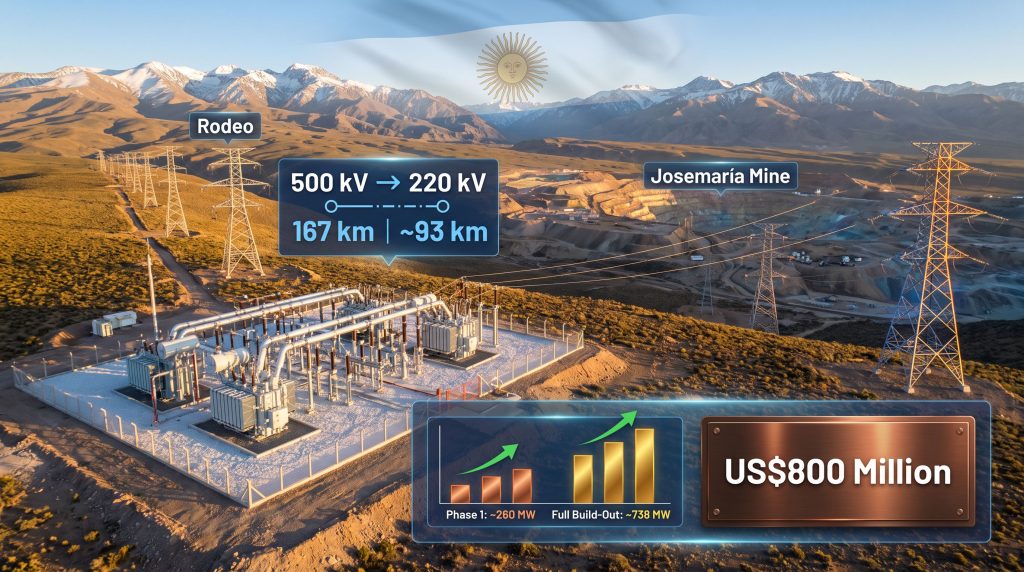
The Vicuña 500kV Argentine mine power line is best understood as a cascading infrastructure system rather than a single cable run. It encompasses several distinct engineering components, each serving a specific function in moving bulk power from the national grid to the mine site:
| Infrastructure Element | Specification | Function |
|---|---|---|
| Nueva San Juan–Rodeo corridor upgrade | 500 kV equipment installation | Grid entry point modernisation |
| Rodeo–Chaparro transmission line | 167 km at 500 kV | Primary long-distance power delivery |
| Chaparro substation | GIS technology, 500 kV to 220 kV transformation | Voltage step-down and distribution hub |
| Chaparro–Josemaría line | ~93 km at 220 kV | Final delivery to mine site |
| Rodeo transformer yard | 500/132/33 kV configuration | Regional grid integration |
The selection of Gas-Insulated Switchgear (GIS) technology for the Chaparro substation is a technically significant choice. In standard open-air substation designs, the switchgear requires considerable physical space and is highly vulnerable to environmental contamination — dust, humidity, and atmospheric particulates that are pervasive in remote Andean environments. GIS technology encloses all live components within hermetically sealed, sulphur hexafluoride-insulated modules, dramatically reducing the substation's physical footprint while also lowering long-term maintenance requirements in locations where skilled technicians are difficult to mobilise quickly.
For a substation operating at altitude in San Juan's Precordillera, this is not a luxury specification — it is an engineering necessity. Furthermore, the priority usage green light granted by Argentina's electricity authority confirms that these infrastructure choices are being treated as permanent, bankable commitments rather than provisional arrangements.
Why 500kV and Not a Lower Voltage Solution?
Voltage class selection in transmission engineering is fundamentally a function of distance and load magnitude. As power demand increases and transmission distances lengthen, lower voltage systems become increasingly inefficient due to resistive losses — a phenomenon described by engineers as I²R losses, where current squared multiplied by resistance produces heat rather than usable electricity at the delivery point.
At 738 MW of projected full-district demand across distances exceeding 250 km from grid connection to mine site, a 220 kV-only solution would incur transmission losses and voltage stability problems that would render the system economically and technically unworkable. The 500 kV backbone from Rodeo to Chaparro resolves this by minimising losses across the longest segment, with the step-down to 220 kV occurring only at Chaparro for the final ~93 km run to the Josemaría site.
This two-stage voltage architecture — 500 kV backbone feeding into a 220 kV distribution spur — is now the established model for major mining power delivery in Chile and parts of Peru. However, it represents a meaningful precedent for Argentina, where privately financed high-voltage transmission of this scale has not previously been executed for a mining project. The broader implications for copper market trends globally are also worth considering, as new large-scale supply from districts like Vicuña will be critical to meeting future demand.
The Regulatory Architecture: What Priority Usage Actually Means
More Than a Connection Permit
The regulatory approval issued by Argentina's national electricity authority does two distinct things that are easy to conflate but critically different in practice.
First, it approves the system expansion — authorising the physical construction of new 500 kV capacity that does not currently exist on the national grid. Second, it designates the Vicuña project as the priority user of that capacity once built. This distinction matters enormously for project bankability.
Without priority designation, a private investor committing US$800 million to transmission infrastructure faces the theoretical risk that regulatory reallocation could dilute their access to the very capacity they financed. The priority usage resolution eliminates that risk by establishing a clear access hierarchy — the Vicuña project's transmission needs take precedence over other potential grid users on this corridor.
Key Financial Signal: The estimated US$800 million cost of the transmission infrastructure is to be borne entirely by the Vicuña project, with no tariff burden passed through to Argentina's electricity consumer base. If successfully executed, this would represent one of the largest single private infrastructure commitments in Argentine mining history.
The regulatory debate that preceded this resolution centred on contested questions around capacity allocation — specifically, whether a private mining proponent should hold first-claim rights over publicly expanded grid infrastructure. Consequently, the resolution addresses this directly, framing the Vicuña project's entitlements as commensurate with its financial obligation to construct and fund the expansion.
Power Demand Projections: Phased and Substantial
From First Production to Full District Build-Out
The Vicuña district's power requirements are structured in phases that reflect the sequencing of development across multiple projects:
| Development Phase | Estimated Power Demand | Projects Covered |
|---|---|---|
| Phase 1 (initial operations) | ~260 MW | Josemaría + Filo del Sol |
| Full build-out (all phases) | ~738 MW | Entire Vicuña district |
A critical engineering decision embedded in the infrastructure design is the choice to build the 500 kV backbone to accommodate full-district capacity from the outset, even though Phase 1 requires only around 260 MW. This is a deliberate avoidance of what engineers call stranded infrastructure risk — the costly scenario where a transmission system built to minimum specifications must be expanded or paralleled at substantial additional cost as demand grows.
Building once to the highest anticipated specification is more expensive upfront but avoids the regulatory, logistical, and financial complexity of mid-operation transmission upgrades in remote Andean terrain. It also sends a signal to future project financiers that the infrastructure can accommodate district-wide growth without material reinvestment. This approach aligns with the broader case for gold and copper exploration investment in jurisdictions where infrastructure commitments underpin long-term value.
Why Copper-Gold-Silver Polymetallic Processing Is So Power-Intensive
The Josemaría and Filo del Sol operations will involve both concentrator circuits and, depending on final process design, hydrometallurgical facilities. This combination is inherently more energy-demanding than single-commodity open-pit operations because it requires running parallel processing streams — flotation, grinding mills, and potentially heap leach or SX-EW circuits — simultaneously at scale.
Copper concentrators at the scale envisaged for Vicuña typically operate large semi-autogenous grinding (SAG) mills and ball mills that are among the most electricity-intensive equipment in the entire mining value chain. Power interruptions at these facilities create cascading downtime that is extremely costly to recover from, which is precisely why baseload power reliability rather than intermittent renewable supply is a non-negotiable requirement at this stage of planning.
Argentina vs. Chile and Peru: A Comparative Infrastructure Framework
How the Three Major Andean Mining Jurisdictions Approach Transmission
| Factor | Argentina (San Juan) | Chile | Peru |
|---|---|---|---|
| Private financing of transmission | Emerging — Vicuña precedent | Established model | Hybrid public-private |
| Regulatory approval pathway | National grid authority resolution | CNE/SEC framework | MINEM/OSINERGMIN |
| Priority access designation | Project-specific resolution | Competitive tender | Concession-based |
| Voltage class for major mines | 500 kV (new precedent) | 500/220 kV standard | 220 kV typical |
Chile's established model, developed through decades of large copper mine development in the Atacama and Antofagasta regions, treats privately financed transmission as a standard component of mine project economics. Peru's approach has historically involved greater public-sector participation in grid expansion, with concession frameworks bridging the gap between private mine demand and public infrastructure obligation.
Argentina's Vicuña resolution positions the country closer to the Chilean model — placing full financial responsibility on the private mining proponent while granting commensurate access protection. Whether this becomes a template for future remote mining infrastructure in Argentina will depend substantially on whether the Vicuña financing and construction process executes successfully. In addition, the emergence of a major copper system in Argentina has already drawn considerable international attention to the region's potential.
Construction Complexity and the Critical Path to First Power
Engineering 260 km of High-Voltage Infrastructure Through the Andes
The physical challenge of constructing the Vicuña 500kV Argentine mine power line should not be underestimated. The 167 km Rodeo-to-Chaparro segment traverses high-altitude Andean terrain where access roads are seasonal, weather windows are narrow, and helicopter logistics may be required for tower erection in steeper sections. Comparable 500 kV transmission projects in South America — including segments of Chile's Cardones-Polpaico line and various Brazilian inter-regional corridors — have taken between three and five years from construction commencement to energisation, depending on terrain complexity and permitting continuity.
The sequencing of works follows a logical dependency chain:
- Nueva San Juan substation upgrade — establishing the 500 kV grid entry point
- Rodeo transformer yard construction — creating the 500/132/33 kV integration node
- Rodeo–Chaparro 500 kV line construction — the primary 167 km backbone
- Chaparro GIS substation commissioning — the voltage transformation hub
- Chaparro–Josemaría 220 kV line construction — the final ~93 km mine delivery segment
A delay in any upstream component propagates directly to all downstream milestones. This sequencing dependency makes the Nueva San Juan upgrade — often the least discussed element of the system — arguably the most critical early-stage construction risk, since it gates everything that follows.
Environmental and permitting considerations for transmission corridors crossing Andean terrain add another layer of complexity. Argentine provincial environmental impact assessment processes for linear infrastructure can be lengthy, and community consultation requirements in San Juan Province have historically extended timelines for projects crossing shared-use landscapes.
The next major ASX story will hit our subscribers first
What This Approval Signals for Argentina's Mining Investment Landscape
The De-Risking Milestone That Changes Project Valuation
For mining project financiers and equity investors, transmission infrastructure approval is not a peripheral consideration — it sits at the core of whether a project can transition from resource-stage valuation to development-stage valuation. The distinction is material: resource-stage projects are typically discounted heavily because the path to production contains multiple unresolved infrastructure variables. Development-stage projects with secured transmission access trade at substantially tighter discount rates because a major source of execution uncertainty has been eliminated.
Investment Catalyst: Securing dedicated 500 kV transmission access effectively transforms the Vicuña district from a resource-rich but grid-isolated prospect into a bankable, grid-connected industrial mining precinct — a reclassification that materially affects how lenders and equity partners model project risk and assign valuation multiples.
The broader implication for San Juan Province and neighbouring Andean jurisdictions is also significant. Purpose-built 500 kV infrastructure creates lasting regional grid capacity that will outlast the mine's operational life, potentially enabling future industrial development in corridors that are currently inaccessible from an energy standpoint. Furthermore, the Rodeo transformer yard's 500/132/33 kV configuration provides a multi-voltage integration point that could serve smaller regional users well beyond the Vicuña project's own demand profile.
For investors considering copper investment strategies in the current environment, this regulatory milestone represents the kind of infrastructure de-risking event that fundamentally re-rates a project's development prospects. Meanwhile, Argentina copper exploration activity continues to expand across the broader region, further reinforcing San Juan Province's position as a premier destination for resource capital.
The Lundin Mining integrated technical study for the Vicuña district further supports the view that this is a world-class mining development in the making, with infrastructure milestones like the 500 kV transmission approval playing a central role in de-risking the path to production.
Disclaimer: This article contains forward-looking assessments based on publicly available information regarding the Vicuña 500kV Argentine mine power line project. Infrastructure costs, power demand projections, and construction timelines are subject to change. Nothing in this article constitutes financial advice. Investors should conduct their own due diligence and consult qualified advisers before making investment decisions.
Frequently Asked Questions: Vicuña 500kV Argentine Mine Power Line
What is the Vicuña 500kV Argentine mine power line?
It is a privately financed, purpose-built high-voltage transmission corridor designed to connect Argentina's national grid to the Josemaría and Filo del Sol mining operations in San Juan Province. The system comprises a 167 km 500 kV backbone from Rodeo to a new GIS substation at Chaparro, followed by a ~93 km step-down to 220 kV for the final delivery segment to the mine site.
How much will the power line cost to build?
Current estimates place total infrastructure costs at approximately US$800 million, to be funded entirely by the Vicuña project with no cost passed through to Argentina's electricity consumers via tariff increases.
How much power will Vicuña require?
Phase 1 operations at Josemaría and Filo del Sol are projected to require approximately 260 MW, with the full district potentially demanding up to 738 MW across all development phases.
Why does the project need such a high voltage?
The combination of large power demand and long transmission distances makes 500 kV the only technically and economically viable voltage class. Lower voltage alternatives would incur unacceptable transmission losses and voltage stability problems across the 250+ km system span.
What does priority usage mean in this context?
It means the Vicuña project holds first-claim access rights over the new 500 kV transmission capacity it is financing — a critical protection ensuring that the private investor's infrastructure commitment cannot be diluted by regulatory reallocation to other grid users.
Want To Track The Next Major ASX Mineral Discovery Before The Market Moves?
Discovery Alert's proprietary Discovery IQ model delivers real-time alerts on significant ASX mineral discoveries — instantly transforming complex geological and commodity data into actionable investment insights for both new and experienced investors. Explore historic examples of major discovery returns and begin your 14-day free trial at Discovery Alert to position yourself ahead of the broader market.