July 24, 2026
The Geological Jackpot Underpinning the World's Most Ambitious Copper Merger
When geologists talk about the Atacama and its surrounding mineral belts, they speak in terms that most industries simply do not have equivalents for. The porphyry copper deposits stretching across northern Chile and into southern Peru represent some of the most mineralogically endowed terrain on Earth, formed over tens of millions of years through subduction tectonics that concentrated copper sulphides at depths and grades that modern mining economics find extraordinarily attractive. It is against this geological backdrop that the Anglo and Teck copper merger in Chile and Peru must first be understood, not as a corporate transaction, but as a deliberate effort to consolidate control over a geological endowment that cannot be replicated anywhere else on the planet.
Understanding why this merger carries such weight requires stepping back from the deal mechanics and examining what the Andean copper belt actually means for global supply. Chile alone holds approximately 19% of the world's total known copper reserves, while Peru contributes a further 10%. Together, these two countries account for roughly 29% of global copper endowment concentrated within a single, geographically contiguous corridor. No other pairing of nations comes close to this level of reserve concentration for a single commodity of such industrial importance.
When big ASX news breaks, our subscribers know first
Why Both Companies Independently Converged on Copper Before Merging
One of the most underappreciated aspects of this transaction is that it did not originate from opportunism. Both Anglo American and Teck Resources had already made independent strategic decisions to concentrate their portfolios around copper before merger discussions became serious. Teck had been restructuring for years, and by the time the transaction was formally proposed, copper represented approximately 71% of its global asset base.
Anglo American, meanwhile, had been divesting its metallurgical coal operations and preparing to exit its nickel business, effectively engineering a copper-dominant portfolio through subtraction rather than acquisition. This convergence matters for investors because it suggests the merged entity will not suffer from the cultural or strategic misalignment that frequently derails combinations between companies with divergent commodity exposures.
Both management teams had already arrived at the same destination independently, making the merger a genuine meeting of strategic equals rather than a forced union. Furthermore, the deal's architecture reinforces this reading. Structured as a nil-premium, all-stock merger of equals rather than a conventional takeover, the transaction was deliberately designed to avoid the winner-loser dynamic that can undermine post-merger integration.
Shareholders from both companies formally approved the transaction in December 2025, and the planned corporate headquarters will be established in Vancouver, Canada, with a primary listing on the London Stock Exchange. According to S&P Global Market Intelligence, the combined entity is set to transform the global copper mining landscape significantly.
What Does the Anglo–Teck Merger Actually Create?
Defining the Scale of the Combined Entity
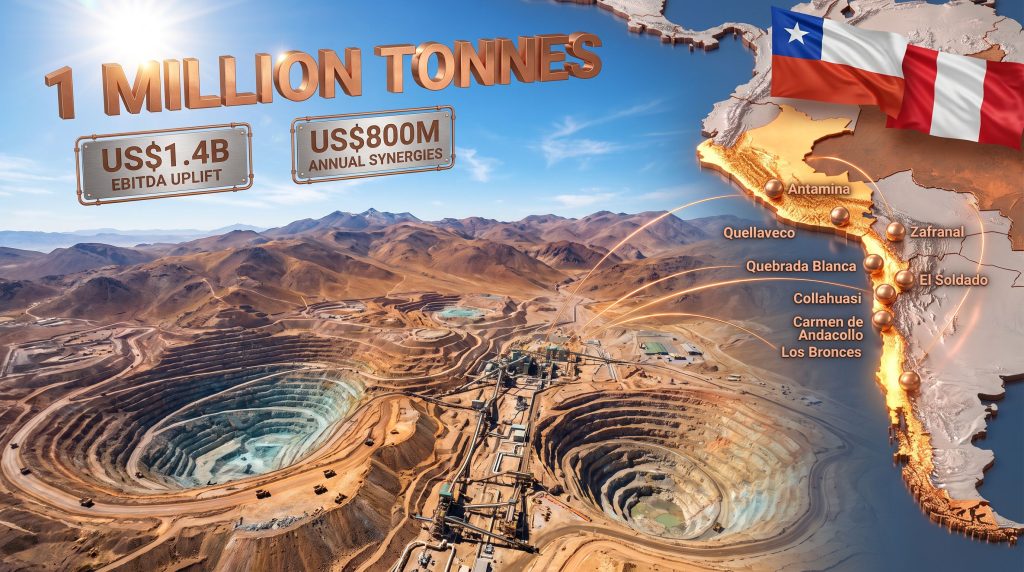
The combined output from both companies' Chilean and Peruvian operations is tracking to exceed one million tonnes of copper in 2026, a threshold that carries real significance in global supply terms. Teck's three primary assets — Quebrada Blanca, Carmen de Andacollo, and Antamina — are collectively targeting approximately 367,500 tonnes for the full year, while Anglo American's Chilean and Peruvian operations are expected to contribute the remainder toward and beyond that million-tonne mark.
The financial architecture of the deal is equally significant:
| Metric | Detail |
|---|---|
| Deal structure | All-stock merger of equals (nil-premium) |
| Annual pre-tax synergies | ~US$800 million |
| Projected EBITDA uplift (Collahuasi–QB integration) | ~US$1.4 billion annually |
| Merger closure deadline | No later than March 2027 |
| Remaining regulatory hurdle | Chinese antitrust approval |
| Jurisdictions already approved | Australia, Canada, Chile, EU, Japan, Mexico, South Korea, USA |
The US$800 million in projected annual pre-tax synergies is meaningful on its own, but the Collahuasi and Quebrada Blanca integration opportunity represents a separate and potentially larger value driver. Geologists and mining economists who have studied the Tarapacá corridor note that the two operations share not only a regional geography but similar ore mineralogy, which creates practical opportunities for shared processing infrastructure that are rarely available between separately owned mines.
How Chile Anchors the Entire Merger Thesis
The Tarapacá Corridor: Where Synergies Are Born
The geographic proximity of Quebrada Blanca and Collahuasi within Chile's Tarapacá region is not a coincidence of corporate geography. Both operations sit within the same geological terrane, hosted by similar porphyry copper systems that formed during the same tectonic episodes. This shared geological heritage means that ore handling, processing chemistry, and tailings management approaches developed at one operation can be transferred to the other with far lower adaptation costs than would be required between geologically dissimilar mines in different countries.
Key Insight: The Collahuasi and Quebrada Blanca pairing represents a potential US$1.4 billion annual average EBITDA uplift through integrated processing, shared logistics, and coordinated mine planning. This single synergy cluster could justify a substantial portion of the entire merger's financial rationale on its own.
The second quarter of 2026 delivered strong evidence that both Chilean assets are performing at or near the top of their recent operating ranges. Quebrada Blanca recorded output of 55,800 tonnes during Q2 2026, described as the highest result in recent quarters. Carmen de Andacollo added 12,800 tonnes during the same period, an increase of approximately 3,400 tonnes compared with the equivalent quarter of the prior year.
Anglo American's Chilean portfolio beyond Collahuasi also posted year-on-year production growth. Los Bronces and El Soldado both recorded increases, with Los Bronces' improvement driven specifically by the reactivation of a second ore processing plant — a notably capital-efficient method of expanding throughput without requiring major new mine development. Anglo's Q2 2026 total copper output reached 173,200 tonnes, representing a 1.6% sequential increase from the first quarter.
Chile's Geological Endowment as a Strategic Moat
What makes the Chile copper outlook particularly compelling is the combination of reserve scale, ore grade quality, and existing infrastructure density. The porphyry copper systems of northern Chile — including the Atacama porphyry belt that hosts Collahuasi and the neighbouring Domeyko belt that hosts Los Bronces — were emplaced at depths that have since been exhumed to economically mineable levels through millions of years of erosion.
The result is a surface-accessible mineralogy that many newer copper frontiers in central Africa or southeast Asia simply cannot match in terms of project economics. From an investor perspective, this geological moat translates into a multi-decade production runway that is genuinely difficult to replicate. New greenfield copper discoveries globally have been declining in both frequency and average grade for more than two decades, making the existing reserve base in Chile and Peru increasingly scarce relative to forward demand projections.
What Role Does Peru Play in the Combined Asset Portfolio?
Quellaveco, Antamina, and the Peruvian Production Platform
Peru's contribution to the Anglo Teck production platform extends well beyond its reserve percentage. The operational performance of Antamina in particular deserves close attention. During Q2 2026, Antamina produced 108,500 tonnes of copper, an increase of approximately 43,500 tonnes compared with the same quarter of the previous year. This is a substantial year-on-year uplift that reflects both favourable ore grade sequencing and operational improvements at the site.
Quellaveco, Anglo's flagship Peruvian operation in which it holds a 50.1% stake, carries a 2026 production guidance range of 310,000 to 340,000 tonnes. The operation has encountered lower-than-anticipated ore grades in recent periods, a reminder that even world-class porphyry copper deposits are subject to grade variability as mining transitions from higher-grade starter zones into more complex ore domains. Importantly, grade variability at Quellaveco is a short-term operational challenge rather than a structural problem, as the deposit's longer-term resource base remains substantial.
It is worth noting for technically informed readers that grade variability in large-scale porphyry copper systems is a well-understood phenomenon. These deposits are not uniform bodies of mineralisation but rather complex three-dimensional distributions of copper sulphides. Anglo's decision to maintain its full-year production guidance despite Q2 grade challenges signals confidence in the ore body's behaviour across the remainder of the year.
The Zafranal Project: Peru's Next-Generation Copper Asset
Teck's development-stage Zafranal copper project represents a dimension of the merger's value proposition that tends to be underweighted in conventional analysis. In May 2026, the project received a critical construction authorisation for its processing facilities, a regulatory milestone that meaningfully de-risks the development timeline. Teck subsequently increased its ownership stake from 80% to 84.5% in June 2026, with partner Mitsubishi Materials diluting from 20% to 15.5%.
The decision to increase ownership at the moment of construction authorisation is a deliberate strategic signal. Companies that lack conviction in a development asset's economics typically do not consolidate their stake precisely when capital commitment is escalating. The stake increase suggests Teck, and by extension the future Anglo Teck entity, views Zafranal as a meaningful contributor to the merged company's long-term growth pipeline.
Anglo Teck Asset Map: Chile and Peru at a Glance
| Asset | Country | Operator | Stake | Q2 2026 Output / Status |
|---|---|---|---|---|
| Quebrada Blanca (QB) | Chile | Teck | 60% | 55,800t |
| Carmen de Andacollo | Chile | Teck | 90% | 12,800t |
| Collahuasi | Chile | Anglo | 44% | Year-on-year increase |
| Los Bronces | Chile | Anglo | 50.1% | Year-on-year increase |
| El Soldado | Chile | Anglo | 50.1% | Year-on-year increase |
| Antamina | Peru | Teck | 22.5% | 108,500t |
| Quellaveco | Peru | Anglo | 50.1% | 2026 guidance: 310,000–340,000t |
| Zafranal (development) | Peru | Teck | 84.5% | Pre-construction phase |
The next major ASX story will hit our subscribers first
How Does the 1 Million Tonne Milestone Signal Merger Readiness?
Reading Production Numbers as Strategic Communication
In mining M&A, there is a well-understood dynamic where operational performance in the period immediately preceding merger close becomes a form of communication directed at regulators, counterparties, and capital markets simultaneously. Demonstrating that both entities are executing reliably at scale before the transaction formally closes reduces the perceived integration risk that sophisticated investors typically discount into the share prices of combining entities.
The trajectory toward one million combined tonnes from Chile and Peru alone in 2026 serves this function precisely. It signals that neither company is entering the merger from a position of operational weakness, and that the synergy projections are not theoretical constructions built on distressed assets in need of rehabilitation. In addition, the largest copper mines forming the backbone of this merger demonstrate the enormous operational scale that the combined entity will command.
Scenario Modelling: Three Post-Merger Production Trajectories
Scenario A: Base Case (Smooth Integration)
- Collahuasi and QB synergies activated within 12 to 18 months of merger close
- Combined copper output stabilises above one million tonnes annually from Chile and Peru alone
- US$800 million in annual pre-tax synergies realised within 24 months of close
- EBITDA uplift from the Tarapacá integration cluster begins contributing meaningfully in the first full operating year post-merger
Scenario B: Delayed Integration (China Approval Lag)
- Chinese antitrust approval extends beyond Q1 2027, pushing merger close toward mid-2027
- Integration planning proceeds in parallel but synergy realisation delayed by approximately one operating cycle
- Near-term capital allocation decisions for both entities experience uncertainty-related friction
- Market sentiment around the transaction softens modestly but fundamental asset values remain intact
Scenario C: Accelerated Value Unlock
- Chinese antitrust approval secured by late 2026, enabling merger close ahead of the March 2027 deadline
- Collahuasi and QB infrastructure investment planning fast-tracked given earlier-than-expected regulatory clearance
- EBITDA uplift from combined operations begins flowing within the first full year post-merger
- Anglo Teck enters its first full year as a combined entity with operational momentum and capital market confidence
Disclaimer: The scenario projections above are illustrative frameworks based on publicly available information and do not constitute financial advice. Actual outcomes will depend on regulatory decisions, commodity prices, operational performance, and other factors that cannot be predicted with certainty.
What Is the Last Remaining Obstacle to Closing the Deal?
China's Antitrust Review: The Final Regulatory Gate
Eight major jurisdictions have already granted clearance: Australia, Canada, Chile, the European Union, Japan, Mexico, South Korea, and the United States. China stands as the sole outstanding regulatory authority whose approval is required before the transaction can formally close, and this fact alone deserves careful analysis.
China's role in this review is consequential for reasons that go beyond procedural formality. China is the world's largest copper consumer, accounting for roughly 55% of global refined copper demand according to data tracked by the International Copper Study Group. A combined entity holding major operating stakes across two countries that collectively control nearly 29% of global copper reserves represents a supply concentration that Chinese industrial planners and antitrust authorities will examine with considerable care.
The review is not simply about market competition in the conventional sense. Copper sits at the intersection of China's energy transition ambitions, its electric vehicle manufacturing dominance, and its broader industrial policy framework. How the People's Republic of China chooses to condition or grant its approval will likely reflect considerations that extend well beyond the standard antitrust analytical framework applied in Western jurisdictions.
From an investor standpoint, the China review represents the single most important variable in the deal's timing and structure. The merger closure is targeted no later than March 2027, and integration planning is reportedly proceeding in anticipation of approval, but the timeline remains contingent on a regulatory process that operates according to its own schedule and logic. For further detail on the regulatory pathway, Teck's merger portal provides an authoritative overview of the transaction's current status.
How Global Copper Demand Underpins the Merger's Long-Term Thesis
Structural Demand Drivers and the Supply-Side Constraint
The strategic case for concentrating copper production at scale is strengthened considerably by the demand environment that the Anglo and Teck copper merger in Chile and Peru is being constructed within. Several distinct and powerful demand vectors are converging simultaneously, reinforcing the copper price drivers that are reshaping global mining investment:
- Electric vehicle proliferation: Each battery electric vehicle requires approximately three to four times more copper than a conventional internal combustion engine vehicle, according to figures widely cited in copper industry analyses
- Grid infrastructure expansion: The International Energy Agency has projected that electricity grid investment globally must roughly double by 2030 to support the energy transition, with copper-intensive transmission and distribution infrastructure at its core
- Artificial intelligence infrastructure: Data centres, which house the computing hardware powering AI systems, are among the most copper-intensive built environments per square metre, requiring substantial copper for power distribution, cooling systems, and server interconnects
- Renewable energy generation: Wind turbines and solar photovoltaic installations both require significantly more copper per megawatt of generating capacity than fossil fuel equivalents
Against these demand drivers, the supply side faces structural headwinds that are less frequently discussed in mainstream analysis. The average copper ore grade at producing mines globally has declined from approximately 1.6% Cu in the early 1990s to below 0.6% Cu at many major operations today, according to data from the Chilean Copper Commission (Cochilco). This grade decline means that producing each tonne of copper requires processing increasingly large volumes of ore, raising both energy consumption and operating costs per unit of output.
Analyst Perspective: Geologists and mining economists observe that Chile and Peru together account for nearly 29% of global copper reserves. A single merged entity with major operating positions across both countries, at a moment of accelerating electrification demand, represents a supply concentration with significant long-term strategic and pricing implications for global copper markets.
The broader copper supply crunch facing the industry further amplifies the strategic rationale for this merger. High-quality, large-scale Andean porphyry copper assets are becoming genuinely scarce relative to projected forward demand. The geological conditions that created them cannot be artificially replicated, and the permitting, infrastructure, and community relationship-building required to bring new Andean mines into production typically requires between 15 and 25 years from discovery to first production.
Frequently Asked Questions: Anglo and Teck Copper Merger in Chile and Peru
What is the Anglo–Teck copper merger?
A nil-premium, all-stock merger of equals between Anglo American and Teck Resources designed to create a top-five global copper producer known as Anglo Teck. The combined entity will be headquartered in Vancouver with a primary London Stock Exchange listing and will have more than 70% of its portfolio concentrated in copper assets.
When will the Anglo–Teck merger close?
The transaction is targeted to close no later than March 2027. Shareholder approvals from both companies were secured in December 2025, and all major regulatory jurisdictions except China have granted clearance. Chinese antitrust approval is the sole remaining requirement before the transaction can formally complete.
How much copper will Anglo Teck produce from Chile and Peru?
The combined output from both companies' Chilean and Peruvian operations is projected to exceed one million tonnes in 2026, with Teck's three assets targeting approximately 367,500 tonnes and Anglo American's operations contributing the remainder toward and beyond that threshold.
What synergies does the merger unlock?
The merger is projected to generate approximately US$800 million in annual pre-tax synergies. The integration of Collahuasi and Quebrada Blanca, located in close proximity within Chile's Tarapacá region, is expected to generate an estimated additional US$1.4 billion in annual average EBITDA uplift through shared infrastructure and coordinated processing.
Why are Chile and Peru so central to this merger?
Chile holds approximately 19% of global copper reserves and Peru holds approximately 10%, making the two countries collectively home to roughly 29% of the world's known copper endowment. Both companies have built their most significant copper operations in these two jurisdictions, making the Andean copper corridor the geographic and geological foundation of the entire merger rationale.
What is the status of Teck's Zafranal project in Peru?
Zafranal continues to advance as a development-stage asset. The project received a critical construction authorisation for its processing facilities in May 2026, and Teck increased its ownership stake from 80% to 84.5% in June 2026 as its partner Mitsubishi Materials diluted from 20% to 15.5%. The project is expected to form part of Anglo Teck's long-term Peruvian growth pipeline.
What Investors and Industry Observers Should Monitor
For those tracking the Anglo and Teck copper merger in Chile and Peru, the following variables represent the most consequential near-term and medium-term watch points. Consequently, copper exploration trends across the Andean corridor will also influence how quickly the merged entity can build on its existing reserve base:
- Progress of Chinese antitrust review and any conditions attached to approval, particularly around supply commitments or structural remedies
- Early integration milestones post-merger close, especially infrastructure planning decisions around the Collahuasi and Quebrada Blanca corridor in Tarapacá
- Quarterly production performance at Quellaveco, particularly how Anglo manages the transition through lower-grade ore domains and whether full-year guidance is maintained
- Zafranal development timeline advancement under the merged entity, including any updated capital expenditure estimates or construction commencement dates
- Copper price trajectory, which will amplify or attenuate the projected EBITDA uplift figures and colour market sentiment toward the combined entity's post-merger valuation
- Ore grade trends across the Chilean portfolio, given the secular decline in grades at mature Andean operations and its implications for long-term production sustainability
The Anglo and Teck copper merger in Chile and Peru is, at its most fundamental level, a bet on geological scarcity meeting accelerating industrial demand. The Andean copper belt's reserve base cannot be replicated, new discoveries at equivalent scale are becoming rarer with each passing decade, and the electrification of the global economy continues to expand copper's addressable demand base in ways that were not fully visible even five years ago. Whether that bet delivers its projected returns will depend on integration execution, Chinese regulatory dynamics, and a copper price environment that markets are watching with considerable attention.
Want to Track the Next Major Copper Discovery Before the Market Does?
Discovery Alert's proprietary Discovery IQ model delivers real-time alerts on significant ASX mineral discoveries — instantly translating complex geological data into actionable investment insights for traders and long-term investors alike. Explore why major mineral discoveries have historically generated extraordinary returns on Discovery Alert's dedicated discoveries page, and begin your 14-day free trial today to position yourself ahead of the market.