July 23, 2026
The Hidden Engineering Challenge Driving Copper Mine Expansion at Altitude
Most conversations about the global copper supply crunch focus on deposit scarcity, permitting timelines, and capital costs. Far less attention is paid to the mechanical infrastructure that determines whether a mine can actually convert ore in the ground into cathode on a ship. At high-altitude operations, that infrastructure faces a uniquely punishing set of physical conditions, and the engineering decisions made around slurry handling equipment can mean the difference between a nameplate capacity that exists on paper and one that performs consistently over a decade of continuous operation.
The decision by the Xizang copper mine to source 11 WARMAN-branded pumps from Weir for its Phase III expansion is, on the surface, a routine capital equipment procurement. Look closer, and it reveals a sophisticated interplay between altitude engineering, incumbent supplier dynamics, tailings management strategy, and China's accelerating push to expand domestic copper output. Understanding why Weir sells 11 pumps to Xizang copper mine matters as much as understanding what those pumps actually do.
When big ASX news breaks, our subscribers know first
Why Altitude Transforms the Engineering Equation for Slurry Pumps
Operating a concentrator plant at high elevation introduces a cascade of mechanical and thermodynamic complications that sea-level engineers rarely encounter. At elevations typical of Tibetan Plateau mining operations, atmospheric pressure is significantly lower than at sea level, which affects several critical variables simultaneously.
Cavitation risk increases substantially. In slurry pumps, cavitation occurs when localised pressure drops cause vapour bubbles to form and then collapse violently against impeller surfaces. At reduced atmospheric pressure, the net positive suction head available to a pump shrinks, which means standard impeller geometries tuned for sea-level conditions can experience cavitation at flow rates that would be entirely safe at lower elevation. This accelerates wear on wetted components and can cause rapid impeller failure if left unaddressed.
Motor cooling efficiency degrades. Lower air density reduces the heat dissipation capacity of air-cooled motor housings, creating thermal management challenges, particularly in high-duty applications like continuous tailings transfer. Without design compensation, motors run hotter than their rated operating envelopes, shortening insulation life and increasing failure probability.
Lubrication behaviour shifts in cold ambient conditions. High-altitude sites frequently experience significant diurnal temperature swings, with ambient temperatures dropping sharply overnight. Lubricant viscosity changes under these conditions affect bearing performance, particularly during cold starts, when hydrodynamic films take longer to establish.
For pump manufacturers operating in this space, these are not theoretical concerns. They are engineering constraints that must be designed into the product from the outset, through impeller geometry selection, seal configurations, bearing specifications, and material choices for wetted components exposed to abrasive slurry streams.
The Phase III Expansion: Scale That Demands Purpose-Built Infrastructure
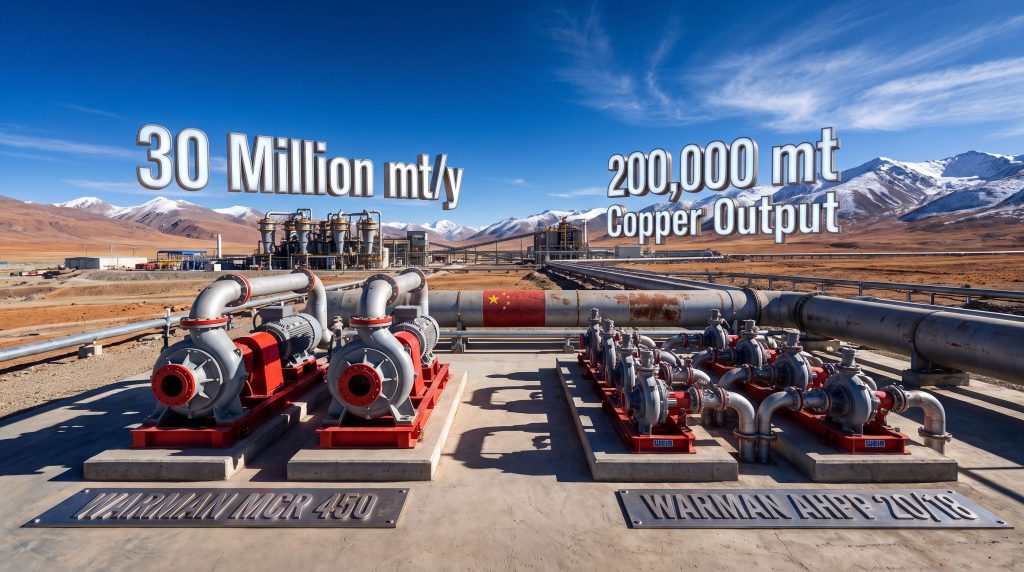
The numbers behind the Xizang copper mine's Phase III expansion place it firmly in the upper tier of brownfield copper processing projects globally. The expansion is designed to lift annual ore processing throughput from 19.9 million metric tons per year to 30 million metric tons per year, a throughput increase of just over 50%. Against that expanded processing base, the operation targets annual refined copper output of 200,000 metric tons.
To contextualise that output figure: the International Copper Study Group estimated global refined copper production at approximately 26 million metric tons in 2023. A single operation producing 200,000 metric tons per year represents roughly 0.77% of global refined output, placing it comfortably within the ranks of the largest copper mines and significant mid-to-large scale copper producers worldwide.
Xizang Phase III vs. Global Copper Mine Benchmarks
| Metric | Xizang Post-Expansion | Mid-Tier Benchmark | Top-Tier Benchmark |
|---|---|---|---|
| Processing Capacity (mt/y) | 30 million | 15 to 25 million | 50 million+ |
| Annual Copper Output (mt/y) | 200,000 | 100,000 to 150,000 | 500,000+ |
| Operational Environment | High-altitude | Variable | Variable |
| Expansion Type | Brownfield Phase III | Greenfield/Brownfield | Brownfield |
The shift from greenfield development to brownfield expansion reflects a broader industry-wide capital allocation logic. Greenfield copper projects face approval timelines stretching 10 to 20 years in many jurisdictions. Brownfield expansions at permitted, operating assets can move from feasibility to first production in a fraction of that time, making them the preferred vehicle for operators seeking to capture demand upside from electrification without bearing the full development risk of a new mine. Furthermore, these mining consolidation trends are reshaping how capital is deployed across the sector.
Anatomy of the 11-Pump Contract: Function, Technology, and Engineering Rationale
The procurement package that Weir supplied breaks cleanly into two functional groups, each addressing a distinct criticality point in the concentrator's processing circuit.
The Two WARMAN MCR 450 Cyclone Feed Pumps
Cyclone feed pumps occupy one of the most technically demanding positions in a grinding circuit. Their function is to deliver a precisely conditioned slurry stream to hydrocyclone clusters, which then classify particles by size, returning coarse oversize material to the mill for further grinding and passing fine undersize forward to flotation or leaching.
The quality of cyclone feed directly governs classification efficiency. Pressure fluctuations, flow rate instability, or density variation at the pump discharge translate immediately into inconsistent cyclone cut points, which in turn affect the particle size distribution of the flotation feed. Since flotation recovery is highly sensitive to particle size, poor cyclone feed pump performance cascades into measurable copper recovery losses downstream.
The MCR (Mill Circuit Range) 450 designation indicates a centrifugal slurry pump engineered for the specific demands of grinding circuit duty: high-density slurry handling, resistance to the coarse, angular particles characteristic of mill discharge, and the ability to maintain stable head-flow characteristics across the variable density conditions that occur as the mill circuit responds to feed grade and hardness changes.
The Nine WARMAN AHPP 20/18 Tailings Transfer Pumps
Tailings transfer represents perhaps the single most demanding continuous-duty pump application in any concentrator plant. At 30 million metric tons per year of ore throughput, the volume of processed tailings requiring transfer to the tailings storage facility is enormous and relentless. These pumps must operate around the clock, handling abrasive, fine-grained slurry across potentially significant distances and elevation differentials between the plant and the TSF.
The AHPP designation stands for Horizontal Slurry Pump, High-Pressure, indicating a pump series specifically engineered for long-distance, high-head slurry transport rather than short-range, high-flow applications. This distinction matters: tailings pipelines at large operations can extend for kilometres, and the hydraulic energy required to push slurry through that pipeline at design flow rates demands pumps with robust pressure capability and wear-resistant materials throughout the hydraulic passage. According to reporting on the Xizang expansion, Weir sells 11 pumps to Xizang copper mine as part of a multimillion-dollar contract designed to meet the site's exceptional engineering demands.
The 11-Pump Package at a Glance
| Pump Model | Quantity | Circuit Application | Key Engineering Role |
|---|---|---|---|
| WARMAN MCR 450 | 2 | Grinding circuit cyclone feed | Particle classification control |
| WARMAN AHPP 20/18 | 9 | Tailings storage facility transfer | High-pressure long-distance slurry transport |
| Total | 11 | Two critical processing circuits | High-altitude performance-rated |
The nine-unit tailings pump deployment also reflects deliberate redundancy thinking. No single pump failure should be able to halt tailings transfer entirely, since interruption of tailings flow creates immediate upstream production constraints and potential TSF management complications. Distributing the duty across multiple units provides both operational resilience and a framework for planned maintenance without full circuit shutdown.
Incumbent Advantage: The Procurement Dynamic That Competitors Rarely Overcome
One detail embedded in the Xizang procurement story carries significant strategic weight: the mine operator was already a WARMAN pump user before the Phase III expansion contract was awarded. This incumbent relationship is not merely a commercial convenience. It represents a deeply structural procurement advantage that fundamentally reshapes the competitive landscape for equipment suppliers at brownfield expansion projects.
Consider what an incumbent supplier position actually means in practice:
-
Operational performance data exists. The mine has years of in-field evidence on pump wear rates, maintenance intervals, parts consumption, and failure modes under its specific operating conditions. This data reduces procurement risk to near zero.
-
Parts standardisation is already embedded. Maintenance teams are trained on the incumbent platform. Spare parts inventories are stocked. Tooling is available. Switching to a competing platform would require parallel investment across all these dimensions simultaneously.
-
The TSF configuration may already be tuned to WARMAN hydraulic characteristics. Pipeline sizing, pump stations, and control system setpoints in an existing tailings circuit are calibrated to the performance curves of installed pumps. Introducing a different pump platform would require revalidation of the entire hydraulic system.
Industry insight: Mining procurement specialists frequently note that the effective switching cost barrier at an established operation with existing infrastructure is among the highest of any capital equipment category. A competing supplier must not only offer superior performance metrics but must effectively underwrite the full operational risk of the transition, which is a standard that very few challengers can credibly meet.
China ENFI Engineering Corporation: The Technical Gatekeeper Role
The endorsement of the WARMAN pump selection by CHINA ENFI Engineering Corporation adds a layer of significance that extends beyond a single contract. ENFI is one of China's most prominent mining and metallurgical engineering firms, with a portfolio that spans mine design, concentrator engineering, smelting technology, and project management across domestic and international resource projects.
In large Chinese mining projects, engineering contractors like ENFI occupy a dual role that Western project structures sometimes underweight. They function simultaneously as:
-
Technical specification authorities who define the engineering performance requirements that equipment must meet.
-
Commercial influence nodes who shape the approved vendor lists from which operators make procurement decisions.
For international equipment suppliers targeting the Chinese mining market, the implication is clear: relationships with leading engineering contractors represent a parallel and arguably more efficient sales channel than direct operator engagement alone. A specification written by ENFI that references WARMAN performance parameters effectively pre-qualifies the incumbent supplier before competitive tendering begins.
The next major ASX story will hit our subscribers first
Tailings at Scale: The Environmental and Structural Imperative
At 30 million metric tons per year of processing throughput, the Xizang operation generates a tailings stream of extraordinary volume. Managing that stream safely involves more than moving slurry from plant to pond. It encompasses the geotechnical integrity of the TSF structure itself, the hydraulic balance of the facility, and the long-term environmental containment of fine mineral particles and process water.
The Global Industry Standard on Tailings Management, known as GISTM, was adopted in 2020 following a series of catastrophic TSF failures globally, including the Brumadinho dam collapse in Brazil in January 2019, which killed over 270 people. GISTM establishes performance-based requirements for TSF design, operation, and closure that apply to operators seeking alignment with international best practice.
At high-altitude sites, TSF engineering carries additional complexity. Seismic activity, permafrost-adjacent ground conditions, and the absence of significant downstream population centres that might buffer evacuation timelines all influence design parameters. Reliable pumping infrastructure is not peripheral to TSF safety; it is central to it. Maintaining correct water balance within a TSF requires precise control of slurry inflow, and pump reliability failures that cause unexpected flow surges or stoppages can stress embankment drainage systems and affect pore pressure distributions within the dam structure itself.
What Large Equipment Contracts Signal About Mining's Investment Cycle
Capital equipment orders of this scale function as forward indicators in the mining sector's investment cycle. Pump, mill, and materials handling contracts at major operations reflect decisions made months or years earlier in feasibility and detailed engineering phases. By the time a contract is publicly announced, the capital commitment has already been made and the project financing is in place.
For market participants tracking copper sector capital expenditure, the Xizang Phase III contract is a data point within a broader pattern. The energy transition demand for copper remains structurally elevated through the 2030s, driven by electric vehicle production, power grid infrastructure investment, and consumer electronics manufacturing. The International Energy Agency projects that clean energy transitions could require more than double the current annual copper supply by 2040 under its Sustainable Development Scenario.
Against that demand trajectory, China's domestic copper producers face a strategic imperative to maximise throughput from existing permitted assets. Brownfield expansions like Phase III at the Xizang operation represent the fastest path to incremental production, with the copper growth drivers underpinning investment decisions at operations of this scale. Consequently, the Weir pump contract serves as one tangible marker of the capital flowing into that expansion cycle.
Frequently Asked Questions: Weir's Pump Supply to the Xizang Copper Mine
What pumps did Weir supply to the Xizang copper mine?
Weir sells 11 pumps to Xizang copper mine as part of the Phase III expansion: two WARMAN MCR 450 cyclone feed pumps for the grinding circuit and nine WARMAN AHPP 20/18 tailings transfer pumps serving the tailings storage facility. Industry coverage of the contract confirms the multimillion-dollar value of the supply agreement.
What is the Xizang copper mine's post-expansion processing capacity?
Following the Phase III expansion, the operation is designed to process 30 million metric tons of ore per year, up from approximately 19.9 million mt/y, targeting annual copper output of 200,000 metric tons.
Why do high-altitude mining sites require specialised pump engineering?
Reduced atmospheric pressure increases cavitation risk, lower air density degrades motor cooling efficiency, and extreme temperature variation affects lubrication behaviour. Equipment must be specifically designed around these variables to deliver reliable performance and acceptable component life.
Who endorsed the WARMAN pump selection for this project?
CHINA ENFI Engineering Corporation, the appointed engineering contractor for the expansion, endorsed the WARMAN pump selection. Given ENFI's technical authority over equipment specification at large Chinese mining projects, this endorsement carries significant procurement weight.
Was the Xizang mine an existing Weir customer before this contract?
Yes. The mine operator had an existing WARMAN pump fleet prior to the Phase III expansion award, which positioned Weir as the incumbent supplier with demonstrated in-field performance data at the specific site conditions.
Key Takeaways for Mining Equipment and Copper Sector Watchers
-
A 50%-plus throughput expansion at a significant high-altitude Chinese copper operation creates substantial demand for altitude-rated slurry handling equipment across both grinding and tailings circuits.
-
The two-circuit, 11-pump package reflects deliberate engineering logic: cyclone feed precision in the grinding loop and high-pressure redundancy in continuous tailings transfer duty.
-
Incumbent supplier positioning combined with engineering contractor endorsement are the two most decisive forces in major mining equipment procurement, frequently outweighing price competition from alternative suppliers.
-
Tailings management reliability at this throughput scale is not merely operational. It intersects directly with TSF structural integrity and international safety standards under frameworks like GISTM.
-
Large equipment contracts of this type serve as leading indicators of mining capital expenditure cycles, signalling that feasibility decisions and project financing have already been committed.
Disclaimer: This article is intended for informational purposes only and does not constitute financial or investment advice. Readers should conduct independent research before making investment decisions. Projections regarding copper demand, production targets, and market trajectories involve inherent uncertainty and should not be relied upon as definitive forecasts.
Want to Capitalise on the Next Major Copper Discovery Before the Broader Market Catches On?
Discovery Alert's proprietary Discovery IQ model scans ASX announcements in real time, instantly identifying significant mineral discoveries across copper and 30-plus other commodities — turning complex data into actionable investment insights for both short-term traders and long-term investors. Explore how historic discoveries have generated substantial returns on Discovery Alert's dedicated discoveries page, and begin your 14-day free trial today to position yourself ahead of the market.